Linky Links

Russell Moore asks if millennials are selfish.
He actually comes to the defense of millennials:

On the whole, though, I find the Millennial generation’s grasp of gospel Christianity far better than what we’ve seen in a long time. They tend to be better at articulating a Christian vision of life, because they’ve had to do so all their lives, never able to count on a pseudo-Christian culture to do pre-evangelism for them.

Anecdotal, I know, but I find this is accurate. My grandparents (the Greatest Generation), while not dogmaticians, new the Bible backwards and forwards. They thought it was an important thing to know. However, my parents (Boomers) didn’t seem to know much of either the Bible or Theology. Russell makes the point that they grew up in a Christian world. I (Millennial) and others arguable grew up in a post-Christian world.

I see it among people I know. Again, this is anecdotal, there are many who are not involved in church (not sure if this is generational or the fact that many people skip out of church in their 20s). However, those whom are involved, they tend to know much more because they want to know more. Maybe because church is optional for us; whereas it was basically a social requirement for the Boomers.

I tweeted this earlier, but he makes a great point about Millennials (you know, the selfish ones) searching for mentors in the church and coming up lacking. I could write a book about the failure of the church to mentor, so I’ll stop here.

Post on Modesty – points out the failure to make men accountable, among other things.

Finally for today – 6 signs of a call to preach or, for me, five reasons why I will never be a preacher.


Zondervan Counterpoint Series

I’ve posted many articles about reading recently and wanted to highlight a series here. I first came across these a few years ago and was instantly intrigued. I thought it was a great way to show differing views with the spectrum of Evangelical Christianity. After reading a few, I’ve put them on my list of must haves for anyone interested in gaining a deeper understanding of a topic.

The book starts with a topic (Adam, Hell, Women in Ministry, etc.), and then has three to five people make their case for their particular view. The authors are usually scholars who have written many books or commentaries on the subject. However, the generally do well writing to a broad lay audience. After each makes their proposal, the others make short critical responses. The original author then has a chance to briefly respond to the criticisms.

I really can’t imagine a way for Christians to get such an in-depth, but (fairly) short and simply written scholarly discourse. Every Christian who has an interest or struggle in belief in a certain issue should start with the Counterpoint series.

If you are interested in buying, you can find them quickly through my amazon store.

Book Review: Just Do Something

Just Do Something: A Liberating Approach to Finding God’s Will by Kevin DeYoung

Rating – A must read

Level – Very readable, short.

Summary – Many people search for God’s will, but American Evangelicals, especially Millennials, have made it an art form. He claims that doing this ‘leads us to no where’ and calls us ‘directionally challenged’ (these are names of the chapters in the book). The basic point is that too many of us sit on our asses ‘waiting’ for God to have a perfect opportunity just fall on us. All this waiting means we don’t accomplish much. The essence of his book: trust God and Just Do Something. Another great takeaway is that God’s Will is about moral decisions. Where we live or which job we take is a non-moral decision.

Review – I found his sections regarding the life of his grandparents especially intriguing. Maybe because my granddads are also quite old and are believers. There is a great section where he asks one granddad about considering God’s will for his job. His granddad’s answer, he hadn’t really thought about that. He knew he needed to pay bills and he knew that required work, so he went and found some.

This book really challenged me on a very personal level.  I felt he was describing me in the parts about waiting to the point of doing nothing, waiting for God to make it happen essentially. He also talks of fear, and people hiding behind God. I believe that is part of my problem. I’m scared to take a risk, but it’s very easy to say, ‘It’s not God’s time, yet’ or something to that affect. While I had some specific convictions, I hope that it would challenge every Christian who reads it to do something.


Building Your Theological Library

I read a lot. My library started quite small, first with just a Bible, then the realization I needed a Study Bible and commentary to really help me understand. From there I moved on to Theology proper and issues of Christian life. All this led, of course, to the terrible idea that I should start a blog, but I digress. Below is a guide to getting started. First set are the necessities, from then on I give categories to buy (in bold) and a few recommendations of each.

If you want to buy and use amazon, please go click the links or go through my store.

The “Introduction to Christian Life” Library:

The “I Want to Know More” Library

  • Commentary – New Bible Commentary, The Expositors Bible Commentary
  • Broader Christian classics – Desiring God by Piper, Knowing God by Packer, Mere Christianity by Lewis, etc.
  • Church History – Church History in Plain Language by Shelley
  • Systematic Theology – Erikson or Berkhof; Outlines of Systematic Theology by A.A. Hodge
  • Topical books (broad) – What Does the Bible say about Homosexuality by DeYoung; How to Read Genesis by Longman

The “I Want a Deeper Understanding” Library:

  • Bibles – you can pick up a topical study Bible here, or a bi-lingual version
  • Church History – History of Christianity in North America by Noll; The Story of Christianity (2 Volume) by Gonzales
  • Commentary – Full version of Expositor’s Bible Commentary; Tyndale Commentary (this one is shorter and works well digitally, Olive Tree often has a $99 sale); New American Commentary
  • Theology – Biblical Theology by Vos; Historical Theology by Allison; Institutes of Christ Religion (2 Volume) by Calvin (Battles translation)
  • Topical Books (narrowed)– Inspiration and Incarnation, Evolution of Adam by Enns; Any of the Counter Point series from Zondervan
  • Basics of Biblical Greek/Hebrew

The “I Don’t Have Any Friends” Library:

  • Bible – Interlinear or parallel Greek/Hebrew Bible
  • Commentary – Word Biblical, Baker’s Exegetical, New International, etc.
  • Theology –Systematic Theology by Hodge;Reformed Dogmatics by Bavinck(Follow along with Blogging Bavinck)

You can buy all these books from my store.

Packer’s 50 Books

Here are 50 books J.I. Packer thinks you should read. It’s funny to have come across this today, considering me post earlier.

I’m saddened to report that I have not read any of these (I won’t count the ESV Study Bible). Even worse, I have only four or five on my list of books to read (though, none on my 2016 Challenge List). Many of the books, though I am familiar with their general category, I’ve never heard of. So many books, so little time.


On Reading

I read a lot of books. Somewhere between 20-30 a year, even more when I can figure out how the Kindle Owner’s Lending Library works. Everyone in my family reads like this (more or less) also. My dad will put down a whole novel in a night. Even my grandparents read for most of their leisure time; which is actually kind of hilarious because we set my 91 year old graddad up with a Kindle, he has to max out the font, but he loves it.

Apparently reading challenges are a thing, that’s why I made one. However, when I tell people this, they seem somewhat shocked, as if it were some insurmountable number. I think it is because so many people don’t want to put the effort in of one book after the other, or if they pick up a big book, they hate the idea of try to slog through it. My wife does this. That’s why I think people should read multiple books at once. I’m currently reading an 800 page book on the 20th century American presidents. I’m not going to come home and read that every night. Just like TV or music or movies, sometimes you want something a little different.

That’s why I’m always(ish) reading at least five books. I have them broken down into five different categories, with some overlap. So, it’s not that I read all five every day, but in a given week or so, I do. My guess would be that I get through them faster than reading five books, one after the other, which actually wouldn’t work for my first category anyway.

Continue reading

Reading List

I’ve been away for quite some time, but I’ve decided to try to pick this up again. Anyway, we’ll see how that goes.


Over the past year or so, I’ve gotten interested in the “Great Books” or “Harvard Classics” or any number of groups of books people think you should read. I’ve looked at collections from different publishers as well as book list from different websites/blogs and authors I like.

On top of that, I found out that things called something along the lines of “2016 Reading Challenge” exist. So, this is my reading challenge for 2016. My goal is to read 31 books. I probably read about 20 something last year, but never really paid attention. I know I was ordering a kindle book every month from the lending library thing and I’m guessing I read between 10-15 additional books.

Why 31? Well, 30 would be 2.5 books a month, which I felt was quite doable. That is also a number that works based on the title of this blog. I was in the middle of reading two different books, so I tacked an extra one to the list.

I haven’t really completed the list yet, but have ideas of types of books that I’ve shamelessly ripped off of other lists. The first two, I have already read, the next seven I am currently reading, but it is a little more nuanced than that. The List:

  1. Just Do Something – Finished
  2. How to Read Genesis – Finished
  3. A Walk in the Woods – Finished
  4. Spiritual Disciplines – Finished
  5. American Presidents
  6. Do More, Better – Finished
  7. Morning by Morning
  8. 1 Peter – Tyndale Commentary – Finished
  9. Crime and Punishment
  10. Mediations
  11. History of the World in 6 Glasses – Finished
  12. Hyperion
  13. Pirate Lattitudes – Finished
  14. Into the Wild
  15. 7 Habits of Highly Effective People
  16. Hitchhikes Guide to the Galaxy
  17. Misbehaving
  18. All the Light We Cannot See (Paperback on Oct. 1)
  19. A biography
  20. A memoir
  21. A book of poetry
  22. A book about a hobby
  23. A mystery
  24. Recommendation from the Wife
  25. Either something in German or about Germany
  26. Something from John Grisham
  27. Something from Kindle Lending Library
  28. Something from Kindle Lending Library
  29. Something from Kindle Lending Library
  30. Something from Kindle Lending Library
  31. Something from Kindle Lending Library

So, there it is. Updates to follow.

Christians and Mental Health

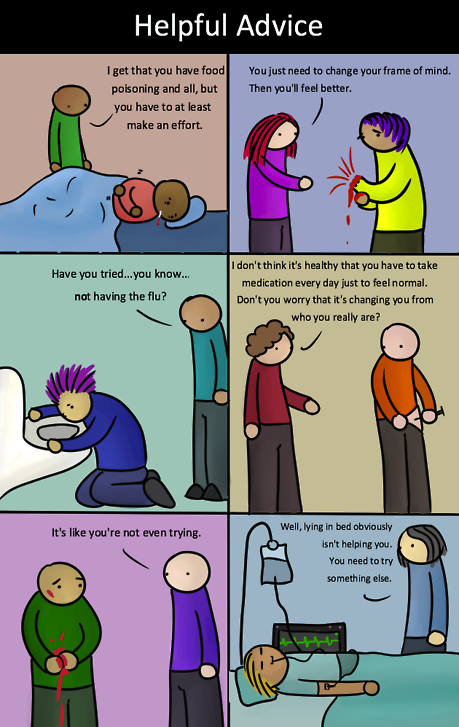
Mental.Physical Illness


I just listened to a great podcast from the Whitehorse Inn at the gym and it reminded of this comic. This is from a secular perspective, but unfortunately, I think Christians are even worse. Go listen to the podcast, there is not much more I can say that she doesn’t, but I’ll hit a few points. She mentions most Christian think of mental illness as schizophrenia or other more dramatic illness that are actually quite rare (about 6%). She says that 26.2% of Christian have a mental illness, mostly anxiety based (general anxiety, OCD, etc.). Autism spectrum and ADHD are also discussed. Interestingly, when discussing anxiety, she left out my affliction, social anxiety.

They go on to discuss the failure of the church to properly address this issues as well as what churches and Christian communities can do to help and support people who are suffering from issues. I want to talk a little about the former as it is something I have experienced myself. Actually, just listen to podcast, there really isn’t much I can add to it. They get in how the church views it as a lack of faith or that as Christians we just shouldn’t be depressed. They refer to this as prosperity gospel light, have faith and think positive and you’ll be alright. I prefer the Smileyface Christianity, where we are all just a bunch of happy people walking around smiling like idiots and if we truly believe, we should feel no sadness. She makes a great point and lack of knowledge in the theology of suffering.  It really is a good listen, go now, there are even other resources and documents on that page.