Blogging Bavinck 1 – The Man

Part of my “Just Do Something” was to be active in this blog and use it as a place to publicly share my thoughts. Additionally, it forced me to put thoughts down in writing. Most of this is focused on working on two different projects. The one here today, is reading through and writing about Reformed Dogmatics. This is a massive four volume work (the shortest of which is just shy of 700 pages), and will likely take me more than a year to write about. So, here it goes.
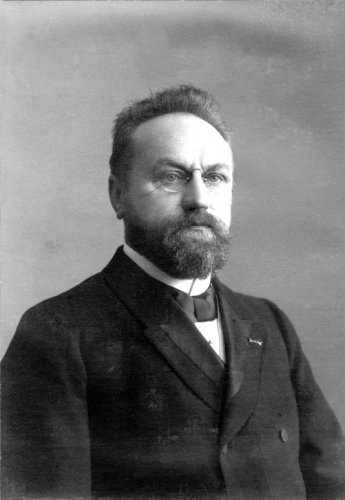
Herman Bavinck was a badass Theologian in the Netherlands. He is not widely known in the US, as his work has just recently (2008) been completely translated to English. He is becoming quite well known in the Reformed community in the us, if you are in seminary or a theology nerd.

Born in 1854, he completed his theological training at Leiden in 1880. He went on to be appointed professor of Dogmatics at Kampen Theological Seminary before eventually coming to be a professor of theology at the newly formed Free University of Amsterdam in 1902 (free in this since of being under control of neither the church nor the state). Where he stayed until his death in 1921. He was a member of the Royal Academy of Arts and Sciences and named to the Senate of the Netherlands Parliment. He was a contemporary of Abraham Kuyper in Amsterdam and B.B. Warfield, even participating in the Stone Lectures in 1908.

His magnum opus, Gereformeerde Dogmatiek was published between 1895 and 1901; revised, expanded and republished between 1906 and 1911; published again, unaltered in 1918; with different pagination in 1928; finally translated to English and published between 2003 and 2008. There was also an abridged (from 3,000 pages to 850) edition in published in English in 2011. Many of his other work have also been or are currently being translated.

I am not too far (100 pages or so) into the first Volume, Prolegomena, but I can already say, it’s tough. Not only is it dense and academic (probably 30 pages on why we should use the term ‘dogmatics’) but it has a bit of an antiquated feel. You have references to metaphysics and the concern for these new scientific departments of religion, as opposed to Theology.

Anyway, should be interesting, check back next Monday as we dive deeper in to Prolegomena.

For more info on Bavinck:

Biography

https://en.wikipedia.org/wiki/Herman_Bavinck

Follow along with me, go buy the whole set here – Reformed Dogmatics (4 Volume Set)

Why You Need a Study Bible

American Christianity has an interesting relationship with the Bible. Many of us claim it is our favorite book, but we know its contents much less well than citizens of other countries. I think one reason is our dual mentality of ‘no creed but the Bible,’ which leads us to know less of what we believe, and our misunderstanding of ‘Priesthood of all Believers.’

We think it’s easy to just grab the Bible, read it through, and understand everything. In good literalist fashion, I once sought to find the most literal version of the Bible I could find. That led me to the New American Standard Bible (NASB). Of course, it hadn’t crossed my mind to try and learn Koine Greek.

Reading parts of the Old Testament, I came across phrases such as, “and his nose became red.” What? Well, it’s an idiom for becoming angry. Who knew that ancient Israel didn’t use the same idioms and maxims as modern Americans? So, I conceded defeat and looked for a more ‘dynamic’ translation.

Continue reading

Book Review: Just Do Something

Just Do Something: A Liberating Approach to Finding God’s Will by Kevin DeYoung

Rating – A must read

Level – Very readable, short.

Summary – Many people search for God’s will, but American Evangelicals, especially Millennials, have made it an art form. He claims that doing this ‘leads us to no where’ and calls us ‘directionally challenged’ (these are names of the chapters in the book). The basic point is that too many of us sit on our asses ‘waiting’ for God to have a perfect opportunity just fall on us. All this waiting means we don’t accomplish much. The essence of his book: trust God and Just Do Something. Another great takeaway is that God’s Will is about moral decisions. Where we live or which job we take is a non-moral decision.

Review – I found his sections regarding the life of his grandparents especially intriguing. Maybe because my granddads are also quite old and are believers. There is a great section where he asks one granddad about considering God’s will for his job. His granddad’s answer, he hadn’t really thought about that. He knew he needed to pay bills and he knew that required work, so he went and found some.

This book really challenged me on a very personal level.  I felt he was describing me in the parts about waiting to the point of doing nothing, waiting for God to make it happen essentially. He also talks of fear, and people hiding behind God. I believe that is part of my problem. I’m scared to take a risk, but it’s very easy to say, ‘It’s not God’s time, yet’ or something to that affect. While I had some specific convictions, I hope that it would challenge every Christian who reads it to do something.


Building Your Theological Library

I read a lot. My library started quite small, first with just a Bible, then the realization I needed a Study Bible and commentary to really help me understand. From there I moved on to Theology proper and issues of Christian life. All this led, of course, to the terrible idea that I should start a blog, but I digress. Below is a guide to getting started. First set are the necessities, from then on I give categories to buy (in bold) and a few recommendations of each.

If you want to buy and use amazon, please go click the links or go through my store.

The “Introduction to Christian Life” Library:

The “I Want to Know More” Library

  • Commentary – New Bible Commentary, The Expositors Bible Commentary
  • Broader Christian classics – Desiring God by Piper, Knowing God by Packer, Mere Christianity by Lewis, etc.
  • Church History – Church History in Plain Language by Shelley
  • Systematic Theology – Erikson or Berkhof; Outlines of Systematic Theology by A.A. Hodge
  • Topical books (broad) – What Does the Bible say about Homosexuality by DeYoung; How to Read Genesis by Longman

The “I Want a Deeper Understanding” Library:

  • Bibles – you can pick up a topical study Bible here, or a bi-lingual version
  • Church History – History of Christianity in North America by Noll; The Story of Christianity (2 Volume) by Gonzales
  • Commentary – Full version of Expositor’s Bible Commentary; Tyndale Commentary (this one is shorter and works well digitally, Olive Tree often has a $99 sale); New American Commentary
  • Theology – Biblical Theology by Vos; Historical Theology by Allison; Institutes of Christ Religion (2 Volume) by Calvin (Battles translation)
  • Topical Books (narrowed)– Inspiration and Incarnation, Evolution of Adam by Enns; Any of the Counter Point series from Zondervan
  • Basics of Biblical Greek/Hebrew

The “I Don’t Have Any Friends” Library:

  • Bible – Interlinear or parallel Greek/Hebrew Bible
  • Commentary – Word Biblical, Baker’s Exegetical, New International, etc.
  • Theology –Systematic Theology by Hodge;Reformed Dogmatics by Bavinck(Follow along with Blogging Bavinck)

You can buy all these books from my store.

Packer’s 50 Books

Here are 50 books J.I. Packer thinks you should read. It’s funny to have come across this today, considering me post earlier.

I’m saddened to report that I have not read any of these (I won’t count the ESV Study Bible). Even worse, I have only four or five on my list of books to read (though, none on my 2016 Challenge List). Many of the books, though I am familiar with their general category, I’ve never heard of. So many books, so little time.


On Reading

I read a lot of books. Somewhere between 20-30 a year, even more when I can figure out how the Kindle Owner’s Lending Library works. Everyone in my family reads like this (more or less) also. My dad will put down a whole novel in a night. Even my grandparents read for most of their leisure time; which is actually kind of hilarious because we set my 91 year old graddad up with a Kindle, he has to max out the font, but he loves it.

Apparently reading challenges are a thing, that’s why I made one. However, when I tell people this, they seem somewhat shocked, as if it were some insurmountable number. I think it is because so many people don’t want to put the effort in of one book after the other, or if they pick up a big book, they hate the idea of try to slog through it. My wife does this. That’s why I think people should read multiple books at once. I’m currently reading an 800 page book on the 20th century American presidents. I’m not going to come home and read that every night. Just like TV or music or movies, sometimes you want something a little different.

That’s why I’m always(ish) reading at least five books. I have them broken down into five different categories, with some overlap. So, it’s not that I read all five every day, but in a given week or so, I do. My guess would be that I get through them faster than reading five books, one after the other, which actually wouldn’t work for my first category anyway.

Continue reading

Andy Stanley Apologizes

On Friday, I noted that Andy Stanley thinks you’re selfish for not attending a mega church such as his. He was since apologized. I give him credit for admitting the mistake and realizing people have differing views, not only on the type of church someone may want to attend, but how certain churches want to run their programs. So, 10 points to him for stepping up and apologizing.