As the subtitle indicates, the book is about preaching the genres of the Bible. It is written to pastors, but I think anyone leading a Bible study, or interested in getting a better understanding of genres can benefit. The book is broken into six chapters – The Greatest Story Ever Told (Preaching Narrative), Let Him Who Has Ears Hear (Preaching Parables), Love Letters (Preaching Epistles), The Beauty of Simple (Preaching Poetry), Words of Wisdom (Preaching Proverbs), And I Saw (Preaching Visionary Writings). Each chapter is broken into two parts, reading and preaching. Additionally, each chapter ends with resources for deeper dives into the genre. There is also an introduction and a conclusion.
My Thoughts
This book is a great introduction to the genres (broadly defined) of the Bible. While it is geared toward preachers, with additional notes about preaching and parts of sermons in various chapters, it is still a helpful book for any Bible teachers or anyone interested in a better understand of the Bible. If you haven’t been exposed to literary aspects or genres of the Bible, this will help you read it well, and I think the book could also be used by itself as part of a study for a community group. People are generally familiar with narrative, you’ve probably heard a sermon/teaching on parables, but most people have not had much introduction to proverbs or visionary wittings, and certainly not much about poetry. The poetry chapter alone is probably worth the price of the book.
The author does a good job of not being too narrow (explaining how much poetry is throughout the Bible, and looking into proverbs that aren’t just the book of Proverbs). This is especially true in the visionary writings chapter, while heavy on Revelation, the chapter didn’t focus on it only. The split of each chapter on reading, then preaching is valuable. The first part offers a great intro to the genre, with the second part being on preaching (or teaching).
In some ways, it was odd that this is written for preaching, as I would expect most preachers/pastors to have learned these structures in seminary or somewhere else before preaching. That said, I think it is great that genre is getting some publicity, and it’s focus is getting to more people, especially those interested in teaching. Too many errors in interpreting various verses/chapters in the Bible come from not having even a basic understanding of literature.
Overall, the book is valuable and a good place to start for those wanting to learn more about writings of the Bible, the end of each chapter gives additional resources (books) you can look into to expand your understanding. For those who aren’t preachers, it is still a book to add to your list. I’m not sure you’ll find a better intro to genres of the Bible. O’Donnell has a bit of a ‘preaching’ stick that gets a little long/redundant, but most points are still applicable to regular teachers and Bible study leaders.
*I received a free copy of this book from Crossway, in exchange for an honest review.
Check out the interview Mrs. MMT did with Hannah Nation about her new book, Faith in the Wilderness. You can watch the video below or listen to the Pod format (and download wherever you subscribe).
This is our last episode in the Five Solas Series. If you are just catching this on for the first time, this Sola functions almost like a summary of the previous three, so if you like what you hear, please go back through and listen for a deeper dive (plus our other two episodes, what lead to the Reformation and Sola Scripture, which means we hold Scripture as our final authority). Ultimately, we are saved by God to His Glory alone. Listen below, find us on YouTube and wherever podcasts are found, or listen on our home page at Modern Cloister.
Level – quick, easy read; relatively short (just over 200)
Summary
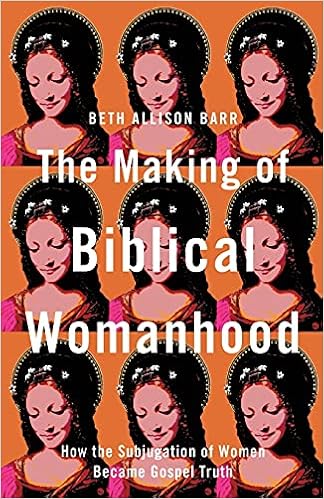
The book is broken into eight chapters – The Beginning of Patriarchy; What if Biblical Womanhood Doesn’t Come from Paul?; Out Selective Medieval Memory; The Cost of the Reformation for Evangelical Women; Writing Women Out of the English Bible; Sanctifying Subordination; Making Biblical Womanhood Gospel Truth; Isn’t it Time to Set Women Free? – plus an introduction that is a tough read if you’ve ever experienced church loss.
The chapters are broadly congruent with the name, though there is overlap with each, and personal narrative as well. The first two chapters focus on early church context/history. The medieval (her specialty) is interesting as is the Reformation impact on women. The next two constitute the issues of the ‘Biblical Manhood/Womanhood’ movement and the final chapter is really more of a conclusion/call to action.
My Thoughts
This book is incredibly popular and mostly well received (many of the negative reviews come from hardline complementarians), but honestly, I’m not sure why. The book could have been three different, more fully fleshed out books. Perhaps the issue is more editorial than Barr’s. The three parts are her personal story (and that of her husband’s, a Southern Baptist (SBC) pastor who changed on women’s ordination and was forced out of the church), what I’ll call historical/theological developments, and issues with the Council for Biblical Manhood and Womanhood (CBMW).
Her personal narrative is hard, it is always brutal to be fired/forced out/leave a church community under negative circumstances. The loss of community can be devastating and happens far more than we’d like to admit and too often people impact do not return to any church. It is truly unfortunate that she could not leave on friendly terms and was basically shunned, this is one of the damaging impact of the CBMW, making women’s ordination a first order theological issue. That being said, and this is an unpopular opinion, they are the ones that changed their view and could no longer subscribe to their church’s confession; the SBC uses Baptist Faith & Message (BF&M). While there should have been an amicable leaving of the church, I’m not sure what they expected to happen. This reminds me of those occasional news stories where someone sues a Catholic school for being fired for not agree with Catholic doctrine. I understand the urge to reform the church, but this is not a new issue, instead it is one that has been forefront in the SBC since before the conservative takeover. I have experienced the pain of lost community, but if your convictions change and are against your church, it is time to find a new church. It is with no sense of irony that she writes as an employee at Baylor. One of the departments at Baylor is Truett Seminary, which is affiliated with the Texas Baptist Convention and the World Baptist Alliance, both of which supports the ordination of women.
Which leads me to my next point, her Biblical/theological arguments for could use some work. There are number of fairly known ones that people use, include the Baptist groups above, and a few that require serious discussion and consideration. She did not use these; and I’m not sure why. Similar, while her discussion of medieval history or the history of women in the church was interesting, I don’t feel it made the point she think it made. I don’t think there is anyone who denies that there were women who preached/prophesied/had a following, I think there are just those who argue that they shouldn’t, and since most of her examples were condemned as heretics, this didn’t make a strong argument for her point. The idea that getting rid of monasteries/convents took away religious opportunities is an interesting and compelling one.
Finally, chapters six and seven cover some of the damage that has been done by groups like the CBMW who elevate ‘complementarianism’ to the Gospel. I think most of her critiques/conclusions are good, except she seems to be making the mistake of equating ‘Calvinism’ with CBMW. I guess because they are broadly reformedish (or at least ‘Calvinist’ in soteriology). In the Presbyterian strain of American churches, the largest, third and fourth largest of the five denominations ordain women as elders; in the Reformed grouping of churches, two of the three (with the largest included) ordain women as elders. In one critique, she is surprised that John Calvin writes on one theological topic the way he does, solely because she assumed he would disagree, I guess do to her misunderstanding of the various strains of reformed churches. I don’t want to digress too much, but this is a common problem when someone you disagree with says something basic and you find yourself ‘surprised to agree’, as if everyone involved didn’t at least agree on the basics of the Gospel. Similarly, she seems to confuse Eternal Subordination of the Son (ESS) with Arianism. ESS is wrong, but more aptly described as unorthodox or heterodox than full on heresy, such as Arianism. Now, Grudem is wrong to support ESS (as are a few of the other presidents of CBMW), but I do think a distinction between ESS and modalism needs to be made. Criticism is valid, as one author (I forgot who) pointed out that if you have to change our view of the Trinity to support your view of women, your view of women may be wrong.
Overall, it really depends on what you are looking for in this book. It is great as a personal narrative, but somewhat surprising in the theological category, especially with her department being adjacent to a seminary. If you want strong arguments for women ordinations I’d recommend Michael Bird’s book on the subject, or the compilations book ‘How I changed my mind on Women’s Ordination’, or go read the scriptural proofs as put forward by any of the denominations that ordain women. I much more coherent and pointed critique of the CMBW would be Aimee Byrd’s ‘Recovering From Biblical Womanhood’, which is excellent. I’d certainly say if you are pastor/leader in your church, regardless of the position you take, you may want to read this due to it’s popularity. This book has enters the discussion often on the topic of women, so that it interest you, you would put it on your list.
If you haven’t listened to the into episode, please listen there first. We try to get a chunk of history out of the way, so we don’t have to cover it on each episode. I think it does a pretty nice job of giving the historical setting and helping the listener understand the need for the Reformation. You can find in the intro here.
In this episode we dive into Scripture Alone (Sola Scriptura), which arguably had the largest impact of any of the Solae. The ‘middle three’ (grace, faith, Christ) are inextricably linked and form a major theological point, but on the practical life of a Christian side, placing the Bible as the top source of authority was hugely impactful. It is also the first domino to fall of sorts, as then all arguments need to start from and end in the Bible. Of course, there has also been an overcorrection, where people think Bible Alone means only me and my Bible, which might have peaked about 200 years ago, when many new denominations/movements started that are essentially heresies from the early church that people quite studying. So, we try to make it clear that confessions, community, etc. are important and needed. I do feel (maybe I am just being hopeful) that there has been a recent renew of interest in early history and the writings of the church fathers.
As always comments or questions are always welcome below. Listen below, find us on YouTube and wherever podcasts are found, or listen on our home page at Modern Cloister.
We are excited to launch a new series on the Five Solas (I know that ‘s’ isn’t correct Latin, don’t @ me) of the Protestant Reformation. This episode is the kick off, then we’ll spend the next few months going through each of the five. Sola is Latin for ‘alone or only’, so you may have heard of Scripture Alone, or Grace Alone through Faith Alone in Christ Alone to the Glory of God Alone. These are the five rallying cries that came out of the Reformation, and we feel that are as important right now as they have been in the last 500 years.
This short episode will be a brief overview of some of the situations that led us to the Reformation. Check back next week for Scripture Alone. I am hoping to have a book review related to the series up at some point soon. I also plan to get back to review some books, putting some Bible Study notes up, but honestly, I’m not too hopeful. We may attempt a book review Pod, so if that is something that sounds good, let us know. Any other comments or questions are always welcome below.
Listen below, find us on YouTube and wherever podcasts are found, or listen on our home page at Modern Cloister.
I am really happy about our first author interview. Mrs. MMT did a great job interviewing Elyse Fitzpatrick and Eric Schumacher about their new book Jesus and Gender, out now and available anywhere. I think it is an important book right now in the ‘gender wars’, calling everyone involved back to humility and Christ-likeness. It is also our first video cast, so I hope you enjoy. As always, comment below.



 Monday Morning Theologian