From their latest album – Found in Far Away Places
Wayne Grudem and Trump
If you are a Christian Theology nerd, internet theologian, or follow the intersection of Evangelical (whatever the hell that even means anymore) and Political, you have probably heard about Wayne Grudem’s endorsement of Trump, call him the morally good choice. I’m not even sure where to start. I read this last Friday night and was honestly very saddened. I’m a huge fan of Grudem. His Systematic Theology text was the first I ever read; really the first of any kind of theology I had ever attempted to study. His book was the gateway to my study of theology that has had a profound effect on my life today (including leading me to become a pretend theologian).
It’s not even that I disagree with all of his points. While I believe his thesis is wrong – Trump being the moral choice – he mentions other policies and outcomes that I support. I think two things bother me most about his article.
First, his lack of originality. His article more or less reads like straight up FoxNews or Tea Party talking points. I am always highly skeptical of anyone who agrees 100% point-for-point with any institution or political party. Maybe that’s a bit much, a little too cynical, but I certainly do not know anyone personally who aligns perfectly with the whole of one political stance (though, I suppose, to be fair to Grudem, the people closest to this tend to be the Tea Party types). When someone does this, it seems they are not thinking for themselves, but instead are reiterating what they have been told to say.
The second major issue is the weight that Grudem carries and the amount of credibly that seems to lend to Trump. He is the general editor of the massive (and massively popular) ESV Study Bible, he is co-founder and former president of the Council on Biblical Manhood and Womanhood, former president of the Evangelical Theological Society, and he was also chair of Biblical and Systematic Theology at Trinity Evangelical Divinity School (likely the best broadly evangelical seminary in America). My point is, he’s kind of a big deal. However, as you’ll see below, his is not the only view from evangelicals. Furthermore, and what is the most concerning to me, his view is not the outright, perfect Biblical view. Someone of his stature making this statement would cause some to believe that Trump must be the correct Biblical or Theological choice, which he most certainly is not.
Alright, with all that said, I’ve already gone longer than originally intended. There is just so much wrong with this, including the fact, as many have pointed out, that he disagreed with most of his own points almost 20 years ago when discussing Bill Clinton. This seems to come from such a political and personal viewpoint, couched as the Evangelical and Theological view, and because it bothers me so, I am removing his book from my recommendation for building your theological library and replacing it with Erickson’s Christian Theology.
If you disagree with Trump, but still can’t bring yourself to vote for Clinton, check out Russell Moore’s thoughts, which get a little more support here.
Responses to Grudem:
“Make no mistake: if we follow Professor Grudem’s advice we will lose this election and lose all moral authority to say character counts in the White House.”
What Grudem should have said.
Why Grudem is wrong.
“Grudem’s article makes no space for uncertainty, no room for dissent, and uses definitive, dogmatic language.”
An Answer to Grudem.
Is Grudem Right?
I wanted to be fair and post a few articles that side with Grudem. Problem is, I couldn’t find any. I literally searched “support for wayne grudem’s position on trump.” If any of my dozen or so followers has seen anything, please let me know.
I’ll end with this bit of satire and a reminder for Christians out there to really think and pray about the upcoming election. Talk to your friends, elders, pastor, or people you respect at church. Think seriously about the impact on our nation, of course, but also (and more importantly on us and how we are viewed) on the voice of Evangelical Christianity – a voice we hope is representative of Christ Himself.
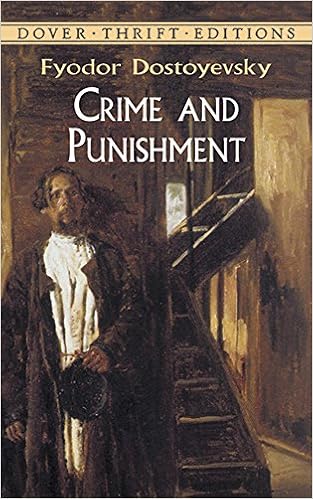
Book Review: Crime and Punishment
Crime and Punishment – Fyodor Dostoyevsky

My Rating –Put it on the List
Level – Tough, dense, fairly long
Summary
Rodion (Rody) Románovich Raskolnikov is a poor college student in St. Petersburg who decides to murder an old pawnbroker with an ax so that he can rob her. Things go awry when someone else is there and he has to kill them both. Though he believes he had the right to kill her, comparing himself to Napoleon, claiming that murder is alright if it serves a higher purpose, he becomes obsessed with his actions. He goes into a near psychotic state, becoming not entirely sure of what is real and what isn’t.
His friend Razumikhin tries to help him, giving him work to do and visiting him, as well as calling on a doctor to see him. Meanwhile, me is suspected and interviewed about the murder. Additionally, his mother and sister are moving to the area for his sister to marry a wealthy man, all for him. The man will be able to help with pay for school as well as help him get set up with a job. During one of his frantic bouts, he sees a man get run over in the street and follows the crowd as the bring the body home, offering to pay for the funeral. He ends up meeting the man’s daughter, whom he falls in love with.
My Thoughts
Two things made this hard to read for me. For one, as always, I was using the Dover Thrift edition, which might not always be the best translation. Secondly, the Russian naming convention of calling them by first and last name but then alternately calling them by just one name, but a different one from the other two. It took me awhile to figure out Razumikhin and Dmitry Prokofyich Vrazumikhin was just one person.
I have the Dover Thrift (of course) which is the Constance Garnett translation. From what I’ve read, the best is Richard Pevear and Larissa Volokhonsky translation, though it seem a bit harder to find. Many others enjoy this version, newly released Crime and Punishment: (Penguin Classics Deluxe Edition) (this is also the version you’ll see if you follow Rodion on Twitter)
(Edit – I came across the naming custom in an article about War & Peace, which is had seen it prior to reading. You can read the whole article, but below are the main highlights)
The common rules are the further:
- the full three-name form (for instance, Иван Иванович Петров, Ivan Ivanovich Petrov) is used in official documents only. Everyone in Russia, Ukraine, and Belarus is supposed to have three names.
- the form “first name + patronymic” (for instance, Иван Иванович, Ivan Ivanovich):
- is the feature of official communication (for instance, students in schools and universities call their teachers in the form of “first name + patronymic” only);
- may convey the speaker’s respect for the recipient. Historically patronymic was the feature of the royal dynasty only (Рюриковичи, Ruerikovichi)
- the surname only (Петров, Petrov) is used in formal communications, but much more rare. One instance where it is used commonly is by school teachers towards their students. There’s some trend in informal Russian to call a recipient with his/her surname expressing the irony as well.
- for informal communication two names are usually omitted and only the first name is used (for instance, Иван, Ivan). In the more informal registers, a diminutive(of which several can be formed from one name) is often used. In rural areas the patronymic name only (for instance, Петрович, Petrovich, Ивановна, Ivanovna) is used by aged people for informal communication between themselves, sometimes young people use such form expressing the irony.
The book started off slow, so if you are willing to power through the first 45 pages and cruise on past 70 pages, you’ll be good to go. Probably he most interesting and entertaining sections are his conversations with inspector Porfiry Petrovich. The whole book has many story lines, however almost all revolve around Rodion, so it is not too hard to follow. Towards the end of the book, you can see what is happening, but are still left wondering somewhat, about how everything will tie back together. It is a masterfully written story.
One of the most compelling parts of the book is Rodion’s inner turmoil. In this aspect, the story of his mind is written as almost a psychological thriller. Dostoyevsky also plums the depths of the broken and guilt ridden mind. Rodion is near manic in his despair and belief in himself. It is almost disturbing to read.
Anyone looking to break into Russian Literature, this is definitely a good place to start and a book to put on your list. At around 500 pages it is the shortest of the Russian heavy weights. I certainly plan to continue you on with more, though I’m torn between sticking with Dostoyevsky or moving on to Tolstoy. Either way, check back for a review in the future.
Reading Hosea
Well, it’s come to my attention that a ‘readers guide’ is actually something different than I was use the term to mean. For that reason, I shall no longer refer to my little series on the Minor Prophets as such. Instead, I will now call them a ‘reading guide’.
On that note, I want to introduce Hosea. Douglas Stuart, writing the commentary for the Word Biblical Commentary, says ‘With the possible exception of the book of Job, no other OT book contains as high a proportion of textual problems as does Hosea’, similarly the New American Commentary starts off with ‘ Hosea is not an easy book.’ Also, James Boice calls Hosea the ‘second greatest story ever told.’ So, I figure as a pretend theologian with no knowledge of Hebrew, I’d weight in. Actually, this is just my attempt to continue on my idea of trying to make the minor prophets easier to understand. See my previous posts – Reading the Minor Prophets and my Cheat Sheet to the Minor Prophets.
Intro to Hosea
We have in the text when Hosea claims to have prophesied ‘during the reigns of Uzziah, Jotham, Ahaze, and Hezikiah, kings of Judah.’ This would be roughly 50 years, from 760 B.C. until 710 B.C. Hosea is called to marry a prostitute. This seems unlikely, and many scholars do not take this approach. Some view her description as meaning someone who will become a harlot. That is to say that she will betray Hosea. A minority opinion is that she is not a prostitute at all, but however, she is someone whom will become an adulteress. That is, Hosea was commanded to marry someone whom he knew would eventually be unfaithful.
Either way Hosea marries Gomar, whom is a representative of Israel. That is because Israel is a prostitute, and adulteress before Yahweh. She claims to be with him, but instead wonders and looks to find solace and protection in others. Israel was not faithful to Yahweh, she hedged her bets and worshiped other gods, in synchronicism, because she did not believe. Hosea is called upon to show Israel, in vivid example, what it is they are actually doing in their relationship with Yahweh.
Commentaries
Hosea, Joel: An Exegetical and Theological Exposition of Holy Scripture (The New American Commentary)
The Minor Prophets: Hosea-Jonah (Expositional Commentary) (Volume 1)
Hosea (Tyndale Old Testament Commentaries)
Hosea-Jonah, Volume 31 (Word Biblical Commentary)
Book Review: What Christians ought to Believe
What Christians Ought to Believe: An Introduction to Christian Doctrine Through the Apostles’ Creed – Micheal F. Bird

My Rating – Must Read
Level – Medium length, fairly easy and does not require more than a basic knowledge of the Bible or Theology.
Summary
The book is essentially an exposition of The Apostles’ Creed. That is, he goes line by line and explains why we believe it and where the proofs are in Scripture. The first chapter is spent on explaining what exactly a ‘creed’ is – which is incredibly important, especially for us Americans and non-liturgical Protestants, who don’t use them. The second chapter is an argument as to why we need creeds. Among the brief history of the cannon and the early church, I also learned that the ‘Peanut Butter & Jelly’ of Australia is ‘Vegemite & Avocado’. So, there’s that.
The remainder of the book breaks down as follows, with a chapter of exposition on each:
- I believe – a chapter about faith
- …in God, the Father almighty, creator of heaven and earth
- I believe in Jesus Christ, his only Son, our Lord – split into two chapters, one on the dual nature (fully human and fully God) and the second on the meaning of Messiah and Lord.
- He was conceived by the power of the Holy Spirit and born of the Virgin Mary.
- He suffered under Pontius Pilate, was crucified, died, and was buried – this line is also split into two chapters, one on the offense and the other on the victory of the cross.
- He descended to the dead. On the third day he rose again.
- He ascended into heaven, and is seated at the right hand of the Father. He will come again to judge the living and the dead.
- I believe in the Holy Spirit,
- …the holy catholic Church, the communion of saints,
- the forgiveness of sins, the resurrection of the body, and the life everlasting. Amen.
My Thoughts
I remember the first time I went to a ‘liturgical church’ – call and response, where the congregation also recites things – which was a word I didn’t even know. It was my freshmen year in college and this was also the first time I’d ever heard the Apostles’ Creed. This is part of the problem with American Protestantism and the ‘no creed but the Bible’ mentality. So few people know what they believe or why – mostly, I think, because we never articulate exactly what it is we believe, giving us the opportunity to teach specifically, and dive into the reason/scriptural proofs for these beliefs. I was likely in my mid-20’s before I even knew what catechisms or confessions were. It was a loss to me, although they are documents that have been used by educated believers for hundreds of years. Even more dramatically, the Apostles’ Creed has been recited by believers for nearly two thousand years.
This book is a depth of riches. It is a must-read for every Christian, whether new or lifelong believer, pastor or laity. It should be given, by the church, to every new church member or professing believer, as well as the basis of a Bible study, Sunday School class, or even sermon series (or at least a reference). Additionally, you should buy a copy for any questioning/curious unbeliever that you may know. It will become more and more important that believers are grounded in the historic faith of the church, and this is an important first step.
*I received a free copy of this book in exchange for an honest review.
Amos 9
This is the final post in my series, Reader’s Guide to Amos. It works(or at least, I’d like it to) as something between a commentary and a Bible Study. Go read the text. Keep that window open. Read through it once to get a broad view of what is happening. Then come back and read through my notes. I’d suggest going back to the text one more time, read through it and when you get to a word or idea you are unsure of, come back and see if there is something in my Reader’s Guide that helps. You can read my original series introduction and the original posts that cover the text up to this point.
Chapter 9
1-4 This is the fifth and final vision of judgement. This vision is different in that there is no symbolism, just destruction, and no spoken words from Amos. These verses show the extent of the Wrath of Yahweh and the inability to escape destruction. There will be no hiding place, not at heaven or in hell, not at the top of the world (Carmel) or the bottom of the sea.
5-6 The third hymn of divine sovereignty. The ‘inescable judgment were reinforced with the celebration of Yahweh’s cosmic power” – Tyndale
7-10 The final woe oracle. Israel is no different than the other nations and will not escape judgment. Yahweh then declares judgment on the ‘sinful kingdom’, which is Israel. However, the destruction will not be total. As He sakes the house of Israel, so shall it be like shaking a sieve, the pebbles will not fall with the grain. The sinners are the pebbles and will die by the sword. Continue reading
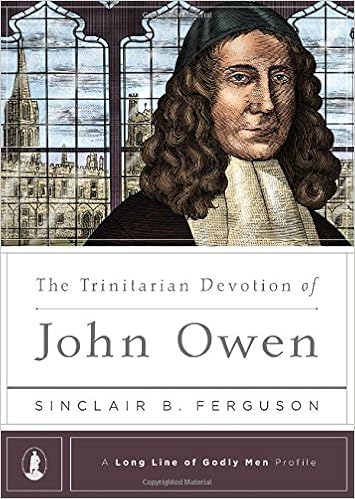
Book Review: The Trinitarian Devotion of John Owen
The Trinitarian Devotion of John Owen -Sinclair B. Ferguson

My Rating –If You are Looking for Something
Level – Short, east
Summary
Like other books in the series, you get a short two for one kind of deal here. The first chapter is a brief biography of John Owen. I don’t he is very well known in the Christian community here in America. He was a British puritan living in the 17th century and quite a prolific author. The second major part of the book focuses on the Trinity, with chapters on each, the Father, the Son, and the Holy Spirit. Much of the book is drawn from the works of Owen.
My Thoughts
I’ve heard of a number of his books, especially Mortification of Sin, but I don’t think I’ve ever read anything from him. It is a timely reminder now, as the controversy of the eternal subordination of the Son so going on, of the importance of the study of the Trinity. I don’t think I’ve ever heard a sermon and participated in a study of the Trinity. This likely has much to do with how difficult the concept is for us to understand. It becomes confusing to discuss and can easily lead to error. I know growing up, I never really understood the three persons to be three independent beings. As in, there was God, whom became flesh as a guy called Jesus, and now speaks through the Holy Spirit. That is, the three persons are just the way that God reveals himself, almost something like taking different forms.
Obviously, misunderstanding the doctrine of the Trinity isn’t as severe as deny the resurrection, but it is an important part of theology. Anyone who takes theology seriously, especially those that are pretend theologians, should really make an effort to gain a better understanding. So, if you are looking for something, this is a good intro to the Trinity as well as good info about John Owen.
*I received a free copy of this book in exchange for a review (see more in my about page).
Amos 8
This is another post in my series, Reader’s Guide to Amos. It works(or at least, I’d like it to) as something between a commentary and a Bible Study. Go read the text. Keep that window open. Read through it once to get a broad view of what is happening. Then come back and read through my notes. I’d suggest going back to the text one more time, read through it and when you get to a word or idea you are unsure of, come back and see if there is something in my Reader’s Guide that helps. You can read my original series introduction and the original posts that cover the text up to this point.
Chapter 8
1-3 – The fourth judgement vision. The for summer fruit sounds like the word for end. We have a play on words that can either mean that Israel is ripe for judgement (summer fruit being fruit that would ripen in the summer) or that it was during the end of the season for the fruit, as is the coming end of Israel. The joyful singing will turn to wailing and mourning. There will be so many dead bodies, the scene so disturbing that the only response is to yell for silence.
4-14 – An oracle of woe for those whom oppress the poor. They are so obsessed with money that they cry out “when will this religious day or feast be over, so that we can get back to work” The observed the law, not engaging in business, but their man focus was still greed. They longed for the worship days to be over, that they can go back to their dishonest gain.
Ephah was the contained used to measure the grain (by volume)
Shekel was the standard weight – 2/5s an ounce
So they want to make the grain smaller than it appears and the weighing mechanism to appear heavier than it is.
Likely not referring to an earthquake, but instead the trembling is in fear. Fear that Yahweh will not forget their deeds and will bring punishment.
Yahweh will bring floods and darkness.
Everyone will be involved in lamentation. All happiness and goodness will be turned into wailing.
Sackcloth and shaving of the head were signs of mourning.
The coming day will be like that of mourning over the death of an only son.
The lord will then send hunger and thirst throughout the land.
Guilt of Samaria is in contrast to the ‘pride of Jacob’ from v.7. Israel swore to false gods, this is their shame and guilt. The word for guilt here refers to their idolatry. References to Dan and Beersheba may represent how wide spread the idolatry was, as they stand at opposite ends of the land from each other. The formula used in verse 14 sounds like those of swearing allegiance to those gods.
Commentary Sources:
Amos, Obadiah, Jonah: An Exegetical and Theological Exposition of Holy Scripture (The New American Commentary)
Joel and Amos (Tyndale Old Testament Commentaries)
Hosea-Jonah, Volume 31 (Word Biblical Commentary)
No Truth, No Sacrifice
Book Review: Billion Dollar Spy
The Billion Dollar Spy: A True Story of Cold War Espionage and Betrayal – David E. Hoffman

My Rating – Must Read
Level – Easy, fast read; medium length
Summary
The story, broadly, is about the CIA field office in Moscow and its operations. Under different CIA directors and even field office directors, their focuses change or ramp up with the escalation of the Cold War. More specifically, the book is about Adolf Tolkachev, a scientist at a research facility specializing in radar technology. He is disillusioned with the Soviet Union and has a cool backstory twist from his wife. This drives him to ‘inflict as much damage as possible.”
My Thoughts
I’ve been on a bit of a Russian kick recently, especially the spy stuff (Bridge of Spies, The Americans, and just finished Crime and Punishment), so this seemed to fit in nicely. This story is so wild when, as you are reading, you stop and remember that it is true. Aside from that, you will read this book as if it were written by Tom Clancy; it is that riveting and compelling. Of course, it is also funny to read about their special spy technology. I have a crappy five year old cellphone, and it has more capabilities in it than most of the stuff they use combined.
I’d highly recommend this book as a must read for anyone who is interested in either spy stories or the cold war. I’m not sure if they play to print it in paperback, but if they do, I’d probably hold off and get it next year and make it a beach read.