2018 Reading Challenge

I sightly exceeded my goal of 25 books last year, by reading 29 books. Now, the prior year, I had a goal of 30, but pretty well passed that, reading 52. I lowered my goal last year as I took some Counseling courses, but as I am not doing that this year, I am raising the goal back to 30. I’d love to set the goal at 48 or 52, to match my 2016, but Sprout doesn’t sleep as much as she used to (bedtime moved back and naps went from 3/4 to zero), so I don’t think that is reasonable, but in the back of my mind, I am kind of hopeful.

So, what am I reading? I have 13 books specifically planned (check out my Goodreads 2018 Shelf for a quick list). I’ll probably tack on another 12 (or less, mostly likely, as I ratchet down the number of review books I request) and then leave myself a little room for randomness in the other five. Of those five, two or three will probably be novels, and at least one will be another counseling book. The 13 I have set out already include:

Devotional – I’ve typically read a whole year devotional, such as My Utmost for His Highest (my review), but this year I’m doing something a little different. I have one, Shalom in Psalms, that goes through, well, the Psalms. This won’t take a whole year, so I have a Lenten one, From the Grave, and an Advent one, The Dawning of Indestructible Joy“, lined up. That should finish out the year, but I may have to find a 30-40 day one in addition and toss it in there. So, kind of sneaky with the numbers, typically the devotional gets me one book, this year it might net me three or four.

Biography/autobiographyA Full Life: Reflections at Ninety was on my list last year, but I didn’t make it to it, so I’ll stick it back on this list.

Non-fictionGödel, Escher, Bach: An Eternal Golden Braid, at 822 pages, this is the second biggest book on my list for this year and one of my top five life goal, big book, non-fiction books to pick up. Unless this takes me all year, I’ll probably have another, shorter, non-fiction in this list.

FictionThe Fall of Hyperion, the sequel to one of my favorite books last year, Hyperion, and the only book I’ve already started reading. At 864 pages, Anna Karenina, will be my biggest book this year and the second longest single volume fiction book I’ve ever read. If that wasn’t enough Russian Literature, I’d also like to work through the two stories (which come packaged in one book, so I’m counting it as one) Notes from the Underground and The Grand Inquisitor. Hopefully, I’ll get to a few more in this category.

Christian-y type books – because two 800 page books won’t take me long enough, I’m also picking up two more 500+ page books. First, I want to get back into finishing Bavnick so I have Reformed Dogmatics, Vol. 3: Sin and Salvation in Christ, on the list with the ridiculous hope that I will actually make it to the even longer (912 pages) Volume Four. Second is what I’ve heard is the best in Christian history – Church History in Plain Language. Outside of the big ones, I had Five Views on Biblical Inerrancy on my list from 2017, but also didn’t get to it, so I’ve move it to this year; Work and Our Labor in the Lord, which is also technically a review book; and finally, Relationships: A Mess Worth Making. This general category will be the biggest, as I fill it out with review books and commentaries.

That is the plan for 2018, a few less books than I think I could probably handle, but a few of them probably to large. Feel free to share your goals in the comments.

2017 Reading Challenge Update

For 2017 I challenged myself to read 24 books, with 19 books called out specifically. I was successful in the number of book, with 29, but didn’t hit many of my specific books. I think this is mostly due to having less time to read, so I didn’t hit the big books (like Capital in the 21st Century) and because I ended up reading mostly review books that were sent to me by Baker Books.

This year I will likely read less review books. Originally, I would request every book they offered, because at first I wouldn’t receive many, if any, of them. Then as I did more and more reviews, they started sending every single one I requested. I had planned to read five or six, and ended up reviewing 12.

I ended up knocking out two of the three novels I had planned, reading Brave New World  (my review) and Hyperion, but not Lolita.

I read all of the required books for school, but haven’t reviewed a single one. I think I also over estimated the amount of time I’d have left to read after finishing schoolwork as well as the impact of a new job that tripled/quadrupled my commute. Throw in Sprout sleeping even less and somehow becoming even more rambunctious, I ended up with far less time than I anticipated. Just in writing this post and reviewing my reading from 2017, I’ve already downgraded my goal for 2018 from 36 to 30 books, realizing that I likely will not have time.

I’ll have that goal up in a post sometime next week. Hopefully, I’ll finish reviewing a few more books from last year and have a rundown on the ESV M’Chenney Reading Bible.

2018 is Here

It is 2018 already, well, it is the 2nd now, but I was eating and watching football all day yesterday, so I didn’t post anything. Most importantly from yesterday, Georgia won and is heading to the National Championship game next Monday here in Atlanta.

I’ll have a few post later this week or next specifically about this site, but for now Phil has the December 2017 Biblical Studies Carnival up over at his Reading Acts and my buddy David has his annual book ranking up over at his This Mortal Life.

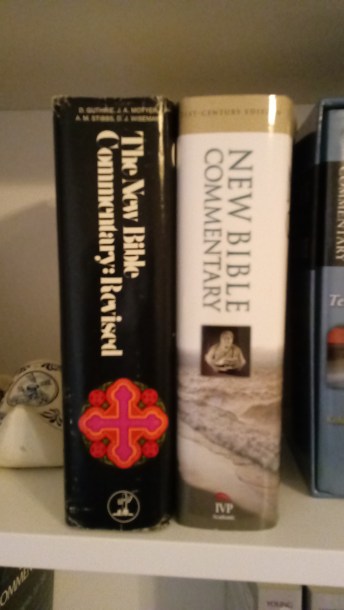
Finally, I’ve posted a few times over the past couple of years about receiving hand me down books from my mom’s dad’s dad, who was a Church of Christ preacher, but yesterday I stopped by my other Granddad’s house. He and my grandmother are moving to assisted living/memory care tomorrow and he wanted to grab a few of his books. Along with a full volume of Matthew Henry’s commentary, I also noticed this.

20180101_165317.jpg

On the left is The New Bible Commentary Revised edition. This commentary was published in the 50’s and revised and republished in the 70’s. It was revised, I believe, again in the 90’s and then totally revamped in the ’21st Century Edition’ in 2008, which is the one on the right (my copy). My granddad is an avid reader and taught Sunday School for something like 60 years, which he took seriously enough to buy multiple commentaries. It was cool to see I had chosen on of the same ones he used for decades, but more than 40 years after he purchased his.


Texas Church Shooting

As always, we wonder if there was any way to prevent this.

Once again, we have a mass shooting in this country. Unsurprisingly, Trump calls this a mental health issue.  Of course, earlier this year, he signed a bill into law that rolled back Obama-era regulations that made it harder for people with mental health issues to purchase guns. If we needed extreme vetting after the NYC attack, does this mean we will have extreme focus on mental health care in this country now? Some sort of ‘extreme’ funding for social services.

I don’t really know what to say. I saw on the news this morning that there was a memorial in Atl yesterday for the Las Vegas shooting. So, we didn’t even have time between the largest mass shooting in modern history and the memorial before another mass shooting. I’m not a very emotional guy, but I feel like crying watching the news stories. Mostly because nothing will happen. Some think that if we can’t talk about gun control now, we never will; but I’m not convinced. I think the ultimate nail in the coffin was 20 first graders being murdered, along with seven others (and the shooter). Just think about that over and over again. There were 20 first graders shot one morning. As a country we did absolutely nothing. If anything, by some accounts, gun control was weakened since then.

It was only 10 years ago that we thought we’d hit an unsurpassable number of 33 at Virginia Tech. We easily passed that just a year ago in Orlando, then set a new record just last month in Vegas. So, two of the five deadliest in modern history have happened over the past 35 days. I was in high school when Columbine happened, and that was a big deal then. I’m sure people thought the same thing, that if we couldn’t talk about it now…. Of course now, Columbine doesn’t even rank in the top 10 deadliest shootings anymore. If you sort that table by year, you’ll see that 12 double digit body count mass shootings have occurred since then.

I have no hope that anything will change. The NRA has an inexplicable amount of power over congress. If you wanted to be very generous and say that some of the congress members who blame mental health aren’t lying through there teeth, still nothing will change, because none of them are proposing to fund mental health counseling in this country or even adequate social services. As always, Christians remain silent and useless. We don’t want to step on anyone’s ‘rights’ regardless of the body count. I guess every couple of months they’ll be a mass shooting with 20 plus dead and we all sit around with our thumbs up our asses and wonder how we could prevent this.


500th Anniversary of the Reformation

Happy Reformation Day. This is the 500th anniversary of the day that Martin Luther nailed the 95 Theses on the door of Wittenberg Church. A couple of things to remember, first Luther was not trying to break away from the church, that is why he (and the others) are called Reformers (and the the event is called the Reformation, not the Great Schism), because they wanted to reform the church. A huge focus was the selling of indulgences (which is still a thing), the more important impact was the ‘rediscovery’ of Grace. We also received the Five Solae (or solas for Americans), to ground us back in the Bible and Grace and away from the Church and Papal Authority.

One of the more fascinating changes that Luther brought was the weekly sermon and the singing of hymns, especially in the common language. Luther also eventually supported marriage of pastors, something all Protestant churches do today, but the Catholic Church still does not. Basically, the typical Sunday morning at church would be unrecognizable to modern protestants. There would be no sermon, basically just the ‘Mass’ or communion, and it wouldn’t be in the common language, it’d be in Latin. Even if you happen to go Advent or Easter and catch a homily (a type of sermon), it would also not be in your language. You would not sing, if there was a choir and any singing it all, it would also, you guessed it, not be in your language. The Bible, again, not in your language. The priest didn’t know Hebrew or Greek, and some of them likely didn’t know Latin. It really is hard to think about today, how far off from any type of church service you’ve ever been to, and how different it would all seem.

As Christians, this should probably be seen as the most important event/date outside of the Bible. Or at least most important since the formulation of the early creeds and confessions. However, the church had drifted so far from those early days, that this is at least on par with the early church.


That is really all I have to say. I’ll leave you with three podcasts, two articles related to the Reformation, and of course a few books to read. I don’t listen to many podcast that or focused towards Christians, because honestly, most kind of suck. Three that I do listen to are White Horse Inn, Theocast, and 5 Minutes in Church History. The first two both did a podcast each on the Five Solae that are well worth listening to for a basic theological understanding. The church history podcast (which if you listen at 1.5X like me, is more like 3:30) posted a podcast every day this month with some historical insights.

Two articles that I found interesting (there were surprisingly few out there), one is kind of a Catholic view, and the other more in the lines of ‘why I’m still protestant.’

You can also check our my review of Martin Luther in His Own Words, Martin and Katharine, and probably the best intro book into Protestantism and Reformed Theology out there.

So, that is it. Take some time and reflect before heading out to teach your kids to take candy from strangers this evening.


Hannity and Jeffress

I’ve rewritten the first sentence to this post about 10 times already, I’m just not sure where to start. I agree with all of John Fea’s points here, but I want to say a little more about the problem. Jeffress speech, and it was a speech not a sermon, was fine. It was a political speech to be sure, one that most Christians would get behind. Though, you really shouldn’t with point number 1, about the Ten Commandments. See my review of One Nation Under God for more, I don’t feel like go through it all again. Also, from the Wikipedia page on the Ten Commandments:

In the 1950s and 1960s the Fraternal Order of Eagles placed possibly thousands of Ten Commandments displays in courthouses and school rooms, including many stone monuments on courthouse property.[133] Because displaying the commandments can reflect a sectarian position if they are numbered (see above), the Eagles developed an ecumenical version that omitted the numbers, as on the monument at the Texas capitol (shown here). Hundreds of monuments were also placed by director Cecil B. DeMille as a publicity stunt to promote his 1956 film The Ten Commandments.[134] Placing the plaques and monuments to the Ten Commandments in and around government buildings was another expression of mid-twentieth century U.S. civil religion, along with adding the phrase “under God” to the Pledge of Allegiance.[132]

His second point on abortion is good, though I don’t think Christian’s should be single issue voters. His final point on gay marriage and the Obergefell decision is also pretty standard, though I guess here, too, we could debate the merits of government trying to legislate morality.

Everything was fine, for his speech. Nothing too dramatic or out of the ordinary for political pundits or Court Evangelicals. He gives his speech, then turns the stage over to Sean Hannity to promote his upcoming movie. All this is fine, if it had occurred on a Friday night or Saturday afternoon, really any time other than Sunday morning. His church is large, and holds an enormous audience, so it is fine to hold a big publicity event there, logistically. However, this was the regular worship service. His speech was a political message, not the Gospel of Jesus. Sunday morning and the worship service of any given church is for proclaiming Christ. It is a time for the ordinary means of grace, the preaching of the Word, taking of communion, and baptism (if you have one).

Jeffress welcomed everyone to hear the Gospel, but I didn’t hear it preached in his message. There was no call to repentance, no need for Christ explained. There was no redemptive narrative. There was only the call to vote not repent, to focus on politics no the cross, to regain power instead of humble yourself, and to make America great again not proclaim the greatness of God.

The American church, for the most part, has sold itself to political power. Events like this one on Sunday at First Baptist Dallas show where are focus is. A cable news hosting received a standing ovation for, well, being a cable news host. There was a roar of the crowd when he, the political conservative, was pitted against another cable news host, a liberal.

I don’t have much else to say about this. I just find it extremely disconcerting. Again, it is not necessarily his message, what he is saying and doing, but when and where he is doing it. This entanglement and church and politics. The movement away form the Gospel to power and control. We can easily look back now at the 1920’s-50’s and see how the ‘mainline’ churches lost focus. Inspired by the Enlightenment, there focus became humanities goodness. The focus on the Social Gospel took time and energy away from the actual Gospel, and they’ve never regained it.

I wonder if in another 50 years, we will look back and say to the 1908’s through now and say, inspired by the Moral Majority and Reagan, the ‘evangelical’ church lost their focus. We looked to political power and away from the cross. Christ tells us you can not serve two masters, and events like these make me wonder which one we are really serving.


One other note, Jeffress said government is ‘designed and instituted by God’, described it as ‘ordained and holy’ as the church. I wonder what he thought/thinks of Reagan and his message of ‘government is the problem.’ This could be a whole post to itself, so I won’t get too much into it now, but this is why I stopped being a Republican. The picking and choosing of when government is good and when it should be involved in regulating things.


Finally, I’ll also steal the idea from Dr. Fea’s other post, comparing Jeffress’ message to the one of my church. The sermon doesn’t seem to be up yet (edit – sermon), but I’ll post it when it is. My pastor gave a message on Political Power. How it is not our goal in life, and that we are called to be Christians first (not America first). I believe his sermon is in complete opposition to what Jeffress is doing. Whether explicitly or subconsciously, he is more concerned with preserving the political power of Christians than he is morality or the Gospel message.

Flags

I wrote a little about flags last summer. That post was mostly about my personal history with the Georgia and Confederate Battle Flags. I do want to do a quick hit on it and then talk about the ‘Pledge of Allegiance’ and the National Anthem, mostly because Confederate images have been in the news since Charlottesville this summer, National Anthem is up again now that football is back on, and mostly because I trying to help my pastor with a sermon series he’ll be doing soon about ‘power’, which includes economic and political power.

I went through the history of the Georgia flag in my previous post, so I just want to focus/expand here on one point. In the original post I pointed out that the Confederate Battle flag gained popularity in the 40’s through the Dixiecrats and that Georgia changed their flag in 1956. I think I should expand on that a bit. It is important to remember what happened in 1954 (after the close of the Georgia Legislature Session) – Brown vs. Board of Education of Topeka, and the Brown II in 1955 (also after closure). I’m not going to go into great detail about what these were, if you aren’t familiar (and American) you really need to go read it and educate yourself, but basically Brown overruled an old case, Plessy vs. Ferguson, and ‘separate but equal’ and essentially ruled that school could not be segregate by law. In Brown II, the Supreme Court said that desegregation must occur with ‘all deliberate speed’. Schools have to desegregate and do it now.

So, how did the Georgia Legislature open in 1956? With this statement from the governor during the State of the  State:

There will be no mixing of the races in the public schools and college classrooms of Georgia anywhere or at any time as long as I am governor….All attempts to mix the races, whether they be in the classrooms, on the playgrounds, in public conveyances or in any other area of close personal contact on terms of equity, peril the mores of the South….the tragic decision of the United States Supreme Court on May 17, 1954, poses a threat to the unparalleled harmony and growth that we have attained here in the South for both races under the framework of established customs. Day by day, Georgia moves nearer a showdown with this Federal Supreme Court – a tyrannical court ruthlessly seeking to usurp control of state-created, state-developed, and state-financed schools and colleges….The next portent looming on the horizon is a further declaration that a State’s power to prohibit mixed marriages is unconstitutional.

This set the tone for the legislative session, one in which they voted to change the flag to include something that Dixiecrats and (recently, but not originally) the KKK had taken up as a symbol of protest. The Senate Research Report about the flag is an interesting read on the history. There is also a great reminder that another proposal that came after Brown was that the State would close all public school rather than integrate and send residents a tax refund to help them pay for private schools (which could still legally discriminate). This sounds frighteningly similar to the current attempt of a ‘voucher’ system for homeschooling (which wouldn’t become legal in Georgia until 1984).

All that to say, I think people can disagree about confederate monuments and their place in society, I’d just ask that people think seriously, especially in the historical context, about what they mean. I think statues to people are weird on their one, but most people disagree, so if a statue to a Confederate general or Colonial was put up in the 1890’s and he was also influential in his state (governor, president of a flagship university), there are legitimate reasons to have some pause about removing them. If a statue was put up, a flag redesigned, or streets renamed in the 1940’s-60’s, you should have very serious reservations about supporting them and truly question the motives behind them.

This, as always, is already longer than I had anticipated writing, so I’ll pivot quickly to the ‘Pledge of Allegiance’ and then a quick thought or two on the national anthem.

Let’s start with Francis Bellamy a Christian Socialist most famous for writing the base of what would become the pledge. His version:

I pledge allegiance to my Flag and the Republic for which it stands, one nation, indivisible, with liberty and justice for all.

Fun fact – Bellamy was opposed to ‘state’s rights’ and the Federal system in general. That is the meaning behind ‘one nation, indivisible’; he, as a socialist, preferred a much more centralized, singular form of government that would make broad laws and states would not make any.  The purpose of the pledge is literally to indoctrinate people towards loyalty to the state.

In 1923 the words ‘Flag of the United States’ were added so all the immigrants knew which particular flag.  The Pledge was recognized by the Feds in 1942 and added to he flag code. In 1943, Supreme Court said it was not compulsory to say the pledge, after a court case brought by Jehovah’s Witnesses. The last change game in 1954, when the phrase ‘under God’ was added – see my review of Kevin Kruse’s book One Nation Under God for more.

Another fun fact, the Bellamy Salute was dropped in the 40’s due to it’s similarity to Hitler salute,  and the flag code was amended to require your hand over your heart instead.

As a libertarian minded Christian, I have a problem with pledging allegiance to a symbol of the State. I only vaguely remember saying the pledge growing up. I do not think it was every day, and looking back, I’m not sure it was said every day. I have the impression that it was more or less up to a particular teacher. When we did say it in high school, many people sat or didn’t say the words, because it seemed like an odd tradition. That all changed my senior year with 9/11. Then it was said everyday all the time.

Anyway, on to the National Anthem. People are kneeling now instead of standing, and it has become such a big deal that our President tweets about it and even sends the VP as a PR stunt to leave when it happened. We can ignore, for the moment, that over six million tax payer dollars were given to billionaires for them to promote patriotism with their ‘non-profit’ over the past few years – read the Senate report here. Doing a little research, it looks like the Anthem was pretty common at sports events following WW2. However, players actually even being out on the field for the playing/singing wasn’t required until 2009. A good place to start on the history of playing the Anthem would be this article from Politifact.

I’m not even sure what I want to say about this. As Christians is this really something with which we have a problem? Do we support compulsory patriotism? Or requirements to pay tribute to the state? I don’t think so. As I mentioned with the pledge above, I’m not big on the government requiring things like this. Instead, I think the effectiveness for which it has brought attention is one reason why certain people are so mad.

It also bothers me how much some people are opposed to protesting in general. This is a peaceful, non-violent, non-disruptive way of trying to call attention to a very serious issue in America. Now, it has kind of been hijacked and is arguably more about the President and his seemingly disbelief in the right of the people to protest. I’ve heard some of the objects – I’m not opposed to them protesting, it’s how they do it – but that is straight up bullshit. I don’t believe that for a second. That is a very common sentiment people try all the time, in all aspects of life. You pretend you are alright with an idea, just not the execution, but ultimately you will oppose any tactic they take. My question for people would be, how would you like them to protest? What would be the acceptable way? Also, do you appreciate the irony that one of our greatest rights that the anthem is and this country is suppose to represent is the right to free speech and to protest?

I’ll end this by saying the official position of the Monday Morning Theologian is that anyone is should be able to protest anything they want at any time so long as the protest isn’t violent or destructive (and to a lesser extent, take traffic in to account). It is un-American to criticize the way someone protest if they follow those rules. Debating what someone protest is great, and should be happening. Instead, in this case, we are getting a bunch of faux patriotism, ‘support the troops’ bullshit that is beyond counter productive. Finally, criticizing them on the ‘how’ only proves to me that people don’t have much else to say on the substance of the protest – that is the police brutality and the treatment of black people by the police in this country. I know our President disagrees with this, but I’d much rather have him argue the merits that say ridiculous think like the players should be fired for not standing during the playing of a song. Really think about the implications of his statements, whether you agree with the players or not, and how that impacts what we view as freedom in this country.

New, New Direction and Other Updates

I have a number of updates I’ve wanted to get to for a while but have kept pushing them off. I realize, somewhat, the irony of saying I’m going a new direction when, that was literally my post just a few months ago.

While I started this site years ago, I really ramped it up about 18 months ago, and I didn’t really have a direction. It was, and still is, mostly book reviews, but I was also working on a number of post going through some of the Minor Prophets, something I’d like to get back into again (especially as I only finished one, Amos, and there are 11 others). I’m currently going through the Sermon on the Mount, and may go back to the prophets when I finish that.

Leading into the election, I ended up writing a good bit more about politics than I had anticipated, mostly due to the inexplicably massive evangelical support of Trump. Considered how much news he is making now, as President Trump, I can imagine that will go back to being a more regular topic. Especially as I have taken a recent interesting in Christian Ethics.

The biggest change overall, especially on a more personal level, is that I had expected to enroll in Westminster this fall with the launch of their new online Counseling program (the MA has been around for a long time, but only this year moved to an online degree). I expected that I would be working on that and moving from my current career. I even took a few courses this past Spring. Over the last year, I’ve looking into different Counseling programs and spoken to many counselors about the field. However, at this point, I do not think it is for me. My fear was always that I would go into a master’s program and end up a career I didn’t like, something that I had already done.

Despite not being very good with people, I thought that counseling was something I could work my way into, but looking back, I think most o that was just hope, especially because of the desperation I was experiencing at my current job. A few things happened in the past six months that have helped me avoid making a costly mistake. First, I started a new job, and I really like it. One question I always had was do I dislike my field or my job. Turned out moving to a new city revamped my desire for my career. This removed the desperation and hurriedness from my decisions making. Providentially, the new company I worked for administers the Myers-Briggs personality type test to new hires.

This turned out to be extremely helpful, as not only did it confirm my current career path/field, but also shed light on some of my concerns related to counseling. For one, I’m introverted, making talking to people draining. Also, I’m not particularly empathetic, which would also be draining. It is already a career with high burnout, and I was headed that way, before even started. I asked one of the counselors about this, and he basically told me, yes, I could do it, but I would be mentally wiped out at the end of the day. I’ve already experienced too much of that in my previous job, and i know the effects it has on your life and family.

Two more quick things about counseling and I’ll move on. One, while I was taking the courses this Spring, I had no time to write. I really missed what (little) I do on this blog, so I think there is something there. Also, the course I was supposed to take this Summer, would have required me to meet with two other students for an hour a week. I was absolutely dreading this. Mrs. MMT was correct to point out the irony of not want to talk to other students about counseling, when this would become my career.

I still have a great interesting in Counseling, and will likely continue to study it as it has already been helpful my leading my small group and speaking with people in general. Eventually, maybe a small ministry in our church could come from it. For now, I don’t see anyway I go do it as a profession.

That is career, as far as that goes right now. What is next for this blog? I’ll continue to do book reviews and Bible Study, but I’d like to expand a good bit and have much more content, with a series of studies on things like Work and Finance, and diving into some current ethical issues. I also have an idea to start a podcast, as I don’t think many of the ones out there are getting it done, or at least not doing what I’d like to see be done.

So, that’s pretty much it. For now at least. I struggle to focus too long on things, and have what you might call and unquiet mind, but I do plan to get more focused content up and hopefully, most of it will be good.

Trump, Jesus, and Machiavelli

I’ve had my issues with Trump and the inexplicable support he had among Evangelicals, so I won’t dive too much into that right now. However, I did come across this article the other day that I found pretty interesting. It is long, but I think it is worth the read as it delves into some of the moral/political issues of Trump and his weird mix/brand of nationalism, fascism, and religion. Here are a few good quote from it:

When you hear the call for a “strongman” whose chief role is to protect the nation against enemies, do you hear the voice of Jesus or of Machiavelli?

Boyd’s point: that those who take New Testament teachings literally are in no position to lead the political march for nationalistic glory.

Conservative talk radio host Erick Erickson wrote two months before the election that seeing fellow evangelists—he named Phoenix Seminary theologian and author Wayne Grudem, among others—“beclown themselves trying to justify support of a man like Trump makes me weep for the shallow faith of a church more wrapped up in its Americanness than its Godliness.”

New York Times reporter quoted one pastor’s resigned plaint: “When you mix politics and religion, you get politics.”

I’ve also had issues with Grudem, so it was interesting to see Georgia’s own Erickson call him out; also  let’s appreciate the word(ish) beclown. Like I said, I’m not going to write more about the issues with Trump, but this articles really gets at the point that he does not really embody any of the values we do as Evangelicals. I remain perplexed at his massive amounts of support, including this coming weekend, from heavyweights in the Christian world. Of course, I have to add my favorite photo of one of his Evangelical supporters (this, if you don’t know, is the son of the man whom founded the Moral Majority, standing with a twice divorced, avaricious man, proudly displaying photos of himself on magazine covers, including playboy. Reference for the Hustler mention)

Image result for trump and falwell pictures

I just cannot see how we can throw such full support behind this man. I remain fully on the side of the #19Percent.


Generational Theory

Tomorrow I will have my first book review up in quite some time. It is called Generation Z, and is basically an overview of the upcoming generation, how they are different, and what our actions/reactions should be as Christians.

Before I do that, I wanted to do a breif summary and some thoughts about generational theory as I feel like it is talked about a lot in the media and church right now – especially as it pertains to so-called ‘millenials’. I’ve also recentyl heard a podcast about boomers and there seems to be daily polls about the current generations. So, it was a post I was already thinking about, and then this book came and here we are.

What generations are around right now?

Greatest – basically anyone over 90, they lived through the Great Depression and fought in WW2. Also known as GI generation. They are the parents of the Boomers as the came back from the war, and popped out a record number of kids (the boom) during the great economic expansion and strengthen social safety programs.

Silent – Born in 30, basically didn’t do anything. Don’t take this as being harsh, but it is the reality. Mostly because there are just very few numbers of them. They are basically those too young to go to WW2, but not Boomers. Their time is short, and their numbers are excessively small due to the depression and especially the war (average age of the infantry in WW2 was 25).

Boomers – children of Greatest. They started during the post-war boom and depending on whom you read, ended in the early to mid-60s. This is a massive population, the largest ever (at the time) that spanned two decades. People argue over the stopping point (though everyone considers 1946 to be the starting point) and many (such as me) advocate seeing this as two different groups.

X – Children of Silent’s. They followed the boomers (whenever you finish them) to anywhere between 1978 and 1984. They are much smaller than the Boomers for one because they occupy a short timescale but mostly because they are children of the diminished Silent.

Millennials – Children of boomers, grandchildren of Greatest. Also known as ‘Y’ and Echo-Boomers. They start wherever you stop with ‘X’ and continue on to anywhere between 2000 and 2005. This is now the largest generation in history, first because they are the children of Boomers, but also because (taken to the fullest extent) they span 27 years from 1978 to 2005, which is obviously a terrible measure and they should also be considered as two distinct groups (more below).

Z – Children of X and Millennials. Born sometime around the Millennium (which means the name Millennials really makes more sense for them). Also known as i-Generation and Homeland Generation. They are born when you finish Millennials (though often much earlier, White puts it at 1993) to anywhere between 2012 to the current crop of children right now. The lines kind of blur here, and I think that is a good thing.

When I was in college and grad school a little over 10 years ago, and the issue of demographics came up, there was a focus on the ‘echo boomers’. These were basically us, the college students at the time, people born in the 80s to maybe early 90s, we were the children of the original Baby Boomers (echo boom, get it?) Kids in the 90s to early 2000s were often listed as “i-generation”, basically the generation that grew up with i-pods, phones, pads, etc. they were also (so as not to tie them to a product) referred to as the ‘millennials’, those born around the time of the millennium. The original idea of millennial was closer to what many call Z now. However, Straus and Howe consider Z (Homeland to them) to be from 2000 to now, making it two distinct groups.

Overall, we were often put together as the commonly referred to ‘Y’, but most demographers so the issue with have a Y generation follow X, mostly that the next would be Z, then you are out of letters. Partly because of this, the more trendy ‘millennials’ took over as the name people (especially the media) used. I’m honestly not sure why Echo-Boom never took off, other than technically an echo is quieter.

Likewise, some have split the boomers into two groups. For a great primer on this check out the podcast – Stuff you should know – What’s the Deal With Baby Boomers – the split them into the following:
1946-1955 – Leading Edge Boomers
1955-64 – Shadow Boomers (also knowns as Generation Jones)

Leading Edge are what you think of when you think 50s childhood. Those who were the young children of the GIs with the ‘idyllliac’ life as portrayed by politicians. The Shadow are known as the Jones (as in, keeping up with the Joneses) or even the ‘Me’ generation due to their focus on consumerism. This is the group most know for rapid consumption and selfishness.

If you want to think seriously about generational theory, these two interdivisions of the two massive groups is helpful. For one, you may have two different generations in the same ‘generation.’ I (’84) and my nephew (’98) by almost all accounts we are both millennials. However, he is my sister’s kid, and cousin to my daughter, quite literally the next generation in our family. Also, his life experience is quite different. He doesn’t remember 9/11, whereas it is a defining event for people my age. He doesn’t know pre-smart phone, let alone pre-ubiquitous cell phones. He basically only knows the Obama administration. The list could go on, and on.

Similarly, early boomers like my dad (’47) have a very different life/worldview that later boomers like my mother-in-law (redacted). My dad served in Korea and all my uncles went to Vietnam. They all remember JFK being shot; that was of the defining events for them. For Mrs. MMT’s family, who are generally about 10-15 years younger, they think more about events in the 70s, the stagflation and energy crises leading up to Reagan.

So, all that is a long way of saying that the generation stuff you hear about so often now is way overblown and generalized. I kind of laugh when I hear a colleague who isn’t even 40 talking about the problems with millennials. Millennials are much older than media portrayal for one, but they also encompass over 75 million people born in a time spanning 3 decades (about 23 years on average), five to six presidents, and countless different economic situations. Again, I finished grad school in ’08, meaning the Great Recession was a defining part of my life (like the depression for my grandparents), my nephew was 10.

Finally, I’ll point out that these lines aren’t perfect. For instance, my sister is an X. Some people with large families may have children that cross lines, or if someone was married very young, their children may fall into the next group. I think generally speaking, the time period in which you grew up is the best indicator, due to being shaped by the culture, and if someone is in some of the blurry edges, they are probably best classified by their parents’ generation. If you noticed, it was quite cycle. Greatest were shaped by the depression and war, then came their children who were shaped by war (but not a major recession/depression due to the law passed by their parents, which they would later repeal), their children are then affected by 9/11 another set of wars and the Great Recession. Likewise, you have the Silent, which is small and kind of off, who then have the ‘X’s who are also small and in a lot of ways, a reaction against the corporatism and greed for the second wave of Boomers. Now, their children and Millennials and whatever is next are all getting blurred together. Part of this is really just how ill-defined my generation is, but also because paths are less traditional. It isn’t men graduating high school then going to trade school/college/military, getting married at 22, then have their first kid within 2 years. That is how you end up with Mrs. MMT and I without question being the same generation (we are less than 6 months apart), but my dad was 37 when I was born, where as her mom was early 20s. Or my nephew who is closer to me in age than he is to my daughter because my sister was 19 when she had a kid and I was 30.

An importance thing in understanding how the church reacts going forward is seeing how history is repeating itself. The Echos, like me (80s) are already known for being more frugal and rediscovering things like cooking and sewing, the same way our grandparents were. While the people just now interring the workforce down to middle schoolers are rejecting the consumerism and self-centeredness of the second half of the boomers (much like ‘X’). While there is a mix of people in the 90s that grew up in the expansion and mirror those boomers in their sense of entitlement and expectations for life.

I’m not as pessimistic about the changes in the next generation as others may be. They will be more diverse and more liberal, but that has been true in every generation. Probably the biggest difference, and the one that does bring them outside of these generational patterns is that they are not growing up a majority Christian culture. I think White does a great job addressing this in his book. So, there is that, I’ve already written much more than I had originally intended, but it is one of the topics I geek out on, so I hope you liked it and that it was helpful