Book Review: Daily Liturgy Devotional

Rating: Must read

Level: About 4-5 pages per day, easily less than 15 minutes depending on your own prayers; mostly easy read, the ‘concise commentary’ is accessibly to all, but some of the prayer book style language may be unfamiliar to many.

Summary

This is a slightly different take on the 30/40/season prayer book, which adds some nice variety while also making it a great reference book for the future. The book is broken into eight thematic sections of five days each – The Gospel, Faith, Love, Hope, Wisdom, Holiness, Perseverance, and Witness. There is also an intro which is relatively helpful (at least explains the few Latin words), but is also the dedication, which is slightly odd, but not really a big deal. The book concludes with footnotes and a further reading section.

Each day includes prayer, a scripture reading, followed with a ‘concise commentary’, a memory verse, prayer prompt, a hymn, and then a space to write thoughts/reflections (according to the author; there are no lined or sectioned areas). On the first of the five days for each section, you will pray the Gloria Patri, Agnus Dei, and Lord’s Prayer. The other four days follow the adoration, confession, thanksgiving, and supplication model. Each section has a recommendation on what to pray as well as a prayer from the Bible or someone in history.

My Thoughts

Two criticisms out of the way first, it slightly bugs me that he didn’t do faith, hope, love. Second, and this is more for Crossway, they need to go ahead and just make an entire modern version of the Book of Common Prayer (I know the ACNA did one in 2019, and it is great, but I’m talking a brand new version, not just revisions). Especially the Psalter, which I’ve heard rumors for years that Crossway was working on. If anyone had the time, money, focus of mission, and theology to do this, it’d be them.

That’s it, those are my critiques. I’ve mentioned it my other reviews of these Family Liturgy’s or Seasonal (church calendar, not meteorological) Liturgy’s and especially the Psalm’s devotionals, this prayer book revival trend for us Evangelical Protestants has been incredible. I like everything about it. Learning common/ancient prayers, the modeling of prayers, the liturgical nature, it is all good.

The devotionals I grew up on, the one line of scripture and then a paragraph of commentary have a time and a place; especially new or immature believers, or those in especially busy times. However, the deeper more engaged, broader focused liturgy’s are what we really need more often. We need more depth, more prayer, more words from those who came before us. There is a reason our Catholic, Orthodox, Anglican, and other Protestant brother’s and sister’s never abandoned this model. The rediscovery and growth in prayer book for conservative Protestants has been wonderful. I think this is especially true for those second generation ‘independent’ or ‘non-denom’ mega church style believers.

This book is great in that it has those eight themes to study for a week (five days, but if you are like me, weekends are hectic, and I use this as a week day devotional). The mix of biblical and historical prayers is solid and helps to teach you ways to pray. The strange part was trying to sing the hymns. I tried to sing out loud by myself, but couldn’t often bring myself to do it. If that isn’t an issue for you, great. However, it is a good reminder that this works wonderfully as a family devotion/worship.

If you a new to the prayer book style or have read all of them, this is still one to get. Probably one of the better intros to the style, if you are new. If you are familiar, this a good one, especially with the themes and the slight change to prayer structures. All around, this a must read/have for those looking to expand or continue a serious prayer life. Also, this is being published Dec 2, 2024, so go buy it and start it the first week of the new year, since you will probably have the goal of increasing your devotional in 2025.

*I received a free copy of this book in exchange for an honest review.

Book Review: On the Christian Life


Rating: Must Read

Level: Very Short (<75 pages), relatively easy (editor uses footnotes for lesser known classical figures)

Summary

Where this book comes from is a little confusing, but it is an excerpt from Calvin’s Institutes of the Christian Religion, which is sold in modern times as two large books. However, Calvin wrote it in four section, with 80 ‘books’, which are essentially chapters. On the Christian Life comes from section three, books/chapters 6 through 10. This is not the first time this portion has been sold separately, variously titled the Little/Gold Book on the (Mature) Christian Life. The contents of the book are meant to be devotional and how we should live lives as Christians. 

The editor has chosen to keep the chapter numbers, instead of ‘translating’ them as well, so the book starts on Chapter 6 – The Life of the Christian, 7 – The Sum of Christian Life, in Which we Discuss the Denial of Ourselves, 8 – Bearing the Cross, 9 – Meditation on the Future Life, 10 – How We Must Use the Present Life and Its Means of Support. This book also includes the editors introduction which explains a little more about Calvin and the history of this book. The table of contents also list ‘How We Obtain Grace’ as if there is Calvin’s intro, but that is just a title page and comes form the name of Section three. However, ‘The Life of the Christian’ (Chapter 6, or the first pages of this book) functions somewhat like an intro from Calvin. 

My Thoughts

This may just be a pet peeve of mine, but I really don’t like keeping the chapter number as they are in the larger book. Surely I’m overthinking it, but having lead Bible/book studies for a long time, having names not match chronology seems confusing. While I’m nit-picking, small books like this often work better in leather (real or fake), especially to be read devotionally. Purely a preference of mine, but figured I’d through it out there in case Crossway reads this. 

This is a really a great intro to Calvin. For a man famous for publishing/writing, we really don’t have much from him. Technically, we wrote commentaries on (almost?) all of the Bible, but those don’t get much popular press. He wrote the Institutes which many people know, but few read. This makes him sound scholarly, as he was, but he was also a pastor with a heart for devotion, and that comes out in this book. A short, cheap, easy to read book is a good way for anyone to learn about any author. The Institutes are far more accessible than you may think, and this excerpt does a good job showcasing that. 

It is a newer translation, which I found very readable. I believe Crossway published this first, because a wholesale new translation is forthcoming. The editor has also added helpful footnotes for modern audiences, as well as keeping Calvin’s original ones. There were a few interesting translation choices, where they would footnote a word and then explain the original in a footnote, and it seemed to me that the original should have stayed or even made more sense sometimes. That being said, I don’t know all the context, and the newer word probably conveyed the original meaning better. Just thought it was interesting, as most translating is. 

As far as the content, the chapter on self denial is worth the book on it’s own. I can’t imagine something that present day American Christians need to hear more. As with the rest of society, we deny ourselves nothing and attempt to fulfil all our want in the pursuit of happiness. Bearing the cross is a good reminder that there are Christian who suffer in the world. The final two chapters blur together somewhat in my reading, but again I think it is something lost on Christians today, that focus on the future. As in, New Creation/New Life, not a few years in the future. It is difficult to not think of only the hear and now. 

This little book has been essential reading for a few hundred years now. I think it is something every Christian should read. 


*I received a free copy of this book in exchange for an honest review. 


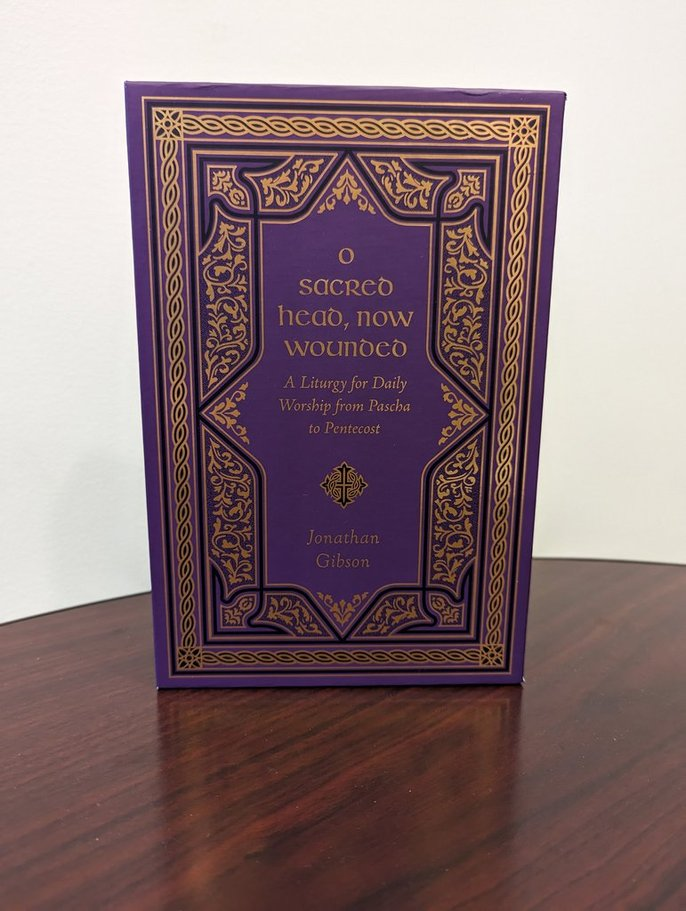
Book Review: O Sacred Head, Now Wounded

Rating: Must Have

Level: Easy (though helpful to have familiarity with liturgy); Long (400+), but each day is less than 10 pages

Summary

This is the third book by Gibson and Crossway of a liturgy for daily worship. The first, being a general 31 day guide called Be Thou My Vision, the second one, like this one is focused on a part of the church calendar, O Come, O Come, Emanuel (see my review here), which went roughly from Advent to Epiphany. I have to admit, I was confused by the dates of this book. The subtitle is A Liturgy for Daily Worship from Pascha to Pentecost. I thought this would be a good Monday to post, as Pascha is (I thought) another name for Easter and Pentecost is the 50th day after Easter. However, this is actually a Lent (timeframe) devotional, though Gibson writes “this [book] is not intended to be associated with the traditions of Lent..” I find this an odd and confusing choice.

This book is neither a 40 (or 46, as Sundays don’t count towards Lent) day Lenten Devotional, not is it a 50 day Easter (Pascha) to Pentecost devotional. Instead, it is a 48 day devotional that starts on Ash Wednesday, proceeds 42 days, and then has special service days – Maundy Thursday, Good Friday, Holy Saturday, Resurrection Sunday (Easter/Pascha), Ascension Sunday (the Sunday after Ascension Day, which is 40 days after Easter),and Pentecost Sunday.

After a preface and acknowledgements, the books starts with an intro (titled Remembering Jesus), where Gibson makes something of a defense of ‘holy’ days, or having special days of remembrance. It is a really interesting chapter, and if you are in the reformed community, you know that there is a pretty sizeable split with strong feelings on both sides of ‘holy days’. 

The following chapter is a very useful (especially if you aren’t used to Liturgy) ‘how-to’ on using the format, which includes: meditation, call to worship, adoration, reading the Law, confession of sin, assurance of pardon, creed, praise, catechism, prayer for illumination, scripture reading, praise, prayer of intercession (and then further petition/prayer), Lord’s Prayer, benediction, and finally a postlude (doxology).  

There are also appendixes for tunes to various parts of the worship, Bible reading plan, and Author, Hymn, & Liturgy index.

My Thoughts

I still find the subtitle odd and do not understand why they would give it such a name. As noted above, Gibson doesn’t want this to be a traditional Lenten style devotional, but it would seem to me that explaining the difference in the book while giving a clearer title would be more helpful. Another confusing aspect is at one point he refers to this season as the ‘Pascal Season’, which coincides with Lent. This is again odd, as most English speaker use Easter not Pascha, and Easter Season (or Eastertide) is the time from Easter to Ascension Day. It is truly a perplexing decision. That being said, it is another wonderful book. I couldn’t come up with much new to say about how it works, so see below for what I wrote about O Come, O Come, Emanual

Honestly, if you attempt any personal or family worship this is a must have. I am a big fan of the structured (liturgical) worship, especially for family devotion. It really doesn’t make it easy to lead or do with your family or community. Really my only (minor) quibble with this is that with 16 parts, it might be just a little too long. However, if you are doing this with a family with young children or you find yourself short on time, there are always parts you can cut. That being said, some sections are only a line or a paragraph long; this shouldn’t take an hour or any extended time. 

If you are unfamiliar with liturgy or structured daily worship this is an outstanding way to get into it. Unless you are from a pretty free-flowing Baptist/non-denom/mega-church background you will probably recognize parts (if not all) of these sections. If you are Anglican, you can see the clear influence of the BCP (which is probably the best book that exist for personal and family worship). 

I know some people don’t like the repetitive nature of some parts of guides like these, saying and can be rote or unfeeling, but really that is up to you. If you don’t take it seriously, or just mindlessly repeat things, then yes, the downside is that it can be meaningless. However, the upsides are a daily reminder of how to worship God, what He has done for us, what so much of the church today and most have always believed and recited, and of course – scripture reading. This is more important than every in church life, especially if you do this as a family/community and use it to help shape and guide children in their beliefs. This is true of any structured worship, but I think is even more important for this time of year, when we are pulled away in so many directions, with so many competing interesting. As I said above, if you are looking for personal/family devotion/worship, this is a must have. 

*I received a free copy of this book from Crossway, in exchange for an honest review. 

Tune My Heart Podcast

As you probably know, Lent starts this Ash Wednesday. I wrote some thoughts on Lent about 6 years ago. I think my views have matured a little more sense then, but I still don’t entirely participate in Lent. Again, mostly because I don’t know how. I am waiting for Jonathan Gibson, who wrote the Advent to Epiphany guide and has an Easter through Pentecost guide come out soon (check back next Monday for my review), to write one on Lent, hopefully next year. It has been a few months sense I’ve read through the Psalms, so I’ll probably use that Lent as a reason to jump back in.

All that to say, if you are looking for something to do, I have a suggestion – check out the Tune My Heart podcast, which you can find it on Spotify, or any other app of choice (as always: rate, review, subscribe). Tune My Heart is a 30 day, daily worship and prayer liturgy. It is based on the Book of Common Prayer, so if you are Anglican (or one of they other churches who use it) it’ll be familiar and easy to enjoy. If you don’t know the BCP, you’ll enjoy this as something new and different.

The series is 30 episodes long and Lent is 40 days (plus 6 Sundays), so you have built in time in case you miss days. Each episode is less than 10 minutes which can fit into your morning commute, if you are still one of those people (like me) that has to commute every day, or easy enough to wake up a few minute earlier for. Check out the Welcome intro below for more information, then go find it and subscribe wherever you get your podcast.

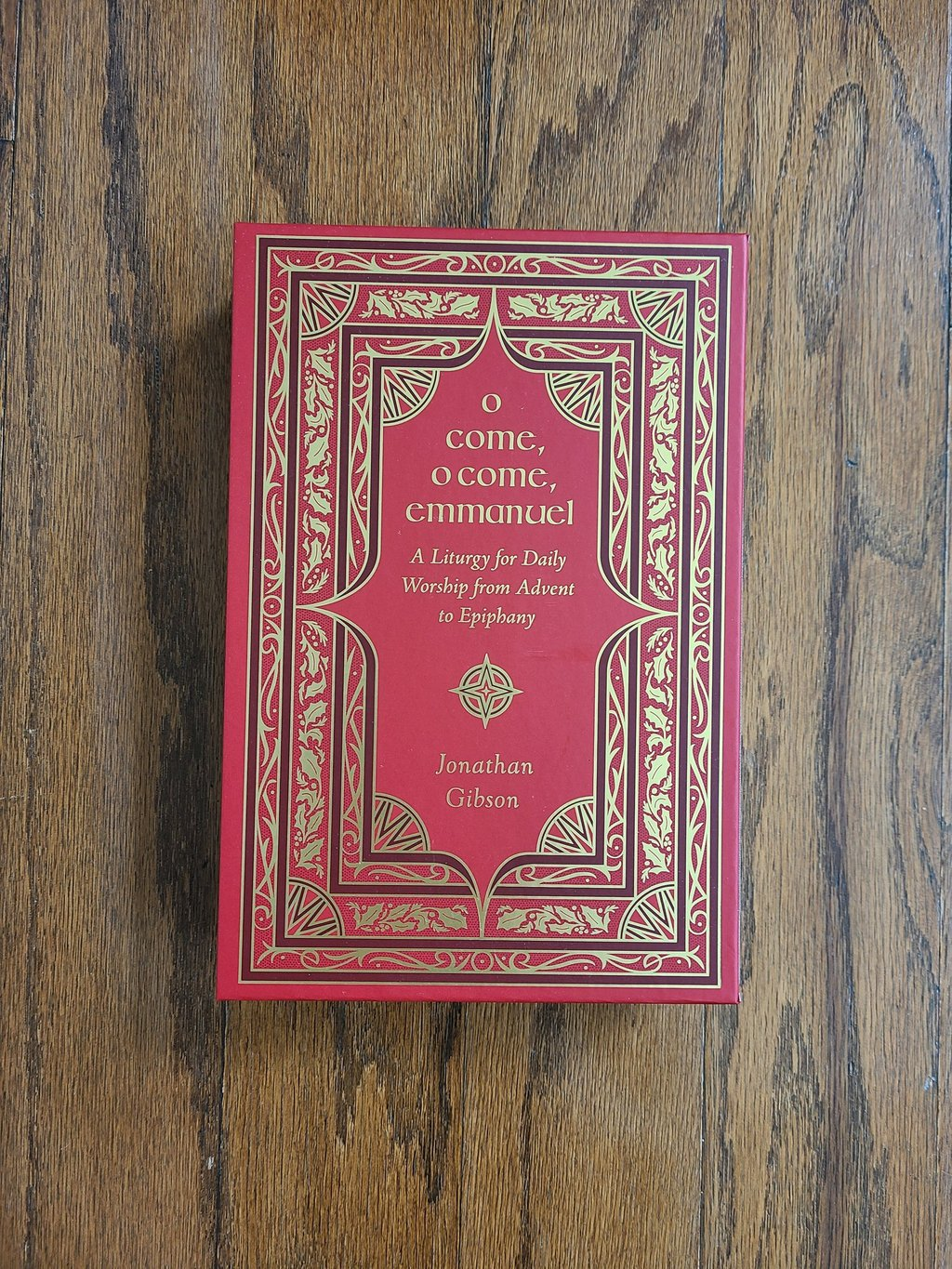
Book Review: O Come, O Come, Emmanuel

Rating: Must Have

Level: Easy (though helpful to have familiarity with liturgy); Long (400+), but each day is less than 10 pages

Summary

This is another outstanding book by Gibson and Crossway, similar to Be Thou My Vision, but this one being focused on Advent, Christmas, and ends on Epiphany. For those unfamiliar, that is January 6th, so to have a round number of 40 days, it may start before ‘official’ Advent. That was the case this year, Advent started yesterday (which is late in the chronological Calendar), and the book starts on November 28th, which was last Tuesday. 

After a preface and acknowledgements, the books starts with an intro (titled Waiting For Jesus), where Gibson explains his reasons/hopes for this book. The following chapter is a very useful (especially if you aren’t used to Liturgy) ‘how-to’ on using the format, which includes: meditation, call to worship, adoration, reading the Law, confession of sin, assurance of pardon, creed, praise, catechism, prayer for illumination, scripture reading, praise, prayer of intercession (and then further petition/prayer), Lord’s Prayer, benediction, and finally a postlude (doxology).  

There are also appendixes for tunes to various parts of the worship, Bible reading plan, and Author, Hymn, & Liturgy index.

My Thoughts

Honestly, if you attempt any personal or family worship this is a must have. I am a big fan of the structured (liturgical) worship, especially for family devotion. It really doesn’t make it easy to lead or do with your family or community. Really my only (minor) quibble with this is that with 16 parts, it might be just a little too long. However, if you are doing this with a family with young children or you find yourself short on time, there are always parts you can cut. That being said, some sections are only a line or a paragraph long; this shouldn’t take an hour or any extended time. 

If you are unfamiliar with liturgy or structured daily worship this is an outstanding way to get into it. Unless you are from a pretty free-flowing Baptist/non-denom/mega-church background you will probably recognize parts (if not all) of these sections. If you are Anglican, you can see the clear influence of the BCP (which is probably the best book that exist for personal and family worship). 

I know some people don’t like the repetitive nature of some parts of guides like these, saying and can be rote or unfeeling, but really that is up to you. If you don’t take it seriously, or just mindlessly repeat things, then yes, the downside is that it can be meaningless. However, the upsides are a daily reminder of how to worship God, what He has done for us, what so much of the church today and most have always believed and recited, and of course – scripture reading. This is more important than every in church life, especially if you do this as a family/community and use it to help shape and guide children in their beliefs. This is true of any structured worship, but I think is even more important for this time of year, when we are pulled away in so many directions, with so many competing interesting. As I said above, if you are looking for personal/family devotion/worship, this is a must have. 

*I received a free copy of this book from Crossway, in exchange for an honest review. 

Christians and Halloween

If you have questions or concerns about Halloween from a Christian perspective, check out this video from inexplicably not bald, devastatingly handsome friend, Pastor Scott Schneiderman. Scott has been on of my closest friends since kindergarten, and is a pastor of a church up in Virginia. If you like the video, check out his site – http://www.re-quip.org – for more and/or give him money.

I really like the focus on amoral decision making, and I think it is something pastors and other leaders in the church need to remind us more often. Kevin DeYoung does a great job of this about decision making in his book, Just Do Something. Beyond that, Scott dives into the history and misconceptions about Halloween. Definitely worth a listen, and if you prefer podcast, search re-quip in your player of choice.

On Bible Translations

Most people either think too much about which translation of the Bible to use or don’t think about it at all; I fall into the former group. In High School, I pretty much only knew of two translations – the New International Version, which seemed to be a standard, and then the old King James. Sometime in college, I also found out about the New Living Translation. I don’t think I dug into the differences or philosophies of translations until around my mid to late 20’s, when I started trying to take studying the Bible seriously. I assumed the best thing to do was to get the ‘most accurate’, which actually the original languages, but most people mistakenly believe is the ‘most literal’. This led me to the New American Standard Bible, which I rarely used after reading. I was also my foray into Study Bibles (more on that in a later post), specifically the Apologetics Study Bible, where I ended up with the Holman Christian Standard Bible (they have since dropped the Holman). I actually really liked this translation, but the truth is, I only ended up with it because it was cheaper than some of the others. Joining a PCA church in 2012, the standard seemed to be the English Standard Version, which is what my current church uses exclusively. A few years later (with a few more study Bibles) and I realized, I don’t really like the ESV. So, right now, I’m in the market for a new (non-study) Bible, and I’m unsure which translation I may buy. I’ve also considered writing a short series on Bible study, one on translations, Study Bibles, and Commentaries; so I guess now is as good a reason as any.

You may have some awareness, as I did years ago, that some some translations are more literal and some just try to give the general idea (there are also paraphrase, but I get into that later). The terms most often used are formal equivalence and dynamic (sometimes called functional, because alliteration helps to confuse people) equivalence. People also like to call this word for word vs. thought for thought. Now, there really is no such thing as literal, as Greek/Hebrew word order doesn’t match English, or sometimes words do not have a clear translation (which is why there are so many). So, some work is needed to make it readable. The readability is often the reason given for moving from word for word. There is also the issue of idiom. If I said ‘his nose was red’ or ‘their teeth will be clean’ or Samaritans don’t share pottery with Jews, you probably don’t know what that means in English. Now, if I said, ‘her belly was enlarged’, you might realize it means pregnant. So, how should translate the idiom ‘literally’. You could use the old language, you could try a more modern one, like ‘with child’ (which just sounds weird), or maybe ‘she was showing’. Or just say pregnant.

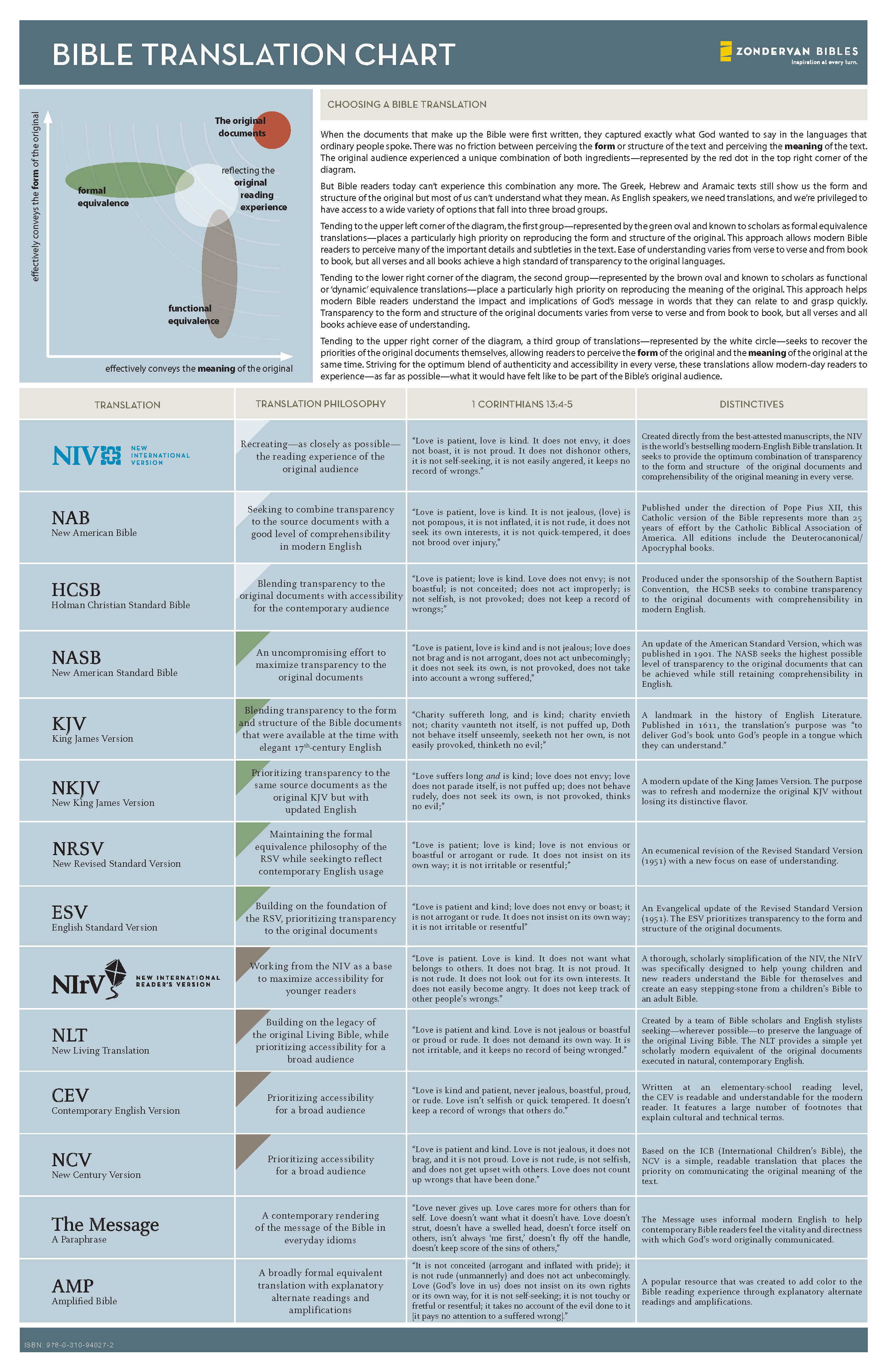
Two other issues in translation are reading level (compare to grade level) and what I’ll call churchyness (or using poetic/odd/archaic language, just because it ‘sounds’ right). Grade level is an important consideration. If you have a middle-schooler, someone who doesn’t like to read, or someone who’s first language is not English, something like the NASB or NRSV, 11th and 10.5, respectively, might not be helpful (let alone the King James). Similarly, if you find the Old Testament confusing, trying the NLT (6.5) may be helpful. I think this is an often overlooked matter when people do look for translations and ‘readability’. Though, generally speaking, the more thought for thought, the easier it will be to read. Churchyness would is typically going to fall into the idiomatic issues I mentioned above, like ‘with child’, others include – lead us not into temptation, or valley of the shadow of death, or darkness is my only companion – when those are more familiar or ‘sound right’, while not being the best translation. These are the issues that come with translation of any kind. I found this chart here, which also has other valuable charts and comparisons.

Briefly, I want to hit a few stats for you, then go into what I consider to be the five main translations, and then two other popular ones that are just bad, and you probably shouldn’t use them. Like many things, the answer to which is the most popular translation will vary depending on who (and how) you ask. In my moderately reformed world, ESV is about all there is. However, it is rarely used outside of the US. If you asked English speakers, my guess would be that NRSV would be by far and away the most known, as it is authorized by the Catholic and Anglican churches; as well as just about the only translation used in scholarship. For America, The Center for the Study of Religion and American Culture at Indiana University and Purdue University asked American’s which Bibles they read and it found King James was first at 55%, NIV (19%), NRSV (7%), New American Bible (6%), The Living Bible (5%) as the top five with all others equaling about 8%. I am skeptical about the methodology, but that is beyond the scope of what I want to discuss here.

My main focus is American Evangelicalism, which is also the group that uses the widest variation, so I will give you a few stats from them. That National Association of Evangelicals asked their members for their preference, and the top five were the NIV (39%), NASB (20%), ESV (13%), NKJV (9%), and NLT (7%), with all others being under 2%. Thom Schreiner has an interesting article about the change from 2011 to 2020, as reported by the Evangelical Christian Publishers Association. The NIV and KJV reamined 1 and 2. The NLT moved from 4 to 3, the ESV moved from 5 to 4, the NKJV dropped from 3 to 5. Other notes in the top 10, the H/CSB stayed at 6 both times, the Reina Valera (RV, a Spanish language Bible) went from unranked to 7, which is kind of cool, and the NASB dropped from 7th to 10th.

You’ll notice below my big five doesn’t necessarily line up with the most used, but I will explain why in each, and then hit on two others that are worth noting. However, all seven are in the top lists (depending on definition). In each section, I will list the acronym, link to the Wiki article, which is actually pretty good for history and overview, then the reading level, then I will jump into why the translation is important and my general thoughts. Since this is how so many people think in terms of how to pick, I will start with the most word for word and move to the most thought for thought.

New American Standard Bible (NASB, History, 11) – This is the most word for word of the 25 or so most popular translations (there is one or two more ‘literal’, but they are hard to find and you won’t see them published from major groups or used in any study Bibles). I’ve heard this is considered the ‘academic’ version for conservative scholars. This translation can be valuable for study, especially if you are trying to get to the most literal version. However, as an everyday reader or devotional, I think it would be tough. It is a hard read (rated hardest to read from one site I found), and has the second highest ‘grade’ rating of all major translations (King James is higher, more on that below). It is generally considered a good version for conservative Evangelicals.

English Standard Version (ESV, History, 7) – This is the one I have the most familiarity with and the one that seems to be gaining in popularity the most. They refer to themselves as ‘essentially literal’. It seems that they are almost as word for word as the NASB, but tries to keep some of the churchyness of the King James. For me, that makes it even clunkier to read than other translations. I don’t like archaic language mixed with literal approach. The readability suffers from this approach, though the level isn’t that high.

Outside of that, my major issue is the amount of harmonization that occurs in the translation (which is kind of the opposite of ‘literal.’ I won’t go much into it here, but if you compare something like Kings vs. Chronicles, or Paul’s conversion accounts in the ESV to other translations, you’ll notice that it doesn’t match often. This is because the translators specifically chose to change the meaning from the Hebrew and Greek for theological reasons or for fear of ‘contradictions’ in the Bible.

This is considered a good version for people who are moderately reformed. People will also point positively and negatively that it is good for complementarians. It is also a common choice in conservative Evangelical churches.

New Revised Standard Version (NRSV, History, 10.5) – I am probably the least familiar with this version, and I don’t think I’ve ever heard it in a church setting. I do have one copy and have to say, I think it is the best in terms of readability. It is a little more thought for though than the ESV (both versions are revisions to the RSV of the 70’s, with something like 96% agreement between), but still ‘essentially’ literal. It also drops old idioms and uses modern English. It is often attacked for being ‘liberal’ due to be being the standard in Mainline denominations and academia.

It is the also the only major version that was ecumnical in the translation committee, having ‘conservative’ and ‘liberal’ Protestants, Catholic, Orthodox, and Jewish members. Due to this, it is pretty straight reading (in some ways more ‘literal’ in the sense that it may be closer to the actual words of the text) because there was no dominating theological bent (this also explains it’s use in academia). It is famously criticized for translating ‘young woman’ in Isaiah. However, that is what the Hebrew says. Interestingly, the LXX (pre-Christian Greek vision of the OT) translates to virgin in Greek. But if you are truely after the most accurate, then ‘young woman’ seems to be what the text calls for. I won’t get much into the ‘gender language’ issues here (nevermind, a few notes below).

I’ve read more than a few people say they wish the ESV was just a reorientation of the theological bend of the NRSV, because, well, they wanted a conservative translation, but also because it has superior readability. This versions is generally considered good for everyone except conservative Evangelicals (not that it is bad for us), though you can find quite a few conservative study Bibles that use this text (though not nearly as many as the ESV or King James).

New International Version (NIV, History, 8) – Many consider this to be the true mid-point on the word for word and thought for thought spectrum. It is a little newer than the NASB, but with far superior readability, which was why it because the stand replacement of the King James in most Evangelicals circles. While they harmonize Paul like the ESV, there are at least footnotes explaining the original Greek. They do not harmonize Kings/Chronicles, but instead note the apparent contradictions, which I find to be a far better treatment than simply change the words of scripture out of fear. They do make a few odd choices, especially in Timothy regarding the husband of one wife, which the translate as being faithful to one’s wife. I guess the translation committee considered this to be the thought (interestingly the NRSV says married only once). This is considered a good translations for conservative Evangelicals, but with broader theology than the ESV.

New Living Translation (NLT, History, 6.5) – I was actually a little surprised to see this make so many top five list. I actually really like it. It is the newest (including updates) of the ‘living’ or ‘modern’ English, though I believe it is an older translation than all the above. It is probably the premier example of a thought of thought translation, it is certainly the best one, in my view. At a sixth grade level, it is also one of the simplest to read and usually ranks as one of the easiest to read. It is great for middle/high schoolers and new Christians. I actually use it often for Old Testament readings, and I recommend it to people trying to read the prophets or Job. They also have a few of my favorite OT scholars, at least one of whom is an expert in Hebrew poetry. Relatedly, as they aren’t going word for word, they have more leeway to be poetical in the Psalms and Wisdom literature. You can find many good study Bibles that use this, but not many in depth or scholarly ones. People seem to be torn whether this is considered good for study or not, but most people find it valuable for devotion or day to day reading. You won’t like it if you want ‘literal’ or disagree with the translation philosophy. It is generally considered good for conservative Evangelicals, and like the NASB or NIV, there isn’t a particular theological bend.

I want to briefly mention two other versions that I think you should avoid, the King James and the Message. First, the King James (KJV). I was surprised to see how popular this still is. It is a version to avoid for two reasons – the language is hundreds of years old, and it is not based on the best available copies. The grade level is actually 13, because you are essentially reading Shakespeare’s English. I know that is the appeal to some people, and if that is you, then this might be a good supplement, but updated language is needed. Not only do some of the words not exist anymore, but in some instances words have completely different meanings than they did, rendering the text inaccurate. There are also many mistranslations due to lack of knowledge of the original languages, especially Hebrew (there are Unicorns in the Psalms). Some KJV only people will tell you that it is based on the best text. This is patently false, and no scholars agree; no other translations use the Greek text used (all the above use the same as each other, as this is the consensus among everyone except KJV only people). There are so many better options, please choose one.

The Message is not a translation, it is a paraphrase and one not meant to be scholarly or accurate in anyway. Paraphrase is well past the thought for thought concept. No scholar or pastor would recommend using this as your everyday reader, not even the translator. You are basically getting one guy’s thoughts on how to paraphrase what he things one verse means to him. If you are curious, it is written at a third grade level. I have heard a few people say this could be helpful in study, but only if viewed/used as something like a commentary. It is not an accurate example of the Bible. If you don’t like reading or are looking for a simple version, please do not choose this, use the NLT.

Hope this was helpful. I’d love to hear from anyone on which versions they prefer and why.

You can see the chart below for more translation philosophy/comparisons. You can also go here and here for more comparisons/summaries of different translations. I did go too much into the ‘gender neutral’ controversy, mostly because I think it is pretty overblown. For one, people were really mad in the 90’s and early 2000’s, but even the ESV uses some ‘gender inclusive’ language now, so, to some extent it has blown over. I’m fine with ‘brothers and sisters’ when it is a group, especially as we know it was read to everyone, and even within some letters there are specific call outs to men, and then also to women’. Something like teach your ‘children’ instead of ‘son’, also makes sense in light of modern English. I don’t have that particularly liberal, and more to the point, find the harmonizing mentioned above to be more egregious. I won’t say any more about that, but Bill Mounce has a good article on it, plus a note on literalism.

Edit: I forgot to mention another issues I have with literal or churchyness, using old measurements. I cannot understand how or why, in modern English, we’d use cubits and baths instead of feet and gallons (or meters and liters, for the rest of the world). Similarly, saying the 6th hour, instead of around noon. Those on the more word for word side should at least translate in footnotes, i.e. ‘9 feet’, not ‘a cubit is roughly 18 inches’; the worst are those that give no conversion metrics. Thought for thought versions tend to translate to modern measures and footnote the original.
Modern Cloister: Impact of Covid on Community

Modern-Cloister-NEW

Slightly different, and shorter, pod today. We wrap up our series on community by discussing the impact of Covid-19. This similar to our Future of Community episode, in that we try to predict what may happen, with the biggest impact being that Covid is certainly accelerating existing trends. We also discuss church and family life over the past year, and a few positives that have seemed to emerge. The main one being people meeting new neighbors, this is true for us, but is also a trend that surveys have show. 

We hope you enjoy this final episode being a bit of excursus and that the series overall was beneficial.  Community is something that is quite important to us, and it only seemed fitting to start the Cloister cast with this topic. If you haven’t listened yet, you can find all the episode in the player below and every where podcasts are found. You can find my commentaries about our previous episodes – History of Community, Decline of Community, and Future of Community. You can find all episode, show notes, and more at ModernCloister.com. We’d love to hear any comments, questions, or criticisms you may have. 

Modern Cloister: Future of Community

Modern-Cloister-NEW

I was out of town last week, so this is a little old, but the most recent Modern Cloister Podcast is up and live. We continue out series in Community and discuss the future of community. Most of it is speculation, but also following various trends. A week or so ago, a Gallup survey came out that shows that church membership dropped below the 50% threshold for the first time since they have tracked. It is worth noting that it is not the lowest in US history, most Historians peg Colonial to pre-Great Awakening membership to something like 20-30%. The survey points to many of the things we discussed in out Decline of Community podcast, such as the rise in the 30’s and the peak in the 50’s, with major changes come in the 70’s and 80’s. They also have a few speculations about the future, and the implications.

I personally do not believe we will drop to the 10% mark in other post-Christian democracies, mostly due to immigration; however, a return to the pre-revival American age of 20-30% seems imminent. I wouldn’t be surprised to see those levels be 2050. We will talk in the next Pod about how we believe Covid will accelerate the trends of the declince.

Covid: One Year

Depending on how you count it – the pandemic had already been called, I was still at work for a week, but Mrs. MMT had just shut down, and schools shut down this week – it has been a year with Covid in our lives. I have written a few thoughts during the past year about Covid and the impact on my life. I don’t have much more to add. As of this writing, more than 530,000 Americans have died from the virus, and while numbers are down, there are still more than 1,500 people dying a day. It didn’t have to be this way, we have the second or third highest per capita death rate, depending on the source. Meaning, we are literally one of the worst three, none of which include Sweden, whose entire plan was to do absolutely nothing. We committed to neither lockdowns and safety measures, nor to completely running the economy as normal, but with distancing and masks. For that, our economy has suffered more than most others (our GDP drop again puts us in the worst performing five). The Republican president at the time recommend we ‘inject bleach’ for the virus, while many Democratic governors in blue states have shuttered their schools (but kept casinos and bars open) against almost all science and pediatric recommendations. I won’t rehash the politics of the past year (most of which are still ongoing), suffice it to say, it is an embarrassment.

I do want to point to one thing, quite disconcerting as David French noted in an earlier article, white evangelicals are the least likely to take the vaccine (though some churches and ‘leaders’ are actively promoting the vaccine). Anti-vaxx isn’t really part of the white evangelical culture, so it seems to be the influence of politics (Trumpism, QAnon, etc.) more than anything else. In some senses, it is ‘fine’ (I guess), to not want the vaccine, but is worst of all, is that white evangelicals were the least likely (only 48 percent, while most others were in the high 60’s) to say that concern for others welfare mattered. Between this and the currently trending argument that empathy is sinful, I don’t know what else to say, so I’ll just leave the words of Christ.

Luke 10:27; Matthew 22:36–40; Mark 12:28–31
 
27 And he answered, sYou shall love the Lord your God with all your heart and with all your soul and with all your strength and with all your mind, and tyour neighbor as yourself.

36 Teacher, which is the great commandment in the Law? 37 And he said to him, gYou shall love the Lord your God with all your heart and with all your soul and with all your mind. 38 This is the great and first commandment. 39 And ha second is like it: iYou shall love your neighbor as yourself. 40 jOn these two commandments depend kall the Law and the Prophets.


The Great Commandment

28 uAnd one of the scribes came up and heard them disputing with one another, and seeing that he answered them well, asked him, Which commandment is the most important of all? 29 Jesus answered, The most important is, vHear, O Israel: The Lord our God, wthe Lord is one. 30 And you shall love the Lord your God with all your heart and with all your soul and with all your mind and with all your strength. 31 xThe second is this: yYou shall love your neighbor as yourself. There is no other commandment zgreater than these.