Book Review: We’re Pregnant

This book will be released next Tuesday (April 24). I was excited to be contacted by a new publisher (or publisher’s agent) to request a review. Obviously, that means I received a free copy of this book in exchange for an honest review.

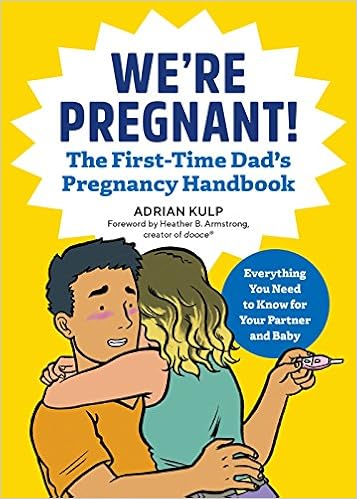
We’re Pregnant! The First-Time Dad’s Pregnancy Handbook

My Rating – Put it on your list

Level – Quick, easy book. Reads much shorter than the roughly 275 pages.

Summary
If you are looking at it, I’m sure you’ve figured out it is a pregnancy book. It is definitely more ‘handbook’ than most other pregnancy handbooks and guides out there. The book is broken into four parts – the three trimesters and what he calls the ‘fourth trimester’. Within each part is a chapter for each month, and each month is broken into weekly subsections.

Each part has an intro to the trimester and a summary checklist for things to have accomplished for the trimester at the end of the part. Chapters (months) likewise have a shorter intro with a stats page with things like size comparisons and ‘new gear’, which is things the baby will develop that month (lungs, toes, etc.). The write-up for the week is about a page and has a separate text box with info such as baby stats, mom stats, and not-to-miss appointments.

The remainder of each sub-chapter is ‘family goals’, which include things like ‘plan ahead’, ‘budget savvy’, and ‘home CEO’. In the intro to the book, Kulp explains each of the 13 family goals that come up. However, each week only has two to four.

The ‘fourth trimester’ is a section devoted to the first three months of the baby’s life. He follows the same format as the other trimesters, which leads to funny comparisons as fruit no longer does the job (for 2 month old, he reference a house cat or Thanksgiving turkey).

My Thoughts
As mentioned above, the is the most handbook style pregnancy book I’ve read. I’d recommend buying the book as soon as you are pregnant and reading through the whole thing. Then, as each week comes up, flip back through and review the stats pages and text box, as well as family goals sections. The trimester checklist at the back of each part is incredibly useful, though it really should be in the front. As you enter each trimester, skip to that end and make yourself aware of the checklist and things you need to accomplish.

Kulp’s writing style is funny and quick, I had never heard of him before, but apparently he is big in the dad blogosphere. The book is a useful guide, the strength is probably the family goals. I didn’t like the names of two of them, because I don’t like the word ‘doula’ and I really dislike ‘daddy daycare’, because the implication being that a dad is not a caregiver. I would just call this parenting. However, the phrase was likely chosen for the alliteration, as Kulp is a stay at home dad with four children, I doubt he sees himself as being stuck on ‘daycare duty’, as I’ve heard to referred to before.

The ‘fourth trimester’ section is a novel concept, most books take you to a few weeks, maybe a month, after birth, if they don’t stop with birth itself. Similarly, the sub-chapters for weeks 41 and 42 are pretty funny, especially if you’ve had a child (or no of one) that stayed too long and the overwhelming feeling of the mom who just wanted to get the baby out of her. I like that he mentions the heartbreak and struggle of miscarriage, telling his personal story; this is a topic often skipped in most pregnancy books (and really life in general, as I found out when we went through one). I also appreciated his focus on keeping an eye on your wife after the birth for signs of  post-partum depression that can be much more serious than the typical ‘baby-blues’.

When I found out we were pregnant, I think I bought six books. I’ve since read and reviewed another four or five, and probably have to put this as the top two or three. Overall, it is a good book, and well written, and I particularly like the guide style, which makes the book very practical with useful tips. There is nothing in there about pre-pregnancy or trying to conceive, so if that is your focus, look elsewhere. He has geared the book to those dads who just found out there are pregnant. So, if that is you, put this on your list.

Book Review: Real Love in an Angry World

Real Love in an Angry World: How to Stick to Your Convictions without Alienating People

My Rating – Put it on your list

Level – Quick, easy read; short book

Summary
A good, quick summary of this book is somewhat hard to do. Bezet’s main idea is that there are unhappy people out there who are mad and/or judgmental towards Christianity. Additionally, these people come from both ends – those opposed to Christianity, and Christians (or at least those who would call themselves as such, like Westboro Baptist) themselves who think your Christianity isn’t good enough. He spends a little time on Christian who have drifted away from historic Christianity, i.e. denying the validity of the Scriptures, miracles, etc. However, most of the time is spent on the two more angry sides, the non-believers and judgmental believers (for instance, he relates a story of taking his wife to see a Celine Dion in Vegas, and losing a few church members once they found out he was in Vegas).

The book is broken into nine chapters that kind of bounce around on different topics. Everything from picking our battles to loving your neighbor (and just who is your neighbor) to then loving you enemy, to a little bit of history on the Bible. He touches on politics a number of times, but not necessarily specific topics or policy points, mainly just that Christians can disagree with each other while still be Christians, and Christians can disagree with non-Christians while still showing love and understanding. I don’t know how long he has been working on the book, but as it was published near the end of 2017, I assume it is at least partially motivated by the rise and election of Trump.

My Thoughts
Overall, it is a good book. Bezet is a good writer, very personal, and I thought, very humorous. I struggle with exactly who should read this book. For most Christians, it is probably worth your time to read, especially because it is so short. It reads quickly and is funny, his points on how to listen to people and how important it is to really listen, and his continual emphasis on the need to truly love others, are great reminders and points weakness for most of us. I especially like his point about loving others being the second great commandment. He points out that on the liberal Christian and non-Christian side, there is often the comment that we just need to love each other because that is what Jesus said and that is all we need. Bezet rightly points out, this is the second great command, this first is to love God. Part of that love means being faithful to God and His Word.

While all is helpful, I think the best use could be for those Christians on the extreme end of the non-loving judgmental side. Those who are the most angry and often express hate. The problem is, of course, I don’t think the people who need it the most would actually read it, and if they did they’d likely just disagree. I guess you never know how the Spirit will move some people, but I remain skeptical. Either way, it might be helpful for you to recognize some issues in your life, and if you see some of these issues in others, it might help you in reaching out to them and helping them to show the love of Christ, while retaining the love for God.

*I received a free copy of this book for an honest review

Book Review: On Pills and Needles

On Pills and Needles: The Relentless Fight to Save My Son from Opioid Addiction

My Rating: Put it on your list

Level: Easy, moderate length (250+), but reads quickly

Summary
A detailed summary of the book is difficult to do. The subtitle more or less says everything you need to know about the book. Van Warner writes a first hand account of watching is his son struggle with addiction to opioids, starting as a teenager and extending through his mid twenties. The book is broken into 25 broad chapters that generally follow a chronological pattern of thought, but not always. There are a few bits of information regarding the pandemic that is the opioid crisis, but these are mostly scattered throughout the narrative of his son’s life. If you seeking answer to the problem, or even just the ‘Christian response’ (the publisher is Baker Books, after all), you will not find any in this book. However, if you are somehow lucky enough not to know anyone with this addiction, it is worth the read, if for nothing else than to gain an understanding of what happens, what addiction look like, and the impact of family and friends of the addict.

My Thoughts
Van Warner is a great writer in a narrative sense, and I found myself compelled to keep reading this book just to see what happens next. It is an emotionally enthralling book, and if you have normal level of empathy and emotions, it is likely you will not get through this book without crying multiple times. That being said, be aware that there is little else to this book than the story of his son. I’m not really sure what I expected when I ordered it, but there isn’t really any resolution or response to the issue. No ‘warning signs’ or way to prevent this from happening. Nothing along the lines of, how to help those hurting or what we should do as a church. All of  which is fine, it is clearly not the intention he had in mind while writing this, but be aware if that is the type of book you are looking for.

Outside of the lack of resolution, the only thing I didn’t like about the book is the typically evangelical hypocrisy of being anti-government, while blaming the government for not doing enough. While he rightly attributes the initial problem to the Pharma Companies, specifically the one that falsely claimed Oxcy was non-addictive, he does lament the government hasn’t done enough. He also point out that Florida is ground zero of the crisis, with an astonishing 93 of the top 100 opioid prescribing doctors working there. Of course, FLorida is notoriously lax in government regulation and I’m sure this and the low tax (meaning less government) environment is partly what brought him there from New York. He himself doesn’t necessarily rant that much against government in his book, but it is odd to read from the perspective of evangelicals, knowing that most of us are heavily pro-business and anti regulation, inexplicably claiming that the free market couldn’t lead us astray, and then, when they inevitably do, we wonder why the government didn’t help. Those critiques are a little past the realm of this book review, but if you become aware of them while reading, it tends to gnaw at you.

Likewise, he blames ‘bureaucracy’ for his son spending two months in county jail, while he supposed to be transferred to another county jail. All this happens in context of his sons possession and intent to distribute charge being dropped. Being dropped. He doesn’t seem to realize how lucky he is that his son is well off and white. Poor people and minorities don’t tend to have felony drug charges just ‘dropped’, but instead spend years in jail.

I’m hesitant to leave that in for just a book review, but the author does seem to be misguided often. Regardless, his story is revisiting, if lacking insight in to solutions. I have a colleague whose son is currently in the grips of heroin addiction, after starting with Oxcy. The things the author writes about, the stories, the pain, the interactions with counselors and police, could have come from her. There is a shocking amount of similarity. I’m sure that is the same for many others out there. If you are looking for a story to help you internalize the crisis, this is a must read. It is probably helpful for anyone in pastoral ministry, counseling, or youth/child workers. There isn’t a list of things that parents/teachers can look for as far as signs of drug abuse, but there are gleanings from the detail of his story. For those with any interest in the epidemic that is currently among us, this is a book you need to add to your list.

*I received a free copy of this book in exchange for an honest review

Book Review: Talking with Your Kids about God

Talking with Your Kids about God: 30 Conversations Every Christian Parent Must Have

My Rating – If you have time

Level – Easy; reads quickly, moderate length (just under 300 pages)

Summary
The title of the book is a bit of a misnomer. This isn’t really a parenting or family book. This might be just because I have a three-year old, but when I see ‘kids’, I think children under 10 and skew even younger. This book is really a basic apologetics intro that can also be used with maybe high schoolers or fairly knowledgeable middle schoolers. There are discussion questions after each chapter, broken in to two parts ‘open the conversation’ and ‘advance the conversation’. The former could be used for middle school or newer Christians, the latter for high school, but also for discussion in a small group or other Bible Study. Very few people have much knowledge of apologetics, and this book would likely be new to most parents, let alone ‘kids’.

The 30 conversations are grouped into five equal parts – the existence of God, science and God, the nature of God, believing in God, and the difference God makes. There is an introduction to each part, then the six topics of conversation. Each topic is then summarized in ‘key points’, followed by the ‘conversation guide’ which consist of ‘open the conversation’, ‘advance the conversation’, and ‘apply the conversation’.

My Thoughts
As stated above, this isn’t really a book for kids. Maybe the first two parts would work to discuss with middle schoolers, but the discussion questions certainly seem more advanced. Those two chapters seem to be the strength of the book, as far as a parent is concerned. As parent, it would be worthwhile to read through these, so that you can know the discussions to have with your children as the move on through school and start to learn about so-called conflicts with the Bible and belief in God. I can’t really see reading through this book or using the advanced conversation questions with a child that is first learning of the conflict, but reading through as a parent, it would be a good reminder of the conflicts they will face and if you’ve never learned much in the way of apologetics, this will certainly move you in the right direction.

Maybe I’m underestimating people too much, but I think this book is much more suited to a small group/Sunday School/whatever you call it, discussion than something to read with children. In that sense, I can’t really recommend this for parents, but I think it is worth checking out as a group leader. The book is fairly basic, but I just don’t see that enough adults have ever learned these ideas, so you need to start with them first. Especially the part, ‘the nature of God’, as this moves out of apologetics and into more of a systematic theology.

Two other criticisms I have are that the existence of God, is a pretty good over all part of the book. There are convincing arguments of the existence of a God, but Crain never steps into the realm of the existence of our God, the God of the Bible. Which leads to the most glaring omission in the book, the Bible. There is no major section devoted to ‘the truth of the Bible’ or ‘how do we know the Bible is true’ or something else along those lines. For me, this is where apologetics or knowledge of God has to start.

One surprising strength of the book, is the final part, ‘the difference God makes’. Again, this really lends itself to a discussion group, as it more or less a group of discussion about the impact our knowledge of God should have in our lives. I really enjoyed this section and will likely use it, if not the whole book, with the group that I lead.

Overall, a pretty good book. I’m not sure it met the stated goal of discussion with kids. Catechisms are still probably the best thing for that. However, I do think it would work really well as an intro to apologetics, a basic primer on the knowledge of God, and could open up great discussion on the impact this knowledge has on our lives. With the ‘key points’ and ‘discussion guide’, I think this book could be repurposed into an interest group study.

*I received a free copy of this book in exchange for an honest review

Book Review: Why Nations Fail

Why Nations Fail: The Origins of Power, Prosperity, and Poverty
Rating – Put it on your list

Level – Moderate, you’ll need some basic familiarity with economics, politics, and history; Long (462 pages before acknowledgements, notes, etc.) overly repetitious and a bit tedious.

Summary 
As I start to write the review, it dawns on me that perhaps the title is a bit misleading. It isn’t so much about why they fail, as to why the never even get off the ground. Some nations seem doomed from the start, however, other become wildly successful. Ultimately, I think, the point of the book is who are the ones that are successful and how does that happen? Acemoglu and Robinson pin it two factors, which taken with their opposites form something like a matrix or quadrant, and you need to overlap with the positive of both. These are whether or not you nation is politically inclusive and, and perhaps more importantly, the whether or not you have extractive institutions.

The politic aspect is fairly straight forward, are you in a dictatorship (or other controlling, top down government) or in a democracy (or other form of responsive government)? If you have no say in politics, and government is controlled by a few or just one person, it is fairly easy to see why that wouldn’t work. The more complicated and impactful side is the extractive institutions. These can take many forms, such as contract law or heavy taxation, but a good example is property rights. If you know you have solid and secure property rights, you are more likely to invest and build up your business. If you fear that an institution may step in at any moment and take your land or business from you, why bother?

The book itself is broken into 15 chapters, with an interesting preface about Mubarak and Egypt. The first chapter compares Nogales, Arizona and Nogales, Sonora; the two cities have similar culture and geography, so why is one rich and the other poor? The chapter serves as the intro to the book and leads into the second chapter where the debunk the reasons for poverty being related to genetics or weather, among others. Chapters 3 through 12 are basically case studies where the authors look a different political situation throughout history through the lenses of responsiveness and extractiveness. In 13 and 14, the authors discuss nations that fail today those that have become successful. The final chapter looks at our attempts to help impoverished nations and how understanding the causes, as the have proposed, will help us to better understand why those attempts have failed and how we can do better going forward.

My Thoughts
First, about the book itself – the authors are both academics, and the book certainly reads that way to an extent. The book could have been much more concise, dropping at least 100 pages without missing any case studies are points. I think part of the issue may come from the publisher/editor, in that instead of setting up most of the chapters as case studies that then looked at their points each time, it might have been better to make their points, and then touch on case studies as proof. Instead, each chapter could almost be read independently, meaning there is too much repetition of their point.

To the content of the book – it was fascinating, anyone with interest in economics, history, or politics, this book is a must read. One of the the more interesting points of history to me, was the impact of the Plague on serfdom in Europe. Eastern Europe reacted one way, England another, which would then impact America (as it was founded with this change as part of history), which ultimately effects me today. Had the reaction in England been the same as the Austria-Hungary reaction, who knows how different the Western World would look, perhaps I wouldn’t be writing this review right now.

Another point the spend some time on that is worth considering is looking beyond just economics. The point to growth of the economy under Stalin, but that the nation still failed. It is also helpful to see and understand how the impacts of colonialism, which was not inclusive but very extractive, still effects those countries and peoples today. The point was driven home a little more for me because I live in the South, which they actually spend some time on. The impacts of slavery on the economics of white people is still being felt today, though less so than a few decades ago. The discussion centers on the fact that obviously slavery is extractive and was horrible for black people, but it also never would have worked politically because it included so few people in the institutions. Most white people were shut out of the economy and wages and this impact lasted a long time. They point out the that median income in the South was about 40% of the median income through the rest of the nation as recently as 1950.

All of this works back to a reminder that part of why life is good for me today is pure luck. From serfdom in England, to the Civil War, on through today. If Lincoln had let the South succeed and be it’s own country, it clearly would have failed, based on the theories of the authors. Meaning, I could be living in a failed state right now, instead of America. They call it ‘small differences and critical juncture’ in history, but it is basically an accident of history; it is somewhat sobering to consider.

Overall, and interesting and challenging book. It could certainly be a bit shorter and cleaner, which is why I didn’t rate it higher, but a book that is well worth the read and one to put on your list.

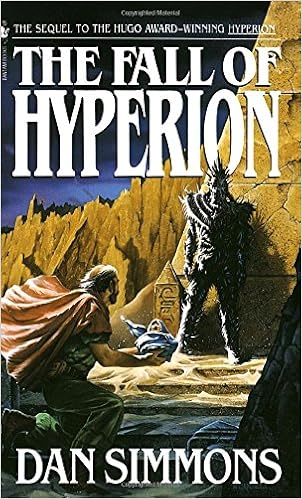
Book Review: The Fall of Hyperion

The Fall of Hyperion

This is the second book in a series, check out my review of the first book – Hyperion.

My Rating – Must Read

Level – Quick, easy read; fairly long at over 500 pages.

Summary
This is a continuation of the first book, Hyperion, so the story line of the Pilgrims in continued, but there is also the introduction of another main character story line. To avoid spoilers (if that is a think for a book published over 20 years ago), I’ll say the Pilgrims all meet the Shrike, all have their stories (more or less) meet a resolution, and find out that their stories are even more intertwined than they knew.

The additional character is Joseph Severn, a Cybrid for the personality/memory of John Keats. Much of the book takes place from his vantage point. Not only his own story, but he is inexplicably tied to the Pilgrims and view what is happening to them in his dreams. CEO Gladstone puts him up in TC2, so that he can keep her apprised of the Pilgrims.

Severn/Keats and the Pilgrims stories also mix together, as does the Ousters, for a few twist and turns you don’t expect coming, including a few new back stories.

My Thoughts
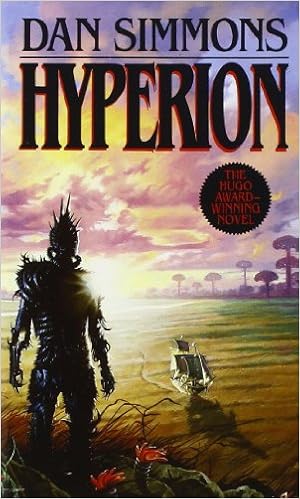
One quick thought, that I didn’t put together form the first book, but become more apparent in this one, why does the cover art show the Shrike with only two arms?

As for the actual content of the book, as much as I enjoyed it, I have to admit, it wasn’t as good as the first. However, if you’ve read the first, this is still a must read. If you haven’t read the first, go read it, then come read this one. This is still a great work of fiction. He is writing during the early days of the internet, but his future thoughts on what it could be come are frightening and a little ephemeral, and in some parts could best be described as ‘trippy’. Smart phones were more than a decade away when the book was published, but the equivalent he uses, sure sounds like them, especially if we were to lose them now; from page 480

“After seven centuries of existence and at least four centuries where few citizens existed without it, the datasphere…simple ceased to be. Hundreds of thousands of citizens went insane at the moment – shocked into catatonia by the disappearance of senses which had become more important to them than sight or hearing.”

The Pilgrim story conclusions are interesting, though some are unsatisfying, and at Severn is not an interesting character. However, the book touches on some of the wildest ideas of AI and has so many intertwined stories and crazy new back stories, it is well worth the read.

Book Review: Hyperion

Hyperion

My Rating: Must Read

Level: Fairly easy read, long (almost 500 pages) but reads quickly

Summary
This is the first book the the Hyperion Cantos series and centers around the stories of seven ‘pilgrims’ as the travel to the distant world Hyperion and a voyage to meet the Shrike. The story take place 700 years in the future, where we have left Earth after it’s accidental destruction and colonized multiple planets throughout the galaxy.  On the ship, each pilgrim – the priest, the soldier, the poet, the scholar, the starship captain, the detective, and the consul – tales their story.

Each mini-story is incredible and interesting in it’s own right. But it is nothing less than impressive they way Simmons weaves the stories together with histories, biologies, geographies, ecologies, and political back stories of a dozens worlds and scores of peoples. It is an amazing, sprawling, interwoven, epic fantasy.

My Thoughts
I’m not a huge sci-fi fan, but I was impressed with this book and honestly shocked that it ins’t more famous. The shear volume and intricacies of the stories and back stories are impressive. I actually found myself staying up late to read and being excited to come back to the book to see what would happen next. I ordered the next book in the series as soon as I was wrapping this one up.

I don’t know how much I should concern myself with spoilers for a nearly 30 year old book, but I’ll just say the pilgrim stories for the priest and scholar were so fascinating to me, that they are worth the price of the book alone. Either one could be it’s own novel, and the concepts Simmons put are great thought experiments.

Of course, the book being so old, there are interesting parts that are oddly anachronistic now, which make them especially funny being projected in the future. For instance, one of the top technologies is the personal fax machine. But his concept of the ‘all-thing’ is basically our modern internet with smart phones, so that was interesting to see. Overall, a great, fun book that is a must read for anyone who likes sci-fi or fantasy, but also for anyone who enjoys thoughtful fiction.

Book Review: Darkness is My Only Companion

Darkness Is My Only Companion: A Christian Response to Mental Illness

My Rating – If you are looking for something

Level – Moderate read, short book but reads longer, but too much ‘philosophizing’

Summary
The best summary of this book comes from the subtitle – A Christian Response to Mental Illness. However, even that is quite all encompassing enough, the book is part autobiography, part pastoral guidance, and part education on what mental health can actually look like. Greene-McCreight’s insights do not come from counseling or academic study of psychology, but her own struggles and personal mental health issues. Because of this, you’ll get invaluable insights into a first hand account of mental health problems, but not a great deal of help in understanding how to respond or counsel people.

She breaks the book into three sections, first, what she calls ‘facing mental illness’, which is her personal story; second ‘faith and mental illness’, which is still mostly her personal story, but with a focus of how mental illness interacted with roll in the church; third, ‘living with mental illness’ which has two chapters, ‘how clergy, friends, and family can help’, which sadly is only seven pages, and ‘choosing therapy’, in which she discusses the churches fears and rejection of psychotherapy. The book finishes with her conclusion and two appendices, one on her use of scripture and a checklist for symptoms and resources.

The title of the book comes from Pslam 88, where verse 18 in her translation reads –

My friend and my neighbor have put away from me,
and darkness is my only companion.

She says she is using NRSV, but nothing I found online matched (I’ve linked the NIV). It must be an older translation, I do not know if it is closer to the original Hebrew or not, but her translation certainly captures the feeling of depression and despair that one feels while struggling with mental illness.

My Thoughts
I wanted to like this book more than I did. I appreciate and have immense respect for her honesty and candor in this book. I was blown away by her personal story. The book is fairly educational, she goes into different medications (as in the levels and types from a pharmacology standpoint), and discuses her experience with Electroconvulsive Therapy, which you might know as ‘shock’ therapy.

Where the book falls short is anything outside of her. It doesn’t appear she has counseled people with mental illness, and as mentioned above, the outside response is only seven pages. I was somewhat annoyed by one of her chapters regarding faith centered around her ordination and her IQ test, that while her score was well above average, she felt didn’t reflect her due to her struggles with depression. I think this partly comes from the Mainline denomination and their clergy’s obsession with where they were educated. She tells us multi times throughout the book that she attended Yale. I support the requirement that pastors be seminary educated, and I think Evangelicals have gone too far with the, ‘we don’t need no education’ stance, but Mainliners have a tendency to view pastoral education too academically, and her book suffers from this.

Greene-McCreight gives us many great quotes from philosophers and Christian’s from the past, but there is very little in the way of pastoral counseling or response to mental illness from those not suffering. I find the especially odd coming from the Mainline, that doesn’t suffer the same strength of rejection to counseling and psychotherapy that Evangelicals do.

One final note to any Evangelical considering reading this book, don’t be turned away because the author is a ‘liberal Christian’, for the most part she holds to a very conservative view of Scriptures. Maybe not seeing outside of her liberal, academic viewpoint, she opens the book defending her use of the Trinitarian view of ‘Father, Son..’, over and against the feminist view that calls for inclusive language for God. For Evangelicals whom haven’t read much outside of their own viewpoint, this can seem strange. For anyone wanting to pass on this book because you don’t believe in female ordination, relax. This book is about her deep struggle with mental illness and anyone who is interested in what the looks like, who hasn’t experienced themselves, I’m not sure you’ll find a more open and honest book. The book falls flat in a few ways, but if you looking for something to learn from a personal story of mental illness, this book is for you.

Book Review: Work and Our Labor in the Lord

Work and Our Labor in the Lord (Short Studies in Biblical Theology)

Rating – If you are looking for something.

Level – Short, moderate read, feels a little redundant at times

Summary
Hamilton attempts to concisely write a theology of work – why we work, what it means to work, and what it would look like to ‘labor for the Lord’. The book is broken into four main parts: work before the fall, work after the fall, work now after Christ’s coming, and finally, work in the new heavens and new earth.

My Thoughts
I’ll start off by saying I think this is one of the most difficult topics for which Christians can write. Not necessarily because the Bible is unclear on work, it is, and not because I thought Hamilton didn’t handle the theological points well. In fact, I thought he did a masterful job from a Biblical perspective; though there were occasionally odd section that appeared to have political undertones, but I guess that’s to be expected from an evangelical publication (or maybe I just read too much into it, and watch too much politics).

No, the problem is the reader. Especially me – educated, white-collar, upper-middle class reader, who has actual opportunities to think about different careers or finding fulfilling jobs. Due to the reader problem, I think books on work are hammered twice. First, because the reader looking for answers, such as what should I do with my life, do not find any and may come away disappointed. Second, because those are the readers, the authors tend to focus on that demographic. Hamilton avoids some of these trappings, probably due to his focus on theology, but they do show up. I won’t digress any further on that point.

The strength of this book is the first section, work before the fall. In our Biblically illiterate, 140 character limit culture, we miss too much of what the Bible actually says. For most of my life, I believed work was punishment for sin. I was around 30 before I heard someone point out that we worked the garden, it was one of the first commands from God and our original role in this world. So, work isn’t our punishment for sin, but our sin has corrupted out work. Hamilton does a great job of teaching and explaining this Biblical truth.

This point is expanded on in the work after the fall section as well. I especially liked the references to Ecclesiastes; which is always a great reminder of the way we view life in general, but I’m not sure I’ve seen it related specifically to work.

Overall, it is a solid book, but it left me wanting a little more. I’m probably a little too critical of Christian books focused on work, so if that is a topic you are studying you should put this book on your list. If not, you might want to skip. It is short, so that is a positive (why not just knock it out) and a negative (maybe not as in depth as you’d like). The Biblical Theology is strong, so that would be another reason to read it. So, grab this book, if you are looking for something.

*I received a free copy of this book in exchange for an honest review.

2018 Reading Challenge

I sightly exceeded my goal of 25 books last year, by reading 29 books. Now, the prior year, I had a goal of 30, but pretty well passed that, reading 52. I lowered my goal last year as I took some Counseling courses, but as I am not doing that this year, I am raising the goal back to 30. I’d love to set the goal at 48 or 52, to match my 2016, but Sprout doesn’t sleep as much as she used to (bedtime moved back and naps went from 3/4 to zero), so I don’t think that is reasonable, but in the back of my mind, I am kind of hopeful.

So, what am I reading? I have 13 books specifically planned (check out my Goodreads 2018 Shelf for a quick list). I’ll probably tack on another 12 (or less, mostly likely, as I ratchet down the number of review books I request) and then leave myself a little room for randomness in the other five. Of those five, two or three will probably be novels, and at least one will be another counseling book. The 13 I have set out already include:

Devotional – I’ve typically read a whole year devotional, such as My Utmost for His Highest (my review), but this year I’m doing something a little different. I have one, Shalom in Psalms, that goes through, well, the Psalms. This won’t take a whole year, so I have a Lenten one, From the Grave, and an Advent one, The Dawning of Indestructible Joy“, lined up. That should finish out the year, but I may have to find a 30-40 day one in addition and toss it in there. So, kind of sneaky with the numbers, typically the devotional gets me one book, this year it might net me three or four.

Biography/autobiographyA Full Life: Reflections at Ninety was on my list last year, but I didn’t make it to it, so I’ll stick it back on this list.

Non-fictionGödel, Escher, Bach: An Eternal Golden Braid, at 822 pages, this is the second biggest book on my list for this year and one of my top five life goal, big book, non-fiction books to pick up. Unless this takes me all year, I’ll probably have another, shorter, non-fiction in this list.

FictionThe Fall of Hyperion, the sequel to one of my favorite books last year, Hyperion, and the only book I’ve already started reading. At 864 pages, Anna Karenina, will be my biggest book this year and the second longest single volume fiction book I’ve ever read. If that wasn’t enough Russian Literature, I’d also like to work through the two stories (which come packaged in one book, so I’m counting it as one) Notes from the Underground and The Grand Inquisitor. Hopefully, I’ll get to a few more in this category.

Christian-y type books – because two 800 page books won’t take me long enough, I’m also picking up two more 500+ page books. First, I want to get back into finishing Bavnick so I have Reformed Dogmatics, Vol. 3: Sin and Salvation in Christ, on the list with the ridiculous hope that I will actually make it to the even longer (912 pages) Volume Four. Second is what I’ve heard is the best in Christian history – Church History in Plain Language. Outside of the big ones, I had Five Views on Biblical Inerrancy on my list from 2017, but also didn’t get to it, so I’ve move it to this year; Work and Our Labor in the Lord, which is also technically a review book; and finally, Relationships: A Mess Worth Making. This general category will be the biggest, as I fill it out with review books and commentaries.

That is the plan for 2018, a few less books than I think I could probably handle, but a few of them probably to large. Feel free to share your goals in the comments.