Book Review: Darkness is My Only Companion

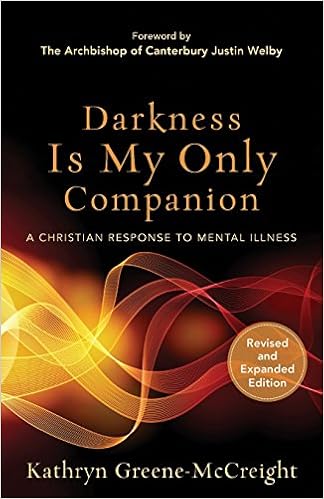
Darkness Is My Only Companion: A Christian Response to Mental Illness

My Rating – If you are looking for something

Level – Moderate read, short book but reads longer, but too much ‘philosophizing’

Summary
The best summary of this book comes from the subtitle – A Christian Response to Mental Illness. However, even that is quite all encompassing enough, the book is part autobiography, part pastoral guidance, and part education on what mental health can actually look like. Greene-McCreight’s insights do not come from counseling or academic study of psychology, but her own struggles and personal mental health issues. Because of this, you’ll get invaluable insights into a first hand account of mental health problems, but not a great deal of help in understanding how to respond or counsel people.

She breaks the book into three sections, first, what she calls ‘facing mental illness’, which is her personal story; second ‘faith and mental illness’, which is still mostly her personal story, but with a focus of how mental illness interacted with roll in the church; third, ‘living with mental illness’ which has two chapters, ‘how clergy, friends, and family can help’, which sadly is only seven pages, and ‘choosing therapy’, in which she discusses the churches fears and rejection of psychotherapy. The book finishes with her conclusion and two appendices, one on her use of scripture and a checklist for symptoms and resources.

The title of the book comes from Pslam 88, where verse 18 in her translation reads –

My friend and my neighbor have put away from me,
and darkness is my only companion.

She says she is using NRSV, but nothing I found online matched (I’ve linked the NIV). It must be an older translation, I do not know if it is closer to the original Hebrew or not, but her translation certainly captures the feeling of depression and despair that one feels while struggling with mental illness.

My Thoughts
I wanted to like this book more than I did. I appreciate and have immense respect for her honesty and candor in this book. I was blown away by her personal story. The book is fairly educational, she goes into different medications (as in the levels and types from a pharmacology standpoint), and discuses her experience with Electroconvulsive Therapy, which you might know as ‘shock’ therapy.

Where the book falls short is anything outside of her. It doesn’t appear she has counseled people with mental illness, and as mentioned above, the outside response is only seven pages. I was somewhat annoyed by one of her chapters regarding faith centered around her ordination and her IQ test, that while her score was well above average, she felt didn’t reflect her due to her struggles with depression. I think this partly comes from the Mainline denomination and their clergy’s obsession with where they were educated. She tells us multi times throughout the book that she attended Yale. I support the requirement that pastors be seminary educated, and I think Evangelicals have gone too far with the, ‘we don’t need no education’ stance, but Mainliners have a tendency to view pastoral education too academically, and her book suffers from this.

Greene-McCreight gives us many great quotes from philosophers and Christian’s from the past, but there is very little in the way of pastoral counseling or response to mental illness from those not suffering. I find the especially odd coming from the Mainline, that doesn’t suffer the same strength of rejection to counseling and psychotherapy that Evangelicals do.

One final note to any Evangelical considering reading this book, don’t be turned away because the author is a ‘liberal Christian’, for the most part she holds to a very conservative view of Scriptures. Maybe not seeing outside of her liberal, academic viewpoint, she opens the book defending her use of the Trinitarian view of ‘Father, Son..’, over and against the feminist view that calls for inclusive language for God. For Evangelicals whom haven’t read much outside of their own viewpoint, this can seem strange. For anyone wanting to pass on this book because you don’t believe in female ordination, relax. This book is about her deep struggle with mental illness and anyone who is interested in what the looks like, who hasn’t experienced themselves, I’m not sure you’ll find a more open and honest book. The book falls flat in a few ways, but if you looking for something to learn from a personal story of mental illness, this book is for you.

Book Review: Work and Our Labor in the Lord

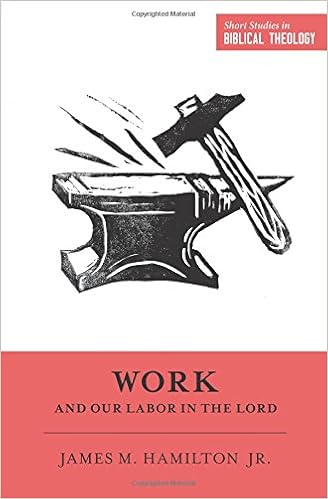
Work and Our Labor in the Lord (Short Studies in Biblical Theology)

Rating – If you are looking for something.

Level – Short, moderate read, feels a little redundant at times

Summary
Hamilton attempts to concisely write a theology of work – why we work, what it means to work, and what it would look like to ‘labor for the Lord’. The book is broken into four main parts: work before the fall, work after the fall, work now after Christ’s coming, and finally, work in the new heavens and new earth.

My Thoughts
I’ll start off by saying I think this is one of the most difficult topics for which Christians can write. Not necessarily because the Bible is unclear on work, it is, and not because I thought Hamilton didn’t handle the theological points well. In fact, I thought he did a masterful job from a Biblical perspective; though there were occasionally odd section that appeared to have political undertones, but I guess that’s to be expected from an evangelical publication (or maybe I just read too much into it, and watch too much politics).

No, the problem is the reader. Especially me – educated, white-collar, upper-middle class reader, who has actual opportunities to think about different careers or finding fulfilling jobs. Due to the reader problem, I think books on work are hammered twice. First, because the reader looking for answers, such as what should I do with my life, do not find any and may come away disappointed. Second, because those are the readers, the authors tend to focus on that demographic. Hamilton avoids some of these trappings, probably due to his focus on theology, but they do show up. I won’t digress any further on that point.

The strength of this book is the first section, work before the fall. In our Biblically illiterate, 140 character limit culture, we miss too much of what the Bible actually says. For most of my life, I believed work was punishment for sin. I was around 30 before I heard someone point out that we worked the garden, it was one of the first commands from God and our original role in this world. So, work isn’t our punishment for sin, but our sin has corrupted out work. Hamilton does a great job of teaching and explaining this Biblical truth.

This point is expanded on in the work after the fall section as well. I especially liked the references to Ecclesiastes; which is always a great reminder of the way we view life in general, but I’m not sure I’ve seen it related specifically to work.

Overall, it is a solid book, but it left me wanting a little more. I’m probably a little too critical of Christian books focused on work, so if that is a topic you are studying you should put this book on your list. If not, you might want to skip. It is short, so that is a positive (why not just knock it out) and a negative (maybe not as in depth as you’d like). The Biblical Theology is strong, so that would be another reason to read it. So, grab this book, if you are looking for something.

*I received a free copy of this book in exchange for an honest review.

2018 Reading Challenge

I sightly exceeded my goal of 25 books last year, by reading 29 books. Now, the prior year, I had a goal of 30, but pretty well passed that, reading 52. I lowered my goal last year as I took some Counseling courses, but as I am not doing that this year, I am raising the goal back to 30. I’d love to set the goal at 48 or 52, to match my 2016, but Sprout doesn’t sleep as much as she used to (bedtime moved back and naps went from 3/4 to zero), so I don’t think that is reasonable, but in the back of my mind, I am kind of hopeful.

So, what am I reading? I have 13 books specifically planned (check out my Goodreads 2018 Shelf for a quick list). I’ll probably tack on another 12 (or less, mostly likely, as I ratchet down the number of review books I request) and then leave myself a little room for randomness in the other five. Of those five, two or three will probably be novels, and at least one will be another counseling book. The 13 I have set out already include:

Devotional – I’ve typically read a whole year devotional, such as My Utmost for His Highest (my review), but this year I’m doing something a little different. I have one, Shalom in Psalms, that goes through, well, the Psalms. This won’t take a whole year, so I have a Lenten one, From the Grave, and an Advent one, The Dawning of Indestructible Joy“, lined up. That should finish out the year, but I may have to find a 30-40 day one in addition and toss it in there. So, kind of sneaky with the numbers, typically the devotional gets me one book, this year it might net me three or four.

Biography/autobiographyA Full Life: Reflections at Ninety was on my list last year, but I didn’t make it to it, so I’ll stick it back on this list.

Non-fictionGödel, Escher, Bach: An Eternal Golden Braid, at 822 pages, this is the second biggest book on my list for this year and one of my top five life goal, big book, non-fiction books to pick up. Unless this takes me all year, I’ll probably have another, shorter, non-fiction in this list.

FictionThe Fall of Hyperion, the sequel to one of my favorite books last year, Hyperion, and the only book I’ve already started reading. At 864 pages, Anna Karenina, will be my biggest book this year and the second longest single volume fiction book I’ve ever read. If that wasn’t enough Russian Literature, I’d also like to work through the two stories (which come packaged in one book, so I’m counting it as one) Notes from the Underground and The Grand Inquisitor. Hopefully, I’ll get to a few more in this category.

Christian-y type books – because two 800 page books won’t take me long enough, I’m also picking up two more 500+ page books. First, I want to get back into finishing Bavnick so I have Reformed Dogmatics, Vol. 3: Sin and Salvation in Christ, on the list with the ridiculous hope that I will actually make it to the even longer (912 pages) Volume Four. Second is what I’ve heard is the best in Christian history – Church History in Plain Language. Outside of the big ones, I had Five Views on Biblical Inerrancy on my list from 2017, but also didn’t get to it, so I’ve move it to this year; Work and Our Labor in the Lord, which is also technically a review book; and finally, Relationships: A Mess Worth Making. This general category will be the biggest, as I fill it out with review books and commentaries.

That is the plan for 2018, a few less books than I think I could probably handle, but a few of them probably to large. Feel free to share your goals in the comments.

2017 Reading Challenge Update

For 2017 I challenged myself to read 24 books, with 19 books called out specifically. I was successful in the number of book, with 29, but didn’t hit many of my specific books. I think this is mostly due to having less time to read, so I didn’t hit the big books (like Capital in the 21st Century) and because I ended up reading mostly review books that were sent to me by Baker Books.

This year I will likely read less review books. Originally, I would request every book they offered, because at first I wouldn’t receive many, if any, of them. Then as I did more and more reviews, they started sending every single one I requested. I had planned to read five or six, and ended up reviewing 12.

I ended up knocking out two of the three novels I had planned, reading Brave New World  (my review) and Hyperion, but not Lolita.

I read all of the required books for school, but haven’t reviewed a single one. I think I also over estimated the amount of time I’d have left to read after finishing schoolwork as well as the impact of a new job that tripled/quadrupled my commute. Throw in Sprout sleeping even less and somehow becoming even more rambunctious, I ended up with far less time than I anticipated. Just in writing this post and reviewing my reading from 2017, I’ve already downgraded my goal for 2018 from 36 to 30 books, realizing that I likely will not have time.

I’ll have that goal up in a post sometime next week. Hopefully, I’ll finish reviewing a few more books from last year and have a rundown on the ESV M’Chenney Reading Bible.

Book Review: My Utmost for His Highest

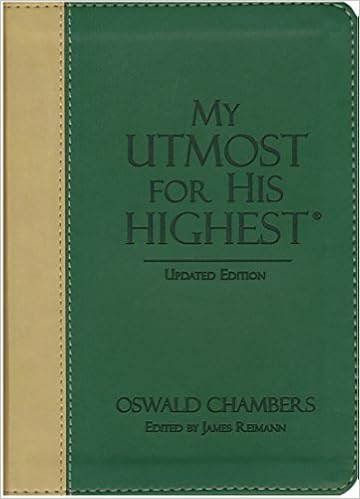
My Utmost for His Highest


My review format is going to be a little different on this one because it is a daily devotional. It is 365 one-page devotions to be read each day of the year. They are all fairly short easy reads, spanning a wide array of topics.

The book was published in 1935 and was based on King James version of the Bible, but there are many options to purchase the devotional with updated language. My edition was edited by James Riemann, who has edited a number of older devotionals. You can find the book in old hardback, or newer paperback for as little as $5 most places, but I purchased the one pictured above, which will cost you about $20, because I’m a sucker for patent leather books.

I’ve read a number of year long daily devotionals, but I think I have to put this as number one. Which makes my more expensive purchase seem like a good choice, as I will probably come back to this every few years or so. As is typical for daily devotionals, you have all or part of one verse, then a brief mini-sermon that can sometimes be something like a commentary on the selected verse or it will be something a little more practical. Often, Chambers has a point he wants to get across, and the selected verse acts more as a proof text. Most of the verses come from the New Testament, and are concentrated mostly around the Gospels.

I think the pastoral nature of this devotional is what makes it so great. His style of writing, and the points he makes or doctrines discussed read less like they are preached from the pulpit and more like they are being spoken from the pastor directly to you.

I’m a big fan of daily devotionals as it is, because they are a great way to focus your mind before you start your day. Most cane be read in less than five minutes. I read them in the morning, even Spurgeon’s Evening by Evening, after I get dressed before I head out to start my day.

The strength of this book is the constant reminder of your need for Christ, what He has done for you, and how that should effect your daily life; what we should do in response to what He has done. That daily reminder of practical Christian living is what makes this devotional a must read.

I like having a book to hold and read, but if you want a digital option, you can actually sign up to receive the content via email from Utmost.org.


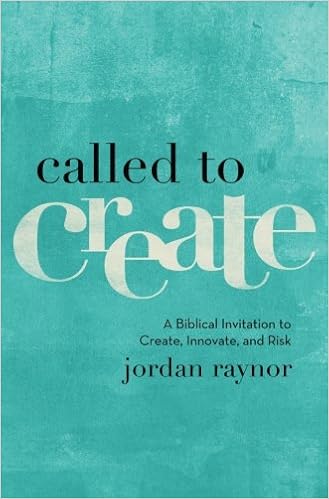
Book Review: Called to Create

Called to Create: A Biblical Invitation to Create, Innovate, and Risk
Rating – If you are looking for something

Level – Easy, moderate length

Summary
The book is basically an argument that all Christian are called to create in come way or another. For the hypothesis to work, Raynor needs to play around with definitions and stretch a little bit to make everyone ‘fit’ the mold. He considering entrepreneurship to be equivalent to creating, and defines it as ‘taking a risk for a general good’. I have a few issues with this definition and his attempt to expand the meaning to cover all forms of creating, but he does make good arguments as to why Christians should work and are called to do so.

The book is broken into four parts – calling, creating, challenges, and charge – of three chapters each with a short intro chapter. At just over 200 pages, it is a ‘medium’ length book but reads pretty well. He gets a little overly repetitive, especially with certain phrases, such as, ‘called to create’.

My Thoughts
I wanted to like this book more, and overall thought it was pretty good, at least at pushing people to work and having a good understanding of the ‘Christian’ view of work, but disagree/dislike two major aspects of this book. First, unfortunately, I think the whole premise of this book, as far as the way to argues his point, is misguided. You do not have to be ‘called’ to create; you can just go create. God doesn’t have to ‘call’ you to start a business, you can just do it. Raynor is obviously a gifted and brilliant entrepreneur, but he doesn’t have to backdoor theology into it.

He somewhat touches on this a bit in his chapter about pastors/missionaries. He pointed out what Luther did during the Reformation as far as saying all work in meaningful and pastors aren’t better other people simply by virtue of their profession. I think this is an issue again in our time, at least among Christians, that people hold up pastors as ‘holier’ or better than other. I actually heard someone ask a lady the other day, what she did to have two of her (three) sons become pastors. The lady said that she didn’t do anything and seemed somewhat surprised by the question, because in the question was the implication that the goal of parent is to raise a pastor or that all other careers are less important. The corollary would mean that she failed with the third son.

Back to the book, while that chapter is great and important for our time, he contradicts the sentiment by writing the rest of the book. I’m sure many people feel ‘called to create’, but maybe some other just like paint, and enjoy it as a hobby. Or maybe some people, as he talks about business owners often, just want to work for themselves.

Related to that, and my second issue with the book – his definition of creating and entrepreneurship. It is very much in the American ethos to see business owners as great and noble, they are the job creators, risk taker, the backbone of our economy; except that almost none of that is true. I’ve never seen a survey of business owners that even listed ‘create’ jobs as a reason to start a business. The number on response to why someone started a business is basically control/lifestyle. People want to be their own bosses. I know that the only reason I’d ever start my own business is so that I wouldn’t have to work 7-5 for someone else. His definition of entrepreneur includes ‘for the general good’ almost no private business are started for this reason. People either thing they can offer a new or better product or want to make a lot of money, if not for the reasons above.

So, I think his whole basis is off, so much so, that he has to circle back and try to inject theology into it. He calls God the ‘first entrepreneur’ to justify everyone else needing to be one. There is no way God meets either part of his definition. God did not create for general good, but for His own glory. Likewise, He did not take a risk – God is all-knowing (omniscient) and all-powerful (omnipotent). By definition, He cannot ‘risk’ anything.

All that said, if you are an entrepreneurial type person, or perhaps a creative person who is thinking of maybe a side hustle or career change, this could be an interesting book. There are cool stories and interviews with people who have started businesses and non-profits. His theology on work is great. Overall, you will get hyped reading this book because the author is such a positive and enthusiastic writer. This is especially true if you are techy or looking into new ways of doing non-profits (in which case, you could look even more in to Charity Water). However, if you are like friends of mine – she writes songs because she likes writing songs, he runs his own business because he wanted to work for himself – I’m just not sure it is the best for you. To me, his entire hypothesis is off-base and ill-defined, however, as I said above, if you are already wanting to start a business and just want some encouragement and are looking for something to read, this is probably a good book for you.

* I received a free copy of this book in exchange for an honest review.

Book Review: Loving My Actual Christmas


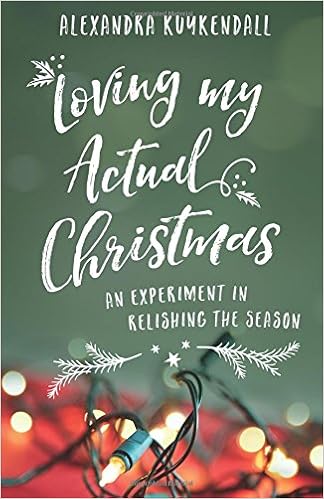
Loving My Actual Christmas: An Experiment in Relishing the Season

My Rating – If you are looking for something

Level – Short, easy book

Summary
I think the best summary of this book comes from the subtitle of the intro chapter – A Recalibrating of the Season. That would be the Christmas and Advent seasons, both the secular and Christian aspects. Her goal in writing this is to help people get past the over commercialized, hectic and stressful parts of the American Christmas season. She advocates doing an Advent devotional/study to help ground you in the Christian aspect.

So much so, that the majority of the book is her going through the four weeks of advent, what she did that week in actual life and what she did as far as reading, studying, and being thankful.

She finishes up the book with a conclusion that is about half as long as the entire book, because there are so many sub parts – scheduling, finances, relationships, and logistics. This is where the book takes a turn from reflection to more practical tips.

My Thoughts
I wasn’t really a fan of this book, not because it is poorly written or has a bad message or anything of that nature. The main issue – I’m quite far from the target audience. She is one of these busy Christian women with four or five kids that is heavily involved with a number of things and is constantly stressed. I’m a father of one, and overall pretty chill guy. I don’t really relate to the pressure and stress of mom bloggers with multiple active kids.

If that is you, then this will probably be a great book to help ground you for the holidays. Another thing I didn’t know when I requested this book, it is a spin off of her other book – Loving My Actual Life: An Experiment in Relishing What’s Right in Front of Me. So, to be fair to the author, had I known about this book, I would have known more about her writing and audience and likely wouldn’t have requested this book. However, judging by the other reviews, had you read that book and enjoyed it, then you will also like this book.

I thought her reflections on the Advent devotional were interesting, and more importantly, it will help introduce some people to the concept of Advent. Most American Evangelical churches do not use a liturgical calendar, which can be very helpful in keeping your mind focused on Christ throughout the year. So if nothing else, if readers decide to start an advent devotion for themselves or a tradition with the whole family from reading this book, then it will have been a great success.

Finally, her concluding thoughts were very practical and useful. If you are the target audience, they are also probably pretty helpful in reminding you not to go to wild and over-schedule yourself too much, both time-wise and financially. Overall, if you fit in this category and are looking for something on the topic of handling the season, this is probably a good book for you.

*I received a free copy of this book in exchange for an honest review.
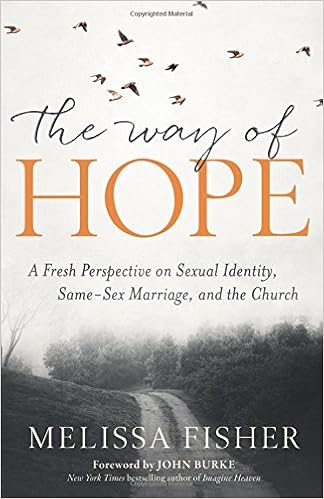
Book Review: The Way of Hope

The Way of Hope: A Fresh Perspective on Sexual Identity, Same-Sex Marriage, and the Church

My Rating – Must Read

Level – quick, easy read; short

Summary
The book is broken into 10 chapters, each more or less representing different phases in Fisher’s life story. Mostly written as an autobiography of her life and journey from fundamentalist church, through homosexual relationships and considering a sex change operation, back to church and struggling to understand it all. Woven throughout the book are suggestions on our response as a church to same-sex marriage and identity issues, based on things she has seen go right and go wrong.

Outside of the 10 chapters that are the core of the book, there is the typical intro and then, at the end (obviously), there is an epilogue that consist of three brief interviews with her mom, her dad, and her ex-wife that are really just incredible. She ask her mom when she suspected she was gay, talks to her dad about her parent’s divorce, and discusses the pain of her own infidelities with her ex-wife.

My Thoughts
Probably the only critical thing I have to say about this book is that the subtitle is wrong. For me, there was nothing in this book that offered a ‘fresh perspective’ on any of her topics. However, her more intended audience might be more of the fundamentalist, don’t discuss sexuality type people she describes in her book that made up her church, family, and small town.

Other than that, the book is great. Her writing style is fantastic – fasted-paced and kind of erratic, funny, and very open and honest. While she does quote quite a bit of scripture and state clearly that homosexual activity is wrong, that isn’t really the point of the book. She isn’t trying to convince anyone to change or offering a theological and biblical defense of the viewpoint from scripture. With the book being mostly about her mixed with her personal writing style, you, instead, feel like to get to know her.

Even more importantly, you get to understand where she is coming from, and, to the extent you can, what she went through. I think this is really the strength of the book. Proximity to issues changes your view, or at least your reaction to them. Extremely conservative Christians in rural areas or small towns, might not have many opportunities to engage with gay people. So, it is easier to ostracize, from a distance. The way she writes this book, someone could read it and start to feel that proximity. Someone could put a face on an issue and at least try to understand.

It is easy to just say, being gay is wrong, and you should chose that. Reading her story (or hearing someone else’s), you see it isn’t that simple. I hope that more people that have that view will read it and see the struggle that gay Christians have. That instead of judging and condemning, we need to love them and help (if we can) them in their struggle.

Finally, those last three interviews at the end were just crazy to me. Obviously, her mom was one of the those people who would rather cut off contact with a gay daughter, but they have since reconciled. Her ex-wife has also made it back into a church, one connected with the one fisher attends. The interviews alone make this book worth the price, add in the personal tone of her spiritual and emotional journey and changes and this is definitely a must read book.

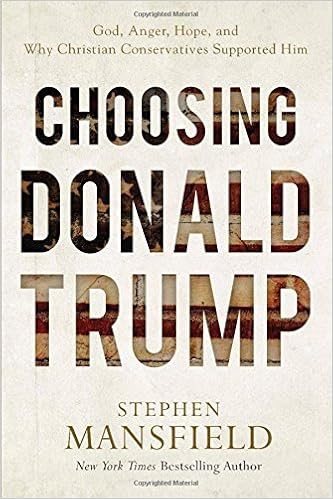
Book Review: Choosing Donald Trump

Choosing Donald Trump: God, Anger, Hope, and Why Christian Conservatives Supported Him

My Rating – Must read

Level – Quick and easy, short book

Summary
The subtitle of the the book pretty much sums up what it is about. Conservative Christians were angry and put there hope a man Mansfield calls ‘an unlikely champion’. If fact that is the first section of the four sections of the book.

This first section has two short chapters about the (then) current political situation and how Trump fit into it. The second section, called ‘the backstory’, is basically a 65 page biography of Trump. The third section, ‘the appeal’, get to why Christians would even be interested in someone like Trump. This is probably the most informative section, with chapters on the Johnson Amendment, Obama, Hilary Clinton, and voters who felt like the found a political voice only in him. The final section, ‘Prophets and Presidents’, where Mansfield dives into the interaction of prophets with kings in the Old Testament and then contrast that with the pastors around Trump today.

The book also includes a short intro and epilogue and an interesting ‘Trump in his own words’ section which is a collection of a few of Trump’s speeches about religion.

My Thoughts
I wasn’t sure what his book was going to be when I saw it on the list from Baker*. I don’t know who Mansfield is or whether he is a supporter or not, and I thought the book might be a bit apologetic for Evangelicals. Instead, it really is just a straight look at the situation. He doesn’t try to paint Trump as the terrible person, nor does he try to portray him in this great light that would explain why Evangelicals could vote for him.

One of the more interesting aspects of the book was the detailing of Trump’s admiration of Evangelicals, or at least preachers. He is somewhat famous now for staying up late and watching cable news, but apparently 20 years ago he stayed up late watching TV preachers. He seems infatuated with their charisma and influence on people. You get the impression that his outreach to Evangelicals maybe wasn’t just a political move, but him actually trying to ‘do good’ so to speak. It was almost like his pushes for ‘religious liberty’ and repeal of the Johnson Amendment are his good works, his attempt to earn some salvation. Honestly, I felt like had Trump met a different strain of American Christianity first, he could just as easily gone a completely different way.

That is actually a really disappointing idea, as this particular charismatic/Pentecostal/fundamentalist strain doesn’t necessarily line up with what he personally believes, but they are on the TV the most, so he sought them. He asked them what he needed to do, and they laid out, at least, the religious wing of his agenda. I really believe that had it been the liberal side, he’d be pushing refugee resettlement and environmentalism, or the reformed side, maybe sex-trafficking and racial reconciliation. He might not have even run as a republican. Anyway, for now that is just an interesting exercise in alternative history.

The biographical part of the book was fascinating. Mansfield did a great job distilling 70 years of this man’s life into just why/how he reacted to the religious vote the way he did and how he doesn’t really fit. The early chapter about Trump’s speech at Liberty University and his commentary on that are great insights.

Finally, I enjoyed the last part of the book where he delves into the famous pastors who supported Trump, their hypocrisy as it came to his morality versus their previous statements about Bill Clinton, and then how the tripped all over themselves to either excuse his behavior or explain why it didn’t matter. There was an interesting survey of all the Old Testament and historical figures different pastors have compare with Trump.

If you are a huge Trump supporter and think he was chosen by God to be the perfect leader of the United States, this book may not be for you; unless you want to be challenged in your thinking. However, if you are opposed to Trump, or politically left, or maybe not opposed but just confused, like me, as to how he garnered so much Evangelical support, this book is a must read.

*I received a free copy of this book in exchange for an honest review.

Book Review: Fahrenheit 451

Fahrenheit 451

You don’t have to burn books to destroy a culture. Just get people to stop reading them.
My Rating: Put it on your list
Level: Quick and easy read, fairly short.
Summary
Away in the dark near future, there is a still a profession called ‘fireman’, but they don’t save houses from burning (houses are fireproof now), but now they start fires. Not for houses, but for books. The book follows the story of one of these firemen as he starts to question why they are doing what they do, and instead starts saving and hiding books. After he is found out, he becomes the victim of the system he used to be a part of.
My Thoughts
This is a classic of dystopian fiction. The scary thing is, though some elements are over the top, much is too accurate. Bradburry rightly predicts (originally published in 1951) that books won’t be banned by the government or people in the majority for challenging the status quo, but instead, books will be questioned or banned for offending some group or another. We see this happening today, especially with elements of history that people do not like. He also predicted the heavy use of what are basically headphones. I went for a walk this morning and noticed every one of the dozen or so people I saw had headphones in.
As a big book-reader and someone who isn’t paranoid about the government, I see Bradburry’s vision as much more accurate than something like 1984. He was even wrong that the government would actively burn books by the will/request of the people. We don’t have to worry about that now, people just stopped reading them. Hell, people buy digital books, so you can’t even burn them anyway. But it doesn’t matter, in the most recent Pew study (2014) 23% of people hadn’t read a book in the past year. That’s up from 8% in 1978, the first year they asked. The median number of books read a year by American adults is 4. We don’t need to burn book, and the government doesn’t need to ban them. We are doing this to ourselves. We have 100 of channel showing pointless shit on TV and endless ways to stalk people we don’t even like on facebook and twitter, who needs books?
Maybe his most accurate portrayal was related to this. One of the characters in the book, whom the police watch due to being ‘peculiar’, lives in the only house that doesn’t glow blue at night. The family has their lights on and can be seen through the window sitting around talking, everyone else has their lights off and is watching TV, so that only a low, flickering blue color can be seen from the street. Where he is wrong is that no one thinks it odd now, but most people likely never think about it. I know I never did, but now if I walk around at night, I notice all the windows from the back of the houses and some of the bedrooms are dark and flickering blue. It becomes kind of eerie if you look or think about it too much.
 Anyway, over all, the book is a bit over-dramatic at times, well not being dramatic enough in others, due to un-imagined technological change. The concepts are great and the portrayal of why life could be like in this dystopian future is frighteningly accurate at times. I as I said above, it is a classic in the genre, and a book to put on your reading list.