Book Review: How Would Jesus Vote?

I’m excited to post my first advanced review of a book. The book goes on sale May 17th, so check out my review and then go buy it (from the link below). It is a must read for anyone interested in current political issues.

How Would Jesus Vote?: Do Your Political Views Really Align With The Bible? by Darrell L. Bock

My Rating – Must Read

Level – Fairly Easy, moderate in length

Summary
The book seeks to look at broad topics in American politics and see what we can determine about them from the Bible. Bock does this mostly by listing verses and how they can apply. Along with an intro and concluding chapter, he writes 13 chapters:

  1. Principals that built America – interesting chapter on the point of religious freedom as the founders saw it.
  2. Loving your neighbor – obviously a major point for Jesus, not only was it the second greatest commandment, but gave us the famous story of the Good Samaritan. Bock points to this idea as our starting point for looking at issues the way Jesus would.
  3. Big or Small Government – brief overview of the pros and cons of each. The best take away is more his point that we needed to realize we can’t have everything and need thoughtfully seek a balance.
  4. Economics of Poverty – he continues the balance idea from the previous chapter and extends it to balancing helping the poor and personal responsibility.
  5. Health Care – this is a tough topic, as there is nothing in the Bible about healthcare. He does a great job pointing out the massive failures of our current system, but doesn’t really say much as to how Jesus or we should vote about it.
  6. Immigration – you really forget how much about immigration there is in the Bible, especially the OT. This seems to be an ancient problem that has affected most societies. Due to this, he takes a stronger stance in this chapter as to which way we should vote and consider this issue.
  7. Gun Control – similar to the health care discussion, there isn’t much in the Bible about guns, as, you know, they didn’t exist yet. He summarizes the horrible impact of our gun violence, but isn’t willing to go as far as saying we should vote to curtail it.
  8. Foreign Policy and Globalization – this chapter explores National Interest or Common Good, the latter being international good. Not much from the Bible here either, but interesting overall and a good general analysis of how the issue impacts America.
  9. War and Peace – looked at the ideas of ‘Just’ War or Pacifism, tracing the concept of a ‘Just’ War (as in justified) to Augustine and the idea of Pacifism to the Bible. Not many policy implications outside of war as a means of last resort, and some questions regarding whether preemptive war counts as justified.
  10. Race – great chapter to take on this issue. Walks a nice line between looking at race and realizing there are real differences and problems as well as clear historical issues, all while reminding us to look past race in the sense that all are created in God’s image as well as tying everything back to ‘loving your neighbor’. He also calls on Christians to care about these issues and to acknowledge there is an issue.
  11. Education – obviously an important topic that is not discussed as much as it should be in our society, but again it felt more like some of the other chapters where he points out how poorly we are doing without really taking up one policy or another.
  12. The Family – one of the stronger chapters as far as policy goes, there are two aspects focused on in this chapter. One is the problem of single parent households and the other is gay marriage. He points to the damage and disadvantages of growing up in a single parent household and focuses on how Christians should seek to strengthen families. He views gay marriage as unbiblical with clear scriptural proofs, but then seems to tie it to the family issue, without discussing the fact that a child could be brought up in a two parent household this way.
  13. Abortion – pretty clear here. He never points to an exact time in which life begins, admitting that we really don’t know. However, it is certainly sooner than 12 weeks. Most Christians will not find anything new in this chapter, but it is a compelling reminder of the issue, nonetheless.

My Thoughts
My only disappointment in this book is he never really states how he thinks Jesus would vote. He usually has a heading at the end of each chapter that asks what would Jesus have to say but never goes as far as picking a side on many of the issues or even alluding to which party may be better than the other on a particular topic. That likely has to do more with the title the editors gave the book than what Bock intended to do.

This is a very important book for people curious as to how their faith should interact with politics, especially in our current political climate where each side, at different times, claims Christ and disparages the other party as the unbelievers. People should take the time to read through the issues and really think about the verses listed.

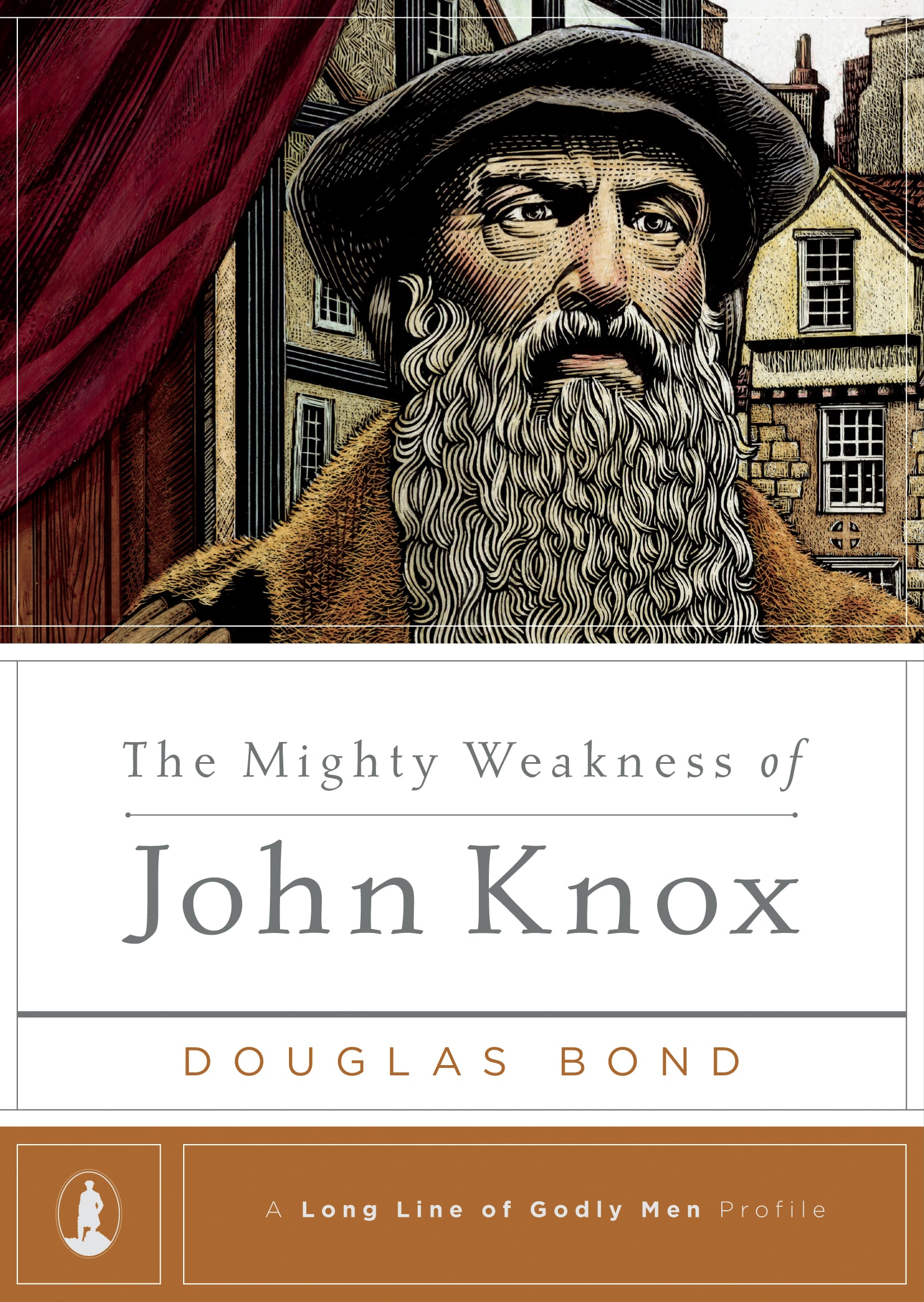
Book Review: The Mighty Weakness of John Knox

I’m very excited to post my first review as part Reformation’s Trust Publishing (the publishing arm for Ligonier Ministries) blogger program. I received this book for free in exchange for posting a review. I look forward to reviewing more from RT, especially in the Long Line of Godly Men Profile series.

The Mighty Weakness of John Knox – Douglas Bond

My Rating – If You are Looking for Something

 Level – Short, easy

Summary
It’s difficult to write a summary of a biography. The book itself is a biography of the life of John Knox. To hit some high points: Knox was friends with John Calvin in Geneva, preached to an English speaking church in Frankfurt, help occupy a castle and endured a siege, was on a slave galley (rowing for a ship) for 18 months, preached before kings and queens, and helped write the Scots Confession.

Bond’s central theme for this short biography is contrasting Knox’s physical weakness with his spiritual might. Apparently, Knox was small and frail and suffered lasting injuries from his time in the galley. When first asked to preach/teach during the castle siege, he ran away crying. However, once he gave in to God’s call, he preached like a trumpet blast and produced many writings as well.

The end of the book also contains the Scots Confession, which is a short (25 articles) confession that is well worth reading.

My Thoughts
This is my first encounter with the ‘Long Line of Godly Men Profiles’ series and will likely not be my last. I knew basically nothing about Knox, other than he was Scottish and was responsible for the Presbyterian Church. His life was interesting enough, and the author wrote well with a clear passion for Knox.

However, one thing I did not like was how often it seemed that Bond was being defensive of Knox. Maybe it is because knew very little of him, but Bond was constantly raising criticisms and then almost too briefly dismissing them. Maybe the legacy of Knox is questioned or viewed negatively, I couldn’t say, but this aspect gave the book an apologetic tone.

Overall, if you are looking for a biography on someone from the Reformation, this is a good start. John Knox led a very interesting life; but if you already know a decent amount about him, there are probably better biographies. This book has piqued my interest in him enough to search out a more in-depth biography.

Dover Thrift Editions

This isn’t quite a series or book review, but if you haven’t been looking for the Dover Thrift Editions when you are buying books, you need to start. These are pretty much all classics of Literature at about as cheap as you can get.

I’ve bought these editions for as low as $1, and box sets at $8. For the most part, Kindle and other ebooks can’t even compete with the prices. If you have Prime you have free shipping already, but if not or you pruchase from somewhere else, you can load up on seven to eight books for super cheap and have then mailed for free.

If you like classics or have any interest in reading them, I highly recommend doing it with these editions. I buy all the classics I read this way. Though, maybe they are not always the best translations. If you are reading Tolstoy or someone else who’s book translations are disputed, do a little research first, it may not always be best.

I’m not getting paid, nor is this whatever the hell those fake post are called, to write this. I just like books and happen to have Prime. I’m also trying to hit a lot of the classics I missed in school or are just now hearing of. That being said, remember I do have an amazon store, so if you want to go browse it, you can click on Dover Thrift Editions to see what all they have to offer.


Updated Reading Challenge

My 2016 Reading Challenge

Through a quarter of the year, I’m on pace to reach my goal. So far, I’ve read 11 books, which would put me on track to read about 44 this year, easily meeting my challenge of 31. I doubt I’ll actually keep this pace, but it’s a nice thought. I’m geeking out a bit with the Goodreads tracking function, because it allows you to order the books by page numbers (as in below, with the exception of Tyndale) and also tells you the number of pages you’ve read (0f books you’ve finished). I’m at 2,163 in case anyone was interested. Actually, it looks like they are only counting eight books in that number, not sure why.

Books so far:

  1. A Walk in the Woods: Rediscovering America on the Appalachian Trail
  2. Pirate Latitudes
  3. Spiritual Disciplines for the Christian Life
  4. A History of the World in 6 Glasses
  5. Four Views on the Historical Adam
  6. The Church: The Gospel Made Visible
  7. How to Read Genesis (How to Read Series How to Read)
  8. Just Do Something: A Liberating Approach to Finding God’s Will
  9. Do More Better: A Practical Guide to Productivity
  10. Meditations (Dover Thrift Editions)
  11. 1 Peter (Tyndale New Testament Commentaries)


I’m currently reading Bavinck, Crime and Punishment, Thinking Fast and Slow, The American President, and The Last Girl, as well as Morning by Morning.

A few more on my list (whether I get to them this year or not):

  • Novels – Hitchhikers Guide to the Galaxy, Hyperion, Girl on the Train, and probably some free kindle stuff.
  • Christiany books – Don’t Waste Your Life, Disciplines of a Godly Man, Radically Normal, Lost World of Genesis 1
  • Bible Study – pretty much all the Minor Prophets, using the New American, Tyndale and Word Biblical Commentaries.
  • Non-fiction – Misbehaving, Jimmy Carter’s Reflections at 90, Sapiens

Book Review: Pirate Latitudes

Pirate Latitudes by Michael Crichton

My Rating –If You are Looking for Something

Level – Easy & quick, medium length

Summary

It’s about pirates. If you are like me, what more do you need? Actually, it’s technically not about pirates, it’s about privateers and they are very particular to make it clear that they are not pirates. Anyway, if follows an English privateer in Port Royal (like, from Pirates of the Caribbean) who has a chance to attack a Spanish fort, that is considered impenetrable, to get to a Spanish Galleon that he hopes is carrying lots of gold.

He assembles his core team, which is of course a color, ragtag bunch, as well as a few dozen other unnamed crew members and sets sail. With storms, other ships, and of course, a kraken, the mission takes on almost an “Odyssey” feel. There are number of interesting twist and turns as the adventure takes much longer than expected. Read it and decide if it has a happy ending or not.

My Thoughts

I’m a fan of anything pirates or Michael Crichton, so I wasn’t disappointed. The book is a little long, and meanders a bit at the end, before finally concluding. I’m also a big fan of the ‘round-up.’ The part where the protagonist sets off to assemble is crew. Crichton does a great and entertaining job of this, early on in the book. If anyone cares, I’ve read that this book is incredibly accurate in regards to maritime history, but, obviously, I can’t confirm that.

There are parts that are predictable and cliché, and an anti-climactic dual that was disappointing, but overall, if you are heading to the beach and want a fun book to read, this is a great option.

Commentaries on 1 Peter

That would be ‘first’ Peter, not ‘one’, for those unfamiliar with the Bible.

So, I’m not going to review 1 Peter here, at least not in the usual book review sense. I may put a few notes out there later, but for now I want to leave a few thoughts on the commentaries I used.

First and foremost, you should be using a commentary.

We just wrapped up our study on 1 Peter this morning. It has been a great eight week study that had us deep in the text and introduced me to a few guys at our new church. I used a few different commentaries in my study – Tyndale was my main one, which I read word for word. I consulted Baker Exegetical New International,  as well as a little bit in the New Bible and the abridged Expositors.

I was surprised to find how readable Baker’s was. I have to say it was probably my first choice overall, the one I found the most insightful. I would definitely recommend Baker’s if you are going for a highly technical one.

Tyndale’s commentary was, as usual, highly readable and approachable, but 1 Peter was written by Wayne Grudem, so it is certainly technical enough. As he has written one of the most of the most popular and readable systematics, it’s not surprise this one pack so much in. If you are watching your budget, take Tyndale over Bakers, but if you can, do both.

I don’t think one is enough (ever really), but especially when you some tricky topics, such as Jesus proclaiming to the spirits in prison.  Baker’s Jobe as posits a somewhat different view of the audience than you’ll likely read in other commentaries. I found it very compelling and would say it’s very much worth the read. The New Bible Commentary entry was a bit short, but I will probably find that more and more as I use other, larger commentaries. Probably still a worthwhile read as an into to a book.

The abridged Expositor’s I found somewhat lacking. I’ll admit I didn’t jump into the unabridged, so, I may be more a byproduct of the editing than of the overall content itself. And of course, I used one of my study Bibles, in this instance, it was the Reformation one and it was also great as an overview.

It was overall a great study, sad to see it over. However, Mrs. MMT and I are now jumping into the first 11 chapters of Genesis. Her and I have never done a study, just us two, so I’m excited and interested to see how that works out. As always, I’ll have thoughts on the commentaries used and hopefully a few mediocre study notes posted.

If you are interested, you can buy the commentaries I mentioned:

1 Peter (Tyndale New Testament Commentaries)
1 Peter (Baker Exegetical Commentary on the New Testament)
The First Epistle of Peter (The New International Commentary on the New Testament)
Hebrews – Revelation (The Expositor’s Bible Commentary)

Book Review: Confessions

Confessions– St. Augustine

 My Rating – If You Have Time

 Level – Moderate, seems longer than it is.

Summary
Basically his autobiography for the first nine chapters, then a chapter on memory, and wraps up his last three chapters in discussing the first chapters in Genesis. His life story is interesting enough, his mother was a Christian and that influenced him. He went off to school and talks about his shenanigans with his boys.

Later on he joins up with the Manicheans but, after the death of a friend, becomes disillusioned with them. Eventually he hears Ambrose preach and after discussion with friends and reading Romans in a garden, he converts and is baptized.

 My Thoughts
My confession: I didn’t really like this book. It’s considered a seminal work in Christian Literature, but I just never got into it. Maybe because of the translation (Penguin Classic), but I didn’t like the writing. It was one of those, say in 20 words what you could say in five type writing styles.

His time at school was probably the most interesting to me. His pondering as to why he would steal pears when he had his own, probably better ones. It certainly should make most people question these things in general, and resonates with males who engaged in general jackassary as adolescents in particular. The thoughts on memory are interesting in a philosophical way, and his chapters on Genesis are worth reading for his style of exegesis.

Overall, I just wasn’t a fan. I hesitated to rank as I have, instead of lower, at the same time, feeling I should rank it higher, due to its place in history. So, I guess, if you have time, check it out and see for yourself.

Book Review: Atlantis Trilogy

The Origin Mystery (3 Book Series) by A.G. Riddle 

My Rating –  Must Read for Sci-Fi or historical fictions fans. Put It On The List for everyone else.

Level – Fairly easy and medium length, reads quickly.

Summary
So, this is actually three books, but you knew that, because… ‘Trilogy’: The Atlantis Gene, The Atlantis Plague and The Atlantis World . I’m not really sure how to summarize this. Starts out with some spies, then a bunch of attacks across the world, then you get everything for the rest of the series – global plaques, ancient history, Nazis, aliens, cool Tibetan Monks, long (very long) running timelines and conspiracies. Just go buy it.

My Thoughts
I actually found the first book on the Kindle Owner’s Lending Library on one of the rare cases that it worked. I ended up reading the rest of the series through it as well. I found myself driving home after work thinking about the story and wondering what would happen next, looking forward to getting home and reading for an hour or so before Mrs. MMT and Sprout got home.

The story kind of bounces around different categories, as mentioned above, but I suspect, that overall if you don’t like some nerdy things, you may not like it. If you have any interest at all, the book will be great. I have to admit, towards the end of the third book, it winds down as if he (the author) isn’t sure how to ended, and it was just kind of done. You begin to see the ending coming anyway, so I don’t think it detracts too much, but it does end with a fizzle.

Still, go buy all three in paperback and knock them out at the beach or lake over the summer.

Zondervan Counterpoint Series

I’ve posted many articles about reading recently and wanted to highlight a series here. I first came across these a few years ago and was instantly intrigued. I thought it was a great way to show differing views with the spectrum of Evangelical Christianity. After reading a few, I’ve put them on my list of must haves for anyone interested in gaining a deeper understanding of a topic.

The book starts with a topic (Adam, Hell, Women in Ministry, etc.), and then has three to five people make their case for their particular view. The authors are usually scholars who have written many books or commentaries on the subject. However, the generally do well writing to a broad lay audience. After each makes their proposal, the others make short critical responses. The original author then has a chance to briefly respond to the criticisms.

I really can’t imagine a way for Christians to get such an in-depth, but (fairly) short and simply written scholarly discourse. Every Christian who has an interest or struggle in belief in a certain issue should start with the Counterpoint series.

If you are interested in buying, you can find them quickly through my amazon store.

Book Review: Do More, Better

Do More Better: A Practical Guide to Productivity by Tim Challies

Rating – Add it to your list (for most); probably not worth the time (for people already well organized)

Level – Readable, short, step-by-step approach

Summary – It is really difficult to write a summary that doesn’t just rip off the table of contents. Basically, he explains the system that works for him. This includes a mission statement (he calls this a productivity catechism), then finding things that get in the way of your productivity and finally the tools to tackle the problems.

I want to focus on the tools here, because in the month or so that I’ve read this book, I’ve tried to adopt them all. The first tool is a basic task manager. He recommends Todoist, and I’ve jumped on the bandwagon. It’s very intuitive and I use it multiple times a day. The price of the book may be worth this chapter alone. Second tool is a calendar; he recommends Google, it’s nice enough. I use a calendar for everything at work, but never tried to apply that idea elsewhere.  It’s been most helpful in keeping me aware of when I have time to do things and when I don’t; which, in turn, helps my task management.

The final tool, I still haven’t gotten a hold on. He calls it something to gather your information and recommends Evernote. I really like the web clipper extension, but haven’t found much else that is helpful, yet.

He wraps it up by reminding us that for the system to work, you must live on the system and you must maintain it consistently.

Review – I particularly like the lazy-busy excuse/productivity thieve; it hit close to home. There are many things I’d like to do (though I sometimes put it on God) and I wish I was more productive. After adopting the first two of his recommended tools, I’ve already noticed a difference. It sounds like a cheesy add, but not only am I getting more done, but I have more time. This book could be very helpful to anyone who needs a productivity boost.