I am really happy about our first author interview. Mrs. MMT did a great job interviewing Elyse Fitzpatrick and Eric Schumacher about their new book Jesus and Gender, out now and available anywhere. I think it is an important book right now in the ‘gender wars’, calling everyone involved back to humility and Christ-likeness. It is also our first video cast, so I hope you enjoy. As always, comment below.
Author: J.K.
Modern Cloister – Interview with Elyse Fitzpatrick and Eric Schumacher
Interview with Elyse Fitzpatrick and Eric Schumacher–Modern Cloister
In this episode, we sit down with Elyse Fitzpatrick and Eric Schumacher, co-authors of the new book Jesus and Gender: Living as Sisters and Brothers in Christ (released April 2022) to discuss their new book and the state of gender discussions in the church. ** About the book Much teaching on gender relations, roles, and rules binds the conscience beyond what Scripture actually teaches. Gender has become a battleground for power. But God created men and women not to compete for glory but to cooperate for his glory. In Jesus and Gender, Elyse and Eric paint a new vision for gender―Christ’s gentle and lowly heart. Drawing from Scripture and experience, Elyse and Eric show how Jesus’s example speaks to all areas of our lives as men and women, including vocation, marriage, parenting, friendships, and relating to each other as sisters and brothers in Christ. Real-life testimonies from a variety of Christians―including Christine Caine, Justin Holcomb, Karen Swallow Prior, and others―show a variety of men and women freed to pursue their gifts for God’s glory. Learn more about Jesus and Gender. About the authors Elyse Fitzpatrick is a nationally sought-after speaker and author. She holds a certificate in biblical counseling and has an MA in biblical counseling from Trinity Theological Seminary. She has authored 23 books and lives in California with her husband, Phil. Learn more about her at elysefitzpatrick.com. Eric Schumacher is a pastor, songwriter, and author. He earned an MDiv in Biblical and Theological Studies from The Southern Baptist Theological Seminary. Eric and his wife, Jenny, have five children and live in Iowa. Learn more about him at emschumacher.com.
Playlist: Modern Cloister
Select an episode to play it in the audio player.
Modern Cloister: Mars Hill Reaction Pod

This has been a long time coming, but something we wanted to share. Most people have probably listened to the Rise and Fall of Mars Hill podcast at this point, if you haven’t, go do it now. The pod mini-series is a broad work that isn’t just about Mars Hill, but uses events/people/mindsets there to discuss ongoing issues in the Evangelical work more broadly. We, unfortunately (like most people), have had issues with church leadership, not dissimilar than Mars Hill. We discuss a little of our story, as well as where we agree/disagree with some of the assessment/conclusions and hopefully offer some useful takeaways. Hope you enjoy the podcast and the episode below, feedback and comments are always welcome. Listen below, find us on YouTube and wherever podcasts are found, or listen on our home page at Modern Cloister.
Modern Cloister Anniversary

Modern Cloister podcast has turned one this past weekend. You can listen to our review of what we’ve taken a away from a year of podcasting, and our plans for the future. We will be back on an every other Sunday schedule for a while. Next up is a Mars Hill reaction pod, then a six part series on the five solas. Plenty of other ideas in the works, if life will let us get to them.
For MMT, I will hopefully be back in with book reviews soon, along with a few other post topic. I’ve started a new job in my real life, and that is taking quite a bit of bandwidth.
Hope you enjoy the podcast and the episode below, feedback and comments are always welcome. Listen below, find us on YouTube and wherever podcasts are found, or listen on our home page at Modern Cloister.
Modern Cloister: Commentaries
This week on the Modern Cloister, we discussed commentaries – what they are, why you should use them, and a few recommendations to get started. I wrote a little about the topic years ago, so not the best, but the outline is good. You can listen to the episode below, or find it on our YouTube page. Hope you enjoy it, as always, let me know any we left out or what you like to use.
Modern Cloister: Study Bibles
We are continuing our Study the Bible Series over at the Modern Cloister. Catch up by listening to our first episode on Translations, and check back in next week when we discuss commentaries. You can find my post on Study Bibles here. Let me know which Study Bibles you use or any that I left out.
On Study Bibles
Almost six year ago, I wrote a post called, Why You Need A Study Bible, which was much shorter than anything I write now, but the point still stands. I think that having a study Bible (or two) is crucial for someone wanting to take the next step in Bible reading. Simply put, the Bible can be difficult to understand. Not the basics – our sinfulness, the death & resurrection of Christ, and God’s redemptive plan for humanity – those are clear. However, the Bible was written thousands of years ago across more than thousand years of time, to different cultures in different languages. So, in wanting to get a better understanding of some of the intricacies of the writings, there is probably no better first step than reading the Bible with good study notes.
Study Bibles are technically nothing new, arguably the Geneva Bible, published in 1560, was the first of what we’d consider a study Bible. Of course, most people couldn’t read or afford any books, so they really didn’t take off in the post WW2 era. A plain ‘reader’ or ‘thinline’ Bible is going to be about 1,000 pages and have nothing else other than a few translation notes. Study Bibles will range from 1,500 to almost 3,000 pages and will include cross references, intros to books (or categories – wisdom, gospels, etc. – or testaments), maps, photos, reconstruction/drawings, articles, reading plans, and, of course, study notes.
The biggest impact to the size/depth is going to be those notes, which can range from a few sentences at the bottom of the page that might only cover a section or chapter to verse by verse exposition that can take up more than half the page. Similarly, book intros can be a paragraph or two to multiple pages, and the range for articles seems to be about 20 to 100, with length varying wildly depending on the study.
I just pulled up ChristianBook.com, went to Bibles, then to the Study Bibles category. It says they have 2,053 for sale. Now, this doesn’t actually mean there are over two thousand study Bibles, there is certainly an amount of duplication, due to ‘studies’ being offered in different translations (if you haven’t thought much about the different translations or have questions/want recommendations, read my post on it here or listen to the Pod for more information), different bindings (hardcover, fake/real leather, etc.), and font sizes (compact, ‘comfort’ – which is just standard, large, and for Nana – giant). Also, some listed as such are not really true study Bibles, more on that below. All told, I would venture a guess of over 100 individual study Bibles, I can think of about 30-40, and I own about a dozen (with hopes of only buying two or three more). So, let’s jump in to some broad categories in which the studies can be grouped, pros/cons, and some recommendations.
Topical – Archeology/Bible Backgrounds, Apologetics, Complete Jewish
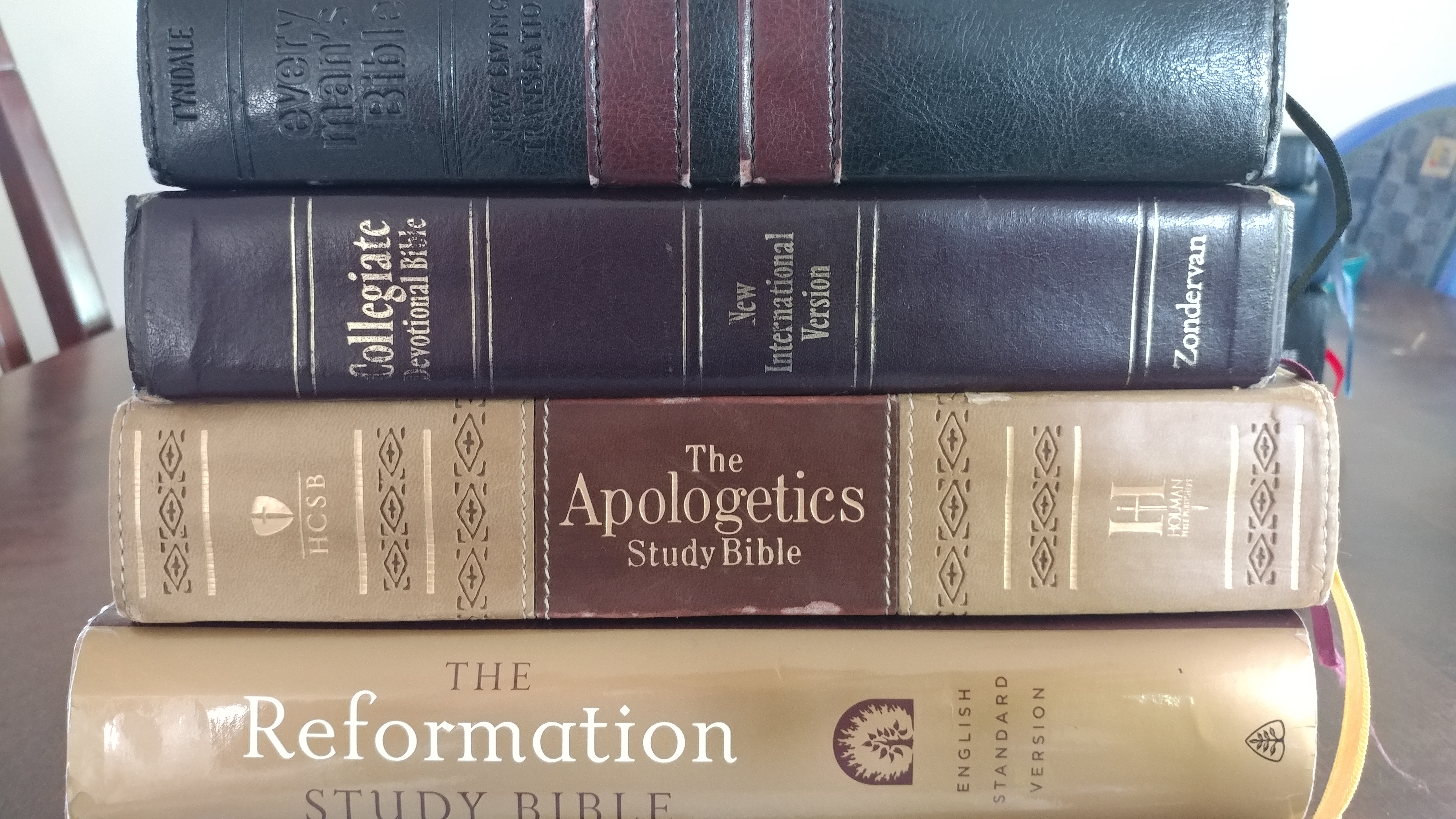
This is an interesting category, as it is obviously varied, and is probably the smallest. That is my Apologetics Bible in the picture. This was the first (well, co-first) study Bible I bought for myself when I first started trying to read/understand the Bible better and started look into translations. The pros and cons for these types of studies are the same – they are narrowly focused. Almost all the articles and the majority of the focus of the study notes are going to be on the topic.
For that reason, I wouldn’t recommend this as your first/only study Bible. It is better to have a broader understanding. The exception would be if a particular topic just really excites you/someone you know and you use it to jump into deeper study. Finally, these types are typically going to be more scholarly, which can put them on the larger size (usually around the 2,000 mark, give or take a few hundred).
Life Stage – Mens/Womens, Teens/College, etc.
This category rightly gets a great deal of criticism, especially for become so narrow and niche, that it can be hard to get past what seems like a simple marketing ploy. I think that can be fair, one answer as to why publishers fire out new study Bibles every year is simply – because people buy them. However, I wouldn’t throw out the whole group, though maybe offer one caution, that if it has more than one modifier, it is probably too narrow/over marketed and may not be beneficial. I’d also recommend doing your research, as some aren’t actually study Bibles (more on that below).
That said, some mens/womens Bibles can really function as a great starter Bible. The ‘Every Man’ in the picture is the other study Bible I bought when I first started studying the Bible. I’m not entirely sure why I bought this one, it might have been because it was NLT, and I was looking for one of those. Some of the articles are about being a man/husband/brother/father, but there are others as well. The intros are about a page each (and include estimated time to read the book), and the study notes are good section by section (or chapter by chapter) information with a pastoral feel. There are similar books for women. If all the articles/notes are about being a man/women, I’d put it in the topical section above and would likely recommend against it.
A quick note on the teen/college, these are almost always reformatted (usually shortened/simplified) versions of general study Bibles (see next section for more info), usually with a different set of articles or verse call out that will focus on the life stage. Ignoring for a moment that too many of the articles/write-ups are going to be about sex/dating, I’d highly recommend these, especially the teen versions. In full transparency, Mrs. MMT and I both had the Teen Life Application Study Bible, which I’m fairly certain I never read. Just like I’m fairly certain I never used my Collegiate Devotional, pictured above. For college age, I’d recommend just a more general mens/womens, if the person doesn’t have a study Bible. The college ones can be a bit more marketed and often weaker on the study notes.
The strength of this category, when done correctly, is that it really functions as great way to wade into study Bibles. As I mentioned, the notes are going to be more concise and broadly applicable. For comparison, both my Collegiate and Mens in the picture above are around 1,500 pages. So, you get that extra info, but far more compact which is helpful in a daily reader or to carry around.
General – Reformation, Quest, ESV, Biblical Theology/Zondervan, Life Application
This is probably what most people think of when they think of a study Bible. Obviously, these will be broader than the topical ones listed above, but also, much more in depth than some of the mens/womens one. Though the range is still quite large, generally speaking, these will be larger than the other types. Most are going to be in the 2,000+ range, but some will push or exceed 3,000. Bibles like Quest, Reformation, or Life Application will be on that smaller side and are great starter options. Reformation stands out a bit among that group, as it is pretty narrowly focused (while not quite topical, there will be an overriding focus on ‘Reformation Theology’). However, if you are already somewhat knowledgeable in theology, or want a more narrow focus, this one is great. I made the mistake of buying the hardback, which I wouldn’t recommend. They other issue is that it is only published in ESV and KJV. If you are truly starting out with your study in the Bible and theology, Quest/Life Application are highly recommended as they their focus in their articles and other call outs will be about asking questions or high to apply scripture in your life. I would put this subcategory as the best overall place to start with a study Bible. These come with great overall notes and articles, good depth, but not quiet as overwhelming as some of the larger ones can be. 
When looking around, most translations have their on study Bible (ESV, NASB, NIV, NJKV). Zondervan owns NIV, but also publishes one as a house. Crossway has essentially done this with ESV. If you enjoy a particular translation, then getting that branded study is probably a good bet. All will have multiple authors and include pretty much everything you’d expect/want in a study Bible.
The ESV Study Bible and the Zondervan (now renamed Biblical Theology, from my understanding, they are the exact same, just rebranded, so if you can find an old Zondervan for sale, it will cost about half), stand out for being quite massive (see picture above, compared to the Quest and a regular Bible). As far as I know, these are the two largest study Bible that exist.
Two other notable options are academic study Bibles, published from universities. One is the Oxford, the other ie Baylor. I believe you can only get them in NRSV (though the Oxford also comes in Anglised, which is probably the best selling in the world). I have the Oxford, which is ecumenical and the standard for many denominations, including most mainline and the Catholic church. If you are used to evangelical style studies, it may seem overly scholarly and lacking in pastoral reflection. I am not as familiar with the Baylor (but it is on my list), but I believe it leans more towards the scholarly level.
As I mentioned above, Quest/Life Application and Reformation are all great options and good ones to start. I have heard good things about for the NIV and would recommend that as well. I am not as familiar with NASB and NKJV, but based on the translation philosophy/issues, I probably would not recommend them, though I have heard a few good things from NASB. They are likely too narrowly focused. That is my main issue with the ESV as well, it is not one I would recommend (an unpopular opinion with my fellow evangelicals), and as noted in the translation post, I do not like the translation and typically try to avoid it. If you want a massive study Bible, go for the Zondervan/Biblical Theology one. It is more broadly evangelicals and will give you a better erray of articles (from most of the same writers) and with a better translation. If you are not evangelical or want a more scholarly option, go with the Oxford. Unfortunately, they do not publish nearly as many Bibles as the others, so they are most expensive, and springing for the leather instead of the hardcover is very expensive, but probably worth it in the long run. Finally, if you are Methodist/Holiness, you might want to try out the Wesley Study Bible (has his ’44 sermons’, but still a collaborative effort on the notes/intros), and similarly, if you are Southern Baptist, check out the CSB Study Bible from Lifeway (license holder for the CSB), which is the publishing arm of the SBC.
Celebrity Preacher – Ryrie, Scofield, MacArthur, Jeremiah
I would recommend against all of these for various theological reasons, but I’d also recommend against any single author study Bible. The biggest benefit of study Bibles is that you get commentary notes and articles from many people (usually over 50), many of whom have expertise in various subject throughout the Bible. You will miss something as one person cannot be an expert in the Ancient Near East, Hebrew Poetry, Greek Culture, etc. Now, most of these preachers are going to consult commentaries they way they do to prep for sermons, but it isn’t quite the same. It is for this reason that you are also going to get the most narrow theological stance and least amount of Biblical understanding. I would recommend against getting one of these, unless you already have a few and then agree almost completely with on of their stances.
Not actually study Bibles – Systematic Theology, Creeds and Confessions, ‘patriot’, most Devotional
There are a few options sold under the ‘Study Bible’ heading that aren’t really study Bibles. This is neither good nor bad, they are just marketed incorrectly. When I say the Systematic Theology one, I was expecting similar to the ‘topical’ above – short but solid study notes, and a focus on theology. Instead, it is a regular Bible with about 30 articles about theology. Kind of cool, if you looking for a regular reader and want some articles, but probably not the most economical option. This is the same with the Creeds and Confessions, which is a regular bible with various creeds and Reformed confessions as an index. For some reason, ‘Good Bless the USA’ and fake articles about American history were put into a Bible, this should certainly be avoided, for myriad reasons other than the lack of study notes. Similarly, when devotionals or popular Christian self-help books become best sellers, they often merge their daily devotions or summaries of the books into a Bible. Again, no study notes or intros, so this isn’t really marketed correctly. Finally, the Sportsman Bible (kind of my list, awaiting a better translation) doesn’t even offer articles (related to the Bible, there are, however, ones on treestand safety), but is waterproof and floats, which is cool, but not helpful for study.
I’ll wrap up with a few helpful tips in deciding what you may want to pick: first, make sure it is a good translation and one you like, most studies are licensed to publishers, which are also the licenses holders or partners with the study Bible; second actually pick up the book and look through the pages (or use the view in your browser) and get an idea of the extent of the notes, is it too little that you fear it might not be helpful or too many that may be overwhelming; finally and probably most helpful, most have an about the series section (usually three to five pages), read it and see if that is your focus and what you want out of a study Bible.
Hope this helps, leave any questions/comments below or let me know what you use and why.
Studying The Bible: Translations

The Modern Cloister is back with a new mini-series with help on picking Translations, Study Bibles, and Commentaries. We start it off with Translations, which is based on a post I wrote last year, cleverly titled – On Bible Translations.
You can listen on the player below (if you are coming to this later, you may have to scroll), or on your favorite podcast platforms. If you prefer YouTube, we have a channel there, and you can listen to this episode here.
As always, we’d love to hear any thoughts or questions.
2022 Reading List
Doing a reading list is a pretty lazy way for people who try to blog to get some extra content in. Anyway, here’s my 2022 Reading Goals:
If you saw my post from last year, you’d recognize three or four of the books that I didn’t get to. I actually still hit my goal as far as number of books, just didn’t read the ones I had planned, as I was sidetracked by the Five Solas series we read for the podcast (I’ve only gotten on review in so far, Scripture Alone). I have the same goal of 24 books, but have only called out 15 of them. You can see the Kindle in the pic, that is for Crossway Reviews, which seems to be on of the only active review programs left (not sure if Baker stopped, or just kicked me out).
Theology – I didn’t realize how many theology books I had planned to read until I was just looking at the picture. I’ve started Evangelical Theology, and hope to finally finish it in 2022; so far, it is probably my favorite Systematic. Biblical Theology and Practical Theology in the Classical Tradition are ones I’ve had on my lists for awhile, but never got around to. I read On The Incarnation during Advent, but wanted to try it out again, either same time, or maybe in Lent. Currently loaded on the Kindle is Tripp’s most recent book, Do You Believe?, which is supposed to be about Doctrines, so I guess it goes here, too.
History – Going to finally start the 2000 Years of Christ’s Power series, and having read On The Incarnation, I’ve been interested in reading more of the early church writings, so I picked up a survey on them called The Great Theologians (which has some medieval on early modern, as well).
Controversial – Jesus and John Wayne; Triumph of the Modern Self (not pictured, I hope I know where I left it); The Making of Biblical Womanhood. If you’ve heard of these, you get why they are on the list. I may also add Recovering From Biblical Womanhood, depending on the others.
Fiction – I do not read much fiction, but always somewhat plan to. I have two modern(ish) classics – Tale of Two Cities and To Have and Have Not
Non-Fiction – The Origins of Political Order has been on my list for awhile and is generally considered a major book on the topic, so I will hopefully get to it this year. A buddy gave me Tripp’s Lead, which seems like a good beginning of the year book. I’ve only read a few books on leadership, I don’t think any of them were ‘Christian’ based. Finally, I will continue to try to read some C.S. Lewis, not sure which book yet, but I’ll randomly pick on from the the anthology.
That is it for this year. Hopefully, I’ll get through them all and a few others. The hardest is part is deciding which ones to read first.
Update and Books
It has been about six months since my last post, which is probably the longest I have ever gone. Life has been a little off the past few month, so we haven’t done a podcast, nor have I written anything. So, we sat down and did a quick update, which you can listen to below.
I’m pretty behind on my books. I think I only read about 20 this year and I’ve only reviewed one or so of them. Hopefully, I’ll post more regularly next year and get back on track with the podcast.
 Monday Morning Theologian