Book Review: Parenting

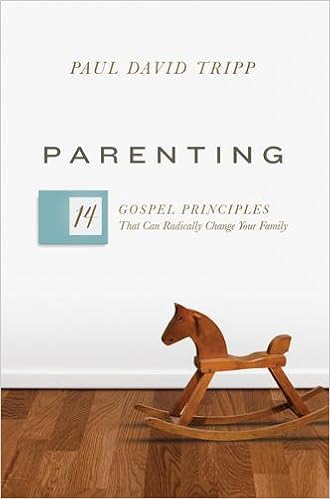
Parenting: 14 Gospel Principles That Can Radically Change Your Family

My Rating –If You are Looking for Something

Level – Quick, easy read

Summary
Well, it’s a book about parenting. Pretty good summary, right? This is an interesting book because the approach is very different that most parenting books. The main difference being that there is nothing ‘practical’ about this book. That can be incredibly frustrating and challenging as you read. You are not going to find anything about sleep training, how to deal with allowances, or curfews in here. I guess the best summary would be to say that it is solid reformed theology and how it relates to parenting.

Probably the most interesting part is a reminder of the most important roll for you is as parent. What would you say if asked? I know it’s not to make my kid happy. My answer is typically something about independence and teaching your kid to take care of herself. That is wrong though, as Tripp points out, your most important goal is to teach your child about God, who He is and what He has done for us. That is his starting point, and it only gets more challenging from there.

My Thoughts
This book is a mix of good reminders, frustrations, and challenges of parenting. If you are familiar with reformed theology, you’ll have a decent idea of what is coming in this. Your child has problems because she is sinful. You don’t model well and have problems being a good parent because you are sinful. That can get old, because at times you feel, what’s the point, then? It is incredibly useful however, like much in the Biblical Counseling movement that Tripp is a part of, the focus on someone’s sinful nature is a good place to start. It can be kind of funny, sometimes, honestly. I’ll catch myself in a moment with Sprout, when I’m angry and thinking, why in the hell did you do that? Then I kind of laugh and think, well, you are just a tiny fallen human.

Tripp also does a good job of shining a spotlight on parents as sinners. That’s also annoying, but again, it is useful to help check your own feelings and reactions. All that being said, I wanted to like this book more. If you are having problems parenting, or looking for a foundation, or just trying to read everything you can about parenting, then this is a good book. It is well written and incredibly strong on theological basis. I may be the only one, but it just didn’t sit right, I’m not sure why. Maybe because it is different. It really is a book about the heart of parenting and understanding the heart of a child.

I have a toddler, so I guess I was wanting something that spells things out a bit more. There are so many day to day things and broader parenting questions that this book doesn’t really address (or attempt to, to be fair). Should you spank, and how old is too old? What about screen time or games on the phone? You won’t find these answers, and maybe in the long run, they don’t really matter, but that is what you expect from typical books. Instead, what Tripp has done, is focus you first on the important task of teaching your child about the Lord, then basically just asking you challenging questions, instead of offering answers, then leave you to figure it out.

* I received a free copy of this book from Crossway in exchange for an honest review.

Book Review: One Nation Under God

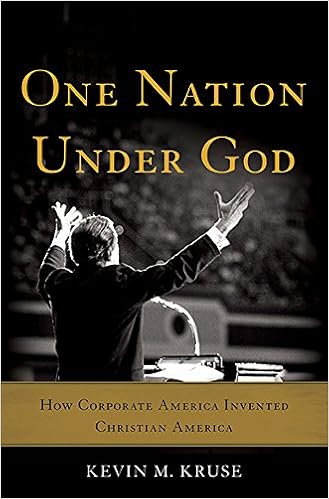
One Nation Under God: How Corporate America Invented Christian America – Kevin M. Kruse

My rating – Put it on your list

Level – easy, a little wordy, medium length but reads quickly

Summary
The title might be a bit of a misnomer. People expecting this book to be about whether or not America was founded as a Christian nation should look elsewhere. There a many, many books with this title that more or less discuss that idea or whether we are currently. In many ways, it is a great and accurate title as the insertion of the phrase ‘under God’ is a critical juncture in his story line. For those unaware, it was added in the 50’s, the so-called ‘good ol’ days’.

What the book is about, is how a group of people decided to try and revise history, and shape the future, for their own personal financial gain. Conflating Christianity with the nation is the method they choose. This started maybe further back than people might have thought. If you are like me, you might assume much of the rhetoric started with Reagan. Instead, Kruse traces is back to the 30’s and business responses to New Deal regulation. In fact, he barely discussing Reagan.

The book is broken into three major parts – creation, consecration, and conflict. That is, the ideas and actions behind the national religion push (very conspiratorially written), the achievement of those goals, and the current situation of those goals clashing with modern America.

I guess I should also note that Kruse is a historian. I have no idea his religious preference, if any, and do not think he mentions it in the book. Point being, this is not written from the Christian prospective and though quite fair and accurate, he does seem suspicious of it. However, it certainly isn’t anti-Christian or an attack in any way.

My Thoughts
I hate to admit that I like this book because it confirmed my own beliefs, but it is true. If you are ever involved in anything politically liberal, you will likely hear that Christians have corrupted the Republican party. However, it is the other way around. I’ve always viewed the situation as Reagan’s attempt to tie Evangelicals to the Republican party as a response to and actual Evangelical Christian, and likely the most religious president in American history, Jimmy Carter. If I ever do get a change to pursue a PhD, I’d like to write my dissertation on this topic.

Interestingly, the attempt to put them together is much, much older and was well in place and already successful before Reagan. It was very interesting, yet disturbing, to read the entanglement of business interest, prosperity gospel preachers, and politics. Perhaps the most shocking thing to me was the placement of the 10 Commandments at courthouses. Many people may have though, well, they’ve been there all along, perhaps hundreds of years. No. Almost all of the monuments, the large, stone tablet looking representations were put up in the early 50’s. They were a marketing ploy. Like a Captain American action figure in a happy meal, they were used to promote the movie ‘The Ten Commandments’.

It all comes down to a basic fear felt by many of the Evangelical Left (that is, those who are political liberal, but deeply conservative in Christian belief) – that Christianity, God, and the Bible have all been used by business interest. Greed has lead to obfuscating history and the portrayal of the future as antagonistic to Believers. All so that certain people in companies could have less regulation and taxes.

This will be hard to swallow for many staunch conservatives. I know, because I used to be one. Then I started to become suspicious that we were being used. Now, I will say, if you are politically conservative, that’s fine, nothing wrong with that. Just don’t claim the Bible is the bases of your economic or tax policy. You’ve been used as a pawn, even voting against your own self interest by people who may not even view God as you do.

However, anyone will to sit, read, and review the facts about politics and religion, this book needs to be on your list. If you are a Christian and political liberal, who has always wondered how it got so off, this book is a must read for historical understanding. If you are a Christian, who maybe doesn’t even have strong political leanings, but were just always curious as to why, in America, the political right and Evangelicals are so intertwined, this book is also a must read. Any Christian with any interest in political at all, should add this to their list of books to read.

I want to wrap up with a quick note about Trump. I’m writing this 4 days before the election, but I don’t think it will be posted until a few weeks after. But, if you’ve looked around and wondered how in the Hell is Trump the supposed representative of the Evangelical vote, this book will help you understand. For one, Trump grew up in the church of one of the biggest, most popular/powerful prosperity gospel preachers. Sadly, this history presented in this book will also explain why so many ‘preachers’ or other ‘Evangelical’ public figures have support the thrice divorced, pro-choice, multi-millionaire. If you’ve read some of these guy’s condemnation of Bill Clinton from the 90’s, but their full throated support for Trump and though, that doesn’t make any sense, then read this book, and it will. We go from claiming that morality matters in the White House, to the weak and somewhat ridiculous claim that we are not electing a ‘pastor-in-chief’ (ridiculous, not because it is wrong, but that apparently only pastors shouldn’t grab random women by the pussy).

I will say, I do hope that the Trump candidacy will disentangle party politics with religion. As I write this, I have a sincere wish that Evangelicals will not vote (majority) for Trump; however, I am not hopeful.

Edit – He won 81% of the Evangelicals, more than Romney or even Bush. 

Evangelicals and President-Elect Trump

I’m not going to provide much in the way of commentary, because I’m just too tired and a little burned out at this point; in fact, I’m going to be extra lazy and just dump raw links. However, I have to note that 81% of White Evangelicals voted for Trump. I was surprised at how high this was. Maybe you are thinking, well, that is just a consistent vote. Two problems with this, first it is actually higher than W received against Kerry or Gore. Second, that were a huge number of Evangelical leaders, pastors, seminary presidents, and public theologians that came out against Trump, so you’d expect the numbers to be lower.

Of course, things are much more complicated than one subgroup vote. I think, and the polls seem to be showing this, that the democrats lost (well, except the popular vote) due to the fact that they focused too much on identity politics and missed the most important part of elections – it’s the economy stupid. I think many Evangelicals voted for power, to stay a controlling force in government, and we sacrificed our moral voice for it. Unfortunately, I think most Evangelicals were simply tricked into becoming single issue voters – something I think is a terrible idea.

Anyway, that’s really all I feel like writing at this point. Grab them by the pussy, here’s your link dump:

https://blogs.thegospelcoalition.org/thabitianyabwile/2016/11/09/4-problems-associated-with-white-evangelical-support-of-donald-trump/#comment-179779

http://religiondispatches.org/white-evangelicals-win-white-house-for-trump-but-lose-big/

http://www.christianitytoday.com/gleanings/2016/november/trump-elected-president-thanks-to-4-in-5-white-evangelicals.html

https://www.washingtonpost.com/news/acts-of-faith/wp/2016/11/09/why-christians-should-not-succumb-to-the-apocalyptic-language-of-the-election/

http://www.huffingtonpost.com/entry/evangelicals-election_us_5820d931e4b0e80b02cbc86e

http://time.com/4565010/donald-trump-evangelicals-win/?xid=Outbrain_Time_ArticleFooter&iid=obnetwork

http://fortune.com/2016/10/09/evangelical-leaders-back-trump/


Book Review: Sapiens

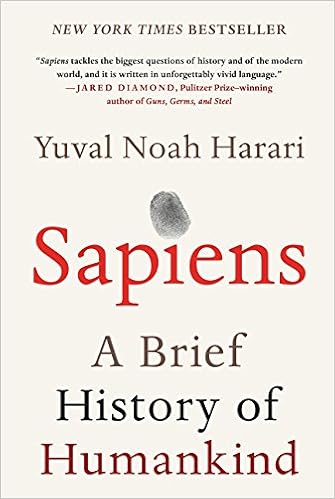
Sapiens: A Brief History of Humankind – Yuval Harari

My Rating – Put it on your list

Level – His style makes it moderate, but the book covers topics like biology, physics, philosophy, anthropology, economics, and of course, history. So, not everyone will be able to jump right into this book. Fairly long at almost 500 pages.

Summary
Harari splits the book into four parts (total of 20 chapters), The Cognitive Revolution, The Agricultural Revolution, The Unification of History, and The Scientific Revolution. You could also see this book as two books. The first two parts deal with the developmental historic and biological evolution of humans. The last two parts, deals more with philosophy, religion, end economics.

The first two parts are exactly what they sound like. Who were the Sapiens, and how many species were there? Why did we, homo, become dominant? Our cognition, broadly speaking, is the answer. He gets a little philosophical on wondering whether the agricultural revolution was  good thing. He is fairly critical, wondering if we would have been better off as hunter-gatherers.

The third, was the most fascinating. In ‘unification’ he means how cultural forces tied as together as a species. He points to money, empires, and religion as the greatest reasons. For pure learning/knowledge of society the two chapters on money and religion are probably the greatest in the book.

The final section is party what it seems, what has changed since the scientific revolutions, but Harari also offers great insight into science replacing religion, economics (especially capitalism), the industrial revolution and an interesting look into the future. Parts of this section were difficult to read, especially as he discusses human actions (like genocide) through the lenses of biology and evolution. He wraps up with a look at the future and the advancement of medicine. The implications of current advancements and the possibility of true immortality leads to great points on the philosophical issues of no death, and whom could attain it.

My Thoughts
I’m a pretty big history nerd and find pre-recorded history especially fascinating. What happened to spark the cognitive revolution 50,000 years ago or the agricultural one 10,000 years ago is extremely intriguing from a historical, religious, and biological standpoint. If you are in any way like this, this book is a must read for you.

As for the last two parts, if you are an economics or recent history nerd, this is also a must read. Particularly of interest is his definitions of money and religion. It’s a great over view of the basic economics of money. Even looking at the physical aspects of not having to carry wheat to pay for things, or having to know the value in weight of all commodities. Some people will probably not agree with his definitions of religion, but they are quite good from a sociological standpoint.

The last half of the book should bother a number of people. For the more conservative groups who may read it for the history and economics insights, his discussions of the problems of capitalism and the industrial revolutions may anger them. Likewise, liberals who cheer on those parts will likely disagree with the assessment that liberalism is, in fact, a religion. They may find it especially repulsive that he as he describes the world through purely secular and biological reasoning, he inevitably concludes that there is no universal truth.

With no universal truth, he argues, we can’t state for a fact that things like the Holocaust are wrong. He points out that there is no right and wrong in biology. Our goal is to perpetuate the species, whether or not it is better for us. He discusses evolutionary examples that are not the best winning out. Natural selection is misunderstood as the propagation of the best attributes, but this is simply not true. I’ve heard this type of thinking, especially the Holocaust example, from Christians before. Typically, I dismiss it as something taught in academically weak fundamentalist apologetic schools. It was startling to read it so blatantly stated, and even proved to be correct.

His writing is great and though the material could be a text book, it is written in a wonderful, almost narrative fashion. If either of the two broader section of the book are things that interest you, this is a must read. However, due to the depth and breadth of this book, I’ll put it as something to put on your list, if the topic are of interest to you, or if you are interesting in learning. The amount you will learn from this book is fairly astounding. For that reason alone, it would be helpful for many people to read.

Book Review: A Walk in the Woods

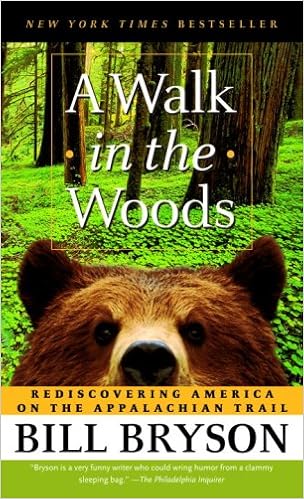
A Walk in the Woods – Bill Bryson

My Rating – If you are look for something to read

Level – easy, fairly short

Summary
Bill Bryson decides he wants to hike the whole of the Appalachian Trail. He realizes that it will be long and he will be on his own, so he puts it out there that he’d like to have someone come with him. An old friend calls up and agrees to go. The first part of the book deals with their antics as they start off on their hike. Then the book somewhat drifts in the middle as he returns home (the plan is not to do the tail all at once, but instead break it up into different parts). He gives a bit of the history of the National Park service in general and the AT in particular.

All the while doing minor hikes in the area of the trail that runs near his house, as well as taking trip down in Virginia and Pennsylvania to do other parts for a few days at a time. The final part of the book, he meets back up with his buddy Katz, to hike thru Main’s 100 Mile Wilderness. He wraps up the book with some final thoughts and reflections on his experience.

My Thoughts
By far the best part of the book is his early exploits with Katz. Anyone with jackass friends or people who have gone on long multi-day hikes with, let’s say, less equipped people, will appreciate the humor of the situation. The middle part really seems a bit listless and even like a later edition. Maybe it was just less interesting to me as I am pretty familiar with the AT and hike the Smokies at least once a year.

This is also a movie now. I have no idea if it is any good, but if it’s on Amazon Prime or something, it’s probably worth watching.

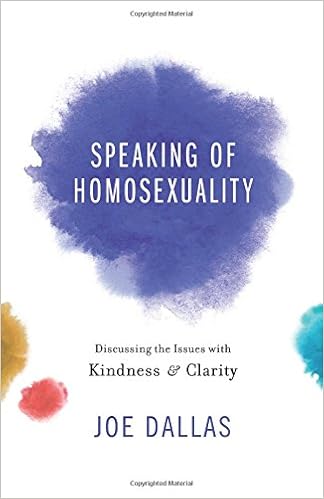
Book Review: Speaking of Homosexuality

Speaking of Homosexuality: Discussing the Issues with Kindness and Clarity – Joe Dallas

Rating – Must Read

Level – Medium length, reads quickly and easily

Summary
The book, as the title indicates, is about homosexuality in the church and the world today. Dallas covers a large swath of the topic, from how to talk  to people about it, to Greek meanings, to modern views. Broken into 13 chapters plus an intro and a conclusion (which is actually chapter 14), the book is four main points.

Chapters 1-3 (The Context of Our Conversation, To Whom Am I Speaking, Rules of Engagement) are the first point of the book, mainly how does the modern world view homosexuality? Who talks about it and how do we talk to them?

The next section, chapters 4 & 5 (Born Gay?, The “Change” Controversy) get into some of the biological and psychological aspects of homosexuality. There is also the issue of counseling and ‘therapy’ for homosexuals in the secular and church settings.

I grouped chapters 6-8 (Same-Sex Marriage; Homophobia, Hate, Hypocrisy, and Harm; Gay Christians) together, but they aren’t all that similar to each other. Chapter 6 is fairly self explanatory, chapter 7 deals with the responses or charges to the responses of Christians, and chapter 8 he gives us his thoughts on people who refer to themselves as Gay Christians.

The final section is the longest because it is basically, ‘What does the Bible say.’ Encompassing chapters 9-13 (Sodom, Homosexuality and Leviticus, What Jesus Did or Did Not Say, Paul and Romans, Paul and Arsenokoites), Dallas takes us through the Bible, including both Hebrew and Greek, the different interpretations today and throughout church history, covering every conceivable verse or story related to homosexuality.

Additionally, there are two helpful aspects about the way in which this book is written. First and probably most important, Dallas has written it like a conversation. He lays out and issue, then states what the ‘Revisionist’ claim, followed by the ‘Traditionalist’ responses. So, broadly speaking, something like – They say X, we respond Y and Z.

Second, he has a 10-point review at the end of each chapter that quickly summarizes the arguments of the chapter. This is a helpful reminded if you need to check back in the book. Or honestly, if you are not much of a reader, you could just read the points and then jump in deeper if something strikes you.

My Thoughts
I’ll be honest, I was skeptical of this book at first. Not entirely sure why. Maybe because of the reviews in the front cover. They were mostly from musicians or people I whose names I didn’t recognize. However, I was very impressed with this book. For one thing Dallas is a great writer. He is extremely, extremely accessible. Just about anyone of any reading level could glide through this book. He has almost a journalistic style, like a long form article in a magazine or a narrative non-fiction report.

This point leads me to what is certainly the strength of the book. The final 75 or so pages (excluding the conclusion) are all from the Bible. As a mentioned above, he goes pretty deep, especially in the Greek (I loved the pronunciation guide listed with each word). These five chapters are theologically and Biblically strong. For a big this size (~230 pages) there is a lot of deep and serious inquiry into Scriptures. I was very impressed.

To circle back to the beginning, this book is also a great help to those whom are angry or feel ‘Christians are losing’ something. Or even people whom don’t know how to engage. It’s an important reminder of how to act, really.

I disagree with his take on the impact of gay marriage on society and I’m skeptical of some grand conspiracy as opposed to a few antagonistic people. However, that was something interesting while reading this book – I found myself disagree at times, but I would alternate from viewing things more liberally at some points and more conservatively at others.

Overall, this is a must read of Christians today who do not know what to do with the issue. Or, even for those who do know what to thing, this book is an invaluable resource on how to engage with others and the Scripture. This is a book that probably every pastor or person in full time ministry should own.


*I received copy of this book in exchange for an honest review, thank you Baker Books. Read more about that here.

Trump on Roe v. Wade at the Debate

Last week a put up a post stating why I do not believe we (evangelicals) should be single issue voters. I haven’t had that many solid responses, mostly just questioning my faith or being told I was ‘spiritually weak’ (though a good writer, so toss up I guess). That could be a whole post, but for now I want to emphasize something I pointed out in that post. I do not believe Trump will have any impact on abortion. I do not think he cares about it. Watch the first minute or so from the last debate. He will not state that he wants to overturn Roe. Instead he says he assumes it will be overturned. But then, not really, as he equivocates with the with the classic conservative line about ‘states.’ What does he even mean by this? That he’d like to see it up to each state? This will in no way end abortion. Many states will choose to keep the practice and citizens of those that don’t will be allowed to freely travel to others.

Yes, I know Hilary then states her whole heart support for abortion, even late term. However, this is for those evangelicals whom are willing to support Trump, and all of his issues and problems, solely because of his stand on abortion. Again, watch the first minute as he answers whether he’d like to see it overturned and really try to think how committed he is.

Edit – Also check out this great post about how ineffective Trump or the Supreme Court nominees would likely be in ending abortions.

He probably won’t be on the ballet in your state, but check our Evan McMullin if you insist on being a single issue voter. Trump is not the choice for evangelicals.

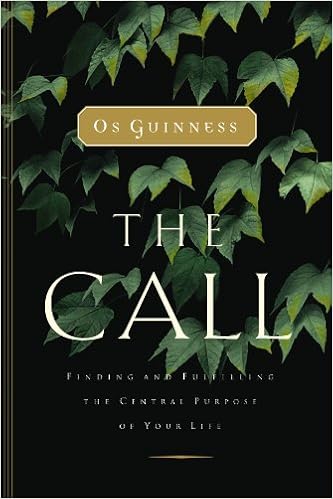
Book Review: The Call

The Call: Finding and Fulfilling the Central Purpose of Your Life  – Os Guinness

My Rating – If you are looking for something

Level – Choppy read, short but reads longer than it is

Summary
First of all, if you’ve been recommend this book by a friend or pastor and they tell it is written by a guy named Guinness, no relation to the beer, you should question if they actually read the entire book. He is actually related, though distantly, to the original founder of the brewery.

This is another book about Christians and work. It is probably the most famous and the one many pastors or counselors will mention first. It is not quite 20 years old, and is already the ‘classic’ on the subject. The book is written as somewhat a devotional/study and is broken down to 26 short chapters with a note in the table of contents that the intent is that each chapter be read and reflected on one day at a time.

Probably the best thing you can get from this book is the different in vocation and avocation. That is your work and your calling. They are not necessarily the same thing. He points at the us, as Christians, have forgotten about calling. We don’t really teach about it and help people find theirs.

My Thoughts
This book is often cited by other authors writing books on calling and work, but I didn’t enjoy it all that much. Maybe it was his writing style, but I just could never get into it. To be fair, I didn’t read it as suggested, in the 26 sittings, so that may have affected things. I think the writing was overly wordy and more complicated than needed. Perhaps due to his intention of writing 26 independent reflections, it was at times redundant at times while also being disjointed at other times.

If you’ve already knocked out a few books on calling or work and are still looking for something else, you should put this on your list. Other than that, it probably isn’t worth your time. Many, if not all, of his major points are quoted and discussed by Keller in Every Good Endeavor. I’d recommend reading that book instead. The book is Biblically sound and strong on history, but the writing will likely not appeal to most people.

Should Evangelicals be Single Issue Voters?

On Monday, I posted some thoughts and a great link to an article about why Evangelicals shouldn’t vote for Trump. This is something I am adamant about, and I am not alone. Now, this isn’t to say that Evangelicals can’t vote for Trump – but please, please do not call him the Christian candidate. If you like assault rifles, say that is why you are voting for him. If you are rich and want your taxes cut, say that is why. If you really think he will build an actual wall and believe this matters, vote for him. Just do not make the claim that he is the moral candidate.

All that to say, Mrs. MMT also posted the same article on her Facebook page. The results were, sadly, not all that surprising. Of course, there were some that questioned whether she was a believer or ‘knew the gospel,’ but most basically the questions came down to abortion.

So, buckle in, I’m about to write about something I never wanted to have to do before, but I feel compelled to. Actually, let’s back up a second. Many people have written about being a single-issue voter, Kushiner even arguing that we are all technically single issue voters. So, I want to define what I mean when I say single-issue voter. Burk rightly, I think, points out that single-issue voting doesn’t mean that one point makes someone qualified to be president, it means only that taking a certain position disqualifies you. I think that is an important distinction. Also, I agree that everyone is technically a single-issue voter, so for that sake, let’s say we are only talking about the major ‘wedge’ issues – abortion, gay marriage, gun control, etc.

Abortion is clearly the big one for Evangelicals. As I said, Mrs. MMT found out the hard way, that it is almost the only thing people think about in this election. It is frustrating for a lot of reasons that people go there. First of all, the point of the main article was that Trump is not the option. Mostly, though, as I will explain later, we really shouldn’t be single-issue voters.

Alright, back to abortion. There are a few things to say about it as an issue. First, will a Trump presidency make an impact? Second, what would a Clinton presidency do? Third, how should we think about abortion as Evangelicals? Finally, should we limit pro-life to only abortions?

What would Trump do? My thought is nothing. I feel he will have roughly zero impact on abortion. He has been adamantly pro-choice his whole life. He claims to have changed his mind. I remain skeptical. Even if he has, I expect him to be as about as faithful to his claims as he has been to people named Mrs. Trump (I stole that line, but forget the source). I believe Bush was strong pro-life, and even he was unable to affect anything.

Clinton will do nothing for the legality of abortions. If anything, opportunities for abortion may expand. However, she does want to expand healthcare access. Currently, the US has one of the highest abortion rates in the Western world. Throughout the world, there is a correlation between universal healthcare and lower abortion rates. So it is possible that indirectly, a pro-choice candidate may decrease the abortion rate.

Besides healthcare, it’s also possible that some of her proposed social policies could lower the rate. Programs like expanded child care tax credits, maternity leave, sick leave, raising the minimum wage, and other assistance to the poor. We know that roughly 50% of abortions are by women who make below the poverty line (just over $11K) and another 25% between the poverty line and 200% of the poverty line. So, generally speaking, about 75% of all abortions are by women who make $22K or less. To me, that is a clear indication that poverty impacts women’s decisions.

Now, I have a good friend who I’ve known for almost 30 years, a strong believer who is actually working on his master’s in apologetics (follower of this blog, too), who righty points out that people who get abortions don’t do so because they are poor, but because they are sinful. This is true, abortion is clearly a sin, and it is our own sinful nature that causes us to sin. However, I think we have to go a step further and examine the sin. What is the heart of the sinner, why are they acting the way they do? I do not think that someone wakes up one day and says, “Hey, I’d really like to murder a baby today.”

No, I think they are afraid, maybe they are selfish, maybe they don’t want to lose their job. There is certainly the issue of economic security. Sadly, some people who have been interviewed have stated they were afraid they couldn’t feed their current children if they had another mouth to feed. None of these things excuse what they did. People are still choosing to end a life. But they aren’t ending a life for the sake of ending a life. There are other issues. These other issues are where Christians and public policy can help.

So, that is part of how I think Evangelicals should view the issue. The other part is the reality that the issue is just not going away. Maybe it’s because I’m young(ish) and was born almost a decade after Roe v. Wade, but I view the legal aspect as a battle we’ve already lost. I’ve lived my entire life under the legality of abortion. So, that could be biasing my view. However, we’ve had three republican presidents since 1980, serving a total of 20 years, and none have done anything. As it is, the country is only becoming more socially liberal, and I just don’t see us repealing it. In that case, I believe it is incumbent on us to do everything we can to minimize the number that will occur. Because they will continue, and this is true whether or not they are legal.

Finally, is being anti-abortion all there is to being pro-life? I believe pro-life includes at least two other aspects. First, war. And I believe Clinton is actually more hawkish than Trump, so we’ll call that a draw. Second, the death penalty, since killing people is clearly not pro-life. I’m a small government guy, so it has always baffled me that so many of the libertarians/republicans I know support giving the state the power to kill (and this could be a whole other post).

I suppose you could also make the argument that we could throw gun control in there, too. Many, many, people die every year from ‘accidents’, but much like abortion, I don’t think gun rights are going anywhere, with the possible exception of assault rifles.

So, which one really is the more pro-life candidate when looking more broadly at life? Probably a draw at best, since both candidates certainly have mixed views and records. That leads me to my larger point. I do not think we should be single-issue voters. Is it really wise to ignore so many issues in one person, for a single position the other person holds?

Trump has proposed banning an entire religious group. He has advocated war crimes. He certainly isn’t a family values guy. He either does not believe he has sinned or disagrees with the need to repent. Where do we draw the line?

It is also problematic to try to decide which issue is the most important. That is essentially what you are doing by being single issue. Is abortion the most important problem in our country? Can you make a Biblical argument that it should be the one and only qualifier to not vote for someone? I do not think you can. So, for me, I try to look at the multitude of issues, which maybe I’ll write more about later, but I should probably wrap this up, as I do have a few more things to say.

Granted, I do believe this would be a different conversation if abortion were not already legal. I could never, in good conscience, vote for someone advocating changing the law from illegal to legal. Because that can make an impact, that can change things. If you vote for someone who claims they will keep something legal that is already legal, there is no change. But as I said above, this is the world we live in. This law already exists, and it’s highly likely to NOT be going anywhere. As such, we can only try to reduce them.

Some may argue that I am simply accepting the culture, being conformed by the world as it is. I completely disagree. If I were engaging in some loose cultural Christianity, I’d probably just go ahead and support abortion. But I don’t. I’m pro-life. As I said, I think we should do every possible thing we can to prevent as many as possible, so that we can save as many children as possible. I do not see that as a cultural compromise.

However, in some senses, everyone is shaped by culture. As I said above, I do think the battle of legality is over and lost, but the war to save children is not. That’s why I advocate for things such as what is listed above – overcoming evil with good. So, I’m admitting my worldview has been shaped, to an extent, by my life, but I don’t think it’s any different than a previous generation having their views shaped by the moral majority and Christian right, who put tax rates up there on par with abortion in importance.

Let me wrap up by, again, pointing out that I want to be critical of Trump. This is not the same thing, in any way, shape, or form, as supporting abortion. I am pro-life, to the fullest extent. I do not think voting for either Trump or Clinton will have any impact on this. I do think Trump is the more morally repugnant of the two. What about third party? Well, Gary Johnson and Jill Stein both support abortion rights, so those options aren’t particularly attractive. Obviously, I’m not going to just skip voting. So, what does that leave?

I’d love to hear from anyone who has any thoughts on this issue. Please leave your thoughts in the comments or email me. If someone wants to write a longer response to me, I’d be happy to publish it here. It would also be great to hear from anyone who is a single-issue voter (that issue being abortion) and who plans to vote for Trump. I’d be really interested in hearing why you think he is the right/more or Evangelical/Christian choice. I welcome any feedback; however, I reiterate that I am pro-life and in no way support abortion, so if your only response is to tell me abortion is wrong, I am going to drop the ban hammer on you.