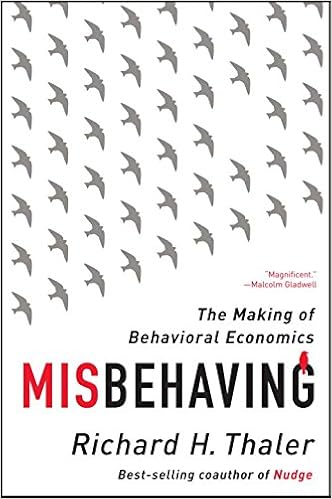
Book Review: Misbehaving

Misbehaving: The Making of Behavioral Economics

My Rating: Put it on your list

Level: Moderate to difficult, depending on your base knowledge of Economics and Psychology. Moderate in length, but reads quickly

Summary
Part Thaler autobiography, part time line of the development of the field, with plenty of humorous anecdotes and academic ‘anomalies’, this book does not read like a history of an academic discipline. The book is broken into eight broad chapter based around years in which Thaler worked through differing parts of the development of the field. The chronology starts with him as a graduate student, where he is just starting to look into ideas that would become the discipline, and proceeds up to the present, where he seems poised to hand over the reins to the next generation. Along the way are his stories of getting the discipline recognized by academic journals, struggles with the establishment, and gaining allies (across other disciplines, as well) and students that will become the next generation.

My Thoughts
This book, like the somewhat related book (Thinking, Fast & Slow) by his fellow collaborator, Daniel Kahneman, kind of annoyed me in how well it is written. Thaler has had a nearly five decade career as researcher and writer, so he should write well, but that is not what I mean. His book is funny and reads quickly like a narrative. As I said above, it it part autobiography, and lends itself tremendously to humorous narrative that leaves you interested in reading more. As a pretend internet researcher and writer, I am envious that someone with actual credentials writes so well.

All that being said, I think I missed the subtitle of this book when I first heard about it a few years ago. I heard Thaler on a interview, and knew he was related to behavioral economics, but didn’t quite realize this was book he was promoting. I must have searched his name on amazon and bought the first book I saw, without noticing the reference to ‘Nudge’ on the cover. Nudge was really the book I was looking for, which is more about the research out of Behavioral Economics as it relates to topics like money and health. ‘The Making of Behavioral Economics’ should have clued me in to this book being more of a history. Luckily, I enjoy history and biographies, and as I said above, he is a very talented writer.

One of the first things that stuck out to me was how long he as been in the field. His book starts in 1970, with him as a grad student. I wouldn’t be born for another decade and a half, and I don’t consider myself very young. I’ve heard that Millennials will have between seven and 17 careers over their lifetimes, so it amazes me to read of someone’s history in a field that is longer than my lifetime.

Reading history is always fascinating, because you, with the addition of hindsight, can read and say, ‘how did these people miss this?’ I couldn’t believe some of the resistance he and others would face as the argued against the efficient market hypothesis. I was in high school during pets.com (look it up kids) and the tech bubble and finished grad school a few months before the housing bubble popped, so I struggle to believe in any way the the market is efficient and that people are well informed. Thinking back to my undergrad economics courses, I believe I was taught the distinction between theory of economics (people who Thaler calls Econs) and actual behavior (called Humans). In grad school, the distinction was called that of theory and practice. So, it is interesting to see that a few decades before, saying things like this, which to me are clearly true, would get you laughed out of conferences and barred from academic journals.

This history was interesting, and the debates with other academics were amusing and insightful, but the book really shines with the anecdotes. I won’t go through all of them here, but the include an economist who refuses to sell his wine (for a gain) at the market price while also stating he would never buy it at the price and companies whose stock prices are lower than their subsidiaries (even when purchasing the larger company stock means getting the smaller companies stock included; this means the larger company is valued in negative dollars relative to market cap).

These types of stories are what I enjoy reading. They are amusing on their own, but also challenge your assumptions about certain areas, but even more, make you really question whether you actually know what you are doing. You may think you do everything rationally, but you probably don’t, and that is illustrated time and again in this book. If you are looking for just stories and research results, you are probably better off with Nudge or Thinking, Fast and Slow. However, if you are interesting in Behavioral Economics in general, this is definitely a book to put on your list.

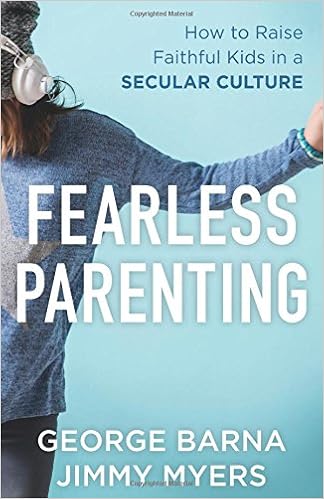
Book Review: Fearless Parenting

Fearless Parenting: How to Raise Faithful Kids in a Secular Culture

My Rating: Probably not worth your time

Level: Quick, easy read; short book.

Summary
The title of this book is a little strange. For the most part, the book is about Biblical parenting in a secular world (which is more or less what the subtitle says). The name comes from the second chapter, where the authors tell you to reject fear as your basis of parenting. That is all well and good, but the response in this chapter is in relation to the first chapter, which might be one of the worst examples of writing in any parenting book, ever. I’d highly recommend skipping the first chapter, if you have any plans on finishing the book.

The remainder of the book is pretty solid; with almost a completely different feel than the first chapter (as if there were two authors…). The first few chapters are general reminders and thoughts on parenting from a Christian perspective that should be familiar to most church-going families. Some of the topics covered later in the book include clothes, materialism, social media, and ‘screen-time’, and they all contain good, practical advise.  The one section where the book really does shine is in discussion of kid’s sports. In it, the author calls out parents who try to live vicariously through their children in sports and challenges parents to ramp down the amount of sports played and to not make them the number one priority in the life of your family. The section of the book was redeeming enough for me to not rate the book lower.

My Thoughts
I wanted to like this book more, but it was hard to get past the first chapter. In it, the author ‘projects’ what life make be like in 2030. Some of the ‘data’ points (such as rising crime, or Trump reducing/balancing the budget) are somewhere between disingenuous to out right lies. In case you decide to fact check (which I did), he heads you off by pointing out that if you think he is being ‘too political’ (or, what I’d call, maybe just being a complete political hack) it is because YOU, reader, are too politically correct. Along with misused data, the author also gives us an Orwellian tinged far right-wing dystopian fantasy; including the suggestion that new government agencies will be created and that pastors will have to submit their sermons/teaching for approval by the state.

Honestly, this first chapter is just embarrassing. It hurts me on two levels. First, as a Christian, it is embarrassing that this book is written by/for and published by Christians. I suppose the author may shrug it off and say, ‘this is just what could happen.’ However, his projections are based on neither facts nor anything to do with Christians. It is straight up far-right political (hackery?, propaganda? fantasy/nightmare? I can’t even come up with the right word for this). It reminds me of the chain email that went around (you probably got it from your mom or grandpa) 2008/2009 that claimed that Obama was the anti-christ and that Revelation said he would be a Muslim. Of course, the book of Revelation makes no such claim, and Islam would not be founded for a another couple of centuries. Overall, I think the first chapter could best be summed up as an email your grandmother would forward you because she is scarred. I think this is probably one of the biggest reasons why young people leave the church today. This is beyond the scope of a book review, but a generation ago, people left the mainline churches because they sounded like democratic party meetings, and now people are leaving evangelical churches because they sound like republican party meetings.

Second, this chapter was bad in it’s use of statistics. George Barna and I both have master’s degrees in City Planning, so I feel he should know better. Which leads me to another criticism of the book overall – with one of the authors being the head of a major polling/research group, the book was very lacking in data. I was interested in this book partly because I thought, with Barna being co-author, it would be data heavy. Then again, based on the first chapter, maybe that is for the best.

This has already gone on too long for a review, so I’ll wrap up quickly. The sections/chapters on social media and screen time offer some great guidelines and I appreciate anytime a parenting book (especially Christian focused) offers practical examples. The section materialism was impressively counter-cultural. It did a good job of calling parents out for their endless wants and purchases as a way of setting a poor example for our children. Finally, I was really impressed with the section on sports. This is something of a sacred cow in America, particularity for things like Baseball and Football (especially here in the South). It is an incredible challenge the author lays out, telling someone you may skip a tournament, or not enroll in a sport because it has games on Sunday. They do well in discussing the impact too many sports have on your family life (e.g. vacation time or even canceling vacations), on your children’s health, and, most convictingly, your own idols (vicarious living, or idol of parenting a sports star in think on how that reflects on you).

I haven’t seen a parenting book really reflect on sports to this extent before, and it almost makes the whole book worth reading. However, due mostly to the drag of that first chapter, I think this book is mostly not worth your time. If you are specifically looking for some guidelines on materialism, social media/screen use, and sports participation, it may be a worthwhile. However, you can probably find some decent guidelines for most of these online somewhere, or perhaps in other books.

*I received a free copy of this book in exchange for an honest review.

Sermon on the Mount – Those Who are Persecuted

Matthew 5:10-12

Verse 10 is the final of the eight beatitudes, then you kind of have verses 11 & 12, just hanging out there. These two verses continue with the theme of persecution, but there is a transition happening here. Grammatically, He switches from using the third person to the second (blessed are those vs. you). Some have argued that these act as a transition section to the upcoming ‘salt & light’ teaching, and I think that makes the most sense. I think Christ is talking more broadly to the crowd and then narrows in to His disciples. Something like, ‘speaking of persecution, it will happen to you, my close followers. Also, you will be as salt and light.’

However, for my purposes, I’m lumping all the persecution in together and then move on to Salt and Light next week. One a side note, in the ‘fun with reading commentaries’ category, D.A. Carson says that it makes sense that Christ will follow peacemaking with persecution, while John Stott, says that it is a strange succeeding point. I’m actually inclined to disagree with both, as I don’t see as much of a connection. Peacemaking is us intervening with two other parties, while persecution is someone else’s reaction to us. I don’t seem them as countervailing actions. Anyway, back on topic.

V10

This might be the most straight forward and easy to comprehend of the beatitudes. For one, it isn’t dependent on us, other people need to act in this instance. So, what is ‘righteousness sake?’ One thing it isn’t, is for being a member of the church, that would be anachronistic to the hearers of the message. As it is the last of the beatitudes, I view is taking up any of the preceding beatitudes. Of course, later on in the Sermon, Christ will expound on a number of laws and even more so in later parable (such as loving your neighbor) that are necessary for righteousness.

Interestingly, the promise of this brings us right back to verse 5:3, where we started. As we discussed, poor in spirit can be seen as knowing you are spiritually bankrupt, which is essentially the opposite of self-righteousness. Now, it is for true righteousness, the promise to come is the same.

V11

This verse becomes much more specific relative to the prior verse. We move from ‘those’ to ‘you’, the disciples, and from ‘righteousness sake’ to ‘because of Me.’ This moves from an inference that something could happen to almost the expectation that something will happen. This should have been somewhat startling to the disciples, remember, this was quite early in Christ’s ministry (the beginning actually). As Jews, they would have some idea of religious persecution in the broad sense, but now they are being told that be doing something specific (following Christ), persecution will happen. People will revile you and say false things about you. With the benefit of hindsight, they should have seen maybe Christ was not the type of Messiah they were expecting.

V12

If the persecution comment wasn’t surprising enough, the statement comparing them to the Prophets should have put them over the top. On the one hand, they are told the reward is great, on the other, they can expect some of the same treatment they knew the prophets had received. Also, to put them on the level of the prophets tells us about who they thought Christ was. The prophets were those that spoke for God, often with direct revelation from Him to the world. If them following Christ meant they would be giving the word of God, then clearly they saw Christ for who he was.

Follow along in the series – Intro, The Poor in Spirit & Those Who Mourn, The Meek and Those Who Hunger & Thirst, The Merciful, Pure in Heart, and Peacemakers.

Commentaries used in this series:
Sermon on the Mount (The Story of God Bible Commentary)
The Message of the Sermon on the Mount (Matthew 5-7 : Christian Counter-Culture)
Studies in the Sermon on the Mount
Matthew (Baker Exegetical Commentary on the New Testament)
The Expositor’s Bible commentary : Matthew, Mark, Luke, with the New international version of the Holy Bible (Expositor’s Bible commentary, Vol.8)
Matthew: An Introduction and Commentary (Tyndale New Testament Commentaries)
New Bible Commentary

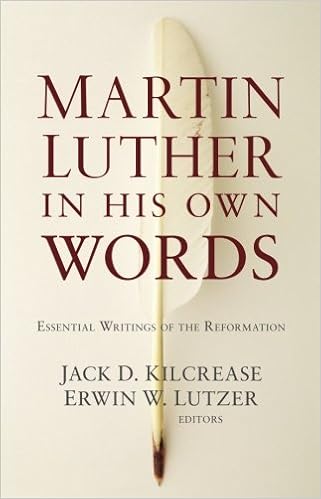
Book Review: Martin Luther in His Own Words

Martin Luther in His Own Words: Essential Writings of the Reformation

My Rating – If you are looking for something

Level – Short, but moderately difficult read. This isn’t an intro for the Reformation, some knowledge of church history and theology will be needed.

Summary
The title could be a bit misleading to some, i.e., one may think it is a sort of autobiography. However, the book is a collect of Martin Luther’s writings. Twelve selections, to be precise, broken into five broad topics (cleverly) modeled after the five solas – fida, gratia, scriptura, Christus, and gloria.

If you are unfamiliar, the five ‘solae’ (alone or only in Latin, think of the modern words sole and solo) was the cry of the Reformation. So the chapters are laid out in the Latin words mentioned above that correspond to faith, grace, Scripture, Christ, glory (to God). Delving into these is beyond the scope of a book review, but as this year (2017) is the 500 anniversary of the Reformation and Martin Luther was the initiator, it was a pretty interesting way to divide the book.

There is an into by Kilcrease before each selection that helps with context and there are a few footnotes within the selections that are helpful for understanding particular, archaic, and/or theological/ecclesiastical terms.

My Thoughts
There is a difficultly in trying to review a sample pack of a book. My main critique would be that Luther’s most famous writings are probably ‘The Bondage of the Will’ and his Larger & Short Catechisms, and if you know much about him, his commentary on Galatians, and of the 12 selections, only four come from sources other than these. Granted, this may have been their reason for the selections, but I would have preferred a more diverse grouping.

I wanted to like this book more, but maybe because I am fairly familiar with Luther, it just didn’t quite do it for me. However, if you do not know much about Luther’s writings or the beginnings of the Reformation, this may be a great place to start. Kilcrease’s introductions are great and very informative. Or, if you are curious about Luther’s writings and don’t know where to begin, this would be a great place to start. If you haven’t read much, the translation footnotes are incredibly helpful and will make it an easier read the just pulling some of the freely available online versions of many of his writings.

There is renewed interest in Luther and the Reformation in general this year as we approach the 500th anniversary and this book is one to read, if you are looking for something.

If you were looking for a biography then check out Here I Stand: A Life of Martin Luther. I haven’t read it yet, but the general consensus seems to be that it is the best.
If you think this book sounds a little to introductory, or you’ve read it and want more of Luther, then this collection (which I have read) seems to be the best next step (there is some overlap) – The Martin Luther Collection: 15 Classic Works

*I received a free copy of this book from the publisher in exchange for an honest review.

Sermon on the Mount – the Merciful, Pure in Heart, and Peacemakers

The past few post I’ve covered the first four beatitudes, which relate to how we respond to God. Today, I’ll move on to Matthew 5:7-9, which relate to how we respond to others.

V7

What does it mean to be merciful? Well, it sounds simple, but it is one who shows mercy. Sure, sounds good, so what is mercy? The Greek word is eleos and is the stand new testament word for mercy, or sometimes compassion. This is in response to pain, misery, and brokenness of others. The word is both used for our reaction to others and God’s reaction to us. The word being used for merciful has an active sense, so we are actively responding to people, we are showing people mercy and compassion.

So, in some ways, this one is fairly simple – show mercy and mercy will be shown to you. Maybe the questions is obvious, but who is showing you mercy? We know that just because you show mercy or kindness to people does not mean that people will show it to you. The answer, as has been to the doer of all the second clauses of the beatitudes, is God. The tense used for ‘be shown mercy’ has a future active sense, leading one translator to make up the word ‘mercied’, which I like as a way to understand this verse. This continues the eschatological theme of the Sermon on Mount. That in our knowledge of God grace and mercy to use in the end, out of gratitude and obedience, we show others mercy and compassion today.

V8

Both verse 7 and 9 are very much continuation of the promises of the Old Testament, but this is probable the most direct of the three. There is almost nothing to comment on. We are supposed to love God with all our…heart. The Psalms call out to God, asking for Him to create in us a clean (leading to pure) heart. One commentator defined the pure heart as one of ‘inner moral purity and single mindedness,’ the single mindedness being in devotion to God.

What do we receive for this pure devotion? To see the face of God. This is the ultimate sense of blessing in the Old Testament, the ultimate way of experiencing the Glory of God. Remember that this is exactly what Moses requested of God, thought even he was only allowed to see God has He passed by.

The most direct connection is Psalm 24:6 – the generation of those whom seek him, will see the face of the God of Jacob.

V9

What exactly is a peacemaker? McKnight says it is one with ‘active entrance into warring parties, to make reconciliation. In Psalm 34:14(?) we are told to turn away from evil, seek peace pursue it. Being sons of God has two distinct meanings in this context. First, there is the obvious, that as a son(child) there would be an inheritance which of course brings us back to the overall eschatological sense of the Sermon on the Mount, specifically as it related to the Kingdom of God. The second, less obvious to modern readers is in the Hebrew, ‘to be called sons,’ has the meaning of sharing the characteristics of a father, in this case, God the Father, though Jesus Christ the Son.

There is a reason Christ is called the Prince of Peace. He is the ultimate reconciler, between us and God. Paul says in Colossian’s 1:20, ‘and through him to reconcile to himself all things, whether on earth or in heaven, making peace by the blood of his cross.’

What a great place to end our quick look into these three beatitudes. If you are thinking, aren’t there eight, you only did four earlier. We will look next week at the final one, those persecuted, and look at their connection to the following two verses.

Follow along in the series – Intro, The Poor in Spirit & Those Who Mourn, The Meek and Those Who Hunger & Thirst

Commentaries used in this series:
Sermon on the Mount (The Story of God Bible Commentary)
The Message of the Sermon on the Mount (Matthew 5-7 : Christian Counter-Culture)
Studies in the Sermon on the Mount
Matthew (Baker Exegetical Commentary on the New Testament)
The Expositor’s Bible commentary : Matthew, Mark, Luke, with the New international version of the Holy Bible (Expositor’s Bible commentary, Vol.8)
Matthew: An Introduction and Commentary (Tyndale New Testament Commentaries)
New Bible Commentary

New, New Direction and Other Updates

I have a number of updates I’ve wanted to get to for a while but have kept pushing them off. I realize, somewhat, the irony of saying I’m going a new direction when, that was literally my post just a few months ago.

While I started this site years ago, I really ramped it up about 18 months ago, and I didn’t really have a direction. It was, and still is, mostly book reviews, but I was also working on a number of post going through some of the Minor Prophets, something I’d like to get back into again (especially as I only finished one, Amos, and there are 11 others). I’m currently going through the Sermon on the Mount, and may go back to the prophets when I finish that.

Leading into the election, I ended up writing a good bit more about politics than I had anticipated, mostly due to the inexplicably massive evangelical support of Trump. Considered how much news he is making now, as President Trump, I can imagine that will go back to being a more regular topic. Especially as I have taken a recent interesting in Christian Ethics.

The biggest change overall, especially on a more personal level, is that I had expected to enroll in Westminster this fall with the launch of their new online Counseling program (the MA has been around for a long time, but only this year moved to an online degree). I expected that I would be working on that and moving from my current career. I even took a few courses this past Spring. Over the last year, I’ve looking into different Counseling programs and spoken to many counselors about the field. However, at this point, I do not think it is for me. My fear was always that I would go into a master’s program and end up a career I didn’t like, something that I had already done.

Despite not being very good with people, I thought that counseling was something I could work my way into, but looking back, I think most o that was just hope, especially because of the desperation I was experiencing at my current job. A few things happened in the past six months that have helped me avoid making a costly mistake. First, I started a new job, and I really like it. One question I always had was do I dislike my field or my job. Turned out moving to a new city revamped my desire for my career. This removed the desperation and hurriedness from my decisions making. Providentially, the new company I worked for administers the Myers-Briggs personality type test to new hires.

This turned out to be extremely helpful, as not only did it confirm my current career path/field, but also shed light on some of my concerns related to counseling. For one, I’m introverted, making talking to people draining. Also, I’m not particularly empathetic, which would also be draining. It is already a career with high burnout, and I was headed that way, before even started. I asked one of the counselors about this, and he basically told me, yes, I could do it, but I would be mentally wiped out at the end of the day. I’ve already experienced too much of that in my previous job, and i know the effects it has on your life and family.

Two more quick things about counseling and I’ll move on. One, while I was taking the courses this Spring, I had no time to write. I really missed what (little) I do on this blog, so I think there is something there. Also, the course I was supposed to take this Summer, would have required me to meet with two other students for an hour a week. I was absolutely dreading this. Mrs. MMT was correct to point out the irony of not want to talk to other students about counseling, when this would become my career.

I still have a great interesting in Counseling, and will likely continue to study it as it has already been helpful my leading my small group and speaking with people in general. Eventually, maybe a small ministry in our church could come from it. For now, I don’t see anyway I go do it as a profession.

That is career, as far as that goes right now. What is next for this blog? I’ll continue to do book reviews and Bible Study, but I’d like to expand a good bit and have much more content, with a series of studies on things like Work and Finance, and diving into some current ethical issues. I also have an idea to start a podcast, as I don’t think many of the ones out there are getting it done, or at least not doing what I’d like to see be done.

So, that’s pretty much it. For now at least. I struggle to focus too long on things, and have what you might call and unquiet mind, but I do plan to get more focused content up and hopefully, most of it will be good.

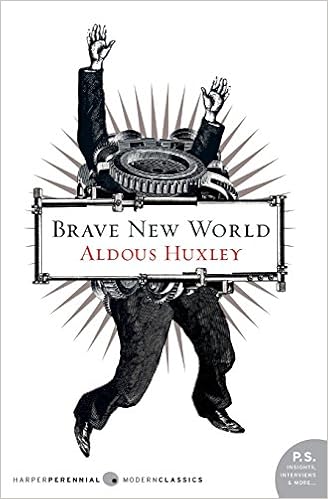
Book Review: Brave New World

Brave New World

Rating: Put it on your list

Level: Quick, easy read

Summary
Huxley’s most famous book is set in a dystopian world roughly 600 years in the future; puns abound as the time is known as the Year of Our Ford, a reference to Henry Ford and the roll out of the Model T (all crosses at churches are cut to a ‘T’ and Ford is a used as a swear). The book explores eugenics as were feared by some at the time of the right (1932), including forced sterilization; strict classes separation for the sake of ‘order’; ‘sleep-learning’ and classical conditioning; open sexual ‘freedom’; and most famously, self medication with high power psychopharmaceuticals, in the book known as ‘Soma’.

The book is famous enough I won’t spend any more time on the summary, but will note that it somewhat kicked off an era of in which some of the most famous dystopain books of the 20th century were written. Most notability, within 20 years both 1984 and Fahrenheit 451 were written. Both Brave New World and 1984 are widely considered two of the best books of the 20th century (though I find 451 more frighteningly accurate).

My Thoughts
This book is most famously contrasted with 1984, so I will get that out of the way, as the offer two competing views about books and our free time. In 1984, the government bans book, in Brave New World, there is no need. We have TVs (though hilariously viewed from his time as small and black and white), special entertainment complexes after work, orgies, and of course, Soma. Huxley’s view of the future had us seeking our own pleasure as the reason for our undoing.

Along with technological issues, the other surprising thing to the modern reader might be his fear of the breakdown of the family. My copy was published in 1946 and in his forward he writes that he has heard there are parts of the US where the divorce rate is pushing 50%, of course we are now roughly that as a nation. As someone born in the 80s, after the sexual revolution and the advent of the no-fault divorce, this fear of his seems quaint and almost strange. Additionally, in the forward, he reflects that he set his world in the distance future, but feared we’d be closer to it by the end of the century. The sex didn’t get quite as crazy (mostly due to his fear of what would happen with minors) as he thought, and eugenics has (mostly) fallen away, but he was correct on some level as far as conditioning goes. Though, in our current world, the conditioning comes from media and our consumerist culture than it does from government ‘learning centers’ and schools. What he did nail was ‘Soma’, the explosion of pills lit up in the 90’s, 60 years after the writing of the book, not 600 (Xanax was released in 1981, less than 50 years out).

He (obviously) didn’t get everything correct, but many of the overall issues are still with us today, especially the way we are conditioned, often without knowing it. The writing is good, maybe not as quick and clear as it could be, but overall this is an easy and entertaining read. If you are a fan of dystopian literature, this is a must read. For everyone else, I think you need to put this on your list, if for nothing else than it’s cultural impact and significance. I think it is always fascinating to look at what those in past thought the future would be like.


Sermon on the Mount – The Meek and Those Who Hunger & Thirst

Matthew 5:3-6

Las week, I only made it through verses 3 & 4, so this week I’ll wrap up the first section of the Beatitudes and go through verses 5 & 6. So, let’s jump right in.

V5
Who are the meek? This isn’t a word used often in modern English. Discussing this passage with my study group, we could only come up with that Christmas song where they call Jesus meek and mild. The Greek word is praus, which can mean – humble, gentle, considerate, courteous, long suffering, and free from malice. Barclay calls meek being ‘angry at the right time and never at the wrong time’, and according to Aristotle, meekness is being ‘angry on the right occasion, for the right people, for the right amount, and for the right length of time’.

Maybe because they are homonyms, but I think most people just go straight to associating meekness with weakness. I think quite probably gets in there a good bit to. Other Biblical references include Moses being called meek in Numbers, and both James and Peter writing about meekness as a way to act and receive the Word.

How we see who the meek are in this verse is influenced by how we understand the blessing. The reward for being meek is inheriting the earth. The word translated can mean either earth (as in the physical aspect) or land. This has a pretty clear meaning to Israel, but what about today? Similar to those who mourn, you can double dip into eschatological meanings here. For Jews, it is the Messianic Kingdom, for Christians it is the second coming – think inheriting the new Earth. Considering the likelihood that the mourning is the broken world with the blessing being the new Earth, I view the meek as the longsuffering and humble. Combining the two verses, and we should read each in light of the other, that means we mourning the brokenness of the world, but in humility of our own sin, and of course we may live our whole lives in the world, not seeing the restoration, making us long suffering. The blessing for this combined affliction is the same, we will be comforted when we inherit (as heirs to the Kingdom) the new Earth after the second coming, resurrection, final judgement, and restoration of all things.

V6
This is another phrase that is hard to understand in modern American life, hunger for me means something drastically different than to the original hearer/reader (or the majority of Christians over the past 2000 years, or any number of hundreds of millions elsewhere in the world today). I’ll eat breakfast around 6:00, then get to work and get moving and around 11:00 someone will mention lunch, and I’ll think, ‘man, I haven’t eaten since breakfast, I’m starving.’ Compare this to even my grandparents who were growing up before ‘three meals a day’ was even a concept. Or to the original hearer/reader, where there were likely days when on food was consumed. That is real hunger.

Likewise, thirst is a difficult concept. For one, there is no running water, indoor plumbing, etc. You have to go to a well. Now, I live in what was formally a malarial swamp (if you’ve ever wondered why the CDC is in Atlanta…), but the context hear is a desert. The well can run dry and it may not rain for months. I have some neighbors that moved here from LA about a year ago and one of the things they said they enjoyed here was listening to thunderstorms. They tell me that it may rain once, and then not again for a month or so, and that is pretty much the expected outcome. So, this concept is a bit lost on me, as even in our level 3 drought years, we still receive about 30 inches or so of rain. However, I do know you can last weeks without food, but only days without water.

This is a long intro to two commonly used words, but it is helpful for context. The picture here is someone who hasn’t eaten in a week and had no water in a day or two. It is someone who will soon die if they do not find food and water. This is the level to which we should seek righteousness. This is a theme throughout Christ’s ministry, later He will tell us to ‘First, seek the Kingdom and its righteousness”. So we know that He isn’t talking, if you have time, or when it is convenient for you, but seek it as if it is the drop of water that will keep you alive.

Finally, what is the blessing? They will receive it. The BEC translates the promise as, they will be filled. This takes us back to the point from last week about being poor in spirit. We need to empty ourselves to be filled. Those who seek Christ and His righteousness will find it, and He will give it to them. They will be covered in Christ’s righteousness, and it is through Christ that we will one day enter the Kingdom or inherit the new Earth.

That wraps up the section of the Beatitudes about how we relate to God, next week I’ll move into the section about how we relate to each other.

Follow along in the series – Intro, The Poor in Spirit & Those Who Mourn.

Commentaries used in this series:
Sermon on the Mount (The Story of God Bible Commentary)
The Message of the Sermon on the Mount (Matthew 5-7 : Christian Counter-Culture)
Studies in the Sermon on the Mount
Matthew (Baker Exegetical Commentary on the New Testament)
The Expositor’s Bible commentary : Matthew, Mark, Luke, with the New international version of the Holy Bible (Expositor’s Bible commentary, Vol.8)
Matthew: An Introduction and Commentary (Tyndale New Testament Commentaries)
New Bible Commentary

Trump, Jesus, and Machiavelli

I’ve had my issues with Trump and the inexplicable support he had among Evangelicals, so I won’t dive too much into that right now. However, I did come across this article the other day that I found pretty interesting. It is long, but I think it is worth the read as it delves into some of the moral/political issues of Trump and his weird mix/brand of nationalism, fascism, and religion. Here are a few good quote from it:

When you hear the call for a “strongman” whose chief role is to protect the nation against enemies, do you hear the voice of Jesus or of Machiavelli?

Boyd’s point: that those who take New Testament teachings literally are in no position to lead the political march for nationalistic glory.

Conservative talk radio host Erick Erickson wrote two months before the election that seeing fellow evangelists—he named Phoenix Seminary theologian and author Wayne Grudem, among others—“beclown themselves trying to justify support of a man like Trump makes me weep for the shallow faith of a church more wrapped up in its Americanness than its Godliness.”

New York Times reporter quoted one pastor’s resigned plaint: “When you mix politics and religion, you get politics.”

I’ve also had issues with Grudem, so it was interesting to see Georgia’s own Erickson call him out; also  let’s appreciate the word(ish) beclown. Like I said, I’m not going to write more about the issues with Trump, but this articles really gets at the point that he does not really embody any of the values we do as Evangelicals. I remain perplexed at his massive amounts of support, including this coming weekend, from heavyweights in the Christian world. Of course, I have to add my favorite photo of one of his Evangelical supporters (this, if you don’t know, is the son of the man whom founded the Moral Majority, standing with a twice divorced, avaricious man, proudly displaying photos of himself on magazine covers, including playboy. Reference for the Hustler mention)

Image result for trump and falwell pictures

I just cannot see how we can throw such full support behind this man. I remain fully on the side of the #19Percent.


Sermon on the Mount – Poor in Spirit and Those Who Mourn

Matthew 5:3-6

The beatitudes are broken up, like a lot of things in the Bible, into you relating to God and then you relating to people. The first four – the poor in spirit, those who mourn, the meek, and those who hunger and thirst for righteousness – are how we relate to God.  The second clause is how He relates back to us – theirs is the kingdom, will be comforted, shall inherit the earth, will be filled. We will hit two of these this week and the other two next week.

V3

What does it mean to be poor in spirit? The best descriptor I can across was ‘spiritual bankruptcy’. However the focus isn’t necessarily on ‘poor’ in the sense that you aren’t very good at being spiritual, it is more in realizing that you are ‘bankrupt’. It is how Isaiah feels before the thrown of God when he says ‘woe to me, I am a man of unclean lips’. That is what knowing you are poor in spirit sounds like.

What about the opposite, what is rich in spirit? First of all, you can’t be rich, because of our fallen nature. We are too sinful to be rich in spirit, which is why Paul says I keep doing what I don’t want to do. Basically, I know I shouldn’t sin, but I just keep on sinning anyway. Self-righteousness is what happens when you think you are rich. That is the message to the church in Laodicea in Revelation 3:17 – For you say, I am rich, I have prospered, and I need nothing, not realizing that you are wretched, pitiable, poor, blind, and naked.

I have this quote in my notes, but forgot to attribute it, I think it was Martyn Lloyd-Jones, that you must empty yourself before you can be fill by God. Being poor in spirit means you realize what you have isn’t worth much, especially compared to the surpassing worth of knowing Christ, so you are willing to give that up and look to God for fulfilment.

V4

Who are those that mourn? Reading through the commentaries and studies on this, there didn’t seem to be much in the way on consensus. There were four main ideas of what we are mourning, but the support for each seemed fairly well spread out. Those who mourn may be mourning:

  1. Their own sin
  2. The humiliation/destruction of Israel
  3. Their persecution
  4. A broken and sinful world

I am least inclined to agree with number 3, for one, it is early enough on in Christ’s ministry, that there are not any ‘Christians’ yet, and so it would have to mean some future persecution that those who are beginning to follow would have to be aware of now. Mostly, though, I don’t think it fits in this section of the beatitudes. Persecution is discussed, but it comes later; and working in the framework of the first four beatitudes being about our reaction to God, persecution doesn’t fit.

I’m also less inclined to go with number two, but mostly because it is difficult to understand (for today). DA Carson makes the argument that the mourning is the current low position of Israel and the coming destruction of the temple. As Matthew is the most Jewish focused of the Gospels, this seems to make sense. He points to the weeping remnant that mourns and that there is an eschatological hope for future comfort. This is pretty clean academically, but I struggle with the focus being so narrow. There aren’t any more first century Jews around. I’m two thousand years later, living on the other side of the world. Doesn’t mean it is the wrong interpretation, but it moves it from a broader point about life, to a specific time and place; which I’m not convinced fits in the Sermon.

Number four is related to this, in a way, but is still able to have a more broad meaning. It carries the same eschatological sense, but can be applied for today and for any Christian throughout the world. We can look around and mourn the sinfulness and brokenness of this world, but be comforted by the fact that Christ will come again. That is the ‘will be comforted’ part, that the world will be restored in the new Earth after his coming. This interpretation is probably the easiest to fit and understand, and I think is the best way to go.

Relatedly, but without the future earth and kingdom restoration connotations, is mourning our own sin. The comfort then is less about restoration, but more individualized, with the comfort being deliverance from God’s penalty. So, we mourn our own sinfulness, but we will be comforted because the penalty has been paid for us and we do not incur the wrath of God.

That is it for this week, check back next Monday for my thoughts on the Meek and Those Who Hunger & Thirst for Righteousness.

Commentaries used in this series:
Sermon on the Mount (The Story of God Bible Commentary)
The Message of the Sermon on the Mount (Matthew 5-7 : Christian Counter-Culture)
Studies in the Sermon on the Mount
Matthew (Baker Exegetical Commentary on the New Testament)
The Expositor’s Bible commentary : Matthew, Mark, Luke, with the New international version of the Holy Bible (Expositor’s Bible commentary, Vol.8)
Matthew: An Introduction and Commentary (Tyndale New Testament Commentaries)
New Bible Commentary