Four Views on Hell: Second Edition (Counterpoints: Bible and Theology)

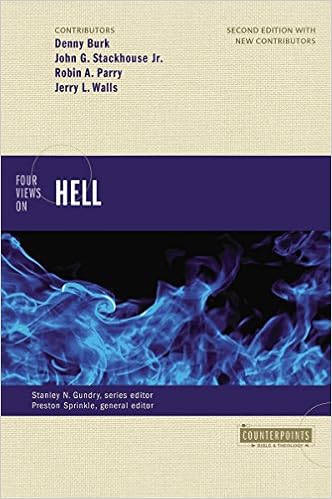
As you know, I’m a big fan of the Counterpoint series, and I had (somewhat) recently purchased the Four Views on hell. However, recently I saw the updated second edition on Netgalley. This review is for the second edition. After I read the original, I’ll make a few comments on it as well.
My Rating -Put it on the list
Level – Medium length, get’s mildly technical, but overall fairly easy.
Summary
As the title say, the book argues four thoughts on hell. Well, really it is three views of hell, and another who goes on a tangent. All authors believe that hell is real, that it is punishment, and that it is the place that those whom die without the knowledge of Christ are destined to go.
Denny Burk argues for the ‘traditional’ view of hell, i.e., that it is a place of eternal punishment. John G. Stackhouse, Jr. argues for ‘annihilationism’ or that those punished in hell will eventually destroyed. They will cease to exist and therefore not receive eternal punishment. Robin A. Perry argues for a Christian Universalism, a term I’m more familiar with is universal reconciliation – that Christ will eventually reconcile all to him, even those in hell. Jerry L. Walls also takes what he calls the ‘traditional’ view, which is purgatory. As far as hell goes, he more or less aligns with Burk, in that it is everlasting conscious torment, but that few people will eventually end up there. Most will end up in purgatory, and then head to heaven.
Eternal punishment is probably the most widespread belief among Christians today and throughout history. Burk’s basic argument is that God’s goodness is so infinite compared to us, that our sin (against God) likewise needs to be punished infinitely. Burk makes strong arguments, but where he really shines is in his responses to the other authors.
Annihilationism, as Stackhouse points out, dates back as far as the early church fathers, including Origen. He basic premise is that through Christ, we have eternal life, but in sin, we only have death and destruction. Stackhouse probably uses the most Biblical proofs for his argument including the ‘Lake of Fire’ in Revelation.
Universalism seems to be more based on hope than on extensive Biblical texts. The idea that God saves even those in hell and that all will eventually be saved is something all Christians should hope for. I certainly do, I just do not see it in the Bible. He focuses most on the morality of eternal punishment (or how it isn’t) and the verses that say things such as, ‘takes away the sins of the world.’
Purgatory is an interesting chapter. Walls believes in eternal torment, but that most will not experience it. Instead, they will go to purgatory and then enter heaven. He argues, somewhat convincingly, that purgatory is the only answer to questions the Bible leaves open about what happens after death and beliefs in heaven and hell. The chapter is a good primer on Purgatory, but as you read it, as well as his response articles, you are left wondering, ‘why are you here?’ He seems to be only tangentially related and possibly should have been in a different book all together. Maybe something about what happens after death, or even one on heaven, or something along those lines. This is really more on the editors, but he does seem out of place.
My Thoughts
As I said earlier, I hope for universal reconciliation. I just do not think it is the case. I generally land somewhere in between (or rather, go back and forth) eternal punishment and annihilationism, often more to the latter as I see more Biblical support for the idea. I won’t list this as a must read, due to the tangent on purgatory, but for anyone willing to challenge themselves and learn about the different views on Hell, this is a book you should put on your list.
I received a free copy of this book in exchange for an honest review.
 Monday Morning Theologian
Pingback: Top post of the first half of 2018 | Monday Morning Theologian
Pingback: Top Posts of 2018 | Monday Morning Theologian
JK, thanks for your review of four views on hell. I read this book too and I thought it was excellent. I am also an author on this topic, and I just wanted to let you and others know that I believe I may have had a breakthrough discovery on this topic which brings forth new evidence that weighs heavily in favor of annihilationism. As you probably know Revelation 14:11 is one of the pivotal verses on the topic and is also one of the most debated over. My discovery is in regard to Revelation 14:11. As you probably already know, the language in Revelation 14:11 is shared with Isaiah 34, “smoke goes up forever”. If we look in the Dead Sea scrolls, the language of Isaiah 34 is a little bit different and may be revealing:
[Isaiah 34:6-7, 9-10 DSSB Dead Sea Scrolls Bible] 6 The Lord has a sword filled with blood, gorged with fat, with the blood of lambs and goats, with the fat of rams’ kidneys. Indeed the Lord has a sacrifice in Bozrah, and a great slaughter in the land of Edom. 7 The wild oxen will fall with them and the young bulls with the mighty steers. Their land will be drunk with blood and their soil saturated with fat. …… 9 It streams will be turned into pitch, and its soil into sulfur, and its land will become pitch. 10 It will burn night and day and will never be extinguished. Its smoke will go up from generation to generation, and it will lie waste forever and ever. No one will pass through it.
Of course this Isaiah 34 passage above reads this way in an English translation of the Hebrew Masoretic text below (aligning with the language, “Its smoke will go up forever” which John re-used in Revelation 14:11):
[Isaiah 34:6-7, 9-10 NASB20] 6 The sword of the LORD is filled with blood, It drips with fat, with the blood of lambs and goats, With the fat of the kidneys of rams. For the LORD has a sacrifice in Bozrah, And a great slaughter in the land of Edom. 7 Wild oxen will also fall with them And young bulls with strong ones; So their land will be soaked with blood, And their dust become greasy with fat. … 9 Its streams will be turned into pitch, And its loose earth into brimstone, And its land will become burning pitch. 10 It will not be extinguished night or day; Its smoke will go up forever. From generation to generation it will be desolate; None will pass through it forever and ever.
As you may recognize, the language in verse 10, in either the Dead Sea scrolls or the Masoretic text, above is very reminiscent of the virtually never ending smoke of the continual morning and evening regular sacrifice in the Old Testament sacrificial system. The abundant sacrifice language preceeding verse 10 above may also give us more reason to understand that verse 10 is also using the language of sacrifice. I have done several years of deep research on this topic and found that there is an abundance of evidence in numerous places in the Bible to demonstrate what I’m proposing here about verse 10 being the language of the continual morning and evening regular sacrifice. If this is correct, the language that John is using in Revelation 14:11 hearkens back to a sacrificial symbolism which communicates complete and utter destruction to the point of ashes and not endless torment. If you or anyone here visiting your page would be interested to see the results of my research, please feel free to take a look at “Hell Is Made Holy” which you can find online for no green just using my name David Aaron Beaty and “Hell Is Made Holy”. Thanks again for your book review. God bless
LikeLike