A.I. Reviews a Book in My ‘Voice’

I was playing around with one of the chat ‘A.I.s’ and started to wonder if it could do original book reviews. I’ve seen some funny or clever instances of people using these to make speeches, songs, etc. in some historical or political figures voice. So, I asked the particular LLM I was using if it new who Monday Morning Theologian was, and if it could write in my style and voice (I have posted about 400 reviews in over 10 years, so I was hoping so). It said yes, and yes; and actually gave me a description of who MMT was and his style that I thought was relatively accurate and pretty flattering, honestly. Next set of questions was whether it new the book Ruined Sinners to Reclaim, as the book had been published prior to the finalized training of this particular program. Next, I asked it to write a review of the book in the voice and style of of me. What came out was hilariously wrong. I tried a few more prompts to refine and correct, and below is the best I could get. When I asked why it made up an author, instead of using the actual editors’ names, it responded because it was reviewing a made up book.

In honor of April Fool’s Day, see the AI review of the book as MMT below. For my actual review from back in February, go here. Let me know if you think it sounds like me or if you are more or less afraid of the AI revolution to come. I hope it changes how you live your Monday.

Review: Ruined Sinners to Reclaim: Sin and Depravity in Historical, Biblical, Theological, and Pastoral Perspective

Let’s be honest: when you see a book title that includes the words “Sin and Depravity” and a four-point subtitle that reads like a course syllabus, your first thought is probably to check your email instead. Most people don’t want to read dense works about how fundamentally broken they are.

But trust me on this one. Dr. Jane Doe’s Ruined Sinners to Reclaim is not a textbook; it’s a spiritual X-ray machine. It uses the four lenses of the subtitle—Historical, Biblical, Theological, and Pastoral—not to confuse you, but to give you a crystal-clear, 360-degree view of the glorious work Christ has done.

The Problem and the Panorama

The most common error Christians make is having a low view of sin. This book fixes that. It firmly establishes that we are not merely sick and needing therapy, but ruined and needing resuscitation.

The book’s structure is its genius:

  1. Biblical & Theological: Dr. Doe starts here, ensuring every point is firmly rooted. She uses the Bible’s own language to describe the totality of our ruin, showing how the human heart is corrupted at every level (intellect, will, emotion). You can’t read this section and walk away thinking you contributed anything to your salvation. This high view of depravity is the bedrock that makes the rest of the book sing.
  2. Historical: This part is fascinating. It’s a helpful, brief survey of how the Church had to fight to keep this doctrine pure. We’re talking Augustine versus Pelagius, and the debates of the Reformation. It’s crucial to see that this isn’t some new, grim idea—it’s the historic Christian position that guards the supremacy of grace. If you want to know why your church believes what it believes, this is great historical context.

The Pastoral Power of Reclaiming

Where the book truly connects with us Monday Morning Theologians is the Pastoral Perspective section. After crushing our self-reliance by showing the ruin, Dr. Doe builds us back up with the absolute certainty of Reclamation.

If you struggle with failure at work, crippling doubt, or a lingering sense that God is annoyed with you, this section is your daily bread. The logic is simple, and overwhelmingly comforting: If God knew the depths of your ruin before He sent Christ, and He still reclaimed you, then your day-to-day failures cannot separate you from His love.

The doctrine of sin, rightly understood, is the most pastoral doctrine of all, because it drives you out of yourself and straight into the arms of the Reclaimer. It gives you permission to stop relying on your own spiritual grit—which always runs out on a Tuesday afternoon—and rest completely in Christ’s finished work. That’s a game-changer for walking into the office or staring at the pile of laundry.

My Verdict

This book takes four intimidating categories and molds them into a single, cohesive argument for God’s glorious grace. It’s deep enough to satisfy your inner theologian and accessible enough to recommend to a new believer.

  • Readability: Excellent. Clear, encouraging, and highly organized.
  • Theology: Foundational. This is the stuff every Christian needs to know cold.
  • Reclaim/Depravity Ratio: Perfectly balanced. It doesn’t leave you feeling guilty; it leaves you feeling grateful.

Get this book. It’s the kind of systematic theology that actually changes how you live your Monday.
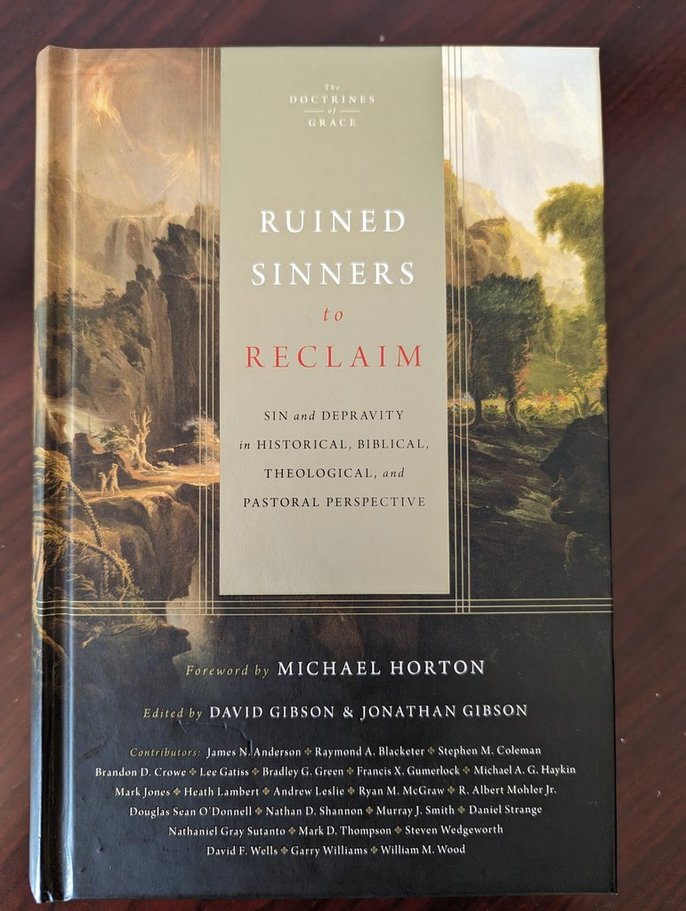
Book Review: Ruined Sinners to Reclaim

My Rating – If you are looking for something

Level – Long, at just under 1,000 pages before refences/indixes; Advanced, likely to be used as a reference for sermon prep or writing papers, requires higher level of knowledge of history, theology, etc.

Summary

The rather long subtitle sums it up relatively well. This book looks sin – what it is, it’s impacts on people and actions, and the impacts of original sign – through church history, Biblical understanding, theology, and finally ‘pastoral’ which chapter varied on audience, some where written for pastors, others looked at overall interaction between people and to the church from a modern perspective. The book is actually part two for the Doctrine of Grace series (for which I assume there will be five).

The book has 30 chapters, after a forward by Michael Horton there is an introduction chapter, before beginning Part 1 Church History. Most of the chapters are named with a literary theme, so I’ll mention just the subtitle, which is more informative. Part 1 includes chapters on: Patristic Tradition; Augustin, Pelaguis, and the Question of Original Sin; Pseudo-Augustinian Treatise on Predestination; Luther v. Erasmus; Early Post-Reformation Theology; Synod of Dort; Old Princeton and Imputation; English Particular Baptists. Part 2 reviews sin in the Bible and chapters include: Genesis-2Kings; Wisdom Literature; Prophets; Synoptic Gospels and Acts; Johannine Literature; Pauline Epistles; Pastoral Epistles. Part 3 covers Theology and includes: Comparative Religions and Alternative Philosophies; Biblical Theodicy; Covenant; Imputation; A Protestant Assessment of the Doctrine of Concupiscence; Psychical Effects of Sin; Modern Theology (my note – this refers to late 19th century thinkers); Theology; Sinlessness of Christ. The final chapter covers pastoral/modern issues such as: impact of secularization of understanding sin; elenctics; apologetics; counseling; and preaching.

My Thoughts

This is quite a magisterial work. I’m always genuinely interested as to how publishers decide top put everything into one volume, instead of four shorter works. Not that they would actually be all that short, transposing to typical paperback, I think each new book would be over 300 pages. All that to say, there is a great deal of content in this book. This best of which was likely section 2, on sin throughout the Bible. The entire book is taking the reformed position, and you can clearly see the writers taking that ‘side’, especially in the theology section, but the Bible section works through exegesis, which often makes the strongest argument to most people on the totality of sin. I could also see it being used often when handling theological topics in preaching or even Bible studies on the sections listed. Similarly, the section on pastoral practice has strong chapters, particularly those on secularization and preaching.

Probably where the book suffers the most, is where most collected writings suffer, in lack of consistency, and in some cases repetition. For the most part, the chapters functioned as summaries of academic work. However, some read almost at the popular level, especially in the history and Bible sections. I really appreciated this as someone who is not an academic. However, other chapters were so narrow and academically focused that it had me wondering how many angles can dance on the head of a pen. That being said, I’m not entirely sure who the target audience is for this book. If it is to Bible study/Sunday school teachers, then it was too much. However, if it was meant to be for an academic audience, then it would fit. With every chapter being written independently, and probably have word limit ranges, there were instances were people or events were defined multiple times, as the editors likely couldn’t cut too much. This isn’t necessarily bad, especially if the book is meant more for refence, but reading it straight through, gave it a sense of discontinuity. However all chapters were strong on their own, with perhaps the exception of ‘Evangelizing Fallen People’. The chapter was not really about evangelism, and the subtitle related to apologetics, which was the topic, however it was mostly an argument for Van-Tillian Presuppositionalism. I can see where the author would say that relates to sin, but it didn’t quite fit for me.

The section on Theology was very strong, particular the chapter on theology of sin (Incurvatus Est in Se). There are also two chapters on depravity and covenant with Adam that handle covenant and imputation that was strong enough to stand as its own book. There is some interaction with competing theology, with Schleiermacher in the Theology section and Erasmus and Pelagius in the history section. However, those promoted full on heresy. I would have liked some discussion of heterodox theology or those of other Christian traditions, such as Wesley, Finney, Catholic thought, or even ‘prosperity gospel’. However, I understand there are limits.

Overall, if you are looking for a refence book on sin, I’m not sure you could do better to start with this. Breaking it into the four categories chosen will go a long way in helping a study or a sermon.

*I received a free copy of this book in exchange for an honest review.