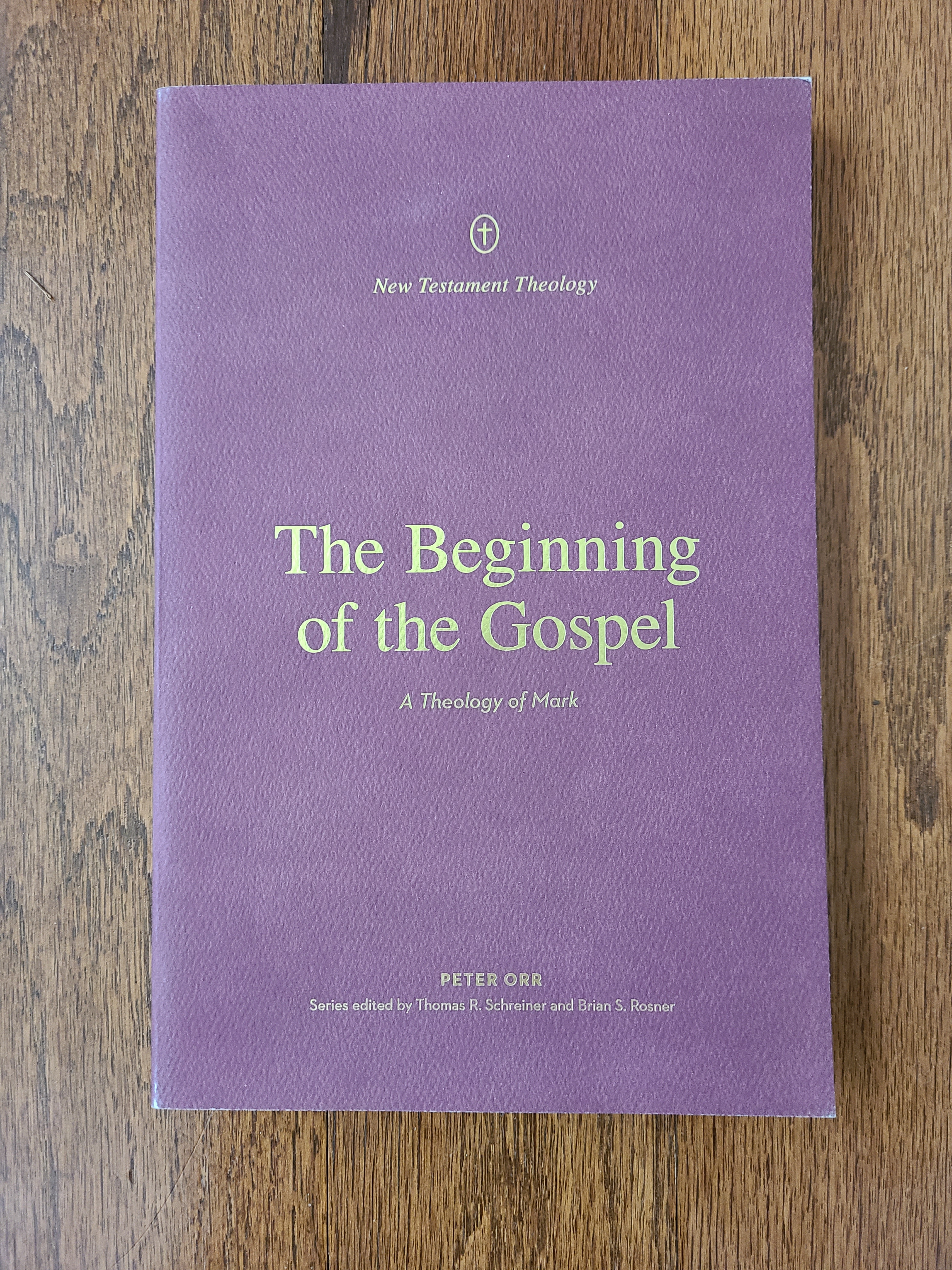
Book Review: The Beginning of the Gospel

Rating – Put it on your list

Level – Moderate, written at popular level but Biblical knowledge is helpful; short (less than 200 pages).

Summary

This book is part of Crossway’s New Testament Theology series, and I think it is a fairy unique angle for study. The series preface says they are seeking, in this series, to take a Biblical Theological approach to the major themes of each book covered. If you aren’t as familiar with the term Biblical, it is as opposed to the more common Systematic way of handling theology; the latter being focused on topics first (sin, the church, etc.), while the former looks at overarching themes that unfold as you read through the Bible (or individual book in this case).

The book is broken into seven chapters – Divine Identity, Revelation, The Kingdom of God is at Hand, Repent and Believe the Gospel, Follow Me, What Moses Commanded, and Died, Buried, and Raised. There is also an introduction and epilogue. The intro chapter in this series is consistently one of the best out there on the topic. The on for Mark is less than 15 pages, but acts as a mini commentary. 

My Thoughts

This is a solid study on Mark. As mentioned above, it isn’t a traditional commentary, but focuses more on themes/theology of book. My main criticism would be that the chapters are almost too disparate. Other books in this series, while not having a unifying theme, still seem to flow more cohesively. That being said, if you are looking to teach/preach on Mark, this a book to add to your list. 

Particularly chapters one, two, and six are interesting in the connections he makes. First, who Jesus actually claims to be (and who his followers thought he was) is supposedly debated often today, but in reality His claims are clear. The chapters on handling the Old Testament is also instructive.

Something unique to Orr’s approach is the connection with both Peter and Paul to Mark. Mark is often associated with Peter’s perspective in the Gospel, but he also worked with Paul, and many of the theological elements of the Epistles are present in Mark. Whether Mark or Matthew were the first Gospel written is debatable, but either one would come later than most Epistles, so much of the original audience had the knowledge and writings, before the had the Gospels. I think that is hard for modern readers to remember, because we view it (and the Bible is arraigned) chronologically. There is also often a criticism from those outside the church that the Epistles, especially Paul’s, were a later change to Jesus’ message and that they altered the theology of the Gospels. Orr does a good job showing not only how aware Mark was of those letters but how his Gospel interacted (and agreed) with them.

If you are doing a Bible study or preparing a sermon series, this book can’t really stand on it’s own and would need to be supplemented with additional commentaries (especially if it is a sermon series). However, the chapters could be a good outline for a study and the book raises many good points and tackles some of the more confusing elements. If you are interested in deeper study of Mark, put this on your list. 


*I received a free copy of this book in exchange for an honest review.

Book Review: From the Manger to the Throne

My Rating: Must Read

Level: Moderate, written at popular level but Biblical knowledge is helpful; short (less than 200 pages).

Summary

The book is broken into seven chapters – The Great Reversal; Peace on Earth as in Heaven; Israel, the Gentiles, and Isaiah’s Servant; The Way of Life; The Success of the Last Adam; The Son of Man’s Rule and the Ancient of Days; and The Year of Jubilee. There is also the series preface, book preface, intro, and an epilogue. If they chapters don’t look chronological to you, it is because they aren’t. The unique aspect of this series is that it seeks to catch all the major theological themes, but in commentary style.

My Thoughts

This is the first book I’ve read in Crossway’s New Testament Theology series, and I think it is a fairy unique angle for study. I’ve seen this book (or series) occasionally referred to as a commentary (not by Crossway) and while that isn’t technically correct, I can see where people are coming from. If you took a true scholarly commentary on Luke (e.g. Baker’s) and stripped out just the sections on theological themes or maybe an excurses on angels, you’d end up with something like this book. The series preface says they are seeking, in this series, to take a Biblical Theological approach to the major themes of each book covered. If you aren’t as familiar with the term Biblical, it is as opposed to the more common Systematic way of handling theology; the latter being focused on topics first (sin, the church, etc.), while the former looks at overarching themes that unfold as you read through the Bible (or individual book in this case).

Now, the seven themes Gladd has chosen are probably not the consensus themes among theologians/scholars. I imagine if you asked 10 people to pick seven themes, they might agree on three or four of them. Even as I read, I caught myself wondering whether one or two of the topics really belonged. That being said, I actually think this adds to the potential use for the book. As I read, I kept thinking about how great this would work as a small group or other Bible study. I would have loved to hear others’ feedback on some of the threads Gladd pick’s up on. He obviously makes compelling cases in each chapter and backs up each point with scripture from all over the Bible, so I don’t think any of them are ‘wrong.’ For a pastor a bible study leader, that gives you some compelling material to challenge people.

I was pretty much hooked on this after the intro while long for an intro to a book this size (over 10% of the pages) it makes sense once you read it. Gladd takes you through a quick summary of all of Luke. It was probably one of the most concise, while still being dense and comprehensive, overviews of any book of the Bible I’ve ever read. It really would be a great way to start off a Bible study.

I wouldn’t recommend this book as the first thing someone reads on Luke, or even for a new believer. To be as short as it is, you need some level of scripture to begin. This book would best be used in self study as a supplement to a regular commentary or, as I mentioned, an eight part Bible study with a group. I think getting everyone caught up on Luke from the intro, then spending a study time on each chapter would be a great use of this book and lead to some interesting discussion. For pastors preaching through all of Luke, this would certainly give you some ideas to focus on and themes to pull out and make sure are coming out in your sermons. While being somewhat technical, it is well and is a fair quick and easy read; it is also short at under 200 pages. If you are already familiar with Luke and look for another way to study, or leading a study, or are a preacher, this book is a must read.

*I received a free copy of this book in exchange for an honest review.