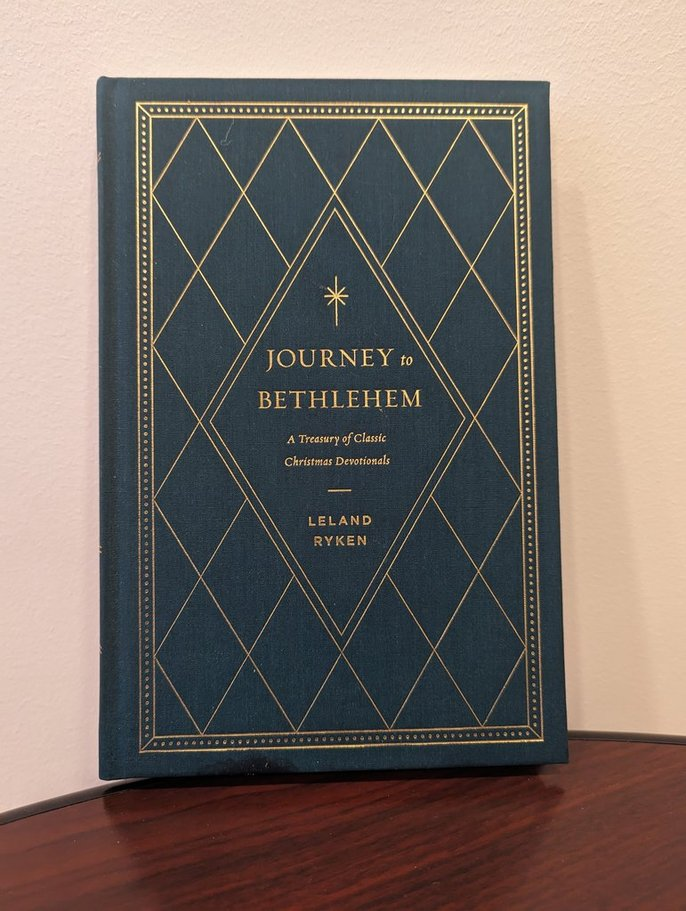
Rating: Put it on your list
Level: Easy, Short (5ish minutes a day/30 days)
Summary
In some ways, this is a typical 30-day devotional, with a section to read, then reflection, etc. However, I think Ryken has done something unique in his choices. It is easy to find a 30-50 day devotional that has writings from numerous authors in the past, but Ryken has only reserved 10 of the days to pure thoughts of others, the remainder of the days are reflections on hymns or poems.
The book is broken into three sections, the first being Hymns, then what he calls ‘Classic Prose Devotionals’, and finally Poems. Each day follows the same format – the text (e.g. Joy to the World, an excerpt from On The Incarnation, The Magnificat), then a commentary/reflection, then a brief ‘devotional takeaway’, before a final note and word of scripture. There is also a short intro into each of the three sections. Finally, what he calls ‘notes’ which is essentially a bibliography, if you want to find more info, as well as two indexes – one for the people in the book, another referenced scripture.
My Thoughts
I’ll start with the only thing I didn’t like, and that was the choice of categories. Choosing Hymns and then Poems, is too similar to me (he acknowledges as much in his into to Hymns, stating, ‘Every Hymn begins its life as a poem.’ That is very minor and nit-picky, maybe I just like symmetry too much, but I wonder if the book would have been better off as just hymns/songs/poems.
Other than that, the book is great, it should be on everyone’ s list/rotation to read around Advent/Christmas. Ryken is a great write, and maybe an even better editor. I really appreciate the summary takeaway and then ending with scripture. His choices for each day are interesting and spread out (there are so many options), but there are plenty you will be familiar with, while adding some that may be new.
I knew six of the Hymns (and four are probably one everyone sang at a Christmas Eve service), the Prose included big names (Calvin, Luther, Augustine) but then other maybe not everyone has heard of (Bernard of Clairvaux, Spurgeon, Athanasius). Interestingly, he added the Nicene Creed to this section, which I really enjoyed. Similarly, the Poems included works of Chesterton, Milton, and Eliot, but I didn’t know any of the others. Except he put the Magnificat in this section, which was a good and interesting point to make. If you aren’t familiar with that name, it is the historic name for the section in Luke 1:46-55w here Mary responds to Gabriel after being told she will give birth to Jesus (it also kind of answer the question Mary Did You Know?, but I’m not trying to start a fight a Christmas).
Overall, I highly recommend this book, the devotions are short enough to fit into a busy time and his choices of authors and especially hymns/poems makes it interesting and different enough compared to the so many other great and traditional ones out there. So, if you didn’t get to a devotional reading this past December or you did and are looking for something different next year, this is a book to put on your list.
*I received a free copy of the book in exchange for an honest review

 Monday Morning Theologian