Book Review: God Among Sages

God among Sages: Why Jesus Is Not Just Another Religious Leader

My Rating – If you are looking for something

Level – Easy read, moderate length (a little repetitive)

Summary
Samples has put a book together that looks at Christ and historic Christianity, and compares Him to the leaders or representatives of four other major religions. The book is broken into three parts – a historicity of Christ, both as a man and God; a short intro to representatives of four other religions and how they compare to Christ; a few thoughts on plurality in the world and the Biblical view of other religions.

The first part of the book is broken into four sections, but overall it is a basic apologetic for the Christ of traditional Christianity. Samples goes through Christ claims of divinity, the reliability of the Bible, and then a few points on the fact that Christ, the man, a person in history, actually existed.

The second part of the book is really the meat and what you’d expect based on the title. It is also broken into four parts and Samples hits on Krishna as representative of Hinduism, Gautama (the Buddha’s birth name) for (obviously)  Buddhism, Confucius, and finally Muhammad for Islam. In each section he outlines the life of the person, the basics of their teachings/beliefs, and then how they compare to Christ.

The final part of the book is broken into three sections, plurality in our world, Biblical view of other religions, and finally a concluding summary of Christ’s claims verses the other four.

My Thoughts
I wasn’t really sure how to rate this book. I liked a good bit of it, but found other parts annoying. I guess it will depend on the perspective from which you come to this book. It is a little too apologetics 101 for me, especially the first part of the book. I understand, that almost by definition, if you are trying to substantiate the claims of Christianity, you have to use apologetics, but what bothers me is really more of the tone. There is a just an attitude and style of argument from those in the philosophical (especially Ontological) and presuppositional  apologetic framework seem to have. It just rubs me the wrong way. If you like it, or are new to apologetcs, the you will probably really enjoy the first section of the book. All that being said, he does a good job summarizing arguments for the reliability of the Bible and Christ’s claims of divinity that all Christians should know pretty well.

The section about the other leaders was a well written introduction. Some of it was new to me and others a good reminder from my high school world religions class. As Christianity declines and more people arrive from different parts of the world, it is becoming more and more important to know the basis of other beliefs. This book could be a good start (Sample pack? sorry) into the study of world religions. He cites other works at the end of each chapter if you want to go deeper. The only part I really didn’t like about the section of the book is that he repeats his arguments (stated in the first part of the book) about Christ again and again in each chapter. Maybe it is a pet peeve of mine, I just dislike redundancy and repetitiveness.

The last section of the book was probably my favorite. Sometimes, I’m not sure I’d necessarily call them moments of doubt, I do wonder, what if all paths lead to God? That does change my view that this is the path Christ chose for me, but what if one day we get to heaven and we find out that everyone is there and they all came through different ways? Maybe that would be kind of neat. Samples summary of the issues with plurality point out that this isn’t really possible. For one thing, not all ‘paths’ even have a ‘god’. Many don’t have an afterlife, but reincarnation. Also, what about people who are on no path, so to speak? Even as you try to be kind and loving and accepting (to some extent) of all other beliefs, it is good to remember that plurality (in the sense of all beliefs being equally valid) is unworkable.

I think many people could learn something from this book. However, it may not be for everyone. It isn’t quite on the level of everyone should read it, but if you are looking for a good intro to either divinity of Christ, reliability of the Bible, any of the four religions covered, or Christianity in a pluralistic world, then you should put this book on your list.

*I received a free copy of this book in exchange for an honest review. See more here.

Book Review: Misbehaving

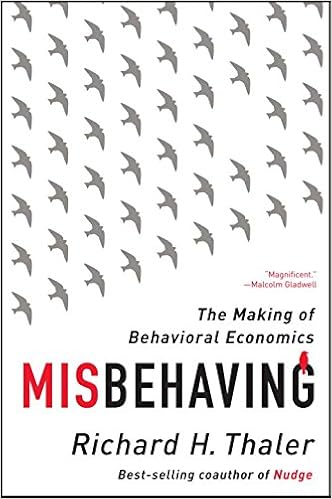
Misbehaving: The Making of Behavioral Economics

My Rating: Put it on your list

Level: Moderate to difficult, depending on your base knowledge of Economics and Psychology. Moderate in length, but reads quickly

Summary
Part Thaler autobiography, part time line of the development of the field, with plenty of humorous anecdotes and academic ‘anomalies’, this book does not read like a history of an academic discipline. The book is broken into eight broad chapter based around years in which Thaler worked through differing parts of the development of the field. The chronology starts with him as a graduate student, where he is just starting to look into ideas that would become the discipline, and proceeds up to the present, where he seems poised to hand over the reins to the next generation. Along the way are his stories of getting the discipline recognized by academic journals, struggles with the establishment, and gaining allies (across other disciplines, as well) and students that will become the next generation.

My Thoughts
This book, like the somewhat related book (Thinking, Fast & Slow) by his fellow collaborator, Daniel Kahneman, kind of annoyed me in how well it is written. Thaler has had a nearly five decade career as researcher and writer, so he should write well, but that is not what I mean. His book is funny and reads quickly like a narrative. As I said above, it it part autobiography, and lends itself tremendously to humorous narrative that leaves you interested in reading more. As a pretend internet researcher and writer, I am envious that someone with actual credentials writes so well.

All that being said, I think I missed the subtitle of this book when I first heard about it a few years ago. I heard Thaler on a interview, and knew he was related to behavioral economics, but didn’t quite realize this was book he was promoting. I must have searched his name on amazon and bought the first book I saw, without noticing the reference to ‘Nudge’ on the cover. Nudge was really the book I was looking for, which is more about the research out of Behavioral Economics as it relates to topics like money and health. ‘The Making of Behavioral Economics’ should have clued me in to this book being more of a history. Luckily, I enjoy history and biographies, and as I said above, he is a very talented writer.

One of the first things that stuck out to me was how long he as been in the field. His book starts in 1970, with him as a grad student. I wouldn’t be born for another decade and a half, and I don’t consider myself very young. I’ve heard that Millennials will have between seven and 17 careers over their lifetimes, so it amazes me to read of someone’s history in a field that is longer than my lifetime.

Reading history is always fascinating, because you, with the addition of hindsight, can read and say, ‘how did these people miss this?’ I couldn’t believe some of the resistance he and others would face as the argued against the efficient market hypothesis. I was in high school during pets.com (look it up kids) and the tech bubble and finished grad school a few months before the housing bubble popped, so I struggle to believe in any way the the market is efficient and that people are well informed. Thinking back to my undergrad economics courses, I believe I was taught the distinction between theory of economics (people who Thaler calls Econs) and actual behavior (called Humans). In grad school, the distinction was called that of theory and practice. So, it is interesting to see that a few decades before, saying things like this, which to me are clearly true, would get you laughed out of conferences and barred from academic journals.

This history was interesting, and the debates with other academics were amusing and insightful, but the book really shines with the anecdotes. I won’t go through all of them here, but the include an economist who refuses to sell his wine (for a gain) at the market price while also stating he would never buy it at the price and companies whose stock prices are lower than their subsidiaries (even when purchasing the larger company stock means getting the smaller companies stock included; this means the larger company is valued in negative dollars relative to market cap).

These types of stories are what I enjoy reading. They are amusing on their own, but also challenge your assumptions about certain areas, but even more, make you really question whether you actually know what you are doing. You may think you do everything rationally, but you probably don’t, and that is illustrated time and again in this book. If you are looking for just stories and research results, you are probably better off with Nudge or Thinking, Fast and Slow. However, if you are interesting in Behavioral Economics in general, this is definitely a book to put on your list.

Book Review: Martin Luther in His Own Words

Martin Luther in His Own Words: Essential Writings of the Reformation

My Rating – If you are looking for something

Level – Short, but moderately difficult read. This isn’t an intro for the Reformation, some knowledge of church history and theology will be needed.

Summary
The title could be a bit misleading to some, i.e., one may think it is a sort of autobiography. However, the book is a collect of Martin Luther’s writings. Twelve selections, to be precise, broken into five broad topics (cleverly) modeled after the five solas – fida, gratia, scriptura, Christus, and gloria.

If you are unfamiliar, the five ‘solae’ (alone or only in Latin, think of the modern words sole and solo) was the cry of the Reformation. So the chapters are laid out in the Latin words mentioned above that correspond to faith, grace, Scripture, Christ, glory (to God). Delving into these is beyond the scope of a book review, but as this year (2017) is the 500 anniversary of the Reformation and Martin Luther was the initiator, it was a pretty interesting way to divide the book.

There is an into by Kilcrease before each selection that helps with context and there are a few footnotes within the selections that are helpful for understanding particular, archaic, and/or theological/ecclesiastical terms.

My Thoughts
There is a difficultly in trying to review a sample pack of a book. My main critique would be that Luther’s most famous writings are probably ‘The Bondage of the Will’ and his Larger & Short Catechisms, and if you know much about him, his commentary on Galatians, and of the 12 selections, only four come from sources other than these. Granted, this may have been their reason for the selections, but I would have preferred a more diverse grouping.

I wanted to like this book more, but maybe because I am fairly familiar with Luther, it just didn’t quite do it for me. However, if you do not know much about Luther’s writings or the beginnings of the Reformation, this may be a great place to start. Kilcrease’s introductions are great and very informative. Or, if you are curious about Luther’s writings and don’t know where to begin, this would be a great place to start. If you haven’t read much, the translation footnotes are incredibly helpful and will make it an easier read the just pulling some of the freely available online versions of many of his writings.

There is renewed interest in Luther and the Reformation in general this year as we approach the 500th anniversary and this book is one to read, if you are looking for something.

If you were looking for a biography then check out Here I Stand: A Life of Martin Luther. I haven’t read it yet, but the general consensus seems to be that it is the best.

If you think this book sounds a little to introductory, or you’ve read it and want more of Luther, then this collection (which I have read) seems to be the best next step (there is some overlap) – The Martin Luther Collection: 15 Classic Works

*I received a free copy of this book from the publisher in exchange for an honest review.

Book Review: The American President

The American President: From Teddy Roosevelt to Bill Clinton

Rating –  Put it on your list

Level –  Moderate to difficult read, 800+ pages

Summary
This book is kind of unique. I thought I was buying a big book that essentially be a volume of shortish biographies for all the presidents of the 20th century. In a since that is what it is, the presidency from Teddy to Bill. The major difference it is really is focused on each man’s presidency more than it is the man himself. There is short biographical into, so to speak, but it really is more a chronicle of their years in office.

It is more than just history that Leuchtenburg write on, the uniqueness comes from his approach of how the presidency changed under each man and overtime. In a way, the book is more a biography/history of the presidency in the 19th century; certainly much more so than a collection of biographies.

My Thoughts
It really is an interesting book. The presidency changed so dramatically from Teddy to Bill, covering those changes and diving into the intricacies of how and when they happened really is a fascinating take on history. For his part, Leuchtenburg is a master historian, but if I had one criticism of him, it is that often it seemed he was going out of his way to find a long, rare word. I fire threw about 50 books a year and write reviews for most of them, so I feel I have a pretty decent vocabulary, but I felt like I had to look up words every few pages or so.

In that sense, the book was a bit academic, but for the most part, his writing is much more of story telling. You can breeze through a surprising amount of pages as he tells the tale of the major shifts in the way the most powerful office in the country has been handled. When you are ready to tackle this book, you better well know, it is not small. Not only is it well over 800 pages, but they are large pages, and densely packed with writing.

All that said, anyone interested in politics or history needs to pick up this book. Hopefully, there are come college classes out there requiring it. The book is a wealth of information and is exceedingly important to see how we got to where we are today with regard to presidential power.

Book Review: The New Dad’s Playbook

The New Dad’s Playbook: Gearing Up for the Biggest Game of Your Life

Rating – Put it on your list

Level – Quick and easy

Summary
The book is basically what it says it is – a guide to fatherhood – just (sometimes too) heavily mixed with football metaphors. The book is 14 chapters broken into five parts, all based on a football season – training camp, regular season (pregnancy), super bowl (birth), postgame, and off-season(dad things, have another child). The attempt to put everything neatly into these categorise can be a bit of a stretch, especially in the ‘training camp’ section, but actually work out really nicely in ‘regular season’ and ‘post game.’

My Thoughts
This book turned out better than I thought. I was little skeptical at the beginning, with the intro chapter somewhat meandering, but Watson really got into stride with the practical advice. As mentioned above, training camp was probably the weakest, but I have to say, I was really surprised at how well the ‘regular season’ chapter turned out. It was a great pregnancy 101. Watson actually goes through the different terminology, stages of pregnancy, and medical options defining and explaining in quick and simple terms what they mean. Maybe it is because Baker is a ‘Christian’ publisher (who typically aren’t great a practical advise), but I was surprised at how useful and practical this section was.

‘Postgame’ and ‘Off-season’ where also good chapters, where he moves away from practical advice (in the step-by-step, playbook sense) and honestly moves into challenging men. Basically saying we need to step up for our family, work to keep the marriage strong, and then realize we will fail, regardless, and that it is alright, because you can’t be a perfect dad. To wrap-up and really expand the breadth of the parenting aspects, he ends on a solid discussion on what it means to have another child, and even differing thoughts on how long to wait and how many children to have.

For those skeptical that you can find a practical (pre)parenting book from a CHristian publisher, this one is the exception. For those maybe interested due him being a famous football player, but disinterested in the CHristian-y parts, I think it is still a solid option. The intent of the book is to be practical and helpful, he isn’t kidding with the ‘playbook’ part of the title. However, it is clear that the man loves God. He obviously takes his relationship with God, his wife, and his children very seriously. It was encouraging and convicting at the same time.

Any pre-dad should have a number of books and resources in mind, and this is definitely one to put on your list. If you have a friend that doesn’t like reading and might only read a book because it was written by a football player (and you probably know a few), this book is perfect. I can think of a guy right now whose wife is almost through the first trimester that I will give this book to. The practical advice, the sports references, and the quick and easy pace of the read will make this book one that anyone will finish.

* I received a free copy of this book in exchange for an honest review.

**You still have time to order this book and give it to a pre-dad as a father’s day gift, should you be so inclined.

Book Review: The Imperfect Disciple

The Imperfect Disciple: Grace for People Who Can’t Get Their Act Together

My Rate – Must Read

Level – Fairly easy, short to moderate length.

Summary
A book about how to be a disciple written by someone who apparently isn’t very good at it. As usual, I don’t have a very good summary of what this book is about. The best summary of the books is right there as the subtitle – grace for people who can’t get their act together. I don’t know how to add to that. There are 10 chapters (20ish pages each) with a short introduction and even shorter conclusion.

My Thoughts
This is what a book about discipleship should be. This might be the best book I’ve read this year, certainly the best ‘Christian’ book of the year, probably the best in a while. I was given a copy of this book to review, but I may actually go buy a few more to hand out. So, what makes it so good? Was there anything revolutionary in this book for me? Honestly, no. There was almost nothing new and different for me, other than a growing jealously of his writing style.

Why would I want more copies of this book then? Because it is the best book to give out to people who ‘try’ hard to be ‘good’. I resonated deeply with his background, in the fundamentalist/moralistic sects of the baptist world. It probably took me until my 20’s to really understand Grace and the Gospel. To his subtitle, I already know I don’t have together and never will, and understand that this is the need for grace. However, there are so many people who don’t yet know this. Wilson is a master at saying what needs to be said in a way that will be heard by those who need to hear. He writes with the obliviously well worn heart of a pastor who has seen people burn themselves out or tear themselves down.

Buy this book for a new believer. Buy this book for the old believer you know who is always trying to ‘be’ better and is confused as to why they can’t. Buy this book if you disciple anyone, or lead any small group. Buy this book if you work with youth or college students. Buy this book for anyone new to the Biblical concept of Grace. Finally, go ahead and get if for yourself. It is a fun, enlightening read. I just pulled up amazon and it is less than $9. Admit it to yourself, that is less than you spent last time you went to one of those weight your ice cream places.

I rarely ever hold pages, or underline/make notes in non-academic books (things other than commentaries or systematics), but I just flipped back through this and found 15 dogeared pages. Maybe the most surprising is how broad they are, everything from what it means to be a disciple with examples from Isaiah, to issues with American Christianity and consumerism, to depression and struggling with your faith, and coincidentally to me as I am studying this right now – some good teaching from the Sermon on the Mount.

This book really is a go to book for what it means to be a disciple and a must read for anyone interested in the topic of being a follower of Jesus. The depth of the theology and pastoral messaging was incredible, while at the same time the book was funny and honest. He writes the way a non-pretend theologian blogger would write if he were to write a book.

* I received a free copy of this book in exchange for an honest review.

Book Review: The Christian Life

The Christian LIfe: A Doctrinal Introduction

Rating – Must Read

Level – Quick, easy read

Summary
The subtitle of this book is really illustrative of what this book is about. It is an introduction to doctrine for Christians, more specifically reformed theology. This is probably the best intro book I’ve ever read. You won’t get the full intro that you’d need to tackle Systematic Theology, there is no doctrine of church, sacrament, eschatology, etc., but his chapters on man, sin, grace, election/adoption, justification, and christian living are possibly unmatched in their accessibility to the average Christian.

I’d highly recommend this book for anyone looking to understand more about doctrine, to go above a Sunday School level, and it may even work as a gateway book into deeper study of theology. Ferguson was a theologian and professor, but this book is written by a pastor first and foremost and can easily be read by any Christian at any level of education and knowledge.

My Thoughts
If I’ve somehow been unclear, I’m really high on this book. Clocking in under 200 pages but with 18 chapters, anyone can hope in and out of the different doctrinal chapters with ease. As I mentioned above, this is a great intro for anyone looking to expand their knowledge. It is also a great reminder to pastor and theologians of the basics of doctrine. A way to bring those who greater knowledge back down to a simpler level, a more concise study of what others need to know.

This is written almost as a series of sermons and could be a great book for a Bible study or community group looking for something to read. For pastors and elders in the church, this should be the go to suggested reading for anyone inquiring about doctrine. Overall, it is a must read for every Christian.

Book Review: Katharine and Martin Luther

Katharina and Martin Luther: The Radical Marriage of a Runaway Nun and a Renegade Monk

Rating –  If you have time

Level – Easy read, short to medium length

Summary
For the most part the book is about the marriage of Katharina and Marin Luther. The first few chapters look at the two of them individually, then their life together, culminating in the death of Martin. The book is at its best, not necessarily discussion their marriage, but when getting into the minutia of life in the early modern period. The book is at it’s worst when the author seems surprised by the fact that life was hard for women 500 years ago.

If you are looking for an interesting book about the marriage between a former monk and former nun, this is probably not it. There are interesting insights, but it is far from a good history, there is a good bit of editorializing and comparing them to marriages of today. There is a little bit about the famous Table Talks and their life together mentoring and growing the next generation of reformers, but not nearly enough. In my view, this should be the centerpiece of a book about their marriage. It truly was revolutionary, but the author instead focuses her surprise on the fact that Martin loved and respected Katharina despite believing the Bible to the the Work of God.

My Thoughts
It should be pretty clear from above that I was a little disappointed in this book. The author goes in and out of interesting historical facts to discussing her shock that someone could read the Bible, believe it, especially as it pertains to the so-called ‘roles of marriage’ and then still love their wife. She starts with a good history of the issues women face, and they are shocking and substantial, but she doesn’t seem to be able to separate them from their place in history and our current time. She anachronistically puts modern views into the history of the early modern period.

Katharina and Martin hosted dignitaries, students, pastors, and leading intellectuals of the time from across Germany and other parts of Europe. She really misses out in this book by not getting into more of those conversations and how they related to each other. She also comes off a bit patronizing, unintentionally, to Katharina. She takes minor quips and solid comebacks and conflates them into great iconoclastic events.

Overall the book seems a bit jumbled, shifting focus too often. There is far too many uses of phrases like, ‘one wonders’ and ‘it’s not hard to guess’ for my liking. To be fair, in her defense, she never claims to be a historian or that this book is a definitive biography of historical discussion on their marriage. Her near unending shock that there are many letters retained from possibly the most famous and impactful European in church history greatly outnumber his wife’s letters in a time when most women (or people for that matter) could not even read, gets old quickly.  I guess if you happen across this book at a good price it could be worth while, but over all, it is probably not worth your time.

*I received a free copy of this book in exchange for an honest review. See more here.
2017 Reading Challenge

As I mentioned in my review of my 2016 challenge, I’m not planning on reading as many books this year. There are a few reasons for this, one, as of last week, I have started a new job that has roughly tripled my commute. Another reason is that I am starting some course work from CCEF, before entering completely into a new master’s program with Westminster. Taking classes means specific reading requirements, but also lots of writing, so I cannot devote as much time to reading. Finally, as I plowed through more and more books last year, I ended up writing less and less. So, with what little time I have between taking classes, a new job, and a toddler, I’d like to focus a little more writing.

Anyway, to the books. I’m laying out my challenge a little differently this year. Last year, I basically just say, hey, I’m going to read a bunch of books. This year I’m listing a number of specific books, and then some categories for the remaining few.

The first group are two books that I am reading daily, one is a devotional, My Utmost for His Highest, and the other is the Bible. I’ve mentioned the M’Cheyne plan before, so I’m putting it to the test this year.

Next group, novels. If I ever finish War and Peace, I’d like to check out three other novels – Hyperion, Lolita, and Brave New World. I also have read a few books through the Kindle First thing, so, call it maybe two more from that category.

The third group is my Christiany stuff, of which there are only three. I know, that’s not many for a blog with Theologian in the title, but bear with me, more Christian life/thought type books will come out in other categories. The specific three I’d like to hit are Five Views of Biblical Inerrancy (from the great Counterpoints series), Boice’s exposition on the Sermon on the Mount, and the classic, The Plan of Salvation.

Next up, non-fiction. Again, only four of these, though it does include one ‘big-book’, Capital in the Twenty-First Century (funny side note on this, Kindle can tell if you’ve finished a book or not and obviously if you’ve downloaded a book. So, the year this book came out, it was the most downloaded non-fiction, and the least read/finished, percentage-wise, of any book). Another good one I’ve I wanted to read for a while, Misbehaving (about Behavioral Economics). Sprout just turned two, so obviously it’s about time for me to obsess over her education, so I have Einstein Never Used Flash Cards on the list. Rounding out the non-fiction list is an autobiography from Jimmy Carter – A Full Life, Reflections at Ninety – which is just a cool title. I’ll also add a stretch goal here, if I’m doing well come, say, November, I’ll through in Gödel, Escher and Bach, another big book, so we will see.

Probably the biggest category, books I need to read for school. So far this include, Marriage Matters, Hold Me Tight, The Christian Life, and Systems Theory in Action. I’ve already read two others for these classes. This is the list for just two courses. Now, in the summer, I’ll take one or two more courses, but none in the fall, so this list will grow by probably three to seven.

Finally, my review copy books. So far, there are three on my list – The Christian Lover, Pillars of Grace, and The End of Protestantism. The first two are from Reformation Trust Publishing, which has been pretty easy to use. The last one is from Netgalley, which I’m not entirely sure that I like. I’ve reviewed a few from there, but I’ve also skipped a number of them, and they’ve been taken off my list or my ability to read them is gone. Not really their fault, since I didn’t review them. However, I think I just like working with the publishers directly. I’ve requested three more from Baker, and Crossway just emailed me the other day to say I need to go pick up another one. This will round out whatever is left in my goal of 24, and any that comes after that.

So there you go, I’ve specifically called out 19 of my 24 book goal (I guess 20 of my 25 stretch, if that works) with the final five being a mix of school and review copy books. Hopefully, it will go well and maybe I can move it up to 30 in the fall, however that will probably be my max, so I can focus on other things. Of course, this is likely to be a very crazy year, so it’s possible that I won’t even hit my goal.

You can stay updated at my Goodreads page, or wait for an update that will come probably sometime in the summer.

Book Review: Parenting

Parenting: 14 Gospel Principles That Can Radically Change Your Family

My Rating –If You are Looking for Something

Level – Quick, easy read

Summary
Well, it’s a book about parenting. Pretty good summary, right? This is an interesting book because the approach is very different that most parenting books. The main difference being that there is nothing ‘practical’ about this book. That can be incredibly frustrating and challenging as you read. You are not going to find anything about sleep training, how to deal with allowances, or curfews in here. I guess the best summary would be to say that it is solid reformed theology and how it relates to parenting.

Probably the most interesting part is a reminder of the most important roll for you is as parent. What would you say if asked? I know it’s not to make my kid happy. My answer is typically something about independence and teaching your kid to take care of herself. That is wrong though, as Tripp points out, your most important goal is to teach your child about God, who He is and what He has done for us. That is his starting point, and it only gets more challenging from there.

My Thoughts
This book is a mix of good reminders, frustrations, and challenges of parenting. If you are familiar with reformed theology, you’ll have a decent idea of what is coming in this. Your child has problems because she is sinful. You don’t model well and have problems being a good parent because you are sinful. That can get old, because at times you feel, what’s the point, then? It is incredibly useful however, like much in the Biblical Counseling movement that Tripp is a part of, the focus on someone’s sinful nature is a good place to start. It can be kind of funny, sometimes, honestly. I’ll catch myself in a moment with Sprout, when I’m angry and thinking, why in the hell did you do that? Then I kind of laugh and think, well, you are just a tiny fallen human.

Tripp also does a good job of shining a spotlight on parents as sinners. That’s also annoying, but again, it is useful to help check your own feelings and reactions. All that being said, I wanted to like this book more. If you are having problems parenting, or looking for a foundation, or just trying to read everything you can about parenting, then this is a good book. It is well written and incredibly strong on theological basis. I may be the only one, but it just didn’t sit right, I’m not sure why. Maybe because it is different. It really is a book about the heart of parenting and understanding the heart of a child.

I have a toddler, so I guess I was wanting something that spells things out a bit more. There are so many day to day things and broader parenting questions that this book doesn’t really address (or attempt to, to be fair). Should you spank, and how old is too old? What about screen time or games on the phone? You won’t find these answers, and maybe in the long run, they don’t really matter, but that is what you expect from typical books. Instead, what Tripp has done, is focus you first on the important task of teaching your child about the Lord, then basically just asking you challenging questions, instead of offering answers, then leave you to figure it out.

* I received a free copy of this book from Crossway in exchange for an honest review.