Books for Christmas and New Year

There are less than 10 days to Christmas, but if you have two day shipping and still need some gift ideas you can get these in time. Or, if you are wanting to ‘start the New Year right’, I have some devotional recommendations for you. Click on the links below to read my review of each book and get more information.

First, here are three short daily devotionals for you to start off the New Year:

Psalms in 30 Days, probably not better way to start a New Year or new devotion time than the Psalms.

Daily Liturgy, this is a great 40 day devotional that is not tied to any season

O Sacred Head, Now Wounded, This a a Lent devotional, so you’ll have more time to order or read something first.

Or, if reading isn’t really your thing (thanks for visiting was is not basically a book review site) or you don’t have the time right now, or need something to fill a commute; try the Tune My Heart podcast. This is a 30 day liturgy and prayer podcast, all of them are less than 10 minutes and are a great way to start your morning.

If you are looking for something related by not a devotional, try Disciplines of a Godly Man, which is a very popular book and now my most popular post of all time.

If you are looking for some good non-fiction, Why Nations Fail, has been in the news recently as the authors have won this years Nobel Memorial Prize in Economic Sciences.

Finally, four more books that I haven’t reviewed yet, but are worth mentioning:

Deep: Freediving, Renegade Science, and What the Ocean Tells Us about Ourselves; this is probably my favorite book I’ve read this year. The subtitle is basically accurate, if any of it interest you, get this book. The final chapter is a little long and meandering, but the rest of the book is great.

The Rise and Triumph of the Modern Self: Cultural Amnesia, Expressive Individualism, and the Road to Sexual Revolution; I’ve been meaning to write a review of this for years, but it is so impactful, I think it’ll be a multi-part review or maybe something different all together. I think very few books explain parts of our current cultural moment like this. Just a head up, it isn’t too long, maybe 400 or so, but it is on the more difficult side for reading. He interacts often with past philosophers and theologians. Don’t let that be a deterrent, just know if you don’t have a lot of familiarity, it can seem like a slog at parts.

Dune; this is one of my all time favorite works of fiction. The second movie is out, both movies are based on the one namesake book. If you liked the movies, you should check out the book. Or you haven’t done either, it’s worth grabbing to see what the hype is about.

A Christmas Carol; also one of my all time favorites, and I had to throw in some sort of Christmas book. I read this just about every year and watch two or three versions of the movie, the Muppets probably being my current favorite. Some of the scenes/dialogue are taking exactly from the book, which is something like 60 pages. So, you can rip through this in an afternoon if you were so inclined.

Hope this helps with last minute Christmas ideas, or books to start in January. I don’t think I’ve made a post quite like this, so let me know if it was useful or not.

Book Review: On the Christian Life


Rating: Must Read

Level: Very Short (<75 pages), relatively easy (editor uses footnotes for lesser known classical figures)

Summary

Where this book comes from is a little confusing, but it is an excerpt from Calvin’s Institutes of the Christian Religion, which is sold in modern times as two large books. However, Calvin wrote it in four section, with 80 ‘books’, which are essentially chapters. On the Christian Life comes from section three, books/chapters 6 through 10. This is not the first time this portion has been sold separately, variously titled the Little/Gold Book on the (Mature) Christian Life. The contents of the book are meant to be devotional and how we should live lives as Christians. 

The editor has chosen to keep the chapter numbers, instead of ‘translating’ them as well, so the book starts on Chapter 6 – The Life of the Christian, 7 – The Sum of Christian Life, in Which we Discuss the Denial of Ourselves, 8 – Bearing the Cross, 9 – Meditation on the Future Life, 10 – How We Must Use the Present Life and Its Means of Support. This book also includes the editors introduction which explains a little more about Calvin and the history of this book. The table of contents also list ‘How We Obtain Grace’ as if there is Calvin’s intro, but that is just a title page and comes form the name of Section three. However, ‘The Life of the Christian’ (Chapter 6, or the first pages of this book) functions somewhat like an intro from Calvin. 

My Thoughts

This may just be a pet peeve of mine, but I really don’t like keeping the chapter number as they are in the larger book. Surely I’m overthinking it, but having lead Bible/book studies for a long time, having names not match chronology seems confusing. While I’m nit-picking, small books like this often work better in leather (real or fake), especially to be read devotionally. Purely a preference of mine, but figured I’d through it out there in case Crossway reads this. 

This is a really a great intro to Calvin. For a man famous for publishing/writing, we really don’t have much from him. Technically, we wrote commentaries on (almost?) all of the Bible, but those don’t get much popular press. He wrote the Institutes which many people know, but few read. This makes him sound scholarly, as he was, but he was also a pastor with a heart for devotion, and that comes out in this book. A short, cheap, easy to read book is a good way for anyone to learn about any author. The Institutes are far more accessible than you may think, and this excerpt does a good job showcasing that. 

It is a newer translation, which I found very readable. I believe Crossway published this first, because a wholesale new translation is forthcoming. The editor has also added helpful footnotes for modern audiences, as well as keeping Calvin’s original ones. There were a few interesting translation choices, where they would footnote a word and then explain the original in a footnote, and it seemed to me that the original should have stayed or even made more sense sometimes. That being said, I don’t know all the context, and the newer word probably conveyed the original meaning better. Just thought it was interesting, as most translating is. 

As far as the content, the chapter on self denial is worth the book on it’s own. I can’t imagine something that present day American Christians need to hear more. As with the rest of society, we deny ourselves nothing and attempt to fulfil all our want in the pursuit of happiness. Bearing the cross is a good reminder that there are Christian who suffer in the world. The final two chapters blur together somewhat in my reading, but again I think it is something lost on Christians today, that focus on the future. As in, New Creation/New Life, not a few years in the future. It is difficult to not think of only the hear and now. 

This little book has been essential reading for a few hundred years now. I think it is something every Christian should read. 


*I received a free copy of this book in exchange for an honest review. 


Book Review: Biblical Typology

Rating: If you are looking for something

Level: Short at just over 200 pages; medium to difficult, knowledge of literature helpful, written somewhat academically.

Summary

Typology might be an uncommon word for most people, but you may have heard that there are ‘types and shadows’ in the Old Testament that point to or are about Christ. In fact, that is the first part of the sub-title: How the Old Testament Points to Christ, (which the book does, but the ‘His Church, and the Consummation’ less so). This is the act of looking all people or events in the Old Testament, and seeing if they relate to Christ or his work. 

The book is broken into seven part, with multiple chapters in each: Introducing the Challenge of the Old Testament – Understanding the Old Testament, Interpreting Noah’s Flood, The Bronze Serpent; A Framework for Typological Interpretation – Basic Theology for Typology, The Shape of Our Response to the Bible; Introducing the Practice of Typological Interpretation – Introducing Clowney’s Triangle, The Tabernacle and Its Furniture, Clowney’s Triangle for the Episodes in Genesis, Underlying Principles for Clowney’s Triangle; Deeping Our Understanding of Typological Meaning – Symbolism and Theophany, The Nature of Meaning, Three Complementary Perspectives on Meaning, The Theme of Mediation, Comparing Types with Other Relations Between Meanings, Analogies, Symbols, Types, and Prophecies as Perspectives, Allegorization; Enrichment of Clowney’s Triangle – Enhancements to Clowney’s Triangle, Multifaceted Meaning, Boundaries for Typological Interpretation, Maxims for Typological Interpretation; The Practice of Typological Interpretation; Types in Mosaic Administration, Types in Redemptive Plots, Types in Creation, Types in the Earthly Life of Jesus; Interpretation of Analogies – Analogies as Similar to Types, Using the Triangle for Analogy, Analogies for the Attributes of God, Analogies for the Trinity, The Extent of Analogies. 

This also an intro and conclusion chapter, as well as five very helpful appendices (about 50 pages worth). 

My Thoughts

I struggled with this book. I was excited to get it, because the treatment of certain portions of the Old Testament is one of the more complicated issues we face during Bible Study. However, I’m not sure this book is a big help. While it is jammed with a lot of information, it is often disjointed at times. For instances, the first part of the book rolls through a few Old Testament events (such as the flood) and then discusses five ways to interpret or use these readings (or not use, as Poythress points out some churches just avoid the OT altogether). These are helpful, and critique some of the most common ways people (incorrectly) view the Old Testament – by moralizing the ‘stories’ or searching for ‘secret’ interpretations. 

So that first part is going well, discussing wrong interpretations, wrong views, how to develop holistic views, and what people have done in history. Then the part ends, and the second part briefly overview the theological impact of typology, and then part three (on interpretation) moves completely away from these (and the book never returns) and goes into Clowney’s Triangle. Edmond Clowney was a pastor and theologian, and past president of Westminster Seminary (where Poythress teachers). His triangle is an interpretation method that looks at original meaning, then moves how it points to Christ, and finalizes an application. I have never heard of this before, and honestly it might be the best treatment of application for a preacher you can find. I don’t know if Clowney himself ever wrote a book on this method, but someone else should. 

The book then jumps to technical aspects of language, back to the triangle, then to ‘practice’ (somewhat relating back to the first part of the book), then ends with analogies. Each part was interesting, and could be helpful, but it also felt like each part could be it’s own book. Certainly parts one and three could be much further developed. At times, it seemed like the author (or editor) wasn’t sure whether this was a narrative overview of interpretation or if this book should have been a heavy textbook that could be four times as long. Maybe that would make it a reference book? One you pull off the shelf when you need help with a sermon, but not one to read through? Honestly, it was hard to tell. 

In defense of the book, it might have meant to be a intro/survey of the issues. I wouldn’t be surprised if find out Poythress had the intention of using this as the intro book for a class on Biblical Typology, while explaining more in lectures and assigning supplementary reading. However for the average reader, this isn’t the best. Or even a community group leader/teacher for Bible study, this could be used as a reference on types, especially the first part (or the last, on analogies). I do think the chapter on the triangle is extremely helpful and would be valuable for any preacher or more formal Bible teacher (as in, someone who teaches dozens or larger groups, not small Bible study groups that are more discussion based). If that is you, then this book is for you, if you are looking for something. 


*I received a free copy of this book in exchange for an honest review. 


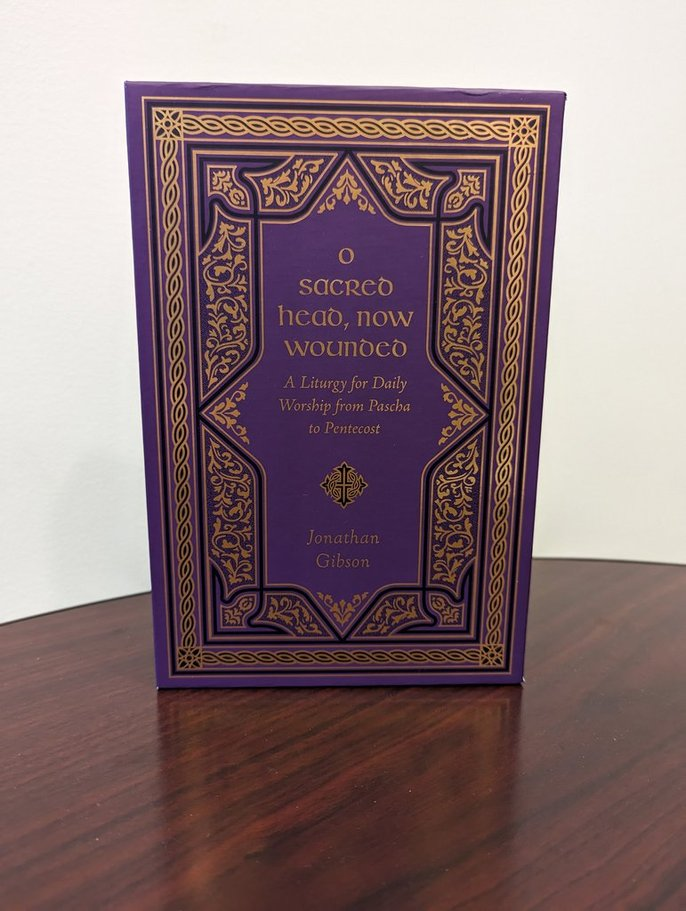
Book Review: O Sacred Head, Now Wounded

Rating: Must Have

Level: Easy (though helpful to have familiarity with liturgy); Long (400+), but each day is less than 10 pages

Summary

This is the third book by Gibson and Crossway of a liturgy for daily worship. The first, being a general 31 day guide called Be Thou My Vision, the second one, like this one is focused on a part of the church calendar, O Come, O Come, Emanuel (see my review here), which went roughly from Advent to Epiphany. I have to admit, I was confused by the dates of this book. The subtitle is A Liturgy for Daily Worship from Pascha to Pentecost. I thought this would be a good Monday to post, as Pascha is (I thought) another name for Easter and Pentecost is the 50th day after Easter. However, this is actually a Lent (timeframe) devotional, though Gibson writes “this [book] is not intended to be associated with the traditions of Lent..” I find this an odd and confusing choice.

This book is neither a 40 (or 46, as Sundays don’t count towards Lent) day Lenten Devotional, not is it a 50 day Easter (Pascha) to Pentecost devotional. Instead, it is a 48 day devotional that starts on Ash Wednesday, proceeds 42 days, and then has special service days – Maundy Thursday, Good Friday, Holy Saturday, Resurrection Sunday (Easter/Pascha), Ascension Sunday (the Sunday after Ascension Day, which is 40 days after Easter),and Pentecost Sunday.

After a preface and acknowledgements, the books starts with an intro (titled Remembering Jesus), where Gibson makes something of a defense of ‘holy’ days, or having special days of remembrance. It is a really interesting chapter, and if you are in the reformed community, you know that there is a pretty sizeable split with strong feelings on both sides of ‘holy days’. 

The following chapter is a very useful (especially if you aren’t used to Liturgy) ‘how-to’ on using the format, which includes: meditation, call to worship, adoration, reading the Law, confession of sin, assurance of pardon, creed, praise, catechism, prayer for illumination, scripture reading, praise, prayer of intercession (and then further petition/prayer), Lord’s Prayer, benediction, and finally a postlude (doxology).  

There are also appendixes for tunes to various parts of the worship, Bible reading plan, and Author, Hymn, & Liturgy index.

My Thoughts

I still find the subtitle odd and do not understand why they would give it such a name. As noted above, Gibson doesn’t want this to be a traditional Lenten style devotional, but it would seem to me that explaining the difference in the book while giving a clearer title would be more helpful. Another confusing aspect is at one point he refers to this season as the ‘Pascal Season’, which coincides with Lent. This is again odd, as most English speaker use Easter not Pascha, and Easter Season (or Eastertide) is the time from Easter to Ascension Day. It is truly a perplexing decision. That being said, it is another wonderful book. I couldn’t come up with much new to say about how it works, so see below for what I wrote about O Come, O Come, Emanual

Honestly, if you attempt any personal or family worship this is a must have. I am a big fan of the structured (liturgical) worship, especially for family devotion. It really doesn’t make it easy to lead or do with your family or community. Really my only (minor) quibble with this is that with 16 parts, it might be just a little too long. However, if you are doing this with a family with young children or you find yourself short on time, there are always parts you can cut. That being said, some sections are only a line or a paragraph long; this shouldn’t take an hour or any extended time. 

If you are unfamiliar with liturgy or structured daily worship this is an outstanding way to get into it. Unless you are from a pretty free-flowing Baptist/non-denom/mega-church background you will probably recognize parts (if not all) of these sections. If you are Anglican, you can see the clear influence of the BCP (which is probably the best book that exist for personal and family worship). 

I know some people don’t like the repetitive nature of some parts of guides like these, saying and can be rote or unfeeling, but really that is up to you. If you don’t take it seriously, or just mindlessly repeat things, then yes, the downside is that it can be meaningless. However, the upsides are a daily reminder of how to worship God, what He has done for us, what so much of the church today and most have always believed and recited, and of course – scripture reading. This is more important than every in church life, especially if you do this as a family/community and use it to help shape and guide children in their beliefs. This is true of any structured worship, but I think is even more important for this time of year, when we are pulled away in so many directions, with so many competing interesting. As I said above, if you are looking for personal/family devotion/worship, this is a must have. 

*I received a free copy of this book from Crossway, in exchange for an honest review. 

Free E-Book: Disciplines of a Godly Man

The Gospel Coalition is offering a free digital copy of Disciples of a Godly Man with an updated study guide. You should be able to download using this link, but it doesn’t say anywhere how long the promotion will last. The ask for your name and email, and you can opt out of the additional newsletters/promotions (though, then you’d miss out on free books sometimes).

I don’t often post links to free books (actually, I don’t often post at all anymore), but Disciplines of a Godly Man is my most read post of all time (and the most so far this year, as of Jan 4, so people are trying to start the year off right). In fact, if you search ‘reviews of Disciplines of a Godly Man’ I’m on of the top real results, even above The Gospel Coalition’s review (probably why they are giving it out for free, they feel threaten by the MMT). Anyway, go read my review, and then get the free book or by the hard copy, it really is a great book.

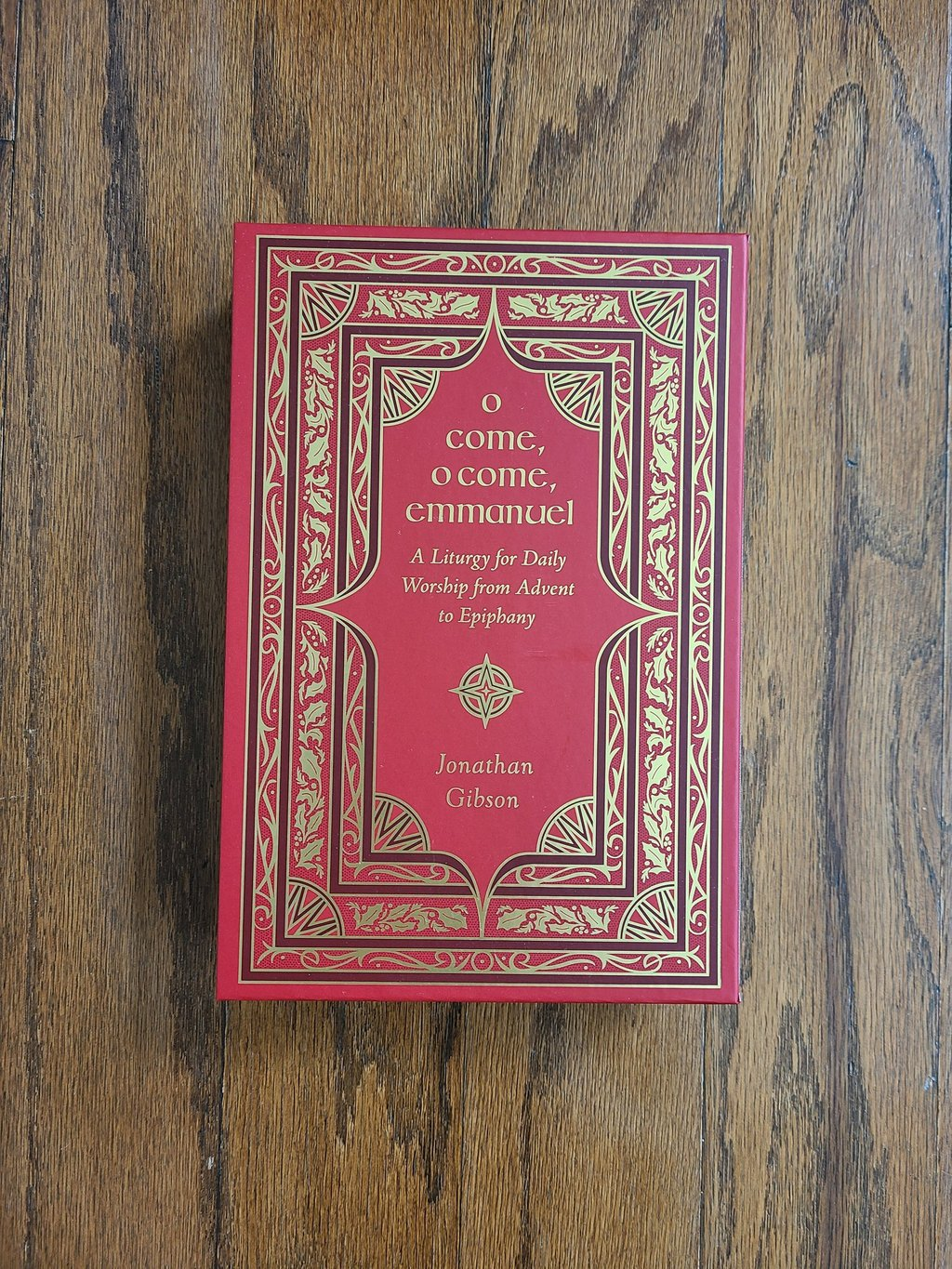
Book Review: O Come, O Come, Emmanuel

Rating: Must Have

Level: Easy (though helpful to have familiarity with liturgy); Long (400+), but each day is less than 10 pages

Summary

This is another outstanding book by Gibson and Crossway, similar to Be Thou My Vision, but this one being focused on Advent, Christmas, and ends on Epiphany. For those unfamiliar, that is January 6th, so to have a round number of 40 days, it may start before ‘official’ Advent. That was the case this year, Advent started yesterday (which is late in the chronological Calendar), and the book starts on November 28th, which was last Tuesday. 

After a preface and acknowledgements, the books starts with an intro (titled Waiting For Jesus), where Gibson explains his reasons/hopes for this book. The following chapter is a very useful (especially if you aren’t used to Liturgy) ‘how-to’ on using the format, which includes: meditation, call to worship, adoration, reading the Law, confession of sin, assurance of pardon, creed, praise, catechism, prayer for illumination, scripture reading, praise, prayer of intercession (and then further petition/prayer), Lord’s Prayer, benediction, and finally a postlude (doxology).  

There are also appendixes for tunes to various parts of the worship, Bible reading plan, and Author, Hymn, & Liturgy index.

My Thoughts

Honestly, if you attempt any personal or family worship this is a must have. I am a big fan of the structured (liturgical) worship, especially for family devotion. It really doesn’t make it easy to lead or do with your family or community. Really my only (minor) quibble with this is that with 16 parts, it might be just a little too long. However, if you are doing this with a family with young children or you find yourself short on time, there are always parts you can cut. That being said, some sections are only a line or a paragraph long; this shouldn’t take an hour or any extended time. 

If you are unfamiliar with liturgy or structured daily worship this is an outstanding way to get into it. Unless you are from a pretty free-flowing Baptist/non-denom/mega-church background you will probably recognize parts (if not all) of these sections. If you are Anglican, you can see the clear influence of the BCP (which is probably the best book that exist for personal and family worship). 

I know some people don’t like the repetitive nature of some parts of guides like these, saying and can be rote or unfeeling, but really that is up to you. If you don’t take it seriously, or just mindlessly repeat things, then yes, the downside is that it can be meaningless. However, the upsides are a daily reminder of how to worship God, what He has done for us, what so much of the church today and most have always believed and recited, and of course – scripture reading. This is more important than every in church life, especially if you do this as a family/community and use it to help shape and guide children in their beliefs. This is true of any structured worship, but I think is even more important for this time of year, when we are pulled away in so many directions, with so many competing interesting. As I said above, if you are looking for personal/family devotion/worship, this is a must have. 

*I received a free copy of this book from Crossway, in exchange for an honest review. 

Book Review: Christianity and Science

Rating: If you are looking for something

Level: Difficult (wordy, academic style, knowledge of enlightenment and higher critical philosophies/theories is helpful); Short – 230 pages

Summary

The book has 13 chapters – Intro, How the Concept of Christian Science Emerged, Defects That Clung to Christian Science, Positive Science, Evaluation of Positivism, Consequence of the Verdict, The Concept of Science, The Natural Sciences, The Humanities, Theological Science, Revelation, The Blessing of Christianity for Science, and A Christian University. There is also a lengthy Editors’ Introduction, which explains some of the translation issues and gives a little bit of background in to Bavinck’s life and situation. 

Written in 1904, but looking back over the previous 50-70 years, the book focuses on changes to society and to the university system that has come from recent official moves towards liberalism and secularism. Bavinck is focused specifically on The Netherlands, but also broadly on the post-enlightenment and higher critical movements of Europe in general. 

There is a also a good explanation of what Bavinck means by ‘science’, which was essentially synonymous with ‘learning’ or ‘knowledge’, and science was often still in the title of disciplines (e.g. Theological Science). The book was also originally titled Christian Science, which the editors changed due to the current American religious movement. However, the phrase is used throughout the book. 

It should also be noted that this is not a discussion of Christianity vs. Science, in the way of some of our modern American discussions. 

My Thoughts

I’ll get the negative out of the way first, if you haven’t read Bavinck before, it can be difficult. This may only bother me, but he has sentences that run for paragraphs, and paragraphs that run for pages. Also, he is distinctly a product of his time, the theological and philosophical arguments that were raging at the time are front and center in his writing. While most people are probably familiar with Kant, I’d guess that Schleiermacher is less well known (though maybe not to the type of people that would read a Bavinck book), let alone the list of other German philosophers and theologians that have faded into obscurity. The editors make short notes as to whom he is referring and what they did, but without some background knowledge, I’m not sure how impactful it is. The notes help for those who were contemporary politicians in The Netherlands, because their thoughts/arguments are pretty straight forward, but the writings of the academics and their nuance may be lost. 

That being said, so much of his writing then is still applicable to us today. It is odd as an American, hearing the arguments about the Government funding private (including religious) schools, but most of Europe started in a different place than we did. They are coming from an official (confessional) religion and then moving secular. So, often ‘equality’ means funding all viewpoints/religions equally, while here it means funding none. For a more modern/current take on these issues, look up Michael Bird, as he writing/arguing some of these same issues right now in Australia (where the Government does fund all schools). 

There are some esoteric arguments in the first few chapters, especially about ‘positivism’, but especially starting in the Humanities chapter to the finish, the writing sounds very contemporary. He points out the issues/problems of ‘greatest good for the greatest number’ argument of morality, while also criticizing the ‘private matter’ of  a ‘preference and taste’ view of choosing a ‘personal religion’. The Theological Science chapter discusses how theology can/should be taught and the issues of many schools moving (in some cases required) to religion departments; pointing out that if there is no universal or deeper truth, then the studies of religion may as well move to History or Psychology departments, or if the Bible is just writings, why not a subset of Literature? Finally, the University chapter is wild it how it almost predicted the future. He feared the political re-shuffling of the professors based on ‘openness’ and ‘tolerance’  not actually being use the way the word implies. He states, ‘according to the doctrine, there is room for all, but according to life, only for us and our friends. If you ever see studies/surveys of professors today and see their very narrow set of beliefs/viewpoints (for the most part), you can see he is correct. He even points to the fact that professors come from other professors and is less about how might be the ‘best’ and more about ‘who do we want to get along with’, which is just interesting to see that written 120 years ago. 

Overall, as is just about everything from Bavinck, this was a great book, he is truly a talented and gifted writing/academic. I just wonder how many people would benefit from this book, or rather who the audience would be. So, if you like Bavinck and are exciting more of his works are being translated to English, this will be pretty great. If you are in academia, you would also benefit. Obviously, some of the issues are a bit dated and the refences to contemporary Dutch politics isn’t always applicable. However, if you are studying or wanting to learn more about history and how we’ve gotten to our modern moment, this could be helpful. So, if you are looking for something, this book is great, but I do think you need to be looking to get much out of it. 

*I received a free copy of this book in exchange for an honest review. 
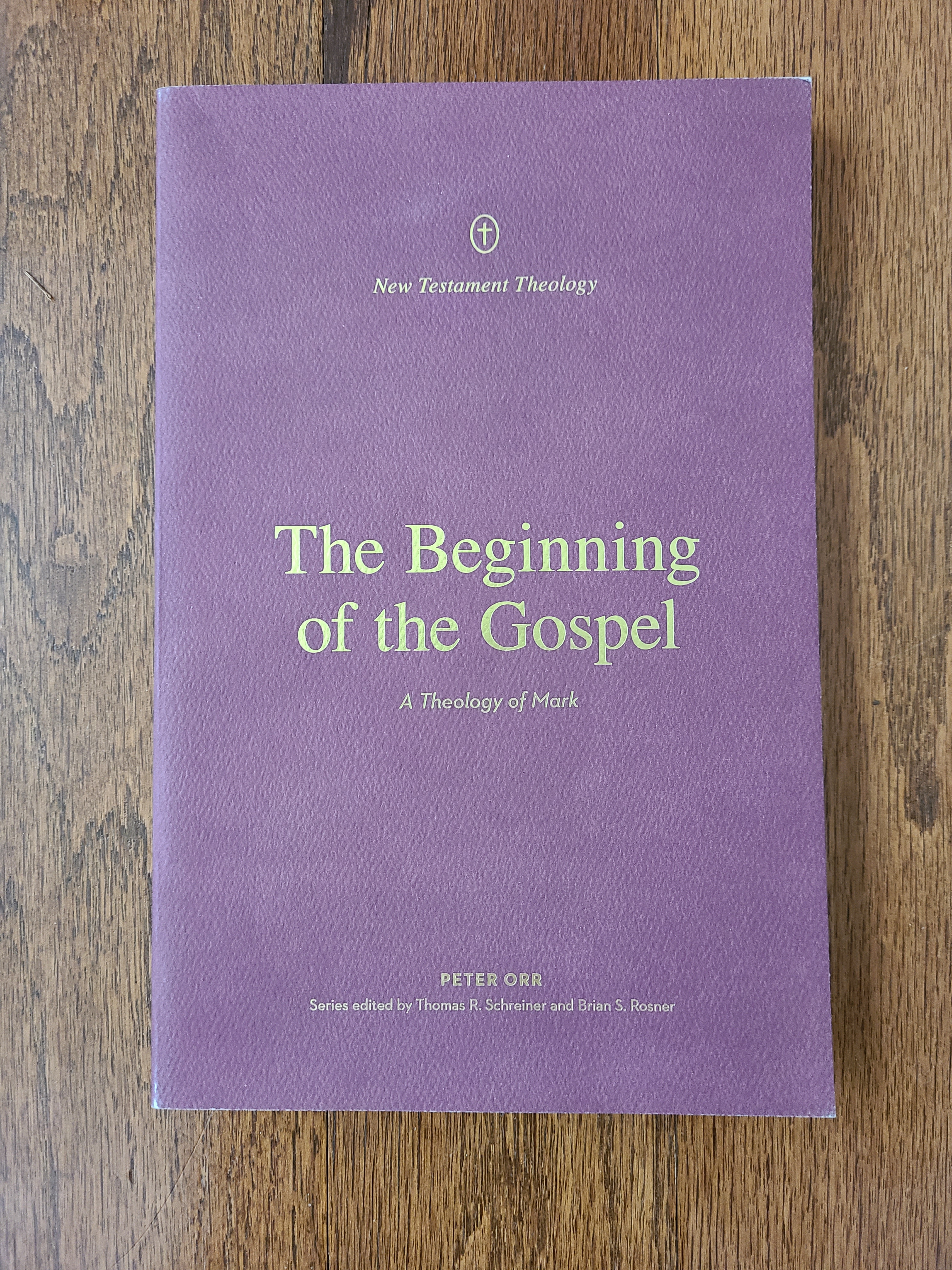
Book Review: The Beginning of the Gospel

Rating – Put it on your list

Level – Moderate, written at popular level but Biblical knowledge is helpful; short (less than 200 pages).

Summary

This book is part of Crossway’s New Testament Theology series, and I think it is a fairy unique angle for study. The series preface says they are seeking, in this series, to take a Biblical Theological approach to the major themes of each book covered. If you aren’t as familiar with the term Biblical, it is as opposed to the more common Systematic way of handling theology; the latter being focused on topics first (sin, the church, etc.), while the former looks at overarching themes that unfold as you read through the Bible (or individual book in this case).

The book is broken into seven chapters – Divine Identity, Revelation, The Kingdom of God is at Hand, Repent and Believe the Gospel, Follow Me, What Moses Commanded, and Died, Buried, and Raised. There is also an introduction and epilogue. The intro chapter in this series is consistently one of the best out there on the topic. The on for Mark is less than 15 pages, but acts as a mini commentary. 

My Thoughts

This is a solid study on Mark. As mentioned above, it isn’t a traditional commentary, but focuses more on themes/theology of book. My main criticism would be that the chapters are almost too disparate. Other books in this series, while not having a unifying theme, still seem to flow more cohesively. That being said, if you are looking to teach/preach on Mark, this a book to add to your list. 

Particularly chapters one, two, and six are interesting in the connections he makes. First, who Jesus actually claims to be (and who his followers thought he was) is supposedly debated often today, but in reality His claims are clear. The chapters on handling the Old Testament is also instructive.

Something unique to Orr’s approach is the connection with both Peter and Paul to Mark. Mark is often associated with Peter’s perspective in the Gospel, but he also worked with Paul, and many of the theological elements of the Epistles are present in Mark. Whether Mark or Matthew were the first Gospel written is debatable, but either one would come later than most Epistles, so much of the original audience had the knowledge and writings, before the had the Gospels. I think that is hard for modern readers to remember, because we view it (and the Bible is arraigned) chronologically. There is also often a criticism from those outside the church that the Epistles, especially Paul’s, were a later change to Jesus’ message and that they altered the theology of the Gospels. Orr does a good job showing not only how aware Mark was of those letters but how his Gospel interacted (and agreed) with them.

If you are doing a Bible study or preparing a sermon series, this book can’t really stand on it’s own and would need to be supplemented with additional commentaries (especially if it is a sermon series). However, the chapters could be a good outline for a study and the book raises many good points and tackles some of the more confusing elements. If you are interested in deeper study of Mark, put this on your list. 


*I received a free copy of this book in exchange for an honest review.
Book Review: From the Manger to the Throne

My Rating: Must Read

Level: Moderate, written at popular level but Biblical knowledge is helpful; short (less than 200 pages).

Summary

The book is broken into seven chapters – The Great Reversal; Peace on Earth as in Heaven; Israel, the Gentiles, and Isaiah’s Servant; The Way of Life; The Success of the Last Adam; The Son of Man’s Rule and the Ancient of Days; and The Year of Jubilee. There is also the series preface, book preface, intro, and an epilogue. If they chapters don’t look chronological to you, it is because they aren’t. The unique aspect of this series is that it seeks to catch all the major theological themes, but in commentary style.

My Thoughts

This is the first book I’ve read in Crossway’s New Testament Theology series, and I think it is a fairy unique angle for study. I’ve seen this book (or series) occasionally referred to as a commentary (not by Crossway) and while that isn’t technically correct, I can see where people are coming from. If you took a true scholarly commentary on Luke (e.g. Baker’s) and stripped out just the sections on theological themes or maybe an excurses on angels, you’d end up with something like this book. The series preface says they are seeking, in this series, to take a Biblical Theological approach to the major themes of each book covered. If you aren’t as familiar with the term Biblical, it is as opposed to the more common Systematic way of handling theology; the latter being focused on topics first (sin, the church, etc.), while the former looks at overarching themes that unfold as you read through the Bible (or individual book in this case).

Now, the seven themes Gladd has chosen are probably not the consensus themes among theologians/scholars. I imagine if you asked 10 people to pick seven themes, they might agree on three or four of them. Even as I read, I caught myself wondering whether one or two of the topics really belonged. That being said, I actually think this adds to the potential use for the book. As I read, I kept thinking about how great this would work as a small group or other Bible study. I would have loved to hear others’ feedback on some of the threads Gladd pick’s up on. He obviously makes compelling cases in each chapter and backs up each point with scripture from all over the Bible, so I don’t think any of them are ‘wrong.’ For a pastor a bible study leader, that gives you some compelling material to challenge people.

I was pretty much hooked on this after the intro while long for an intro to a book this size (over 10% of the pages) it makes sense once you read it. Gladd takes you through a quick summary of all of Luke. It was probably one of the most concise, while still being dense and comprehensive, overviews of any book of the Bible I’ve ever read. It really would be a great way to start off a Bible study.

I wouldn’t recommend this book as the first thing someone reads on Luke, or even for a new believer. To be as short as it is, you need some level of scripture to begin. This book would best be used in self study as a supplement to a regular commentary or, as I mentioned, an eight part Bible study with a group. I think getting everyone caught up on Luke from the intro, then spending a study time on each chapter would be a great use of this book and lead to some interesting discussion. For pastors preaching through all of Luke, this would certainly give you some ideas to focus on and themes to pull out and make sure are coming out in your sermons. While being somewhat technical, it is well and is a fair quick and easy read; it is also short at under 200 pages. If you are already familiar with Luke and look for another way to study, or leading a study, or are a preacher, this book is a must read.

*I received a free copy of this book in exchange for an honest review.

Modern Cloister Interview: Fatcat Books

Check out the interview Mrs. MMT did with Natasha Kennedy and Todd Hains about there book series ‘Fatcat’, which includes children’s book on the Apostles’ Creed, the Lord’s Prayer, and Christmas (with more to come). You can watch the video below or listen to the Pod format (and download wherever you subscribe).