Book Review: Katharine and Martin Luther

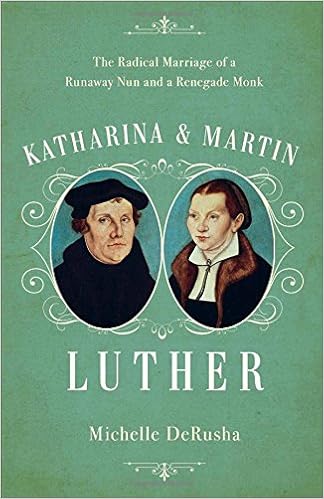
Katharina and Martin Luther: The Radical Marriage of a Runaway Nun and a Renegade Monk

Rating –  If you have time

Level – Easy read, short to medium length

Summary
For the most part the book is about the marriage of Katharina and Marin Luther. The first few chapters look at the two of them individually, then their life together, culminating in the death of Martin. The book is at its best, not necessarily discussion their marriage, but when getting into the minutia of life in the early modern period. The book is at it’s worst when the author seems surprised by the fact that life was hard for women 500 years ago.

If you are looking for an interesting book about the marriage between a former monk and former nun, this is probably not it. There are interesting insights, but it is far from a good history, there is a good bit of editorializing and comparing them to marriages of today. There is a little bit about the famous Table Talks and their life together mentoring and growing the next generation of reformers, but not nearly enough. In my view, this should be the centerpiece of a book about their marriage. It truly was revolutionary, but the author instead focuses her surprise on the fact that Martin loved and respected Katharina despite believing the Bible to the the Work of God.

My Thoughts
It should be pretty clear from above that I was a little disappointed in this book. The author goes in and out of interesting historical facts to discussing her shock that someone could read the Bible, believe it, especially as it pertains to the so-called ‘roles of marriage’ and then still love their wife. She starts with a good history of the issues women face, and they are shocking and substantial, but she doesn’t seem to be able to separate them from their place in history and our current time. She anachronistically puts modern views into the history of the early modern period.

Katharina and Martin hosted dignitaries, students, pastors, and leading intellectuals of the time from across Germany and other parts of Europe. She really misses out in this book by not getting into more of those conversations and how they related to each other. She also comes off a bit patronizing, unintentionally, to Katharina. She takes minor quips and solid comebacks and conflates them into great iconoclastic events.

Overall the book seems a bit jumbled, shifting focus too often. There is far too many uses of phrases like, ‘one wonders’ and ‘it’s not hard to guess’ for my liking. To be fair, in her defense, she never claims to be a historian or that this book is a definitive biography of historical discussion on their marriage. Her near unending shock that there are many letters retained from possibly the most famous and impactful European in church history greatly outnumber his wife’s letters in a time when most women (or people for that matter) could not even read, gets old quickly.  I guess if you happen across this book at a good price it could be worth while, but over all, it is probably not worth your time.

*I received a free copy of this book in exchange for an honest review. See more here.

Book Review: Generation Z

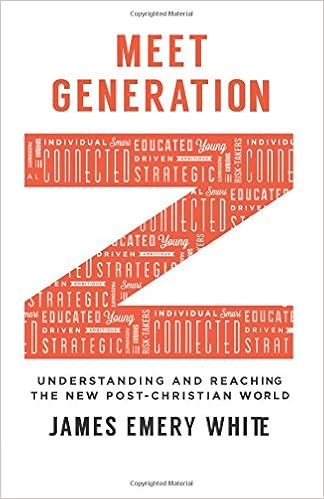
Meet Generation Z: Understanding and Reaching the New Post-Christian World

Rating – Put it on your list

Level – Pretty easy ready, goes quickly, about 200 pages.

Summary
The book is exactly what it sounds like, and introduction to Generation Z, who he defines as those born between 1993 and 2012, how they will be different form previous generations and what the churches needs to do about it.

The book is broken into two parts, plus a pretty extensive appendices. The first part is focused on the Zs and the second on the difference and the churches new approach. The focus is mostly on the changing demographic of Zs, they are less white, more multiethnic, more liberal (economically and socially), and less Christian. White does a good job explaining the way technology is changing their lives, especially as it relates to early sexualization and porn.

My Thoughts
I think White does a good job of not being alarmist. It is a fact of history that the next generation will be our undoing, people have been saying it for thousands of years. So, it was good to read him taking a measured approach. There is a lot of media hype over the ‘nones’, and he explores how it is possible that a middle group who could go either way on the church is now siding with the no-religion group because it is the more socially advantageous position as it is more of the culture norm (the same way the opposite was true 50 years ago and through most of American history). I’ll add two reason I think the ‘nones’ are overblown, one it is cool now to be ‘independent’, we see it with political parties. I see it in church going people who are very devout, they like to say that they don’t like names or denominations. This is already a bit of a tangent, but second, I’ve worked with detailed surveys throughout my career. People are bad at them. You can look at the polling data and see that 9% of self-identified Atheist are certain there is a god when asked. I think it is something like 14% when the question is asked of self-identified Agnostics. Likewise, there are a number of self-identified Christians who say it is impossible to know if God exist. Due to this, I do think church attendance will continue dropping with the Zs and whatever comes next, but the core of the devout won’t change too much.

I like his definition of Z better than some of the others I’ve seen. Other have them starting in 2000 or even as late as 2005, and I think his focus works a little better. More importantly, there is a difference between them and the millennials, just as there was between X and boomers, and SIlent and Greatest before them. The first half of this book is good for anyone looking for a brief primer on the upcoming generation. The book as a whole is important for Christians to understand the changes that are coming, especially pastors and youth workers. Anyone in this latter group should make reading this book a priority.

*I received this book for free in exchange for an honest review. See more here.

Generational Theory

Tomorrow I will have my first book review up in quite some time. It is called Generation Z, and is basically an overview of the upcoming generation, how they are different, and what our actions/reactions should be as Christians.

Before I do that, I wanted to do a breif summary and some thoughts about generational theory as I feel like it is talked about a lot in the media and church right now – especially as it pertains to so-called ‘millenials’. I’ve also recentyl heard a podcast about boomers and there seems to be daily polls about the current generations. So, it was a post I was already thinking about, and then this book came and here we are.

What generations are around right now?

Greatest – basically anyone over 90, they lived through the Great Depression and fought in WW2. Also known as GI generation. They are the parents of the Boomers as the came back from the war, and popped out a record number of kids (the boom) during the great economic expansion and strengthen social safety programs.

Silent – Born in 30, basically didn’t do anything. Don’t take this as being harsh, but it is the reality. Mostly because there are just very few numbers of them. They are basically those too young to go to WW2, but not Boomers. Their time is short, and their numbers are excessively small due to the depression and especially the war (average age of the infantry in WW2 was 25).

Boomers – children of Greatest. They started during the post-war boom and depending on whom you read, ended in the early to mid-60s. This is a massive population, the largest ever (at the time) that spanned two decades. People argue over the stopping point (though everyone considers 1946 to be the starting point) and many (such as me) advocate seeing this as two different groups.

X – Children of Silent’s. They followed the boomers (whenever you finish them) to anywhere between 1978 and 1984. They are much smaller than the Boomers for one because they occupy a short timescale but mostly because they are children of the diminished Silent.

Millennials – Children of boomers, grandchildren of Greatest. Also known as ‘Y’ and Echo-Boomers. They start wherever you stop with ‘X’ and continue on to anywhere between 2000 and 2005. This is now the largest generation in history, first because they are the children of Boomers, but also because (taken to the fullest extent) they span 27 years from 1978 to 2005, which is obviously a terrible measure and they should also be considered as two distinct groups (more below).

Z – Children of X and Millennials. Born sometime around the Millennium (which means the name Millennials really makes more sense for them). Also known as i-Generation and Homeland Generation. They are born when you finish Millennials (though often much earlier, White puts it at 1993) to anywhere between 2012 to the current crop of children right now. The lines kind of blur here, and I think that is a good thing.

When I was in college and grad school a little over 10 years ago, and the issue of demographics came up, there was a focus on the ‘echo boomers’. These were basically us, the college students at the time, people born in the 80s to maybe early 90s, we were the children of the original Baby Boomers (echo boom, get it?) Kids in the 90s to early 2000s were often listed as “i-generation”, basically the generation that grew up with i-pods, phones, pads, etc. they were also (so as not to tie them to a product) referred to as the ‘millennials’, those born around the time of the millennium. The original idea of millennial was closer to what many call Z now. However, Straus and Howe consider Z (Homeland to them) to be from 2000 to now, making it two distinct groups.

Overall, we were often put together as the commonly referred to ‘Y’, but most demographers so the issue with have a Y generation follow X, mostly that the next would be Z, then you are out of letters. Partly because of this, the more trendy ‘millennials’ took over as the name people (especially the media) used. I’m honestly not sure why Echo-Boom never took off, other than technically an echo is quieter.

Likewise, some have split the boomers into two groups. For a great primer on this check out the podcast – Stuff you should know – What’s the Deal With Baby Boomers – the split them into the following:
1946-1955 – Leading Edge Boomers
1955-64 – Shadow Boomers (also knowns as Generation Jones)

Leading Edge are what you think of when you think 50s childhood. Those who were the young children of the GIs with the ‘idyllliac’ life as portrayed by politicians. The Shadow are known as the Jones (as in, keeping up with the Joneses) or even the ‘Me’ generation due to their focus on consumerism. This is the group most know for rapid consumption and selfishness.

If you want to think seriously about generational theory, these two interdivisions of the two massive groups is helpful. For one, you may have two different generations in the same ‘generation.’ I (’84) and my nephew (’98) by almost all accounts we are both millennials. However, he is my sister’s kid, and cousin to my daughter, quite literally the next generation in our family. Also, his life experience is quite different. He doesn’t remember 9/11, whereas it is a defining event for people my age. He doesn’t know pre-smart phone, let alone pre-ubiquitous cell phones. He basically only knows the Obama administration. The list could go on, and on.

Similarly, early boomers like my dad (’47) have a very different life/worldview that later boomers like my mother-in-law (redacted). My dad served in Korea and all my uncles went to Vietnam. They all remember JFK being shot; that was of the defining events for them. For Mrs. MMT’s family, who are generally about 10-15 years younger, they think more about events in the 70s, the stagflation and energy crises leading up to Reagan.

So, all that is a long way of saying that the generation stuff you hear about so often now is way overblown and generalized. I kind of laugh when I hear a colleague who isn’t even 40 talking about the problems with millennials. Millennials are much older than media portrayal for one, but they also encompass over 75 million people born in a time spanning 3 decades (about 23 years on average), five to six presidents, and countless different economic situations. Again, I finished grad school in ’08, meaning the Great Recession was a defining part of my life (like the depression for my grandparents), my nephew was 10.

Finally, I’ll point out that these lines aren’t perfect. For instance, my sister is an X. Some people with large families may have children that cross lines, or if someone was married very young, their children may fall into the next group. I think generally speaking, the time period in which you grew up is the best indicator, due to being shaped by the culture, and if someone is in some of the blurry edges, they are probably best classified by their parents’ generation. If you noticed, it was quite cycle. Greatest were shaped by the depression and war, then came their children who were shaped by war (but not a major recession/depression due to the law passed by their parents, which they would later repeal), their children are then affected by 9/11 another set of wars and the Great Recession. Likewise, you have the Silent, which is small and kind of off, who then have the ‘X’s who are also small and in a lot of ways, a reaction against the corporatism and greed for the second wave of Boomers. Now, their children and Millennials and whatever is next are all getting blurred together. Part of this is really just how ill-defined my generation is, but also because paths are less traditional. It isn’t men graduating high school then going to trade school/college/military, getting married at 22, then have their first kid within 2 years. That is how you end up with Mrs. MMT and I without question being the same generation (we are less than 6 months apart), but my dad was 37 when I was born, where as her mom was early 20s. Or my nephew who is closer to me in age than he is to my daughter because my sister was 19 when she had a kid and I was 30.

An importance thing in understanding how the church reacts going forward is seeing how history is repeating itself. The Echos, like me (80s) are already known for being more frugal and rediscovering things like cooking and sewing, the same way our grandparents were. While the people just now interring the workforce down to middle schoolers are rejecting the consumerism and self-centeredness of the second half of the boomers (much like ‘X’). While there is a mix of people in the 90s that grew up in the expansion and mirror those boomers in their sense of entitlement and expectations for life.

I’m not as pessimistic about the changes in the next generation as others may be. They will be more diverse and more liberal, but that has been true in every generation. Probably the biggest difference, and the one that does bring them outside of these generational patterns is that they are not growing up a majority Christian culture. I think White does a great job addressing this in his book. So, there is that, I’ve already written much more than I had originally intended, but it is one of the topics I geek out on, so I hope you liked it and that it was helpful
Updates

Alright everybody, I have finally had some time to write again. I just finished my classes last week. The past month was crazy with final exams, final case studies, and final papers. It ended up being a lot more work than I thought. I’ll have an up date and review of the courses/CCEF in general up soon, as well as where I cam going from here.

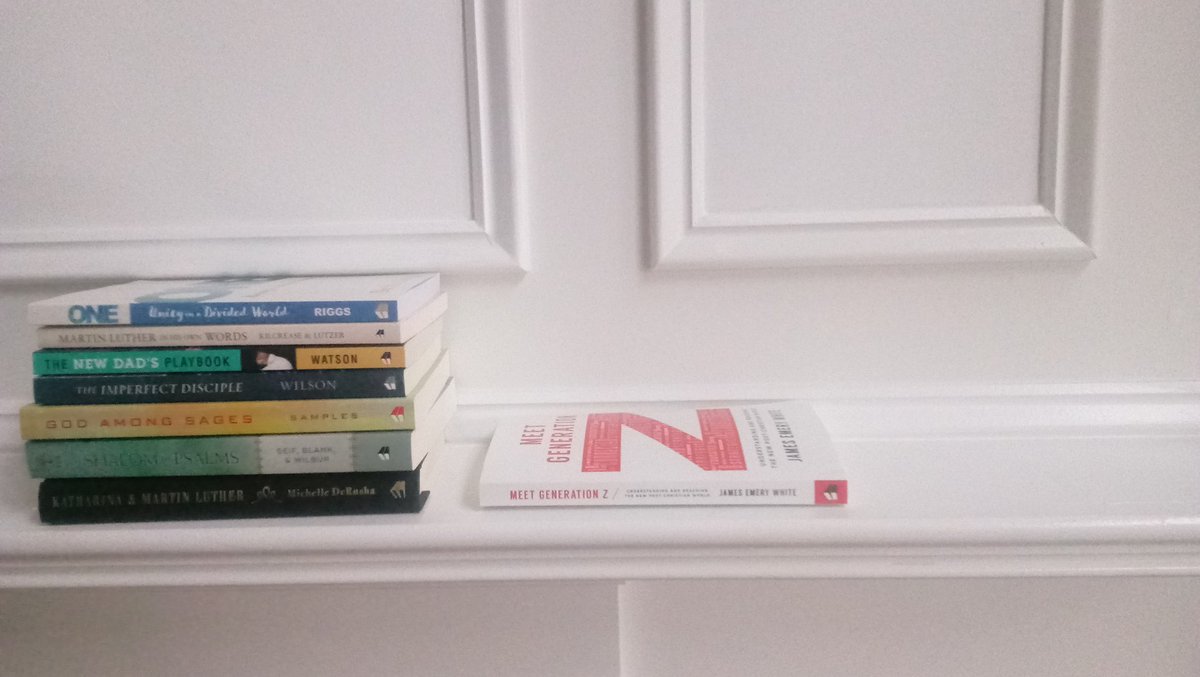
Tomorrow I am will have a short post up about generational theory in preparation for my review of Meet Generation Z that will be up on Wednesday. I’ve been fall really behind in reviews, and will hopefully have at least one a week up for the next two or three months. Here are the books that just Baker Books has sent to me review over the past 3 months. The stack on the left is the books I need to read, the stack in the middle is books I’ve finished reading, and the stack on the right is what I’ve reviewed. So, falling behind. I’ll try to do better next time.

In the mean time, it is Biblical Studies Carnival time for April already. Go check it out over at Theologians, Inc.


Good Metal Friday 2017

Posting has been spotty, but I’m on my last paper of the courses for this semester tonight. Book reviews should return as early as next Wednesday, and my random ramblings will be sporadic as always.

So, I post the guys all the time, but only because they have the best content of any Christian Metal out there. I had hoped to have this up earlier, so that my dozen or so readers could reflect on this longer. This song is taken/based on a quote from the puritan John Flavel. See the quote below, watch the video, listen to the song, and think (maybe even ponder) and the bargian that Christ made for us. He took on our debts, our sins, and tresspasses, and paid them all, paid them in full; with his blood. He drank the cup of God’s wrath, that we would have everlasting life.

Today, on Good Friday, we commerate His death, His propitation of our sins, that we me be seen as blameless before God. His death was the subsitutanary atontement for our sins. He took our place, so that we can have a place with Him, as adopted sons and daughets of God. Reflect on this tomorrow, as we await the commeratation of the resurrection and think of the hope we have.

“Here you may suppose the Father to say when driving His bargain with Christ for you.The Father speaks. “My Son, here is a company of poor, miserable souls that have utterly undone themselves and now lay open to my justice. Justice demands satisfaction for them, or will satisfy itself in the eternal ruin of them.” The Son responds. “Oh my Father. Such is my love to and pity for them, that rather than they shall perish eternally I will be responsible for them as their guarantee. Bring in all thy bills, that I may see what they owe thee. Bring them all in, that there be no after-reckonings with them. At my hands shall thou require it. I would rather choose to suffer the wrath that is theirs then they should suffer it. Upon me, my Father, upon me be all their debt.” The Father responds. “But my Son, if thou undertake for them, thou must reckon to pay the last mite. Expect no abatement. Son, if I spare them… I will not spare you.” The Son responds. “Content Father. Let it be so. Charge it all upon me. I am able to discharge it. And though it prove a kind of undoing to me, though it impoverish all my riches, empty all my treasures… I am content to take it.”

  • The Works of John Flavel, Vol.1, “A Display of Christ in His Essential and Mediatorial Glory”, 42 Sermons, Sermon Number 3, “The Covenant of Redemption between the Father and the Redeemer”, Use 6.

I’ve posted this video before (last Easter, actually), but this one is put to a movie. I have no idea why Jesus is super white and pretty, or the reason for the Spanish subtittles. You can reflect on the words and images, nonetheless.

Systematic Theology Study Bible

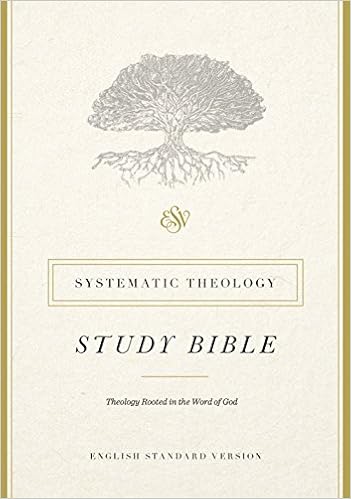
ESV Systematic Theology Study Bible – New from Crossway , coming some time in the Fall. The latest date I’ve seen is October 21, 2017; however, it has already moved once as far as I can tell. You know I’m big on Study Bibles, and obviously adding Systematics is going to be big for me. I plan on getting this as soon as I can, hopefully before it is published. I’ll keep you updated on what I know.

Update – Looks like all editions (Hardcover, Leather, fake Leather) are going to be available 10/31/2017. That is the 500th Anniversary of the Reformation starting (Luther nailing the 95 Theses).

I won’t be buying the hardcover, I tend to favor the fake leather, but I can’t quite tell what the design looks like. May actually splurge and get the real leather.

Romans 12:21

Well, my assignments and reading for school have pretty much kept me from posting anything new the past few weeks. Also, the past week or two has been pretty this:qabsyvj

We’ve had the crud run through everyone in the house. That’s always fun when I have a new job, Mrs. MMT has a new job, Sprout is potty training, and I’m taking these courses. Oh yeah, and at some point, we’d like to have a life. Oh, also, as I mentioned in my reading challenge, I had requested a number of book from Baker, well, I received three in the mail this week. Good stuff.

I’m kind of freaking out about the amount of stuff I have going on. Then again, when my head stops being a lead balloon, things may not seem so bad. Anyway, that means no book review this week, also, the post is a day late. So, I’m just going to double dip. One of my assignments was to write up a few short thoughts on a verse that has particular meaning to me, so this is what I cam up with –

Be not overcome by evil, but overcome evil with good. – Romans 12:21

This is a verse that has been important to me for about the last 10-15 years. There are two parts that get to me. The first part, ‘be not overcome’ addresses a number of circumstances. If you watch the news a great deal, or get involved with ministries to the destitute, sex-trafficking, or refugees, you can feel overwhelmed. I sometimes see so much evil in the world that I just want to stop. I want to withdraw and avoid everything, and it becomes easy to feel like it is just too much, so why bother? I really likely the simple, direct, indicative, ‘be not overcome’.

The second part, ‘overcome evil with good,’ is sort of a launching point to many other aspects of the Bible. It makes me think of other verses, such as: turn the other cheek; the darkness fears the light; if God is for us, who can be against us; pray for your enemies; and basically the entirety of Revelation. There is almost a feeling for triumph with this part of the verse. You know that, long-term, in the end, Good will overcome and evil will be vanquished.

There is a lot of encouragement in the verse. To the first part, it says to me that if we are command not to be overcome, then it is within our ability (or that God will give us the ability) to overcome. That is very freeing, you know that when bad things happen, you will not always be overwhelmed, and eventually, goodness prevails. And it’s that second part that is probably the most encouraging. As I mentioned above, the end is already decided, the outcome is not in doubt; evil will be overcome by good.

It is a great reminder of the sovereignty of God. It give you hope and strength to get through whatever trails you may face. My wife and I actually put this verse up on a chalk board by the door not too long ago. We were part of a church plant that died. There were internal issues that actually lead to a church trial and eventually the defrocking of the pastor as well as the church being removed from the denomination. It was a frustrating and discouraging time for us, so this was a reminder that all we can do is what God has commanded is right, and we know that in the end, all will be restored.

2017 Reading Challenge

As I mentioned in my review of my 2016 challenge, I’m not planning on reading as many books this year. There are a few reasons for this, one, as of last week, I have started a new job that has roughly tripled my commute. Another reason is that I am starting some course work from CCEF, before entering completely into a new master’s program with Westminster. Taking classes means specific reading requirements, but also lots of writing, so I cannot devote as much time to reading. Finally, as I plowed through more and more books last year, I ended up writing less and less. So, with what little time I have between taking classes, a new job, and a toddler, I’d like to focus a little more writing.

Anyway, to the books. I’m laying out my challenge a little differently this year. Last year, I basically just say, hey, I’m going to read a bunch of books. This year I’m listing a number of specific books, and then some categories for the remaining few.

The first group are two books that I am reading daily, one is a devotional, My Utmost for His Highest, and the other is the Bible. I’ve mentioned the M’Cheyne plan before, so I’m putting it to the test this year.

Next group, novels. If I ever finish War and Peace, I’d like to check out three other novels – Hyperion, Lolita, and Brave New World. I also have read a few books through the Kindle First thing, so, call it maybe two more from that category.

The third group is my Christiany stuff, of which there are only three. I know, that’s not many for a blog with Theologian in the title, but bear with me, more Christian life/thought type books will come out in other categories. The specific three I’d like to hit are Five Views of Biblical Inerrancy (from the great Counterpoints series), Boice’s exposition on the Sermon on the Mount, and the classic, The Plan of Salvation.

Next up, non-fiction. Again, only four of these, though it does include one ‘big-book’, Capital in the Twenty-First Century (funny side note on this, Kindle can tell if you’ve finished a book or not and obviously if you’ve downloaded a book. So, the year this book came out, it was the most downloaded non-fiction, and the least read/finished, percentage-wise, of any book). Another good one I’ve I wanted to read for a while, Misbehaving (about Behavioral Economics). Sprout just turned two, so obviously it’s about time for me to obsess over her education, so I have Einstein Never Used Flash Cards on the list. Rounding out the non-fiction list is an autobiography from Jimmy Carter – A Full Life, Reflections at Ninety – which is just a cool title. I’ll also add a stretch goal here, if I’m doing well come, say, November, I’ll through in Gödel, Escher and Bach, another big book, so we will see.

Probably the biggest category, books I need to read for school. So far this include, Marriage Matters, Hold Me Tight, The Christian Life, and Systems Theory in Action. I’ve already read two others for these classes. This is the list for just two courses. Now, in the summer, I’ll take one or two more courses, but none in the fall, so this list will grow by probably three to seven.

Finally, my review copy books. So far, there are three on my list – The Christian Lover, Pillars of Grace, and The End of Protestantism. The first two are from Reformation Trust Publishing, which has been pretty easy to use. The last one is from Netgalley, which I’m not entirely sure that I like. I’ve reviewed a few from there, but I’ve also skipped a number of them, and they’ve been taken off my list or my ability to read them is gone. Not really their fault, since I didn’t review them. However, I think I just like working with the publishers directly. I’ve requested three more from Baker, and Crossway just emailed me the other day to say I need to go pick up another one. This will round out whatever is left in my goal of 24, and any that comes after that.

So there you go, I’ve specifically called out 19 of my 24 book goal (I guess 20 of my 25 stretch, if that works) with the final five being a mix of school and review copy books. Hopefully, it will go well and maybe I can move it up to 30 in the fall, however that will probably be my max, so I can focus on other things. Of course, this is likely to be a very crazy year, so it’s possible that I won’t even hit my goal.

You can stay updated at my Goodreads page, or wait for an update that will come probably sometime in the summer.

New Direction

As many of you probably know, I have been considering seminary for quite some time. My issue was always, what would I do with a degree, especially the MDiv? People who know me personally know that I would make a pretty poor pastor, and I would be quite bad at preaching. That generally led me to look at some of the other master’s programs, especially from RTS. Well, over the past couple months, I’ve actually been looking into counseling. At first, I was looking locally, at places like Richmont and Mercer, but also found some good programs online, such as the counseling degrees offered by Southern, Midwestern, and Westminster. I was especially keen on Westminster, as I thought it offered one of the best mixes of theology and Bible studies, with counseling coursework. Also, they were launching a new online program that starts this fall.

So, I applied. I didn’t get in for the fall, though I guess I’m technically waitlisted, but I am in for the next time the start matriculation, which will be, at latest, fall of ’18; I’ll know for sure in July. One thing I can do right now is take courses at CCEF that will transfer in when I start the full program. So, I did that, too. As of Jan 18, I will be taking two courses, Dynamics of Biblical Change (basically the intro to Biblical Counseling), and Marriage Counseling.

I am not entirely sure what I am doing with this. A few months ago, I was fully planning on making a career change. However, I’ve recently started a new job. As that plays out, I will see if what I needed was a job change, and not a career change. That would mean this would be more for just some sort of ministry, though I don’t know what form that will take.

Anyway, so that is an update of where I am and what you can expect from this blog over the next few months. I will continue to do book review and to be pretend theologian, but there will also likely be heavy doses of counseling related writings.