Easter 2020

091.jpg (30K)

Luke 24:1-12 (ESV)

The Resurrection

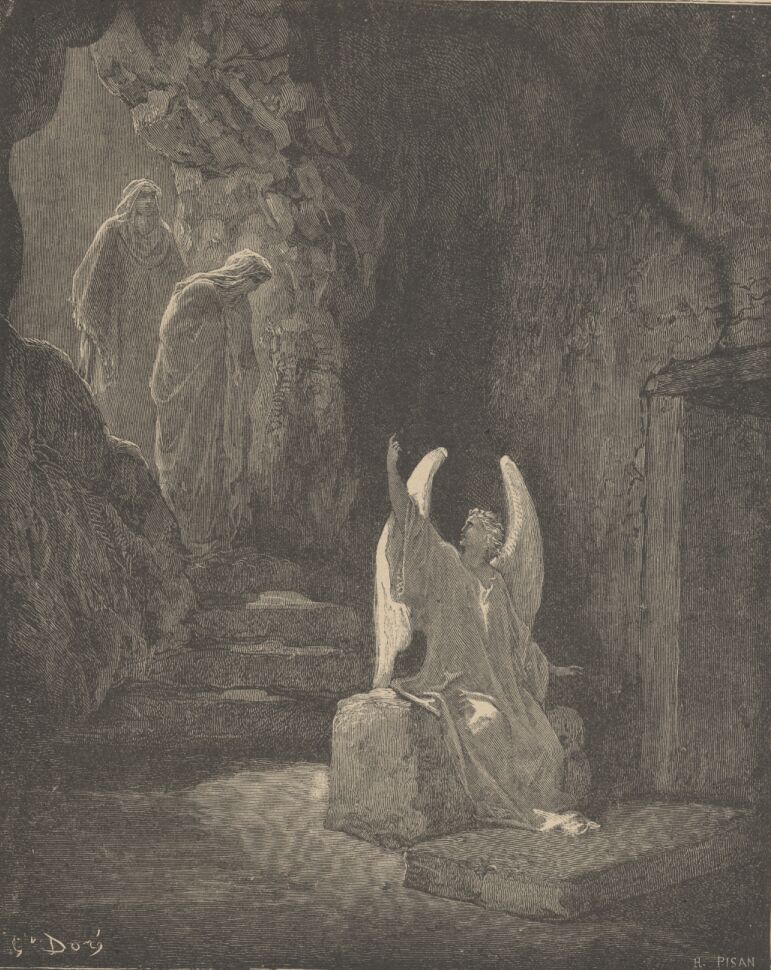
But on the first day of the week, at early dawn, they went to the tomb, taking the spices they had prepared. And they found the stone rolled away from the tomb, but when they went in they did not find the body of the Lord Jesus. While they were perplexed about this, behold, two men stood by them in dazzling apparel. And as they were frightened and bowed their faces to the ground, the men said to them, “Why do you seek the living among the dead? He is not here, but has risen. Remember how he told you, while he was still in Galilee, that the Son of Man must be delivered into the hands of sinful men and be crucified and on the third day rise.” And they remembered his words, and returning from the tomb they told all these things to the eleven and to all the rest. 10 Now it was Mary Magdalene and Joanna and Mary the mother of James and the other women with them who told these things to the apostles, 11 but these words seemed to them an idle tale, and they did not believe them. 12 But Peter rose and ran to the tomb; stooping and looking in, he saw the linen cloths by themselves; and he went home marveling at what had happened.

Good Friday 2020

It is Good Friday today, just as a reminder to anyone out there, like me, who is struggling to keep up with which day it is. It doesn’t feel like Good Friday, mostly because nothing feels the way it should right now. Hopefully, your church is finding a way to record or broadcast something. If not, feel free to check out mine – Roswell Church (a bonus is, you’ll get to hear Mrs. MMT sing). More specifically, nothing feels right because of the quarantine (I guess it is officially shelter in place), and the pain that comes from that is the separation; separation from friends, family, activities, some of us are even missing work. I’ve been thinking a good bit about separation as it relates to Good Friday, and wanted to offer a few thoughts. It is a sad, lonely, frustrating, and hard time, but with apologies to John Piper – don’t waste your separation.

Remember that the Son was separated from the Father. For all of eternity, before the creation of time, and before the universe as we know it existed, there was the Triune communion of Father, Son, and Holy Spirit. This was the perfect existence of God, lacking nothing. However, the Son would empty Himself (not of his Divinity, but of His willingness to exercise authority) and take the form of a man, the man Jesus. At the end of His ministry, He was crucified, which is what we remember on Good Friday. While on the cross, He took our sin on to Himself, and in the eyes of the Father replaced our sin with His righteousness. However, the Father could not look upon the Son with this sin, and the Son experienced separation from the Trinity and the wrath of God. Separation from God is the definition of Hell. So the Son, who had spent an infinite amount of time with the Father, gave that up to bear our sins, to take our punishment, to experience Hell, so that we would not. Think about that separation today.

Remember that we are now no longer separated from the presence God. There was even more that happened on the cross. We are told that the veil in the temple was torn in two, from top to bottom. In the temple, which already had requirements to enter, that was a veil that separated an area called the Holy of Holies, that only the High Priest could enter, and only once a year on the Day of Atonement to office a sacrifice. But now, the ultimate sacrifice, Jesus, was made. The veil (our separation from the presence) was taken away. We no longer need a High Priest, but through Christ, our Great High Priest, we can go directly to the Father. This is why we now have the opportunity to pray every day to God and ask forgiveness for our sins. We no longer need some intermediary, but can go directly to God. Think about the removal of that separation today.

Remember that nothing can separate us from the love of God in Jesus Christ. Thematically, you aren’t supposed to talk about the happy ending on Good Friday, that is supposed to wait until Easter (spoiler alert: Christ conquered death, rose again, that one day we shall do likewise), but I’m only pretend writer, so it is alright. But in remembering our current situation, our state of separation from society, it is important to remember that in some way it doesn’t matter. It is awful, but it is temporary. Thinking eternally,  we will be reunited with friends and family, and be in the perfect presence of God. For now, even as we wait, nothing can separate us from God’s love. Think about that today, and be reassured by these words from Romans 8:

35 Who shall separate us from the love of Christ? Shall tribulation, or distress, or persecution, or famine, or nakedness, or danger, or sword? 36 As it is written,

“For your sake we are being killed all the day long;
    we are regarded as sheep to be slaughtered.”


37 No, in all these things we are more than conquerors through him who loved us. 38 For I am sure that neither death nor life, nor angels nor rulers, nor things present nor things to come, nor powers, 39 nor height nor depth, nor anything else in all creation, will be able to separate us from the love of God in Christ Jesus our Lord.

It is Still Lent

Believe it or not, it is still Lent. Everything seems to have gone to the wayside, due to Pandemic, but it is important to remember. Not necessarily Lent, as most people know it, but Good Friday next Friday and, of course, Easter Sunday. I’ve written some thoughts on Lent before, because it has always been a little odd to me. Some people hate it and don’t do it because the Bible doesn’t say we have to, others do it, because their Church says they have to. I don’t always participate, because I feel as if I am not ‘doing it right’. But it should at least be a reflective time. I time to think about our own brokenness and remember of what Christ experienced our punishment for us.

This included being separated from God. Right now, while we are all separated from most everyone and everything, and we are all too aware of the brokenness of the world, it is just that much more important to focus on the Cross and especially the Resurrection. It should point us to our future hope, when there will be no more pain and suffering, no more death, and no more separation. This is a good Lenten practice anyway, but with so much going on right on, I pray everyone is remembering where we can find hope and that that can bring come level of comfort during this time.

Thoughts on Covid-19, Quarantine, and Community

I suppose it was inevitable that I would write something about all that is going on. I wanted to get back to posting my reviews and some other thoughts, but it seems impossible to get Covid-19 off your mind, especially after having remote church service again yesterday.

Providentially, perhaps, I was reading part of Psalm 42 yesterday. Psalm 42 & 43 were likely originally one but were broken up at some point for an unknown reason. The psalm is a pretty well-known one, it is where we get the song ‘as the deer pant(eth) for the water.’ It is not written by David, but by the Sons of Korah (or Korathites), yet it is often attributed to David as a prayer and during a when he is away from the temple, possibly when he was hiding from Absalom. Some modern critics, of course, give no attribution to David, but what is not in dispute is we have a man who is not in Jerusalem, and is longing to be back so that he can worship God.

Because of the work of Christ on the cross, we no longer need a temple or priest or anything else to worship God. We can go directly to God with our prayers, songs, praise and lemants. However, when we are seperated from our community of worship, as we have been the past few weeks, there is a sense of loss. The psalm is in three stanzas, each ending with –

Hope in God; for I shall again praise him,
    my salvation and my God.

It struck me how I do long to praise him again, in community, with other believers and friends at our church home. Again, we can all sing and praise God on our own, in our homes, as we have been doing. But I think it is important to remember that it is still lacking, something is missing, it just isn’t the same. Pastors can ask their congregants to post pictures of their families singing and taking communion together, and that helps, but we must acknowledge the longing. We miss some aspects of God that He reveals to us in and through community and taking communion together. So, I feel that deeply right now, that as a deer longs for streams of water, I long to worship again in community.

This time of longing should also remind us of future hope. That one day in the new Earth we will have perfect communion, all believers worship together, before God himself. We need to remember, always, that one day perfection will come and all the feelings of missing and lacking will be no more.

While it isn’t as enjoyable, please remember we are all ‘social distancing’ for the good of others. This is loving your neighbor. It is important to remember that no matter how inconvenient it is to be stuck in your house, it is far less of a pain than being hospitalized or seeing a loved one on a ventilator. It is a sacrifice for us, but Christians should not be scared to love others in this way. Another thing to remember is that while you may be able to work from home (which, again, is quite inconvenient) others may have no work at all.

Ask your pastors or community group leaders if they know of someone in your community in need, someone who has not received a paycheck in a week or who may not receive one in the next few weeks. I’d challenge everyone to personally decide if the need all (or any) of the stimulus money they are receiving in a few weeks. Maybe you need to shore up your own emergency fund first, but if you are still receiving your regular paycheck, consider giving most or all of it to your Church to be distributed to those who really need it. This wouldn’t be the first time Christians did this (see Acts, Galatians, etc. in the New Testament) and is unlikely it will be the last.

Also, keep in touch with your community and your actual neighbors. Maybe some are old or immunocompromised and cannot go out to the grocery store or to the pharmacy. This should be a time of Christians being once again known for charity in the community.

Remember, too, that while it is annoying, staying at home will help. In a month or so when rates are (hopefully) dropping, let’s remember not to look back and see it was all for nothing, that not that many people were impacted. It will be because of the actions we took to slow the spread, that the rates will decline. As a population, it is hard to see counterfactuals, something that cannot be proven. It is easy to see rates drop and be flippant, but it is because they are actually effective measures that are taken. It is a good reminder that the original vaccine was for Cow Pox (vaccine roughly means ‘no cow’ in Latin) and it took only a single generation before we have the original anti-vaxxers, people who questions the use of vaccines (and this was over 300 years ago). Of course, we still have these problem today, such as the measles outbreak last fall, a disease that was eradicated in the US 20 years ago.

Finally, look for the good where you can. Sure, maybe your babies are crying during communion, but maybe you also have the opportunity to talk with your other children about the significance of communion or what it means to be baptised. Our daughter is too young to attend service at our church regularly, but now she watches it with us. And she loves to sing, whether she knows the words or not. If she doesn’t, sometimes we laugh as she pretends she does. Or yesterday, there was a song she did know – It is Well – which is quite significant to us and so she sings and you wish you had closed the windows because no the pollen is getting to you and making your eyes water. Maybe like us, you have tried to keep your community group going by video conference. It isn’t always the best, and soon all men will have only two hairstyle – buzz cut and hat – but it is good to see everyone and at least check in on each other.

So, keep connected, everyone, we will be together eventually. Admit that longing to be together again. Remember that we are in a fallen broken world, but will live on day perfectly, together. Hope in God.
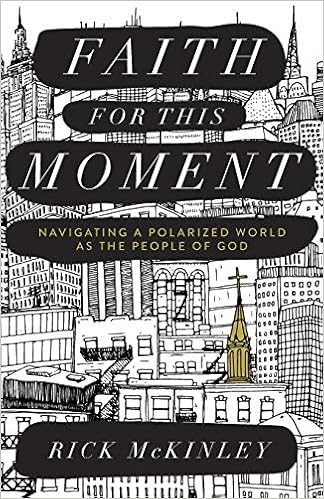
Book Review: Faith for This Moment

Faith for This Moment

My Rating – Must read

Level – Quick, easy read

Summary
The premise of the book is that the US has changed, we are now a post-Christian nation, and so the question that we currently face is, what do we do about it? He points to a turning point (this moment) in his life, and one he thinks had a larger effect on the nation. To him, things changed after the Pulse nightclub shooting back in 2016. He specifically mentions an NPR interview with a local Orlando pastor, who has asked ‘how do Evangelicals respond to his crisis when it is clear politically that Evangelicals are anti-gay and pro-gun.’ Apparently the pastor had no answer. I suppose you could quibble with the anti-gay statement, but perception can become reality, a notion only made stronger with the 81% support of (self identified) Evangelicals for President Trump.

After the Intro, where he points out how proudly nonreligious Portland is, McKinley spends his first chapter discussing this moment as well as other broader trends in US culture. The following 12 chapters answer his question of what to do now. He compares modern Christians in America to ancient Jews in Babylon. That is to saw, we are exiles, which means that we will not fit nicely in to current norms of society. He challenges us to embrace this notion and spends a few chapters each on things like giving, Sabbath, vocation, and hospitality which on the one hand will will differentiate us even further, but on the other, are all commands from God for us to follow.

My Thoughts
I was originally going to rate this book a little lower, but as I wrote the summary, it made me realize how potentially important this book could be; if for nothing else than an intro into thinking about ourselves differently. In the age of political Christianity, where a large number of self described conservatives look solely to government for their source of comfort and strength, McKinley challenges the efficacy of these practices. On page 24 he states, ‘from gay marriage to gun control, these efforts have backfired.’ He goes on to point out the ways in which this is true as well as the lasting impact of the ‘Culture Wars.’ He comes back to this in a later chapter and discusses the fact that our efforts have gone here instead of teaching people the Bible and for this reason, ‘people have put down the Bible, and picked up self-help books.’ He doesn’t discuss this idea too much further but the sad fact is that this has had a double impact as self-help and inward, selfish focus have come back around and are now effecting the church more than the Bible.

A final thought I liked as he challenges political Christianity is in his chapter titled ‘Babylon.’ He discusses empires and the power of nations and reminds us that in the Bible the might nations (Babylon, Assyria, Egypt), where never the good guys. Instead, they were used, by God, to punish his people. This should make every Christian, especially those of us who pursue political power for the sake of Christ, to stop and think for a few moments. I think his challenge to Christian norms of political power might alone be worth reading the book, but if not (or if you are already there) the remainder of the book serves as a valuable intro practices that will help us live out our life in exile.

Many Christians haven’t even heard of some of the practices he touches (mentioned above), and certainly only a few really follow them well. Vocation might be the trickiest topic, especially for a generation who’s idea of career has become so converted. There are many other books to dive deeper into this topic if your interest was piqued. His strongest chapters were on hospitality, some Christians probably fail at most, and Sabbath. Really focusing in on Sabbath and rest and separation is cultural norms is an idea regaining prominence recently; I’ve seen few different books dive a little into it.

My only critique, really, is that the intro was too short. As someone born and raised in the South, I would’ve liked to hear a little more about the life of a Christian on the other end of the spectrum, the Pacific Northwest. Overall, I think it is an interesting, if short, book that hits on some big topics, from our interaction with our current moment, the concept of exile, and reforming some of the ancient practices of God’s people. The breadth of ideas and challenge of this book make it a must read.

*I received a free copy of this book in exchange for an honest review

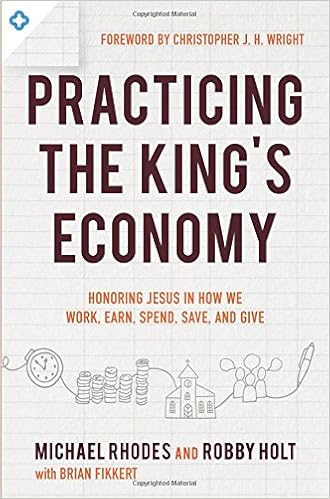
Book Review: Practicing the King’s Economy

Practicing the King’s Economy: Honoring Jesus in How We Work, Earn, Spend, Save, and Give

My Rating- Must Read

Level – Easy read, medium length

Summary
The book basically tries to answer the question of what would it look like if we worked, ran businesses, spent money/time, and gave money/time in a way that was entirely shaped by a Biblical World View. After the intro the book is broken into 12 chapters that are based on the six ‘keys’ to practicing ‘the King’s Economy’. One chapter will introduce the key and the next is a shorter chapter that gives examples of how that key works in the real life, with examples of people/organizations that the authors know.

The six keys are – Worship, this is about who we worship. Is it God or money and how does that look in the way that we give. Community, the focus here is about having a broad community of all types of people, particularly those from different economic classes. Work, why do we work and what is the point of work? Also, what does the Old Testament concept of ‘gleaning’ look like in a modern world? Equity, based on the command that their be no poor among us, this isn’t necessarily just about making sure everyone has money, but that every one has a job and kind provide for themselves (or help to give to others), even further, it is about making sure that those jobs are enough. Creation Care, this is about environmental stewardship. Finally, Rest, and this is a call to bring back the practice of Sabbath.

My Thoughts
I really enjoyed this book. It was probably the most thought provoking and in some way challenging book I’ve read in a long time. Sadly, it isn’t often you read a book targeted at a popular Christian audience that makes you think, even rarely does one challenge the way you should live.

I’ll get the two nit-picky things I didn’t like out of the way first. I didn’t really like the intro, and this was due to their misuse of stats that is a pet peeve of mine. In the intro, they are trying to show that we are richer now than ever, but more unhappy. Unfortunately, they use GDP per capita, which is a useless statistic, because it ignores income inequality and the fact that middle classes wages have been stagnant for decades. It also ignores cost like tuition and healthcare that have risen more rapidly than anything else. However, I don’t disagree with their premise, if nothing else, we are at least more materialistic than ever and constantly surround ourselves with distraction. Second, and I think this is more on the editors or publisher, they only ever refer to Jesus as King Jesus, and this is done to reiterate the title, and it is just awkward and I wish authors/editors wouldn’t do that.

No back to the good part, if you are modern American Christian, especially on the conservative or Republican side, this book will be a challenge. I’d suspect many hardcore Republican’s won’t finish this book as it challenge the assumption that making money is the most important thing in life. It also encourages people to pay living wages, which Republicans generally oppose vehemently. Of course, there are aspects that all sides of the political spectrum will like and dislike, which is a great reminder that neither political party works from a Biblical worldview and we ought not act like they do.

The first chapter, about putting God first and showing that by how we give should challenge the way we all handle money. American’s like to think of ourselves as generous, but in reality we give about 2.5% of income. The Community, Equity, and Rest were interesting chapters that should make you think, and if you take take it seriously, will affect your life. And of course, it should right? The Bible calls us to be different, and especially the chapters on Community and Rest are reminders of just how different we should look. The Creation Care chapter was good and I agree with all of it, I’m a big advocate of environmental stewardship. However, it was probably the weakest on a Biblical basis, and I’m not entirely sure it fit well with the rest of the book.

The best chapter, and worth the price of the book alone, is the Work chapter. For one, many of us, especially white-collar workers who have a lot of options, struggle with what work should look like in out lives, but the crazy part is gleaning. In the Old Testament, the Jews were not allowed to fully harvest their own fields. God required that they leave the edges unpicked so that the poor, widows, orphans, and foreigners would have something that they could eat. Obviously, we are not a majority subsistence agricultural community anymore. So the authors dive into what it could look like and the ideas are fascinating and in some ways pretty radical to the way we view life in America.

I don’t necessarily agree with some of their options, or at least the way that they would work out in most places, but they are thought provoking nonetheless. It is certainly something I’ve never thought about before, but it has been on my mind sense I finished the book a few weeks ago. If you really want to be challenged and forced to think and try to rethink the way we view the economy today, and how we should view it as as Christians, this is a book for you. It is probably my favorite so far of 2018, and is definitely a  must read book.

*I received a free copy of this book in exchange for an honest review.

Top post of the first half of 2018

I noticed many other bloggers do something like top post/most read of X year or the more prolific ones do a top of the month, or even week. I always kind of wondered how they knew, and that’s when I discovered the depth of the stats pages blogging platforms provide. I brought this up to Mrs. MMT and she thought it was stupid…that I didn’t know this was a thing. To be fair, she is an accredited PR professional, and my desire in life is to be a monk, but with sex, and fishing, and college football. Wait, where was I?

So I dug into my stats, and up until a few months ago, my most viewed overall (and winning by far and away for most views the day it was posted) was the time almost two years ago that I hosted the 2016 August Biblical Studies Carnival. That has since been passed by what is also my most read post of 2018 so far. My top five most read of 2018:

  1. Book Review: Sapiens
  2. Book Review: The Imperfect Disciple
  3. Book Review: Disciplines of a Godly Man
  4. Book Review: Spiritual Disciplines of the Christian Life
  5. Tie – 10 Year Anniversary; Book Review: Four Views on Hell; Book Review: Darkness is My Only Companion

Why these posts? I have a few ideas, we’ll start from the bottom. Interestingly, Darkness is the only book review to make the list that I actually posted this year, so it’s probably there just due to recency. Similarly, Anniversary was post two weeks ago, and probably brought more of my Twits than book reviews due to the pictures of me and the Monday Morning Wife. Not sure about Four Views, other than Hell is weird and people have questions about it. Feels pretty cool that people found me from that.

My guess is that Imperfect, and the two disciplines books were popular searches due to Lent. I’ve already stated, I don’t know how to do Lent, but I do have two thoughts to help. First, you are probably looking up Lent because of fasting. I’ve heard nothing better than this Theocast podcast on fasting. Their idea that it isn’t necessarily about giving up food (Protestant view), but more about reclaiming time is fascinating. Second, if you are deciding which book to read, I can help. Imperfect is not about spiritual disciplines, but is still awesome and you should read it, and I’ve already written a post about why you should read Godly Man over Christian Life (though, if you are a woman, it’s still a better book).

So, this brings us to Sapiens. Why? Well, my stats pages tell me the terms searched that led people here, and basically, it was people searching for a ‘Christian review’ of the book. I was shocked/proud to find out that if you google this, I’ll be one of the top 5 or so (it changes) links shown. That’s really cool, but people were probably disappointed in what they found. I didn’t write a ‘Christian’ review in the sense people were probably searching. I mean, I am a Christian and I did review the book, but I think what people were look for was a Christian response. So, as a man of the people, I plan to write a Christian response to this book based solely on my guess what people were actually questioning (off the top of my head, it’s evolution).

Two final thoughts – I do Advanced Review Copy book reviews for a few publishers, but of the six book reviews that have brought the most readers this year, only one (Imperfect, from Baker Books), was one of these. Second, the May 2018 Biblical Studies Carnival is up over at 5 Minute Bible.

That’s it, those are my top five as of June 1, 2018. I plan to do an end of the year post for the most read of 2018, so stay tuned I guess. Thanks everyone who reads or follows me and I apologize in advance to anyone who found my by accident. I’ll try to do better next time.

Easter 2018

He is risen!

We celebrate Easter today and commemorate the Resurrection of Christ. Jesus isn’t dead, and did not stay in the grave, but instead we worship the living Son of God whom is seating at the right hand of the Father. He conquered death, so that we will never truly die, but will one day be brought up with him. There is no sting in death, no victory for the grave, as Christ is victorious, and we will now live.

1 Corinthians 15:50-58

Mystery and Victory

50 I tell you this, brothers: flesh and blood cannot inherit the kingdom of God, nor does the perishable inherit the imperishable. 51 Behold! I tell you a mystery. We shall not all sleep, but we shall all be changed, 52 in a moment, in the twinkling of an eye, at the last trumpet. For the trumpet will sound, and the dead will be raised imperishable, and we shall be changed. 53 For this perishable body must put on the imperishable, and this mortal body must put on immortality. 54 When the perishable puts on the imperishable, and the mortal puts on immortality, then shall come to pass the saying that is written:

“Death is swallowed up in victory.”
55 “O death, where is your victory?
    O death, where is your sting?”

56 The sting of death is sin, and the power of sin is the law. 57 But thanks be to God, who gives us the victory through our Lord Jesus Christ.

58 Therefore, my beloved brothers, be steadfast, immovable, always abounding in the work of the Lord, knowing that in the Lord your labor is not in vain.


Good Friday 2018

Matthew 26:36-42

Jesus Prays in Gethsemane


36 Then Jesus went with them to a place called Gethsemane, and he said to his disciples, “Sit here, while I go over there and pray.” 37 And taking with him Peter and the two sons of Zebedee, he began to be sorrowful and troubled. 38 Then he said to them, “My soul is very sorrowful, even to death; remain here, and watch[a] with me.” 39 And going a little farther he fell on his face and prayed, saying, “My Father, if it be possible, let this cup pass from me; nevertheless, not as I will, but as you will.”40 And he came to the disciples and found them sleeping. And he said to Peter, “So, could you not watch with me one hour? 41 Watch and pray that you may not enter into temptation. The spirit indeed is willing, but the flesh is weak.” 42 Again, for the second time, he went away and prayed, “My Father, if this cannot pass unless I drink it, your will be done.” 


Propitiation of our sins and Substitutionary Atonement, means that Christ took the Wrath of God for us. Every sin of every person, past, present, and future, was laid to rest on Him that day. The sky went dark and the Son was separated from the Father. We call today Good Friday because it was good for us. He took on death, that we may live. However, we should remember, on this day especially, the seriousness of sin and the wrath of God. Jesus even prays, in the verses above, that if there is any way other than to drink the Cup of God’s Wrath, to please let that happen, but if not, He will do God’s will. He consumed that cup for us, taking the full measure of wrath, that He who never sinned, would become as sin for us, so that we would become as righteous before God (2 Corinthians 5:21).


He was distressed until it finished
The pain endured was not diminished
Until the vict’ry’s sound and was won
“Not My will but Yours be done.”

He drank it all, the cup of God’s wrath

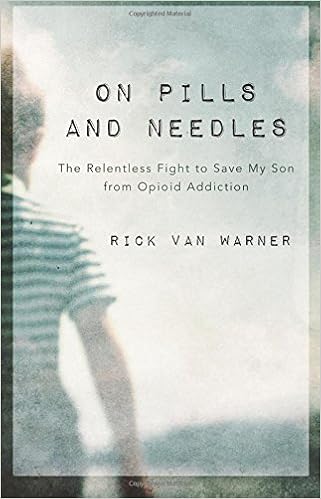
Book Review: On Pills and Needles

On Pills and Needles: The Relentless Fight to Save My Son from Opioid Addiction

My Rating: Put it on your list

Level: Easy, moderate length (250+), but reads quickly

Summary
A detailed summary of the book is difficult to do. The subtitle more or less says everything you need to know about the book. Van Warner writes a first hand account of watching is his son struggle with addiction to opioids, starting as a teenager and extending through his mid twenties. The book is broken into 25 broad chapters that generally follow a chronological pattern of thought, but not always. There are a few bits of information regarding the pandemic that is the opioid crisis, but these are mostly scattered throughout the narrative of his son’s life. If you seeking answer to the problem, or even just the ‘Christian response’ (the publisher is Baker Books, after all), you will not find any in this book. However, if you are somehow lucky enough not to know anyone with this addiction, it is worth the read, if for nothing else than to gain an understanding of what happens, what addiction look like, and the impact of family and friends of the addict.

My Thoughts
Van Warner is a great writer in a narrative sense, and I found myself compelled to keep reading this book just to see what happens next. It is an emotionally enthralling book, and if you have normal level of empathy and emotions, it is likely you will not get through this book without crying multiple times. That being said, be aware that there is little else to this book than the story of his son. I’m not really sure what I expected when I ordered it, but there isn’t really any resolution or response to the issue. No ‘warning signs’ or way to prevent this from happening. Nothing along the lines of, how to help those hurting or what we should do as a church. All of  which is fine, it is clearly not the intention he had in mind while writing this, but be aware if that is the type of book you are looking for.

Outside of the lack of resolution, the only thing I didn’t like about the book is the typically evangelical hypocrisy of being anti-government, while blaming the government for not doing enough. While he rightly attributes the initial problem to the Pharma Companies, specifically the one that falsely claimed Oxcy was non-addictive, he does lament the government hasn’t done enough. He also point out that Florida is ground zero of the crisis, with an astonishing 93 of the top 100 opioid prescribing doctors working there. Of course, FLorida is notoriously lax in government regulation and I’m sure this and the low tax (meaning less government) environment is partly what brought him there from New York. He himself doesn’t necessarily rant that much against government in his book, but it is odd to read from the perspective of evangelicals, knowing that most of us are heavily pro-business and anti regulation, inexplicably claiming that the free market couldn’t lead us astray, and then, when they inevitably do, we wonder why the government didn’t help. Those critiques are a little past the realm of this book review, but if you become aware of them while reading, it tends to gnaw at you.

Likewise, he blames ‘bureaucracy’ for his son spending two months in county jail, while he supposed to be transferred to another county jail. All this happens in context of his sons possession and intent to distribute charge being dropped. Being dropped. He doesn’t seem to realize how lucky he is that his son is well off and white. Poor people and minorities don’t tend to have felony drug charges just ‘dropped’, but instead spend years in jail.

I’m hesitant to leave that in for just a book review, but the author does seem to be misguided often. Regardless, his story is revisiting, if lacking insight in to solutions. I have a colleague whose son is currently in the grips of heroin addiction, after starting with Oxcy. The things the author writes about, the stories, the pain, the interactions with counselors and police, could have come from her. There is a shocking amount of similarity. I’m sure that is the same for many others out there. If you are looking for a story to help you internalize the crisis, this is a must read. It is probably helpful for anyone in pastoral ministry, counseling, or youth/child workers. There isn’t a list of things that parents/teachers can look for as far as signs of drug abuse, but there are gleanings from the detail of his story. For those with any interest in the epidemic that is currently among us, this is a book you need to add to your list.

*I received a free copy of this book in exchange for an honest review