Book Review: Prayer

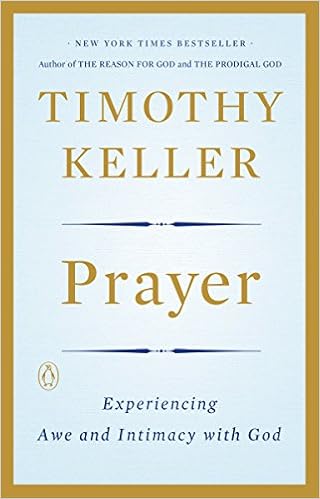
Prayer: Experiencing Awe and Intimacy with God

My Rating – Must Read

Level – moderate, 250+ pages before appendixes and notes

Summary
It is a book about prayer, that is pretty clear from the title. There is a little bit of almost everything, prayer as it is in the Bible, a commentary on the Lord’s Prayer, notes from people in church history, differing prayers styles/times, and ways of doing prayer. Overall it is a good survey of most things related to prayer. The book is broken into five parts – Desiring Prayer, Understanding Prayer, Learning Prayer, Deepening Prayer, and Doing Prayer – with a few chapters per part, for a total of 15 chapters.

My Thoughts
I’ve read a number of book on prayer recently for a sermon series, and as someone who occasionally writes, it is almost annoying the Keller once again has written the best book on a topic. The book is almost academic at some points, particularly the exposition of the Lord’s Prayer, while still remaining pastoral and accessible to most readers. I actually read only part of the book a year or so ago when I was studying the Sermon on Mount and heard his commentary on the Lord’s Prayer was one of the best, then finished this year while studying prayer.

There is a good bit of discussion from people throughout church history (Augustine, Calvin, Luther) regarding prayer. I particularly enjoyed his ‘doing prayer’. This was the strength of the book to me. I’ve read many of the other commentators, and I know that/why we should pray, but I’ve always struggled with the how and especially with the habit of prayer. If that is you, the book is worth it just for that section and the resources in the back.

The only weakness in the book is that Keller doesn’t really discuss unanswered prayers. Or at least, he doesn’t do it well. He isn’t ready to say that God doesn’t answer prayers sometimes. That’s a huge theological issue and maybe outside the scope of what he wanted to do, or just knows the answer is both simple and complex. Check out Yancey for more on unanswered prayer. Keller kind of hedges bye saying the answer can be yes and no. He gives the example of a girlfriend in college that broke up with him and him praying that it wouldn’t happen. He says the answer was no, as the girl did break up with him, but that the answer was yes because he eventually married his wife. I see what he is saying, and I appreciate what his view, however, this isn’t always the case. Some people may never be married; additionally, people die young from cancer, addicts can’t kick their addiction, etc.

It is a hard topic, so I don’t mind that he failed, because what he does cover is covered so well. As I said earlier, the practice of prayer is handled extensively and is reason enough to get the book. If you are just looking into prayer as an intro, or your prayer life is stuck, or you are looking to go deeper in your understanding of prayer, this book is a must read.

Book Review: Prayer – Does it Make Any Difference?

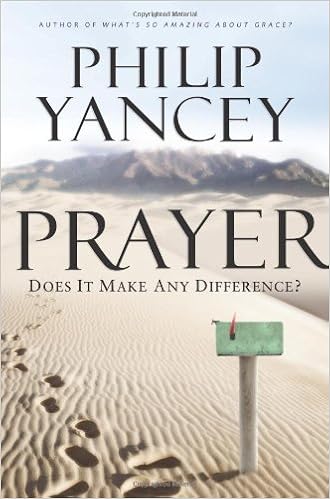
Prayer: Does It Make Any Difference?

My Rating – Put it on your list

Level – Easy read, moderate length

Summary
The title pretty much says it all. The book is about prayer, what is it, what do we do with it, why, and what’s the point? The subtitle isn’t necessarily answered, other than to say, maybe – for us and for God – but also, maybe not. The book is broken into five parts, Keeping Company with God, Unraveling the Mysteries, The Language of Prayer, Prayer Dilemmas, and The Practice of Prayer. Each part is broken down into three to six subparts, for 22 chapters in all.

My Thoughts
I’ve not read a book by Yancey before. I thoroughly enjoyed his writing styles. As a writer and not a pastor, this book doesn’t give you theological insights or pastoral guidance like you might find in Keller, but you get something maybe more personal. Most chapters are fairly short and are usually broken down even further, so you get something almost like blog-post type series of his personal thoughts. Of course, there are many good quotes and insights form other author and theologians, but I think the goal is something more personal. He lays out his struggles, or writes about stories he has heard from others. Yancey is afraid to honestly question the point of prayer.

The strength of the book comes with the first chapter and especially the fourth. In the former, you get the reason for prayer as our main form of communication with God, in the latter, the problems and struggle people face. I was a little disappointed with final chapter as he doesn’t really delve into historical guidelines or lay out any practical steps; though in his defense, I don’t think that was his point. Overall, it is a great personal book on prayer and he points out what many people think and struggle with, something that is all too absent in Christian writing. It probably isn’t the best book if you are seeking a practice of prayer, but if you are just starting to study prayer, it is definitely worth putting on your list.

Book Review: The Stand

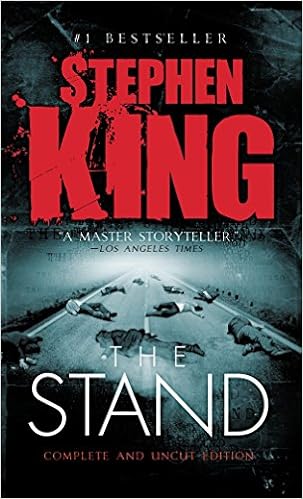
The Stand

My Rating – Put it on your list

Level – Easy read; Very Long (1,150-1,200 pages depending on the edition)

Summary
A mysterious flu-like disease sweeps across the country, then the world killing 99.6 percent of the population. While the disease is 100% fatal, not every one contracts it. The story follows a few different people (some before, some after the flu) that all plan to meet up with a 108 year old woman in Nebraska, before moving to Colorado. Others do not follow the woman, but instead the ‘dark man’, and meet in Las Vegas. Those in Vegas plan to destroy those in Boulder, and eventually take over the world. Those in Boulder prepare to make their final stand (get it?).

If you’ve read much Stephen King, you know there will be twist and turns and other weird things, it can be hard to tell where he is going, because he probably wasn’t sure as he was writing it. My version of the book was the ‘complete and uncut’ version that was republished in 1990. The original was released in 1978, but was about 400 pages shorter. You can read his intros to the book for the explanation, though I still found it somewhat strange, as the book is broken into three ‘books’, why not just publish a trilogy?

My Thoughts
Actually, I’ll start with my dad’s thoughts. King is probably his favorite author and he has read all of his books (including the first publication of The Stand), and according to him, it is a toss-up between this book and Salem’s Lot as King’s best. When I asked other King fans about this, they tended to agree or call Salem’s Lot a close winner, so I guess I know what to read next.

Despite the massive size of the book, it really reads quite quickly. Much of the book is dialogue, so the pages aren’t that full. As always, King writes conversations and peoples’ thoughts so well that speed threw most pages. Some people complain that it drags, but I didn’t really feel that, though I felt he was oddly disproportionate to different times and scenes.

I found the story and people to be compelling, especially the early part of the book, post-flu. It kind of reminded me of the TV show ‘Last Man on Earth’, except most of King’s characters are far more intelligent and resourceful. I found myself thinking, that was smart, I’ll have to remember that…just in case. The first few hundred pages will really make you think, and the rest you read quickly with anticipation as to how it will end. If you enjoy Post-Apocalyptic fiction or are a King fan, this is definitely a book to put on your list.

*Spoilers (am I required to do that for a 40 year old book?)
This isn’t necessarily a spoiler, but I read the book in June and people at work started calling in sick, saying they had a summer cold, a phrase I had never heard before. Honestly, I started to get a little paranoid. I have three final thoughts, to of which are critiques, but it it will ruin the ending if you haven’t read it; so, you’ve been warned. First and foremost, the ending with Trashcan Man blowing everyone up is stupid and even worse it is completely unrelated to the guys who walked there. The didn’t need to be there, Trash might have killed everyone regardless of their presence. Other problem also with the ending, it was really stupid that Stu and Fran drive back to Maine. Boulder had just turned the power back on and had doctors and a functioning hospital, but they leave despite having an infant and her being pregnant again. Finally, with chapter with Stu and Tom making their way back to Boulder are some of the best writing and sweet/sad story lines you may ever read. Probably makes up for the other parts I didn’t like. Definitely worth the read.

Book Review: 50 Core Truths of the Christian Faith

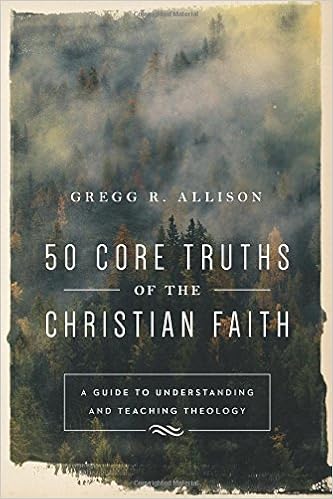
50 Core Truths of the Christian Faith: A Guide to Understanding and Teaching Theology

My Rating – If you are looking for something (if you’ve read other Systematics then pass)

Level – Fairly easy read, longer (400 pages) and a bit repetitive

Summary
This book is a mix of things – an intro to Systematic Theology, a teaching guide, and reference book to broad theological topics. Allison writes from a broadly Evangelical Protestant perspective. The author has broken the book into eight parts – the doctrines of the Word of God, God, God’s Creatures, God the Son, God the Holy Spirit, Salvation, the Church, and Future Things. Each part has varying numbers of chapters, giving you 50 total.

As the subtitle states, the point of the book is to be a guide to understanding and teaching theology, and this leads to a somewhat unique structure to each chapter. It starts with a one or two sentence summary, then bullet points of the main themes, and a list of key scriptures. The largest section of each chapter is ‘understanding the doctrine’, which is broken into three sections – major affirmations, Biblical support, and major errors. After this is ‘enacting the doctrine’, which is basically what the doctrine looks like in our lives, followed by ‘teaching the doctrine’ which includes discussion points as well as a teaching outline. Each chapter ends with a list of resources, however only three Systematics are listed.

My Thoughts
I’ll start out by saying I realize this is an ambitious book, attempting to be both an intro to theology as well as a teaching guide to Systematics.  As an intro, I think Allison does an adequate job. Most full books on theology pass the 800 mark, many going in to the 1,200-1,500 range, if not multiple volumes, so I appreciate his attempt to condense it to about 200 pages or so. Unfortunately, it still manages to feel too redundant. Part of this is due to the structure, having a summary and bullet points then the body, but I think the publishers must have had the intent to make each chapter stand on it’s own, as opposed to building on each other. This forces him to refer back to chapters (or state future points) and the points get repetitive. On the other hand, this is also a great way to learn and internalize the content, which may well have been the goal.

As a teaching guide, I think this could come in handy. The teaching outline presented at the end of each chapter appears to be quite helpful. The book could also function as a quick reference if you have other Systematics you like to use. If you broke out the teaching portions, you might end up with a 125-150 page book, which would likely be worth it on it’s own. If you are looking for something to help you teach theology to other, and you are already familiar and have other books, I think this book would be worth a look. However, as far as a book to study theology on your own, you are probably better off finding something else.

I’ll end the review with a couple theological points and issues regarding the book. First, the main reason I can’t really recommend the book as a way to begin deep study into theology, is that he does argue much with counter points. He lists them as errors, but doesn’t really state how/why others believe this or what their proof-texts necessarily are. If you are really trying to learn at a deeper level, you need to know more about the errors than just that they are errors.

My other problem, and I think this is worse, is that while trying to keep the book geared toward a broader theological level, he gives positive info an different theologies, some of which are completely incompatible. Certain points of Reformed and Arminianist theology cannot both be true. One of them has to be an error, and it is strange that he did not take a stand (though as you read his ‘Biblical support’ it is clear at times where he falls). Likewise, he lists all the points of Dispensationalist theology as equal to Reformed and other historic views of theology. While refusing to call this an error, he does come down on other things, such as calling Annihilationism a heresy. This is especially odd as he wrote a text book on Historical Theology and knows well that support for Annihilationism has much, much deeper historical roots that theologies such as Dispensationalism. I find it odd the doctrines for which he will take a hard stand, will promoting whole theological systems that are wholly incompatible with each other. It is a major failure of the book and one of the reasons I cannot recommend it as much as I would like. You’d be better served by are larger study that looks at points and counterpoints of each doctrine/theology or a study that takes a strictly orthodox view.

*I received a free copy of this book in exchange for an honest review.
 

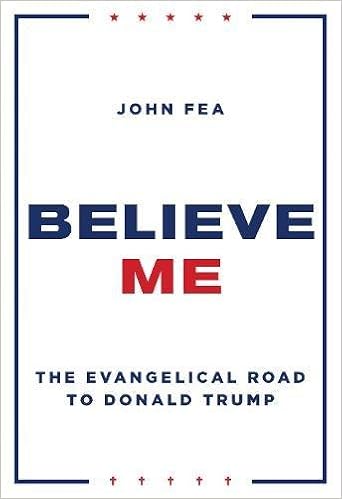
Book Review: Believe Me

Believe Me: The Evangelical Road to Donald Trump

When you receive an advanced reading copy to review, you are supposed to have the review out before the book is published, something I rarely do. However, today is one of the days I’ve done it correctly. This book will be available for purchase starting tomorrow, June 28.

My Rating – Must Read

Level – Short, easy read

Summary
The subtitle kind of says it all. How did Evangelicals so overwhelmingly support Trump (more than any other candidate in history)? He received 81% of self identified Evangelicals. There are people who dispute the support, due to the self identified label and have found that people who attend among those who attend church weekly, the support drops to 40’s. However, Fea is a historian, and clearly knows that we as Evangelicals are now tied to Trump, whether we like it or not.

The book isn’t necessarily a critique of Trump or his policies, but just an explorations as to why this man, of all people, would be considered the ‘Christian candidate.’ Excluding the intro and conclusion, the book is broken into five chapters: Evangelicals Politics of Fear, how people have used fear to drum up support; The Playbook, how Christians have used fear over the past 70 years or so to affect politics in certain ways; Short History of Evangelical fear, from the Puritans to today Christians; Court Evangelicals, those famous Christians today who seek power and influence the ways courtiers once did with kings; and Make American Great Again, what exactly does Trump mean by this, when was it great, and for whom?

My Thoughts
I’m pretty sure the first time I came across Fea’s blog The Way of Improvement Leads Home was during the 2016 elections. He very clearly, as was I, seemed confused as to how Trump had the Evangelical vote. Many Christians now, including some of the most vocals supporters, say they chose Trump because he was better than Clinton, but many of them were supporters in the Primary. Fea points out in the book, that prior to Trump jumping in the race, Carson lead the Evangelical vote, but shortly after, Trump took it over, lost it briefly a few months later, and after recovery always lead. To some people, this made sense, to others it is absolutely confounding.

A twice divorced billionaire, who brags about infidelity, believes if you are rich you can grab random women ‘by the pussy,’ doesn’t believe in asking for forgiveness (a pillar of Christian beliefs), and is so ostentatious that he seems to be the physical embodiment of avarice seems to be an odd choice for the so-called Evangelical vote. This book is essentially Fea trying to understand what happened.

If Court Evangelical is a new term to you, it will likely be the most interesting chapter. The most striking to me was chapter five, Make America Great Again. As Christians, we need to seriously consider the ‘great again’ part and it’s implications. It might be great for me, a Protestant white guy, but what about basically everyone else that exists? And how serious is he about getting back to the ‘good ol’ days’?

There’s a lot more I could write about this topic, and if you are interested, the book is a must read. It is a great intro into how to think about Evangelical support for Trump. Even if you are supporter, especially if you are a ‘supreme court’ supporter, you should really read this book. I do have two brief criticisms and then a final thought before this gets too long.

First, a theological issue. Fea must come from an Arminian branch of Protestantism, as he misunderstands a few things about Puritan thought as well as Calvinism. It doesn’t necessarily change anything in the book, but if you come from a Reformed or Lutheran background, you’ll see some theological and hermeneutical errors. Second, he is a little too quick to say someone in not a Christian. While I agree that Trump shows not a single ‘fruit of the Spirit’ nor any ‘good works’, I’m hesitant to ever doubt someone’s profession of faith.

Finally, I really appreciate the intro and concluding chapters in this book. I’m told some people do not read these, but you really should. I am sure Fea will be attached as a ‘liberal’ or people will say he is not a Christian for writing this book, but the intro makes it pretty clear what he is trying to do. Even more, the conclusion is a great piece of writing on the confusion about the support for Trump. He wrote so much of what I’ve felt or wondered. It’s not that voting for Trump is wrong, it’s that the fact he is viewed as the Evangelical leader just makes no sense. If you are rich, or think the most dangerous think in America is Mexicans picking our fruit, or if you want to ban Muslims, or if you are just a party line Republican, then Trump makes the most sense. And all of that is fine, but to tie him up in religious language and say he is the best candidate for Christians is just confounding.

This vote will follow Evangelicals for all of American history. If you are curious as to how we go her, this book is a must read.


*I received a free copy of this book from Eerdman’s Publishing in exchange for an honest review. This is my first review for Eerdman’s and the first time I’ve received a galley proof in hardcopy.

Father’s Day Reading Recommendations

If you are a dad of a young child or a soon to be dad, I have a few recommendations for books to check out this Father’s Day.

Best pre-dad book I’ve reviewed – The New Dad’s Playbook: Gearing Up for the Biggest Game of Your Life
Best pre-dad I haven’t reviewed – Be Prepared
Another good pregnancy/first few months book that has a great guidebook style (my review) – We’re Pregnant! The First-Time Dad’s Pregnancy Handbook
Best book for early childhood – Brain Rules for Baby (Updated and Expanded): How to Raise a Smart and Happy Child from Zero to Five
Best Gospel-centered parenting book (my review) – Parenting: 14 Gospel Principles That Can Radically Change Your Family
Best book for men in general, but certainly has a few value for fathers and husbands (my review) – Disciplines of a Godly Man (Paperback Edition)

*This book is more focused on women, but is actually a pretty good read. My advice to dads and pre-dads who fear their wife might be over-protective is to have them read this book (y’all both read, she’ll appreciate the effort if nothing else) – Bringing Up Bébé

A few others to consider:
The Pregnancy Instruction Manual: Essential Information, Troubleshooting Tips, and Advice for Parents-to-Be (Owner’s and Instruction Manual)
The Baby Owner’s Manual: Operating Instructions, Trouble-Shooting Tips, and Advice on First-Year Maintenance
Einstein Never Used Flashcards: How Our Children Really Learn–and Why They Need to Play More and Memorize Less
How Toddlers Thrive: What Parents Can Do Today for Children Ages 2-5 to Plant the Seeds of Lifelong Success
The Whole-Brain Child: 12 Revolutionary Strategies to Nurture Your Child’s Developing Mind

The suggestion skew young as they are all about pre-dad to preschool, mostly baby and toddler books, but I’m young (ish) and have just the one preschooler, so I don’t know what to tell you other than to check back in the next few years for more. For borader parenting books I’ve reviewed, but don’t necessarily recommend, check out my review of Fearless Parenting and my review of Talking with Your Kids About God.


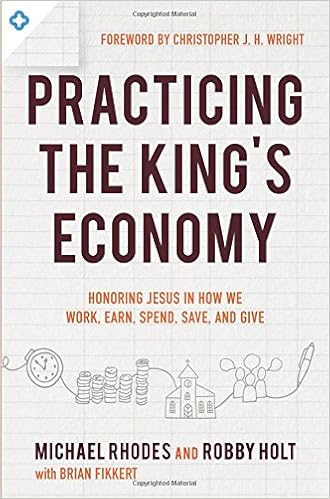
Book Review: Practicing the King’s Economy

Practicing the King’s Economy: Honoring Jesus in How We Work, Earn, Spend, Save, and Give

My Rating- Must Read

Level – Easy read, medium length

Summary
The book basically tries to answer the question of what would it look like if we worked, ran businesses, spent money/time, and gave money/time in a way that was entirely shaped by a Biblical World View. After the intro the book is broken into 12 chapters that are based on the six ‘keys’ to practicing ‘the King’s Economy’. One chapter will introduce the key and the next is a shorter chapter that gives examples of how that key works in the real life, with examples of people/organizations that the authors know.

The six keys are – Worship, this is about who we worship. Is it God or money and how does that look in the way that we give. Community, the focus here is about having a broad community of all types of people, particularly those from different economic classes. Work, why do we work and what is the point of work? Also, what does the Old Testament concept of ‘gleaning’ look like in a modern world? Equity, based on the command that their be no poor among us, this isn’t necessarily just about making sure everyone has money, but that every one has a job and kind provide for themselves (or help to give to others), even further, it is about making sure that those jobs are enough. Creation Care, this is about environmental stewardship. Finally, Rest, and this is a call to bring back the practice of Sabbath.

My Thoughts
I really enjoyed this book. It was probably the most thought provoking and in some way challenging book I’ve read in a long time. Sadly, it isn’t often you read a book targeted at a popular Christian audience that makes you think, even rarely does one challenge the way you should live.

I’ll get the two nit-picky things I didn’t like out of the way first. I didn’t really like the intro, and this was due to their misuse of stats that is a pet peeve of mine. In the intro, they are trying to show that we are richer now than ever, but more unhappy. Unfortunately, they use GDP per capita, which is a useless statistic, because it ignores income inequality and the fact that middle classes wages have been stagnant for decades. It also ignores cost like tuition and healthcare that have risen more rapidly than anything else. However, I don’t disagree with their premise, if nothing else, we are at least more materialistic than ever and constantly surround ourselves with distraction. Second, and I think this is more on the editors or publisher, they only ever refer to Jesus as King Jesus, and this is done to reiterate the title, and it is just awkward and I wish authors/editors wouldn’t do that.

No back to the good part, if you are modern American Christian, especially on the conservative or Republican side, this book will be a challenge. I’d suspect many hardcore Republican’s won’t finish this book as it challenge the assumption that making money is the most important thing in life. It also encourages people to pay living wages, which Republicans generally oppose vehemently. Of course, there are aspects that all sides of the political spectrum will like and dislike, which is a great reminder that neither political party works from a Biblical worldview and we ought not act like they do.

The first chapter, about putting God first and showing that by how we give should challenge the way we all handle money. American’s like to think of ourselves as generous, but in reality we give about 2.5% of income. The Community, Equity, and Rest were interesting chapters that should make you think, and if you take take it seriously, will affect your life. And of course, it should right? The Bible calls us to be different, and especially the chapters on Community and Rest are reminders of just how different we should look. The Creation Care chapter was good and I agree with all of it, I’m a big advocate of environmental stewardship. However, it was probably the weakest on a Biblical basis, and I’m not entirely sure it fit well with the rest of the book.

The best chapter, and worth the price of the book alone, is the Work chapter. For one, many of us, especially white-collar workers who have a lot of options, struggle with what work should look like in out lives, but the crazy part is gleaning. In the Old Testament, the Jews were not allowed to fully harvest their own fields. God required that they leave the edges unpicked so that the poor, widows, orphans, and foreigners would have something that they could eat. Obviously, we are not a majority subsistence agricultural community anymore. So the authors dive into what it could look like and the ideas are fascinating and in some ways pretty radical to the way we view life in America.

I don’t necessarily agree with some of their options, or at least the way that they would work out in most places, but they are thought provoking nonetheless. It is certainly something I’ve never thought about before, but it has been on my mind sense I finished the book a few weeks ago. If you really want to be challenged and forced to think and try to rethink the way we view the economy today, and how we should view it as as Christians, this is a book for you. It is probably my favorite so far of 2018, and is definitely a  must read book.

*I received a free copy of this book in exchange for an honest review.

Top post of the first half of 2018

I noticed many other bloggers do something like top post/most read of X year or the more prolific ones do a top of the month, or even week. I always kind of wondered how they knew, and that’s when I discovered the depth of the stats pages blogging platforms provide. I brought this up to Mrs. MMT and she thought it was stupid…that I didn’t know this was a thing. To be fair, she is an accredited PR professional, and my desire in life is to be a monk, but with sex, and fishing, and college football. Wait, where was I?

So I dug into my stats, and up until a few months ago, my most viewed overall (and winning by far and away for most views the day it was posted) was the time almost two years ago that I hosted the 2016 August Biblical Studies Carnival. That has since been passed by what is also my most read post of 2018 so far. My top five most read of 2018:

  1. Book Review: Sapiens
  2. Book Review: The Imperfect Disciple
  3. Book Review: Disciplines of a Godly Man
  4. Book Review: Spiritual Disciplines of the Christian Life
  5. Tie – 10 Year Anniversary; Book Review: Four Views on Hell; Book Review: Darkness is My Only Companion

Why these posts? I have a few ideas, we’ll start from the bottom. Interestingly, Darkness is the only book review to make the list that I actually posted this year, so it’s probably there just due to recency. Similarly, Anniversary was post two weeks ago, and probably brought more of my Twits than book reviews due to the pictures of me and the Monday Morning Wife. Not sure about Four Views, other than Hell is weird and people have questions about it. Feels pretty cool that people found me from that.

My guess is that Imperfect, and the two disciplines books were popular searches due to Lent. I’ve already stated, I don’t know how to do Lent, but I do have two thoughts to help. First, you are probably looking up Lent because of fasting. I’ve heard nothing better than this Theocast podcast on fasting. Their idea that it isn’t necessarily about giving up food (Protestant view), but more about reclaiming time is fascinating. Second, if you are deciding which book to read, I can help. Imperfect is not about spiritual disciplines, but is still awesome and you should read it, and I’ve already written a post about why you should read Godly Man over Christian Life (though, if you are a woman, it’s still a better book).

So, this brings us to Sapiens. Why? Well, my stats pages tell me the terms searched that led people here, and basically, it was people searching for a ‘Christian review’ of the book. I was shocked/proud to find out that if you google this, I’ll be one of the top 5 or so (it changes) links shown. That’s really cool, but people were probably disappointed in what they found. I didn’t write a ‘Christian’ review in the sense people were probably searching. I mean, I am a Christian and I did review the book, but I think what people were look for was a Christian response. So, as a man of the people, I plan to write a Christian response to this book based solely on my guess what people were actually questioning (off the top of my head, it’s evolution).

Two final thoughts – I do Advanced Review Copy book reviews for a few publishers, but of the six book reviews that have brought the most readers this year, only one (Imperfect, from Baker Books), was one of these. Second, the May 2018 Biblical Studies Carnival is up over at 5 Minute Bible.

That’s it, those are my top five as of June 1, 2018. I plan to do an end of the year post for the most read of 2018, so stay tuned I guess. Thanks everyone who reads or follows me and I apologize in advance to anyone who found my by accident. I’ll try to do better next time.

Book Review: Astrophysics for People in a Hurry

Astrophysics for People in a Hurry

My Rating – If you are looking for something

Level – short book, but if you don’t remember anything from high school physics, it could take a bit a work to read through

Summary
A summary is somewhat difficult, I guess the title says it all. It is 12 short chapters, all related to what he thinks are the important summaries of what you need to know to understand astrophysics. The first chapter being an intro, and the final chapter, no so much a conclusion as concluding reflections, which might have been one of the more interesting parts of the book. Other topics/chapters include ‘Big Bang’, dark matter, dark energy (which I had never heard of), the enormity of space, the minutia of atomic size, and oddly, the periodic table. Each chapter is broken down randomly into subsections of varying size and focus.

My Thoughts
In some ways this is a strange book, it is part summary of astrophysics, but also part journal, and based on the subsections, part lecture notes or maybe parts or popular journal/magazine articles. This made the book a little disjointed, not so much by chapter topic, but the consistency inside each chapter. There would be a fascinating section in chapter that drills down to serious science, then the next section would be a personal story/reflection, some times entirely autobiographical.

The book is written for a popular audience and most sections read quickly. Other than unironically condescending people who believe in things with only theoretical proof (existence of God), only to then explain his knowledge of things with only theoretical proof (the multiverse), the writing is light-hearted and funny. It would definitely make you think, especially with some of the more abstract concepts like dark energy. Contemplating subjects like the size of the ever-expanding universe or just how long it has been around is fascinating.

I guess if you’ve ever wondered, ‘what is astrophysics or how should I start learning about it?’, this is a great place to start. I wish the chapters were a little tighter, but they are certainly interesting, and you will learn (or re-remember) many things. However, the book is so short, it is definitely worth picking up if you are looking for something.

10 Year Anniversary

I don’t typically post personal things, especially pictures or anything that could constitute ‘social media’, that’s not the point of a pretend theologian. However, today is actually my 10 Anniversary. Look at these young, sexy, jackasses:

There is a lot I could say here about the ups and downs of marriage; the struggles and blessings; expectations vs. realities; or even about marrying the greatest woman I know, but I’m going to take a hard pass on all that and just post the pictures. We dropped Sprout off with my parents today, to have a couple day staycation alone, and my parents live on the same street as the wedding venture in which we were married. So, after dropping her off, we swung by and took a picture in front of the alter.

The day we were married 10 years ago was a pretty, picture perfect day of 73 degrees, sunny, and probably only 60% humidity or so.  Today was hot and rainy and we didn’t really think ahead to dress up or anything, but here we are:

20180517_125320

Mrs. MMT is beautiful as always, and I look basically the same as 10 years ago, just older and fatter. I could write pages and pages about the years we’ve spent, and I still can’t believe it’s gone by so quickly, but for now, three cheers for 10 years.