Book Review: Einstein Never Used Flash Cards

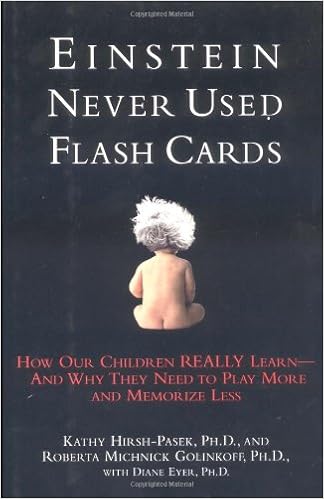
Einstein Never Used Flashcards: How Our Children Really Learn–and Why They Need to Play More and Memorize Less

My Rating – Must Read

Level – Moderate (written by academics, but for a popular audience), medium length (250+)

Summary
The basic thesis of the book is essentially the subtitle. Early education has become far too academic, with a focus on memorizing specific subsets of things (which doesn’t show actual knowledge or comprehension) and are not playing enough. The book is generally written about children under five, so the play is more of exploration and learning how things work. They use the example of teaching a kid to memorize 1+2=3, or having them understand, through play, that if they put one block on top of two blocks already stacked, there will now be three blocks stacked.

Chapter One, The Plight of the Modern Parent, lays out these play to memorization changes with fairly stark statistics, including the fact that in 1970 school age children (I believe that refers to 5-10 year olds) spent 40% of their time in play, but 1997 it was less than 25%; even worse 40% of districts no longer have recess. They also compare to how most other countries don’t bother learning to read until second grade or so, yet all (in the comparison) have better literacy rates and higher general levels of understanding.

The remaining chapters, 10 in total, explain how babies and children learn and then go through specific topics. Chapters two through 10 are – Brainchild: How Babies Are Wired to Learn; Playing the Numbers: How Children Learn about Quantity; Language: The Power of Babble; Literacy: Reading Between the Lines; Welcome to Lake Wobegon: The Quest to Define Intelligence; Who Am I? Developing a Sense of Self; Getting to Know You: How Children Develop Social Intelligence; Play: The Crucible of Learning; and The New Formula for Exceptional Parenting (the title is kind of play on the books that are out there, spoiler – they tell you to relax and let your children play and learn on their own, and to stop overscheduling them).

My Thoughts
I bought this book when my daughter was maybe around two years old, but didn’t read it until she had already turned four. I thought because the title referred to flashcards that perhaps the materials would be focused more on five years and older stages of life, but it is actually the opposite, the learning focuses on babies to about five (though some of the fiveish advice would carry you a few more years). So, don’t make my mistake, go ahead and buy this book as early as you can in your child’s life (or pregnancy).

I’ll als say that, at least in some circles, this book may be a bit dated. It was published in 2003 and I think the flashcard and Baby Einstein books (which they debunk, along with having your kids listen to classical music) have all fallen out of fashion. I think older Millennials, like myself, missed the flashcard memorization part. Though I didn’t get to play 40% of the time, I don’t remember using flash cards until I was in high school. This book was written just after I started college, and I wouldn’t have my first child for another decade. It seems the peak affected children were the second wave Millennials and early Gen Z. My daughter starts Kindergarten this year (assuming schools open again) and we certainly have never felt the need to force her to memorize anything and we never bought any kind of flashcards or other ‘learning’ devices. I’ve read maybe six or seven early childhood education books (I understand the irony of claiming not to be worried) and I think we have a basic understanding from the literature that memorization shouldn’t be the focus, so that could be at play. Also, school was always easy for us, so we assume (maybe incorrectly) that it will be for our children as well and we don’t need to worry too much. That aside, most of my friends have small children and I don’t know many that are concerned with most of the issues brought up in this book.

I’d say maybe the exception to that is the overscheduling, which is definitely true with sports. All that to say, while some of the issues in the book (they state the wrote the book to help correct these issues, and it appears to have helped) maybe be less of a concern, but the concepts and studies cited in this book still remain timeless and useful. That was probably the most interesting aspect of the book to me – all the little experiments or tests you can run on your children. As I mentioned, my daughter was already to old for most, but I read this right before my sons were born, so they have been little test subjects. I really wish the book had an appendix that listed the studies and test you can do with your children. You can see in my summary above, the book is laid out by topic, which has a rough chronology, but doesn’t move straight line with growing children.

Overall, this book is great and incredible interesting, especially if you have the opportunity to try out the subject matters they discuss in the book. For anyone interested in early developmental stages of children, or want to understand the basics of learning of your own small children, this book is a must read.

Book Review: Coronavirus and Christ

Book Image

You can get the book here, for free. 

I’m not doing to normal format today, just a quick review of a short book. You can get it free (digitally, at least) from Desiring God. There are multiple formats. I read it on my Kindle, but look at the PDF, ignoring all the notes and copyright/table of contents, you are looking at about 90 pages. Piper breaks the books in to two parts after an intro about what is happening and where we are (or were, the book was written mid March) – The God Who Reigns Over Coronavirus and What is God Doing Through the Coronavirus.

The first part is five short chapters, all on some aspect of God’s sovereignty. This shouldn’t be too surprising coming from Piper. As always, that sovereignty is both comforting and a little scary. We know that God is in control, but often we wish it was us instead. Likewise, there is a strong line of Christ’s Supremacy, and how He should be out focus. This part is saturated with Scripture, especially Paul.

The second part is what he calls ‘paths’, but I find that a little confusing, because they are not exclusive. Either way, the part heading is a little clearer in that these are things that God is/may be doing with Coronavirus. I don’t agree with all them, necessarily, and Piper even points out that people might; however he lays out what he things God is doing, and then explains why. The six ideas are – Picturing Moral Horror, Sending Specific Divine Judgement, Awakening Us for the Second Coming, Realigning Us with the Infinite Worth of Christ, Creating Good Works in Danger, and Loosening the Roots to Reach the Nations.

I found the first and third chapters to be interesting, but not sure it was the strongest case. I had the most disagreement with the second chapter. The second half were the strongest three, especially the calls to action he gives in the final two chapters.  Those are good reminders of our call in life as Christians and how we should be/act different(ly) than society as a whole. Our call to serve and reach people for Christ should be our highest priorities, even in the midst of tragedy.

He ends the book with a short prayer regarding Covid-19. In some ways the book could be a long sermon, especially the way he lays out the foundations of God’s reign over the world, followed by six ways God is acting. It is strongly Biblical and theologically sound. It is free and short, so if it is worth it for most people to read, even if you are one of those people (like me) who are trapped inside with a bunch of kids, while still trying to work remotely. As I mentioned, I don’t necessarily agree completely with all his points (in part two), but all are worth reading and pondering; the reminder of Who reigns (part one) over all is always a good thing to read and remember, especially in a time of great uncertainty, fear, and crisis.

Book Review: A Full Life

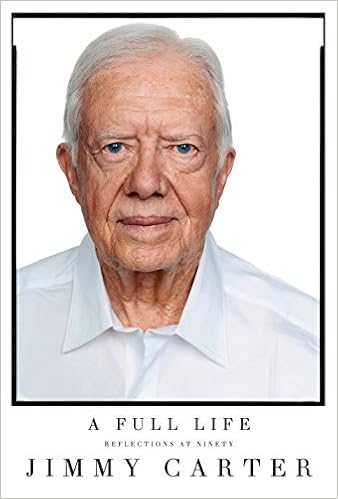
A Full Life: Reflections at Ninety

My Rating – If you are looking for something

Level – Easy, short (just over 200 pages), but a little slow

Summary
This isn’t a book about his presidency, he almost spends the least amount of time on that (his shortest chapter, by one page, is about his entire political career leading up the presidency). It is quite an autobiography either, because it isn’t comprehensive enough, though it is obviously written in the first person perspective. Mostly, it seems to be just a few thoughts on most of the major events in his life.

The book is broken into eight chapters – Archery & the Race Issue, this is the town in which he grew up, with additional thoughts on race at the time (and now to some extent); Navy Years, about his time in Annapolis and in the Navy including the first nuclear submarine, up until his father dies; Back to Georgia, leaving the Navy, taking over the family farm, foray in to politics; Atlanta to Washington, from running for Governor to running for President; Life in the White House; Issues Mostly Resolved, major political issues that he considered mostly complete/accomplished; Problems Still Pending, the issues that were not resolved; Back Home, post presidency, including his work with the Carter Center and Habitat for Humanity.

My Thoughts
I generally enjoyed this book. It is written well enough, but it can be a little slow. In some ways, it feels like talking with an old man, the stories are a little long winded, and some don’t seem to have a point. I didn’t mind this too much, it reminded me of talking with my granddads (both of which passed away last summer). They were from Georgia and South Alabama, both born a few months after Jimmy, and both served in the Navy. The one from Georgia, also named James, likewise taught Sunday School in a Southern Baptist Church for decades. So, for me, there was some very familiar about his life stories (except political office aspects).

Carter was out of office four years before I was born, and up until a few years ago, all I really knew about him was ‘stagflation’, ‘malaise’, and that yankees (especially Kennedys) didn’t like him. Granted, by his own admission, these are his views of events, but it does make me want to go find his official biography of his presidency. I didn’t know that he created the Departments of Energy and Education, that he was a proponent of Universal Healthcare, or supported decriminalizing weed. It is honestly a little depressing that we are still having these debates more than 40 years later with little to no progress.

The other thing everyone knows about Carter is that he is the ‘greatest ex-president ever.’ This certainly shows in the book, as he was in his early 50s when he was out of office, he felt he had a lot to do, and didn’t want to ‘just’ have a museum or library. That is why the Carter Center exists, he wanted a place to work, and it has done a great deal of good, especially as it pivoted to tropical diseases over the past few decades.

The two issues chapters were some of the most interesting, especially to see a politician state such clear positions, and to see how many are unfortunately still issues today. I don’t agree with all of his politics, but I appreciate his articulation and reasons behind it. If you have interest in Jimmy Carter, this alone probable makes the book worth it.  A little slow, but short and easy to read, he gives us something between a diary and an autobiography. Overall, I think it is one worth putting on your list.

Book Review: Jesus Skeptic

Jesus Skeptic

My Rating – Put it on your list

Level – Easy, moderate length (300ish)

Summary
The subtitle does a good job of laying out the premise of the book. As a trained skeptic (journalist) he looks into the impact of Christians and into the credibility of the claims for Christ. The latter is a kind of a classical apologetics for Christ, while the former is more of a modern defense and response to some of the attacks against Christians today.

The book is broken into three parts – Skeptics Welcome, Measuring Christianity’s Impact on Society, and The Most Influential Person – as well as preface, intro, conclusion, and three appendices. The first part is autobiographical and how he came to start exploring Christianity. As an aside for this section, I didn’t like his capitalization of ‘primary evidence’ or him treating the term like it was new or proprietary. The second part looks at things like scientist who were Christians during the scientific revolution, the early Christian efforts to care for people which led to the creation of hospitals, as well as the establishment of public education and Universities. The final part is mostly classic apologetics – did Jesus exist, what did he do, what did his followers believe about him.

My Thoughts
This is also a little nit-picky, but the subtitle doesn’t match the order of the next parts in the book. He explore impact first. Of course most early schools were started to train pastors, and public schools were established to teach literacy, so that people could read the Bible. He takes this to combat the attack that Christians are anti-intellectual today, and as general evidence of the goodness of Christianity (especially with hospitals). He is a little all or nothing in that approach, because there are certainly anti-intellectual Christians, and many of those are big in the home school movement and the general attack on public school that exists today (all with no trace of irony). He has a chapter on the scientific revolution, and the impact of Christians who were important scientist. The stories are good and the evidence of their belief is pretty clear, but I don’t think it will have the apologetic impact he seems to think it might. Similarly, he focuses on abolitionist and slaves that were Christian, but I think attacks on Christianity will only focus on defenders of slavery (which he does acknowledge) or generally doubt the validity of the slaves beliefs.

The final section is the best part of the book, and probably the most useful for young or new Christians. Proof that Jesus (the person) existed is overwhelming and not in dispute in academia, I think the only doubters are internet Atheists, but he does a good job displaying the information from sources outside of Christianity. A common attack against Christian beliefs is that the Resurrection and Deification of Christ were much later additions to the established Church (despite clear evidence to the contrary in the Bible). I think the Divinci Code makes this claim, so it is pretty popular now. Of course there is non-Christian written evidence by Jewish and Greek historians written a few decades (not centuries) after Christ that state that Christians claim Jesus was raised from the dead and that they worshiped him as a god.

The final chapter alone is worth the book. The middle section is good. It is important for Christians to know their history and the impact we’ve had on the world, but the apologetic aspect of the last part is of greater importance. As a church, we’ve done a poor job education our people and this is especially true in history and apologetcs. The books is really well written and very accessible. My hope would be that it would spark some interest in Christians knowing more about ourselves and better able to defend attacks. If you are starting this topic, or already interested, this is a book to add to your list.

*I received a free copy of this book in exchange for an honest review.

Book Review: The Bible Tells Me So…

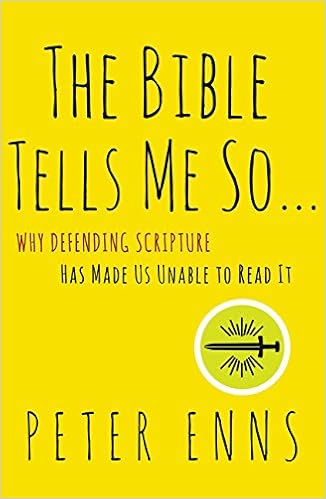
The Bible Tells Me So: Why Defending Scripture Has Made Us Unable to Read It

My Rating – If you are looking for something

Level – Medium length, easy read (Enns is an academic, but writes for a popular audience)

Summary
In some ways it is a little difficult to summarize this book. This is one of his few books that is written entirely for popular audiences, and he uses a unique form/structure, so it bounces around some. If you are familiar with Enns, there won’t be too much new here. For the most part you are getting some higher criticism, difficult passage in the Old Testament (as in, both things we just don’t like and unclear Hebrew), Jesus reinterpreting the Old Testament and changing the Law (because he is God), and Paul doing the same (in light of the resurrection).  The first chapter is autobiographical and touches on the subtitle of the book, but the following chapters mostly fit into the above outlines.

There are seven chapters – I’ll take door number three; God did what?!; God likes stories; Why doesn’t God make up his mind?; Jesus is bigger than the Bible; No one saw this coming; and The Bible, just as it is. The last chapter is a mostly summary and concluding remarks. Each chapter is broken into short (usually just under 5 pages) writings on anecdotes or individual passages form the Bible.

My Thoughts
If you never read any of Enns, this book could be a good places to start. If you have read most of his other books, maybe pass. Alternatively, if you want a summary of this book and response you could read Longmen’s Confronting Old Testament Controversies. You do get a little bit more of the his life story in the first chapter, but I was expecting more on the subtitle. I thought there were be more a thesis regarding our hyper focus on arguing/defending the Bible, and then the impact of that on how we read it. I agree with the former, and was really hoping on my insight on the later. However, often the subtitle and sometimes in the the title are written by the editors/publisher. I might have passed if I had know how small a part of the book this idea was.

Overall, I enjoyed the book. I really like Enns as a writer, his style is short and funny. Everything is very readable, almost like a large compilation of blog posts (but better/more organized). There are points with which I disagree, and some of his translation seem a little too lose, making them lead more to the point he is trying to make than a stricter/better interpretation. It wouldn’t be a the top of my list, but if you’ve read a good bit about OT issues/problems/’contradictions’ or the way Jesus/Paul change/reinterpret them and you are still looking for something, this would be a good option. He has an appendix of notes and further reading from people who agree and disagree with him.

2020 Reading Challenge

I didn’t not reach my goal last year, so I’m trying to be even more realistic this year. I was really torn on setting the goal at 12 or 15. Going with 12 really seems doable, but that isn’t very challenging is it? So, I’ll try to push myself and get the 15 I’d like to read. I have 10 laid out already, one more fiction that will be one or the other depending on which one is in stock at the Library this weekend. The other four will be some combination of the many books on my past few challenges that I have not gotten to yet, a book I want to borrow from a buddy, and ARC books (which, I really plan to ramp down this year).

Non-fictionGödel, Escher, Bach: An Eternal Golden Braid, at 822 pages, this is the second biggest book on my list for this year and one of my top five life goal, big book, non-fiction books to pick up. I started it last year, and only went a few chapters in, it isn’t really the amazing book I had heard, but maybe it picks up. If not, it will be the first major book I’ve given up on. If I have time, I want to get to is The War of Art: Break Through the Blocks and Win Your Inner Creative Battles, which is a book I bought for Mrs. MMT a few years ago on the advice of MxPx front man Mike Herrera

Biography/autobiographyA Full Life: Reflections at Ninety was on my list the last three years, but I didn’t make it to it, so I’ll stick it back on this list. Thankfully, Jimmy has hung on with me.

Fiction – At 864 pages, Anna Karenina, will be my biggest book this year and the third longest single volume fiction book I’ve ever read. This was on my list last year, but Mrs. MMT stole it; however, she did enjoy it. Next up for fiction is either Dune or The Gunslinger. I’ve heard good things about both, and I always like sci-fi, but even better, they are both intro’s to long series, which is nice because I don’t have to think about what to read next. Not sure which it will be, heading to the library with Sprout this weekend and I’ll grab which ever they have. Rounding out fiction for the year will be The World’s Great Short Stories, because I like short stories.

Christian-y type books – Only four books are planned in this category this year, though this categories tends to be the largest due to ARC books and loans from friends. Technically, I’ve already one (Jesus Skeptic). The other three are The Meaning of Marriage by Keller, which is supposed to be one of the best and one my community group may do. One we’ve already started is The Great Divorce. Another book I’ve had on my list for a few years is Speaking Truth in Love, so I fully intend to finally knock that out.

This category is also good for my unplanned mostly due to ARCs, but also my long list of books I’d like to read such as Instruments in the Redeemer’s Hand, Basic Christianity, and Church History in Plain Language. I also have the idea of potentially read reading Prayer (Keller), which is something I rarely do.

Commentaries, Theology, and Language – No big commentary this year and Greek for the Rest of Us, will, unfortunately, remain on the backburner for now. The only goal I have this year is Foundations of the Christian Faith (Boice). I’ve read chapters of this at various time for different studies of Theology, but I’ve never sat down to read the whole thing cover to cover, despite it being the one I recommend to people. Boice was a pastor, so this volume is less technical than others, while still being thorough (740) pages. To that end, it is on the list because Mrs. MMT wants to study theology, so I am reading it with her.

Time permitting, I’ll finally knock out Five Views on Biblical Inearrency. This has also been on my list for about three years, and it has been awhile since I’ve been able to read one of the X Views on… type books, so maybe I will be able to get to it at some point.

Devotional – I read the Bible last year (ish), so I’m back to a true devotional. It must be the year of Keller for me, so I’m doing Songs of Jesus, which is a devotional based on the Psalms. I did a devotional/commentary on Psalms a few years ago and really enjoyed it.

That is it for this year, hopefully life will permit me to get to these.


2019 Reading Challenge Review

TL;DR – Fail.

I had 20 book on my 2019 Read Challenge, 16 that were specifically called out and four that were TBD’s, overall, I only hit 10 (depending on how you count) with only four that were on my specific list. Turns out that a twin pregnancy, and actually having two infants, is a bit more tiring and time consuming that I had originally thought. Who knew?

I didn’t get to many on my list, six of them I never opened, but two I started and didn’t finish. One was Gödel, Escher, Bach: An Eternal Golden Braid, which I’m a few hundred pages into, and may actually give up on. It is well written, and kind of funny, but it is long and tedious and incredibly repetitive. I know people on the internet love this book, but I’m either too dump or too smart, so I guess I’ll never know. It sounds funny, but the other book I didn’t finish was the Bible. Specifically, the M’Cheyne reading plan, which I’ve written about before and generally liked. This year, however, I didn’t like it. So, there will be a forthcoming post about the pros/cons. I also didn’t have 30 minutes to read the Bible each morning as I had hoped. I feel good that I read all the parts that I wasn’t sure I’ve read before, so at least now I’m confident I’ve read the Bible in it’s entirety.

Here are the books I did read:

The Rise of Endymion (reviewed) – Final book in the Hyperion Cantos series. Somewhat of a weak ending, but overall on of the great Sci-fi series I’ve ever read.
Just After Sunset – Collection of short stories from Stephen King, who might be favorite fiction writer of all time. The stories were hit or miss, but mostly good, with one story line making it into my nightmare, so that is a good sign.
Einstein Never Used Flashcards – I’ve had this book on the list of a bit, but thought it had more to do with that 3-5 range for children. Instead, it is more broadly about how small children learn, starting as young as six months. It has a lot of cool experiments you can run on your own children.
New International Greek Commentary on Mark – I’ll have a review of this later, but a different kind than usual with thoughts on the other two-three commentaries I skimmed.
Knowing God – Short study on the attributes of God, even better than I thought it would be. Still need to review it.
The Bible Tells Me So – I still need to get a review out for this, but I was little disappointed. In some ways, if you’ve followed Enns at all, there was knowing new, and the subtitle (how defending the Bible left us unable to read it) was less a part of the book, and therefore less challenge, than I anticipated.
12 Ways Your Phone is Changing You (reviewed) – This was an interesting read after reading Irresistible. I wouldn’t say it is necessary a Christian take on it, but maybe how we should react as Christians. It is also specifically focused on smart phones.
Confronting Old Testament Controversies (reviewed) – Probably the best book I read this year, would recommend it over The Bible Tells Me So.
The Power of Christian Contentment (reviewed) – This was one of the few ARC titles I read this year, and providentially came at an important time in my life.
Narrative Apologetics (reviewed) – Another one of the ARC books I received this year.
A Christmas Carol – I’ll probably put of the review of this book until December, for obvious reasons. I know the story well, I watch two-four of the movie adaptations every year and have done so for decades. I’ve even seen this play (as an adult, I think it is the only one I’ve ever seen). It is one of my all time favorite stories, and now one of my favorite books.

So, that’s it for me this year. I’ll reload a few more on to the 2020 Challenge and see if I can do better this time.

Top Post’s of 2019

Doing a top post’s of a year is what all good, lazy bloggers do at the end of the year. This is actually only the second one I’ve done because I didn’t know until last year that WordPress gave me all these stats. Anyway, overall, this year was a little better than I thought. I had the least post since I started taking the blog a little more seriously back in 2016 (I had over 100 post that year), with only 16. I was happy to see that my views/visitors were actually higher than 2017, but dipped from last year (63 post and almost 50,000 words). I think this is due to finally have some legacy past, some that keep showing up in search engines. For instance, Sapiens led in 2017 and 2018, despite being posted in 2016; it dropped to 11 this year. This has led to an interesting impact, as not a single posts I actually wrote this year made it to my top 10 viewed post this year. So, here it is, my most viewed posts of 2019:

Book Review: We’re Pregnant
Book Review: Disciplines of a Godly Man
1 Thessalonians 4:13-5:11
Book Review: Imperfect Disciple
Book Review: Darkness is My Only Companion
Book Review: Five Marks of a Man
Book Review: Spiritual Disciplines for the Christian Life
1 Thessalonians 1-2:12
Cheat Sheet to the Minor Prophets
Book Review: Practicing the King’s Economy

Unsurprisingly, seven of the 10 were book reviews. For my review last year, I noted that these are the majority of what I did, and also the most popular, and that I should do more of them. Yet, my goal was to actually do less and focus on more original content, however that didn’t really happen this year. Of the seven book reviews, six were in the top ten last year (Five Marks of a Man being the outside), which I think must have more to do with the popularity of the book than with what I have to say about it. What was surprising, where two of my seven part Thessalonians, series were in the top 10, and my Cheat Sheet (which was my intro) to the Minor Prophets made its way up there, despite being written back in 2016. The Minor Prophets series (which I never finished) and the Thessalonians series are probably the two series/set of writings I’m most proud of, so it was cool to see them pop up. 

Of posts actually written this year, I’m Still Here was number one. I would think the page view would skew heavily towards things written in the January, but interestingly, while 2019 Reading Challenge was number 3 (and my second post written), my 2018 Reading Challenge review (first post written) was the least viewed of the year. Maybe bad timing.

I’ll post one prediction for 2020, I think the Review I did this year for Confronting Old Testament Controversies will be up there. It is a great book, and I hope it takes off. So, that is it for 2019. I appreciate everyone who has read or commented on my posts. Thanks for playing along, I’ll try to do better next year.

Book Review: Narrative Apologetics

Narrative Apologetics

My Rating – Probably not worth your time

Level – Short book, but difficult read with academic style and assumed advanced knowledge of apologetics

Summary
Narrative apologetics as a concept is essentially using stories as an apologetic and even evangelistic tool. Not the ‘major conversion’ testimony style, but more of fiction stories that show longing and comparing that to God’s story or something like the exile to explain how we live in the world today.

The book is broken into seven chapters – Introducing Narrative Apologetics, The Theological Foundations of Narrative Apologetics, The Practical Application of Narrative Apologetics, Biblical Narratives: Opening Windows of Perception, Strategies and Criteria for Narrative Apologetcs, The Christian Story and the Meaning of Life, Handing Over: Developing Narrative Approaches to Apologetics. Additionally, there are roughly 20 pages of notes to end the book.

My Thoughts
I’ll start by saying the content of the book isn’t as bad as my rating may suggest. Where it fails is being related to a popular audience. I could be wrong, that might not be the target audience for this book, however, when you write a book that is under 150 pages, I have to think your goal was to reach a wide array. I’ll start with the good, though. The content is solid, and the strength of the book is the Biblical Narrative and The Christian Story chapters. I think these are the best in explaining what narrative apologetics is and what to do with it.

However, the book just feels off. It doesn’t feel like a stand alone book. I seems more like an intro chapter in a large tome of apologetics. If you have ever read one of those 900-1,300 page academic systematcs, you’ll know that ‘theology proper’ intro is usually around 100 pages (which this book would probably shift two with large page size).

As you can tell by the chapter titles, the book is also written in a very academic style. There are numerous citations on every page, a good bit of the in this chapter we will..and we have seen… to begin and end the chapters, and of course the typical academic repetitiveness. The chapters don’t necessarily stand on their own, but still make references to other chapters yet still summarize. So, even as short as it was, it could have been edited even shorter.

Again, the content is pretty good, and could be worth reading if you know what you are getting into. If you buy the book to get an academic intro to a larger concept, I think it could be alright, but as an attempt to reach a popular audience, I really think it missed. If you are interested, I’d just search around and see if there is a shorter academic paper or a popular talk/interview he has done on the topic and maybe go from there. As it is, though, the book just probably isn’t worth your time.

*I received a free copy of this book in exchange for an honest review

Book Review: Confronting Old Testament Controversies

Cover Art

Confronting Old Testament Controversies

My Rating – Must Read

Level – Moderate difficulty (good knowledge of OT and history, but written for popular audience), medium length (about 300 pages)

Summary
The content of the book is straight from the title, reviewing controversial passages from the Old Testament. Longman is an Old Testament scholar, so there is much of his own research and writing on his view, but he interacts with at least 2-3 opposing views/books on each subject.

The lay out of the book is the introduction (un-paginated, but y’all need to read it) then the four controversies (Creation & Evolution, History, Divine Violence, Sexuality) and then an epilogue (he titles ‘Final Word’). Each chapter is broken into three or four subsections with a conclusion at the end and an excurses or two along the way. The other chapters are probably clear, but ‘History’ refers to the Exodus and the Conquests.

My Thoughts
The only real critique I have is probably an issue for the publisher, the subtitle list Evolution, Sexuality, History, and Violence which neither matches the order of the chapters, nor is it in alphabetical order. Not sure why they chose they order they did, and maybe it doesn’t bother anyone else, but here we are.

I think books like this will only become more important as we move further in our post-Christian world (at least in the West). The subtitle of Enns’ The Bible Tells Me So… really explains our situation: ‘Why defending Scripture has left us unable to read it’. This was the way I learned about the Bible in high school, and I hear much of this way of thinking form people today. This is especially true for the first two chapters (Creation & Evolution, and History). People want to rush to defend it in a modern way against modern critiques and ignore what the point was (and still is) from a theological perspective when it was written thousands of years ago. I should note if you like Enns, Longman was his professor at one point and interacts with his book in this book.

I believe strongly that everyone should have this book for the first two chapters alone. I fear one reason we argue the way we do about Genesis and early books is it is just simpler. We don’t want to reason, or read, or understand something beyond the basics, most ‘literal’ understanding. This book would do well to challenge both people ‘for & against’ some of the readings of the early books of the Bible.

The Divine Violence section was maybe the weakest, but I think it is still an important one. Some of the most basic attacks from New Atheists are based on things like the so called genocide and cosmic child abuse. While this isn’t as strong as other sections, it is well worth interacting with, if for no other reason than learning more of the other side. Similarly, there probably isn’t much new for most people about Sexuality. The Bible is pretty clear, and most arguments against this perspective come down to personal preference (E.g. I think it is fine if they love each other, who cares?, etc.) However, this section does give some good verses as well as the whole picture throughout the Bible. Maybe more interesting than that, it also puts the spotlight back on us and challenge the fact of polygamy in the Bible, which was fairly challenging.

As I mentioned above, this really is a must read for anyone who wants to take the Bible seriously. If we care about the Bible and want to understand it (and views against it), we need to interact more with controversies and other hard aspects that challenge our understanding or reading of the Bible.


*I received a free copy of this book in exchange for an honest review.