Book Review: Speaking of Homosexuality

Speaking of Homosexuality: Discussing the Issues with Kindness and Clarity – Joe Dallas
Rating – Must Read

Level – Medium length, reads quickly and easily

Summary
The book, as the title indicates, is about homosexuality in the church and the world today. Dallas covers a large swath of the topic, from how to talk  to people about it, to Greek meanings, to modern views. Broken into 13 chapters plus an intro and a conclusion (which is actually chapter 14), the book is four main points.

Chapters 1-3 (The Context of Our Conversation, To Whom Am I Speaking, Rules of Engagement) are the first point of the book, mainly how does the modern world view homosexuality? Who talks about it and how do we talk to them?

The next section, chapters 4 & 5 (Born Gay?, The “Change” Controversy) get into some of the biological and psychological aspects of homosexuality. There is also the issue of counseling and ‘therapy’ for homosexuals in the secular and church settings.

I grouped chapters 6-8 (Same-Sex Marriage; Homophobia, Hate, Hypocrisy, and Harm; Gay Christians) together, but they aren’t all that similar to each other. Chapter 6 is fairly self explanatory, chapter 7 deals with the responses or charges to the responses of Christians, and chapter 8 he gives us his thoughts on people who refer to themselves as Gay Christians.

The final section is the longest because it is basically, ‘What does the Bible say.’ Encompassing chapters 9-13 (Sodom, Homosexuality and Leviticus, What Jesus Did or Did Not Say, Paul and Romans, Paul and Arsenokoites), Dallas takes us through the Bible, including both Hebrew and Greek, the different interpretations today and throughout church history, covering every conceivable verse or story related to homosexuality.

Additionally, there are two helpful aspects about the way in which this book is written. First and probably most important, Dallas has written it like a conversation. He lays out and issue, then states what the ‘Revisionist’ claim, followed by the ‘Traditionalist’ responses. So, broadly speaking, something like – They say X, we respond Y and Z.

Second, he has a 10-point review at the end of each chapter that quickly summarizes the arguments of the chapter. This is a helpful reminded if you need to check back in the book. Or honestly, if you are not much of a reader, you could just read the points and then jump in deeper if something strikes you.

My Thoughts
I’ll be honest, I was skeptical of this book at first. Not entirely sure why. Maybe because of the reviews in the front cover. They were mostly from musicians or people I whose names I didn’t recognize. However, I was very impressed with this book. For one thing Dallas is a great writer. He is extremely, extremely accessible. Just about anyone of any reading level could glide through this book. He has almost a journalistic style, like a long form article in a magazine or a narrative non-fiction report.

This point leads me to what is certainly the strength of the book. The final 75 or so pages (excluding the conclusion) are all from the Bible. As a mentioned above, he goes pretty deep, especially in the Greek (I loved the pronunciation guide listed with each word). These five chapters are theologically and Biblically strong. For a big this size (~230 pages) there is a lot of deep and serious inquiry into Scriptures. I was very impressed.

To circle back to the beginning, this book is also a great help to those whom are angry or feel ‘Christians are losing’ something. Or even people whom don’t know how to engage. It’s an important reminder of how to act, really.

I disagree with his take on the impact of gay marriage on society and I’m skeptical of some grand conspiracy as opposed to a few antagonistic people. However, that was something interesting while reading this book – I found myself disagree at times, but I would alternate from viewing things more liberally at some points and more conservatively at others.

Overall, this is a must read of Christians today who do not know what to do with the issue. Or, even for those who do know what to thing, this book is an invaluable resource on how to engage with others and the Scripture. This is a book that probably every pastor or person in full time ministry should own.


*I received copy of this book in exchange for an honest review, thank you Baker Books. Read more about that here.

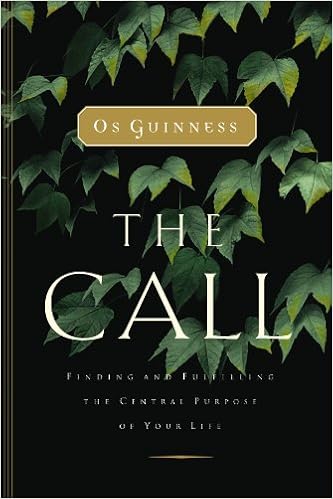
Book Review: The Call

The Call: Finding and Fulfilling the Central Purpose of Your Life  – Os Guinness

My Rating – If you are looking for something

Level – Choppy read, short but reads longer than it is

Summary
First of all, if you’ve been recommend this book by a friend or pastor and they tell it is written by a guy named Guinness, no relation to the beer, you should question if they actually read the entire book. He is actually related, though distantly, to the original founder of the brewery.

This is another book about Christians and work. It is probably the most famous and the one many pastors or counselors will mention first. It is not quite 20 years old, and is already the ‘classic’ on the subject. The book is written as somewhat a devotional/study and is broken down to 26 short chapters with a note in the table of contents that the intent is that each chapter be read and reflected on one day at a time.

Probably the best thing you can get from this book is the different in vocation and avocation. That is your work and your calling. They are not necessarily the same thing. He points at the us, as Christians, have forgotten about calling. We don’t really teach about it and help people find theirs.

My Thoughts
This book is often cited by other authors writing books on calling and work, but I didn’t enjoy it all that much. Maybe it was his writing style, but I just could never get into it. To be fair, I didn’t read it as suggested, in the 26 sittings, so that may have affected things. I think the writing was overly wordy and more complicated than needed. Perhaps due to his intention of writing 26 independent reflections, it was at times redundant at times while also being disjointed at other times.

If you’ve already knocked out a few books on calling or work and are still looking for something else, you should put this on your list. Other than that, it probably isn’t worth your time. Many, if not all, of his major points are quoted and discussed by Keller in Every Good Endeavor. I’d recommend reading that book instead. The book is Biblically sound and strong on history, but the writing will likely not appeal to most people.

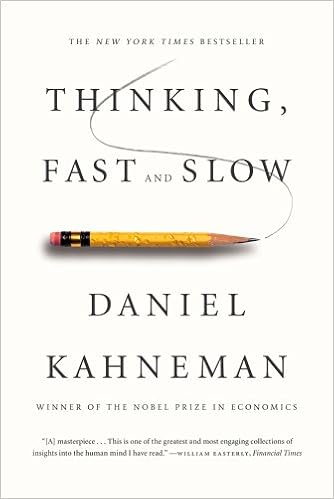
Book Review – Thinking, Fast and Slow

Thinking, Fast and Slow – Daniel Kahneman

My Rating – Put it on your list

Level – moderate to difficult read, it is well written but some of the concept are tough, fairly long, but ready a little quicker then the 400+ pages

Summary
Broadly speaking, this book is about thinking. More specifically, the two systems (fast and slow), basically how you suck at thinking, and finally ‘the two selves.’ Technically, the book is broken up into five parts – two systems, heuristics & biases, overconfidence, choices, and finally the two selves.

Page 20 starts off his quick definitions of the two systems. System 1 is automatic and works quickly with little to no effort. System 2 ‘allocates attention to the effortful mental activities that demand it’ and this usually requires concentration and can be interrupted and disrupted.

The middle three sections could possibly be rearranged but essentially include research biases, design, and problems (fallacies, sample size issues, etc.). This part of the book will blow your mind. It is unbelievable some of the things that affect research, especially anchoring. It should make you terrified to ever go before a judge.

Finally, the two selves. This is basically the self that exists (or existed, experienced something) and the ‘remembering’ self, not necessarily what happened, but what you remember happening. The implications of these two differing selves have far reaching affects. As an example, researchers had two groups of people that underwent a procedure. One group experienced the procedure and long with a high peak of pain, and then slowly fading out. The other group had a shorter experience, but didn’t fade as much, but also didn’t peak as much.

The participants rated pain levels during the event. Later, researchers asked the participants about their experience. Whom had the worse experience? Well, plot twist, it was the shorter one with the lower peak pain. Why? Because all anyone remembered was the end. The ones in pain at the end, rating their procedure as worse than those whom had the longer more painful one. Those participants rated their experience as not that bad, as all they remember is the end, which was just some amount of discomfort, instead of pain.

My Thoughts
This book is crazy. There are so many mind bending things that you will reread some sections over and over again. Some thing you just will not believe. It confirms our worst fears, we really aren’t as smart as we think. We are incredibly susceptible to leading. Subliminal messages and marketing have a much, much greater impact than we think.

Even while reading it, I wanted to think of myself as smarter. Especially the sections about coin tosses and chance. As an experienced gambler, I knew most of these things, especially if you are familiar with probably and things like ‘pot odds’. However, I’m not, as clearly showed in later examples. It is unbelievable how open to suggestion your mind is. We like to all think we are special, unique, and different, however we all fall for the same thing.

If you are looking for a book to challenge your way of thinking, put this on your list. You’ll find yourself arguing with the author, even as he argues with himself, and even as you see the clear evidence. You can learn a great from this book, especially as it related to major life decisions. Additionally, Kahneman is a great writer. I found myself jealous at various points as his summaries of complex research can read almost as easy as a novel. He is also a Nobel Laureate and if you know anything about Richard Thalor (whom makes an appearance) or behavioral economics, this book is for you.


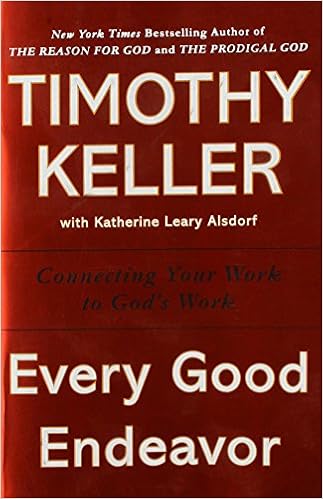
Book Review: Every Good Endeavor

Every Good Endeavor – Tim Keller

My Rating – Put it on your list

Level – Easy read, medium length

Summary
This is another book that is hard to summarize with just repeating the title or copy/pasting the table of contents. I guess the title isn’t super clear, it comes from a quote that he opens the book with. Basically asking, ‘God give us strength in every good endeavor’, so, to prosper and do well in any work or vocation we choose.

The book is broken into three main parts – God’s plan for work, our problems with work, and the Gospel and work. An interesting point in God’s plan is that work is not punishment. We often think we are required to work due to fall, but the punishment is only that it will be hard, not that we will have to do it. The problems section runs down the typical issues people have, be unmotivated and not ‘working as if for the Lord’, or being motivated by the wrong thing (money, prestige, etc.), or making work an idol.

The final section is the strength of the book. Not only are there some practical how-to-ness in there, but it is extremely encouraging. This may be most important part for anyone who does not like their job. You will be lifted up and maybe even be a little pumped while reading this last part. I know it changed my thinking. It caused/challenged me to look at things differently and to find different ways of approaching my job and its issues. Most of all, I was left with a feeling of hope, in that, if doing it for God, it cannot be pointless.

Keller is obviously a great writer, as evidenced by his seven thousand books, most of which are best sellers. The whole book is well written and reads quickly. Most importantly, it is theologically sound and Biblically based. The book’s only weakness (one it shares with almost all of these types of books) is that it is written for white collar professionals. It assumes education, mobility, and choice in careers. There is a passing reference to blue collar work, but I found it lacking.

My Thoughts
The reminder that the curse isn’t the work is an important perspective shift for most people. If you are like me, you remember that the punishments are hard work of the land and pain in child birth. However, we were already called to work and exercise dominion. The reason we don’t like work isn’t because it’s a punishment. It’s that work isn’t what it is supposed to be – it’s hard.

I want to spend a little time reiterating some points for the third section. He does acknowledge that you may not like your job, you may even be stuck there, and in that, he goes on to point out what you can do for the Kingdom while there. Obviously, you can share the gospel. There are other things, though, that I thought were interesting. For one, he discusses just being a good boss. Making your place of employment a great place to work and a place that treats people right, and even more so, being an ethical place. That probably affected me the most as I am stuck in a place that often appears I will never leave. So, what can I do? If you feel this way, this is a good book for you.

I think just about anyone interested in a book regarding the Christian life and work should pick this up. Especially if you are in a white collar field, put it on your list. If not, it is still probably the best book on work out there, but there is just less for you – the only knock I have on the book and the only reason I didn’t rate it higher.

Personal Reading Survey

One of the resources listed in R. Kent Hughes’ Disciplnes of a Godly Man (my review), is the Personal Reading Survey. In it, Hughes has contact several prominant evangelicals and asked them the following four questions:

What five book, secular or scared, have infuenced you the most?
Of these, which is your favorite?
Favorite novel?
Favorite biography?

Now, according to my editor, I can just rewrite the whole freaking thing. So, I’ll list some of the people asked, and then give you his list of books mentioned at least five times (he list all that are mentioned twice, but I don’t want to type that much, go buy the book). He asked 34 people, men and women, preachers, academics, and authors, including James M. Boice, Charles Colson, Elisabeth Elliot, J.I. Packer, R.C. Sproul, Charles Swindoll, and Warren Wiersbe. Somewhat annoyingly, not everyone answered all the questions, or answered the correctly, so to speak.

C.S. Lewis, Mere Christianity was the most listed book with 10 mentions, followed by
Calvin, Institutes – 8
Tozer, The Pursuit of God – 6
Oswald Chambers, My Utmost for His Highest – 5
Dostoyevski, Brothers Karamazov – 5
Tolstoy, Anna Karenina – 5
John Bunyan, Pilgrim’s Progress – 5

Lewis made in on the list further down with thee votes for The Great Divorce. Tolstoy is the only novelist with two books, War & Peace also received two mentions. Three people in the survey made the list, which is pretty cool – Elliot actually had two books, Shadow of the Almighty (4) and Through Gates of Splendor (2), Colson with Loving God (2), and Packer’s Knowing God also had two mentions.

No surprise to see Mere Christianity on there. They may have been the first explicitly Christian book I ever read (if not, it was the second, after Screwtape Letters). The number of reformed people means Institutes was bound to show up. Buswell’s A Systematic Theology of Christian Religion (though one mention came from a guy that actually listed the Bible) received two mentions (though didn’t make the list in the book) and was the only other systematic to make it.

Tozer also received a few mentions for Knowledge of the Holy. C.S. Lewis had five other books mentioned (no Chronicles). Looks like Utmost for His Highest was the only devotional mentioned (though I don’t know some of the books). Maybe the most surprising is the preponderance of Russian Literature among the list for novels. I enjoy Russian Literate, having read Crime and Punishment (my review), currently reading War and Peace, with the rest of the books mentioned still on my list. They are great books, but it seems odd that they would be so common on a Christian list. Maybe it is something I haven’t gotten to yet.

So there you go, if you didn’t have enough books to read, there are some more. Sadly, I’ve read only one of those listed five times or more. Though I have Institutes on my list as the systematic and Utmost as the devotional I plan to read next year. I was torn on whether I wanted to read Anna Karina or Brother’s next, but I guess I should read both. I’m going to go buy Pursuit of God right now. Honestly, Pilgrims Progress just doesn’t interest me, but it’s place on the list makes me want to give it a try. We will see, I hope to read and review them all, but like Goodreads says, ‘So many books, so little time.’

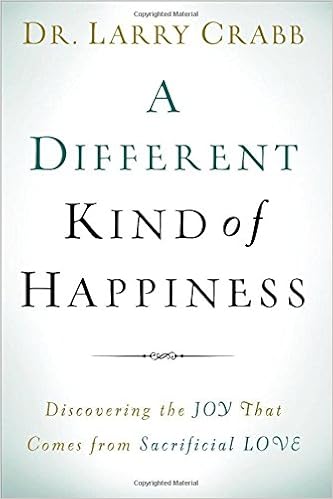
Book Review: A Different Kind of Happiness

A Different Kind of Happiness: Discovering the Joy That Comes from Sacrificial Love

Rating – Put it on you list

Level – Easy, moderate in length

Summary
First of all, do not be thrown off by the cover/title. This is not a fluffy self-helpy type book. Instead Dr. Crabb challenges the readers to love like Jesus, but not the usual Sunday School love you hear about in church. He lays out true sacrificial love and all that it entails; and maybe the best part, he asks, doing you even want to try?

The book is broken in to two main parts, with a third part, that’s really mostly a conclusion/summary. The first part is the idea of happiness. Crabb says there are two kind, first thing happiness and second thing. Firs thing, better known as joy, though he uses them interchangeably, is happiness IN Christ. Second thing happiness is the happiness of pretty much everything else – family, money, health, etc.

The second part consists of an introduction what he calls Spiritual Theology, followed by the seven questions to ask and answer of this theology. The questions are:

  • Who is God?
  • What is God up to?
  • Who are we?
  • What’s gone wrong?
  • What has God done about our problem?
  • How is the Spirit working to implement the Divine Solution to our human problem?
  • How can we cooperate with the Spirit’s work?

He wraps up with some concluding thoughts and presents the question(s) he was hoping this book would ask. Finally, he spends a little time trying to answer that question.

My Thoughts
This book was surprising challenging. I say challenging, I guess I’m basing that on the cover. I had never read anything from Dr. Crabb before. Then all of sudden this summer, he was everywhere to me. First as I have been looking into Christian & Biblical Counseling, his name comes up often. Then I met with the community group pastor of my church who bases some of his small group leader training on ‘Inside Out’, Crabb’s most famous book. About that time, Baker Book’s email to people whom want to receive review copies had this book. So, despite the cover, I gave it a try. Continue reading

Read This, Not That – Disciplines

This is my first post in my new series, go read the intro.

Read This, Not That

20160925_145853.jpg

Disciplines of a Godly Man     VERSUS    Spiritual Disciplines for the Christian Life

My Review – Godly Man                     |     Must Read                |     $9.52     |     232 pages +50

My Review – Spiritual Disciplines  |     Put it on the list     |     $9.65     |     304 pages

Ease of reading
Well, I guess first off I should point out that the books aren’t exactly rivals. Godly Man is, like the title says, for men. Due to this focus, there are things men should do, whereas Spiritual Disciplines are for all, but all explicitly Biblical disciplines for Christian practice. This means that they do take different perspectives. However, there is a great deal of overlap (hence the comparison) such as – reading the Bible, stewardship/giving, learning, serving/ministry, prayer, worship, and evangelism.

Where they differ are in chapters like Fatherhood, Marriage, Friendship, and Work for Godly Man, and Fasting, Silence & Solitude, and Journaling for Spiritual Disciplines. These difference are one of the reasons I rate chose Godly Man as the better option. Though all disciplines in each book are both Biblical and practical, I find Godly Man to be more helpful in practice. It gives much more guidance for men and their day-to-day lives.

The other reason I recommend Godly Man is the way it is written. This includes its actual layout and divisions, but mostly his style of writing. Hughes’ writing is much more personal and pastoral in nature. An older man who was leading a Bible study I was a part of earlier this year commented that finishing the Spiritual Disciplines book is a discipline in and of itself. This reason alone is strong enough for me to say pick up this book first. People who don’t often read, or are completely disinclined to read, likely will not make it through Spiritual Disciplines. Alternatively, anyone can make it through Godly Man. It is written more clearly, while also being shorter, yet broken into more chapters (17 disciplines compared to 10).

For those inclined to read and that are just starting to get interested in disciplines, Spiritual Disciplines is still worth the read, especially with some of the disciplines lost in American Christianity but common of the ancient and global church. Spiritual Disciplines, in this sense, can been seen as something like a “Disciplines 201” book.

Book Review: Disciplines of a Godly Man

Disciplines of a Godly Man – R. Kent Hughes

My Rating – Must Read

Level – Fairly easy read, moderate length

Summary
As the title implies, this is a book about disciplines for men who are trying to live a ‘Godly’ life. After the introduction Hughes goes into the 17 disciplines he has identified as needed for men. He breaks these into four broad categories –

Relationships – which he identifies as the disciplines of purity, marriage, fatherhood, and friendship. He uses the story of David to illustrate the importance of purity. Originally written in 1991 and revised in 2001, there is the noticeable lack of discussion of internet porn. It seems almost funny (naive?) that he would warn about magazines like Playboy, which doesn’t even have nudity anymore. The chapters on marriage and fatherhood are about what you’d expect, though I think he does a good job of warning fathers not to be too harsh in punishment; something often quite lacking in the Christian world. He finishes this section with a chapter on friendship. This was a challenging chapter and a topic I think is often overlooked.

Soul – mind, devotion, prayer, and worship. Mind, encourages us to watch out mental intake. He points out the statistics of the amount of TV people watch on a daily basis as compared to the relatively small amount spent reading. He isn’t opposed to TV, just points out that for the most part, it is there just to kill time, and recommends different things to read instead – Scripture and Christian literature. Devotion, he breaks down into meditation (on the word), confession, and adoration. Prayer and worship are also as you’d expect, worship being specifically about importance of corporate worship.

Character – integrity, tongue, work, and perseverance. Being a man of integrity and clean speech are fairly typical, but the work aspect is unique. I found it especially telling that he would put a chapter on the importance of working in the character section of the book, and after reading the chapter and his arguments, one I fully agree with. The chapter on perseverance was also a new idea to me. His general point is that things aren’t easy, and it takes time to accomplish things, and often it is hard just to keep going. This chapter is a short, but helpful, call to focus on what God has laid out for you and to continue on the path.

Ministry – church, leadership, giving, witness, and ministry. Again, chapters like being involved in church, giving money, and witnessing (evangelism) are typical and as expected. Leadership is another short chapter that bring a different perspective, but something that is important for men especially. We are all called to be leadership in one aspect or another, work, family, the church, etc. He rounds out the section on ministry with a chapter about, well, ministry. By this he means the importance of actually doing something. Be involved, be willing to be uncomfortable, to be challenged, and to fail, if all for the glory of Christ.

Finally, there is a short epilogue with a concluding argument for the importance of Godly discipline and the correct response to grace God has given us. The book is then packed with another 50 pages or so of ‘resources’ including the hilariously dated ‘Bible on Audiocassette’, which, honestly, I’m surprised made it into the updated version (the word is so old that my spell-checker is telling me I have it spelled incorrectly). There are also Bible reading plans (including M’Cheyne, which I recommend), helpful Proverbs regarding speech, hymns, choruses, and praise Psalms. As a reading nerd, the most interesting resource to me was his reading survey. He asks a number of well known evangelicals questions regarding their favorite books. This in itself is probably worth the price of the book, and I should probably make it it’s own post.

Last note on the book, the cover clearly states that there is a complete study guide. This is not what you are probably expecting (unless there was a shipping error and I didn’t receive some sort of stand alone guide), as there isn’t a dedicated ‘study guide’ section. Instead, at the end of each chapter, are some thoughts and discussion questions.

My Thoughts
Overall, I really enjoyed this book. Written very well in general, it especially pastoral in practice and effect. The typical disciplines you see (not a negative, they are always written about because they clearly Biblical and obviously important) written about are handled well, but the strength of this books comes from some of the other chapters that tackles things you don’t always see, such as friendship and work.

I’d say this is probably the best book on disciplines I’ve read so far. One major down side is that, obviously, it is mostly geared to men. Some chapters are universal disciplines, but are written about from man’s perspective, and some chapters are specifically for men. That being said, if you have a father, a son, a husband, or really just any man, this book is a must read on the disciplines that God expects of you.


Read This, Not That

I’m excited to launch a new series called “Read This, Not That”– the purpose of which is to help people with finite time and money decide which books would be best for them.

From my teenage years through my late 20’s, I subscribed to Men’s Health magazine. One of its more popular regular features was called “Eat This, Not That,” which compared the same meal from two different places and told you which one you should eat, and which one you should not. The column featured everything from a burger and fries to a variety of salads.

Now, Men’s Health used actual, measurable metrics such as total calories, fat and protein content to support why one meal was good while another was bad. That’s not quite what I will be getting at – however, if a book is bad and I think you should avoid it, I will say so. In fact, both books I compare might actually be good, but not everyone has the time, money, or inclination to read multiple books on one topic (and have a life). I guess that’s what I’m here for.

While I will attempt some metrics (cost, number of pages, and a made-up scale of readability), for the most part, my choice will be purely subjective. Whereas the “not that” in the Men’s Health series often meant you should avoid it, that will in no way be what it means in my series.

Hopefully, you will find it helpful in selecting from all the books out there, even if my analysis makes you think you should actually go with the ‘not that’ book. I’ll kick off next week with a post on discipline.


Book Review: The Blue Zones

The Blue Zones – Dan Buettner

*Please ignore the Dr. Oz endorsement on the cover. The book is a really interesting look at lifestyle and does not offer magic pills or tonics to purchase.

My Rating – Must Read

Level – Easy read, medium length, but reads quickly

Summary
Blue zones, so named because while researching the first one, a blue circle was drawn around they area under discussion, are areas in the world where people live the longest. Not only do they live longer, but live better as centenarians (100 year olds) then many people much younger do in other parts of the world.

The book takes us through the four blue zones, and shares interviews, history, diets and other fact about the life of the people who live there. The four blue zones are – Sardinia, Okinawa, Loma Linda (California) and Costa Rica. They have since discovered another one in Greece.

The final chapter gives the tips they found in common in all the blue zones so that you can create your own ‘blue zone.’

  • Move Naturally – Everyone studied for the book was extremely active. They walked miles a day, gardened, etc. His point is no one has to run marathons or become powerlifter, you just need to move often.
  • Hara Hachi Bu – A phrase said by the Okinawans before every meal reminding them to eat until they feel 80% full. Calorie restriction has been shown to be very important in longevity.
  • Plant Slant – With the exception of the Adventist in Loma Linda, no one was a vegetarian. However, they all ate meet rarely, anything from once a week to only a few times a year.
  • Grapes of Life – Wine. It plays a big role for the Sardinians and the Okinawans drink Sake, but the others consumed no alcohol. Either way, studies have shown a drink or two a day, especially of wine is beneficial to your health.
  • Purpose Now – Having a sense of purpose, or a reason to get up in the morning, something that drives you.
  • Down Shift – taking time to relax, meditate or slow down and enjoy life.
  • Belong –To a community, but a part of something bigger than yourself. Religious communities, regardless of which one, have been shown to help people live longer.
  • Loved Ones First – Relatedly, take time to cultivate relationships and spend time with friends and family. Prioritizing social life is something we really fail at in America.
  • Right Tribe – People who share common goals and healthy lifestyle. Many studies have shown that who you hang out with has a huge impact on your lifestyle. Have an obese friend increases your chances of becoming overweight. Seek people who have the same above traits in mind.

My Thoughts
Things like this are utterly fascinating to me. Both of my granddads are currently 91 years old and show only a few signs of stopping. Much of their life has included most of the traits. Modern America has us moving further and further away from these things. We eat lots of cheap, processed food. We don’t spend much time with friends or family. We do not rest often. We don’t move.

I’m currently writing this at my desk, I spend far too many hours a day sitting at a desk and wondering how I can move. Adopting as much of the Blue Zone lifestyle will not only help you to live longer, but the time you do spend will be better and healthier.