Sermon on the Mount – the Merciful, Pure in Heart, and Peacemakers

The past few post I’ve covered the first four beatitudes, which relate to how we respond to God. Today, I’ll move on to Matthew 5:7-9, which relate to how we respond to others.

V7

What does it mean to be merciful? Well, it sounds simple, but it is one who shows mercy. Sure, sounds good, so what is mercy? The Greek word is eleos and is the stand new testament word for mercy, or sometimes compassion. This is in response to pain, misery, and brokenness of others. The word is both used for our reaction to others and God’s reaction to us. The word being used for merciful has an active sense, so we are actively responding to people, we are showing people mercy and compassion.

So, in some ways, this one is fairly simple – show mercy and mercy will be shown to you. Maybe the questions is obvious, but who is showing you mercy? We know that just because you show mercy or kindness to people does not mean that people will show it to you. The answer, as has been to the doer of all the second clauses of the beatitudes, is God. The tense used for ‘be shown mercy’ has a future active sense, leading one translator to make up the word ‘mercied’, which I like as a way to understand this verse. This continues the eschatological theme of the Sermon on Mount. That in our knowledge of God grace and mercy to use in the end, out of gratitude and obedience, we show others mercy and compassion today.

V8

Both verse 7 and 9 are very much continuation of the promises of the Old Testament, but this is probable the most direct of the three. There is almost nothing to comment on. We are supposed to love God with all our…heart. The Psalms call out to God, asking for Him to create in us a clean (leading to pure) heart. One commentator defined the pure heart as one of ‘inner moral purity and single mindedness,’ the single mindedness being in devotion to God.

What do we receive for this pure devotion? To see the face of God. This is the ultimate sense of blessing in the Old Testament, the ultimate way of experiencing the Glory of God. Remember that this is exactly what Moses requested of God, thought even he was only allowed to see God has He passed by.

The most direct connection is Psalm 24:6 – the generation of those whom seek him, will see the face of the God of Jacob.

V9

What exactly is a peacemaker? McKnight says it is one with ‘active entrance into warring parties, to make reconciliation. In Psalm 34:14(?) we are told to turn away from evil, seek peace pursue it. Being sons of God has two distinct meanings in this context. First, there is the obvious, that as a son(child) there would be an inheritance which of course brings us back to the overall eschatological sense of the Sermon on the Mount, specifically as it related to the Kingdom of God. The second, less obvious to modern readers is in the Hebrew, ‘to be called sons,’ has the meaning of sharing the characteristics of a father, in this case, God the Father, though Jesus Christ the Son.

There is a reason Christ is called the Prince of Peace. He is the ultimate reconciler, between us and God. Paul says in Colossian’s 1:20, ‘and through him to reconcile to himself all things, whether on earth or in heaven, making peace by the blood of his cross.’

What a great place to end our quick look into these three beatitudes. If you are thinking, aren’t there eight, you only did four earlier. We will look next week at the final one, those persecuted, and look at their connection to the following two verses.

Follow along in the series – Intro, The Poor in Spirit & Those Who Mourn, The Meek and Those Who Hunger & Thirst

Commentaries used in this series:
Sermon on the Mount (The Story of God Bible Commentary)
The Message of the Sermon on the Mount (Matthew 5-7 : Christian Counter-Culture)
Studies in the Sermon on the Mount
Matthew (Baker Exegetical Commentary on the New Testament)
The Expositor’s Bible commentary : Matthew, Mark, Luke, with the New international version of the Holy Bible (Expositor’s Bible commentary, Vol.8)
Matthew: An Introduction and Commentary (Tyndale New Testament Commentaries)
New Bible Commentary

Sermon on the Mount – The Meek and Those Who Hunger & Thirst

Matthew 5:3-6

Las week, I only made it through verses 3 & 4, so this week I’ll wrap up the first section of the Beatitudes and go through verses 5 & 6. So, let’s jump right in.

V5
Who are the meek? This isn’t a word used often in modern English. Discussing this passage with my study group, we could only come up with that Christmas song where they call Jesus meek and mild. The Greek word is praus, which can mean – humble, gentle, considerate, courteous, long suffering, and free from malice. Barclay calls meek being ‘angry at the right time and never at the wrong time’, and according to Aristotle, meekness is being ‘angry on the right occasion, for the right people, for the right amount, and for the right length of time’.

Maybe because they are homonyms, but I think most people just go straight to associating meekness with weakness. I think quite probably gets in there a good bit to. Other Biblical references include Moses being called meek in Numbers, and both James and Peter writing about meekness as a way to act and receive the Word.

How we see who the meek are in this verse is influenced by how we understand the blessing. The reward for being meek is inheriting the earth. The word translated can mean either earth (as in the physical aspect) or land. This has a pretty clear meaning to Israel, but what about today? Similar to those who mourn, you can double dip into eschatological meanings here. For Jews, it is the Messianic Kingdom, for Christians it is the second coming – think inheriting the new Earth. Considering the likelihood that the mourning is the broken world with the blessing being the new Earth, I view the meek as the longsuffering and humble. Combining the two verses, and we should read each in light of the other, that means we mourning the brokenness of the world, but in humility of our own sin, and of course we may live our whole lives in the world, not seeing the restoration, making us long suffering. The blessing for this combined affliction is the same, we will be comforted when we inherit (as heirs to the Kingdom) the new Earth after the second coming, resurrection, final judgement, and restoration of all things.

V6
This is another phrase that is hard to understand in modern American life, hunger for me means something drastically different than to the original hearer/reader (or the majority of Christians over the past 2000 years, or any number of hundreds of millions elsewhere in the world today). I’ll eat breakfast around 6:00, then get to work and get moving and around 11:00 someone will mention lunch, and I’ll think, ‘man, I haven’t eaten since breakfast, I’m starving.’ Compare this to even my grandparents who were growing up before ‘three meals a day’ was even a concept. Or to the original hearer/reader, where there were likely days when on food was consumed. That is real hunger.

Likewise, thirst is a difficult concept. For one, there is no running water, indoor plumbing, etc. You have to go to a well. Now, I live in what was formally a malarial swamp (if you’ve ever wondered why the CDC is in Atlanta…), but the context hear is a desert. The well can run dry and it may not rain for months. I have some neighbors that moved here from LA about a year ago and one of the things they said they enjoyed here was listening to thunderstorms. They tell me that it may rain once, and then not again for a month or so, and that is pretty much the expected outcome. So, this concept is a bit lost on me, as even in our level 3 drought years, we still receive about 30 inches or so of rain. However, I do know you can last weeks without food, but only days without water.

This is a long intro to two commonly used words, but it is helpful for context. The picture here is someone who hasn’t eaten in a week and had no water in a day or two. It is someone who will soon die if they do not find food and water. This is the level to which we should seek righteousness. This is a theme throughout Christ’s ministry, later He will tell us to ‘First, seek the Kingdom and its righteousness”. So we know that He isn’t talking, if you have time, or when it is convenient for you, but seek it as if it is the drop of water that will keep you alive.

Finally, what is the blessing? They will receive it. The BEC translates the promise as, they will be filled. This takes us back to the point from last week about being poor in spirit. We need to empty ourselves to be filled. Those who seek Christ and His righteousness will find it, and He will give it to them. They will be covered in Christ’s righteousness, and it is through Christ that we will one day enter the Kingdom or inherit the new Earth.

That wraps up the section of the Beatitudes about how we relate to God, next week I’ll move into the section about how we relate to each other.

Follow along in the series – Intro, The Poor in Spirit & Those Who Mourn.

Commentaries used in this series:
Sermon on the Mount (The Story of God Bible Commentary)
The Message of the Sermon on the Mount (Matthew 5-7 : Christian Counter-Culture)
Studies in the Sermon on the Mount
Matthew (Baker Exegetical Commentary on the New Testament)
The Expositor’s Bible commentary : Matthew, Mark, Luke, with the New international version of the Holy Bible (Expositor’s Bible commentary, Vol.8)
Matthew: An Introduction and Commentary (Tyndale New Testament Commentaries)
New Bible Commentary

Sermon on the Mount – Poor in Spirit and Those Who Mourn

Matthew 5:3-6

The beatitudes are broken up, like a lot of things in the Bible, into you relating to God and then you relating to people. The first four – the poor in spirit, those who mourn, the meek, and those who hunger and thirst for righteousness – are how we relate to God.  The second clause is how He relates back to us – theirs is the kingdom, will be comforted, shall inherit the earth, will be filled. We will hit two of these this week and the other two next week.

V3

What does it mean to be poor in spirit? The best descriptor I can across was ‘spiritual bankruptcy’. However the focus isn’t necessarily on ‘poor’ in the sense that you aren’t very good at being spiritual, it is more in realizing that you are ‘bankrupt’. It is how Isaiah feels before the thrown of God when he says ‘woe to me, I am a man of unclean lips’. That is what knowing you are poor in spirit sounds like.

What about the opposite, what is rich in spirit? First of all, you can’t be rich, because of our fallen nature. We are too sinful to be rich in spirit, which is why Paul says I keep doing what I don’t want to do. Basically, I know I shouldn’t sin, but I just keep on sinning anyway. Self-righteousness is what happens when you think you are rich. That is the message to the church in Laodicea in Revelation 3:17 – For you say, I am rich, I have prospered, and I need nothing, not realizing that you are wretched, pitiable, poor, blind, and naked.

I have this quote in my notes, but forgot to attribute it, I think it was Martyn Lloyd-Jones, that you must empty yourself before you can be fill by God. Being poor in spirit means you realize what you have isn’t worth much, especially compared to the surpassing worth of knowing Christ, so you are willing to give that up and look to God for fulfilment.

V4

Who are those that mourn? Reading through the commentaries and studies on this, there didn’t seem to be much in the way on consensus. There were four main ideas of what we are mourning, but the support for each seemed fairly well spread out. Those who mourn may be mourning:

  1. Their own sin
  2. The humiliation/destruction of Israel
  3. Their persecution
  4. A broken and sinful world

I am least inclined to agree with number 3, for one, it is early enough on in Christ’s ministry, that there are not any ‘Christians’ yet, and so it would have to mean some future persecution that those who are beginning to follow would have to be aware of now. Mostly, though, I don’t think it fits in this section of the beatitudes. Persecution is discussed, but it comes later; and working in the framework of the first four beatitudes being about our reaction to God, persecution doesn’t fit.

I’m also less inclined to go with number two, but mostly because it is difficult to understand (for today). DA Carson makes the argument that the mourning is the current low position of Israel and the coming destruction of the temple. As Matthew is the most Jewish focused of the Gospels, this seems to make sense. He points to the weeping remnant that mourns and that there is an eschatological hope for future comfort. This is pretty clean academically, but I struggle with the focus being so narrow. There aren’t any more first century Jews around. I’m two thousand years later, living on the other side of the world. Doesn’t mean it is the wrong interpretation, but it moves it from a broader point about life, to a specific time and place; which I’m not convinced fits in the Sermon.

Number four is related to this, in a way, but is still able to have a more broad meaning. It carries the same eschatological sense, but can be applied for today and for any Christian throughout the world. We can look around and mourn the sinfulness and brokenness of this world, but be comforted by the fact that Christ will come again. That is the ‘will be comforted’ part, that the world will be restored in the new Earth after his coming. This interpretation is probably the easiest to fit and understand, and I think is the best way to go.

Relatedly, but without the future earth and kingdom restoration connotations, is mourning our own sin. The comfort then is less about restoration, but more individualized, with the comfort being deliverance from God’s penalty. So, we mourn our own sinfulness, but we will be comforted because the penalty has been paid for us and we do not incur the wrath of God.

That is it for this week, check back next Monday for my thoughts on the Meek and Those Who Hunger & Thirst for Righteousness.

Commentaries used in this series:
Sermon on the Mount (The Story of God Bible Commentary)
The Message of the Sermon on the Mount (Matthew 5-7 : Christian Counter-Culture)
Studies in the Sermon on the Mount
Matthew (Baker Exegetical Commentary on the New Testament)
The Expositor’s Bible commentary : Matthew, Mark, Luke, with the New international version of the Holy Bible (Expositor’s Bible commentary, Vol.8)
Matthew: An Introduction and Commentary (Tyndale New Testament Commentaries)
New Bible Commentary

Intro to Sermon on the Mount

Matthew 5-7

This passage is one of the most well-known, while at the same time, it isn’t known very well. That is to say, if you mention Sermon on the Mount to most (church) people, they will know what you are talking about, but following up with any question – when/where/why, or what is in it, what is he saying, and I don’t think you’d get much of a reaction. There are number of ‘famous’ passages within it – the beatitudes (blessed are…) and the Lord’s Prayer probably being the most known, but there are other passages such as His words on Lust/Adultery and Hate/Murder. Really, the simplest way to state it is that the Sermon is a collection of all of the teachings of Jesus found in Matthew, which are not parables.

What exactly was the Sermon? I’m torn on whether I want to get into some of the deeper academic disputes. Was he actually on a mountain? If so, which one? Where there any in the area? Some commentators break this down a bit and say well, it was probably just a hillside, and in kind of a red-neck way, say that the translation could read the sermon up in the hills. Some people were also concerned that it doesn’t align with Luke’s sermon on the plain, and wonder if the Mount is really more of a plateau, but I think all that is beyond what I want to look at and discuss.

For me, there are a few things that matter, one is Jesus probably gave this sermon or message a number of times. It wasn’t uncommon for itinerate teachers (Rabbis) to go around to different towns and villages repeating their message. Luke focused on only a few ‘blesseds’ whereas Matthew had more and left off the ‘woes’. I also think that is why he puts it at the beginning of the his Gospel.

Finally, there is significance to placing it at the Mount (whether it was actually the first instance or not). Matthew is written for a mostly Jewish audience, and they would have seen the connection between Jesus giving the sermon (expanding and explaining the law) and Moses coming down from Mount Sinai with the original Law (the 10 commandments). If that wasn’t clear, Jesus Himself draws the connection when He later explains lust and adultery, and hate and murder.

The entire intro Matthew gives us is just two verses (5:1-2), which basically says, people were around, so Jesus started His sermon.

Next week I’ll start going through the beatitudes, but for now, what is exactly are beatitudes? We get with word from the Latin word Beatus which means blessed, which is obviously taken form the start of each verse – ‘blessed are…’. So, what does blessed mean? There are two words typically used in the Greek – Makarious and Ealogetos. The latter is word used when someone is blessed by God that most people think of when they hear bless. The word used is actually the former, it means more something of along the lines of happiness, fortunate, or even congratulate (as the tense is accusative).

This is one reason for wide array of translations for the word, but it makes the sense of the phrase confusing in the English. He isn’t saying that God will bless those who are poor in spirit, He is saying something more along the lines of consider fortunate those who are poor in spirit (on famous sermon even used the translation ‘congratulate those…).

I hope that helps as a basic introduction, next week I’ll started on the Beatitudes and hopefully continue you on through the whole sermon.


Commentaries used in this series:
Sermon on the Mount (The Story of God Bible Commentary)
The Message of the Sermon on the Mount (Matthew 5-7 : Christian Counter-Culture)
Studies in the Sermon on the Mount
Matthew (Baker Exegetical Commentary on the New Testament)
The Expositor’s Bible commentary : Matthew, Mark, Luke, with the New international version of the Holy Bible (Expositor’s Bible commentary, Vol.8)
Matthew: An Introduction and Commentary (Tyndale New Testament Commentaries)
New Bible Commentary

May Biblical Studies Carnival

Jeff Carter has the Carnival up, though he is calling it Biblioblog Carnival. Maybe the name changed. Try searching biblioblog if you are having trouble finding it, or just click the link above. When I searched Biblical Studies Carnival, I only came up with Zwinglius Dedivivus’s post. I may have to check in with the godfather of the carnival to see if things have changed. Anyway, enjoy.


Updates

Alright everybody, I have finally had some time to write again. I just finished my classes last week. The past month was crazy with final exams, final case studies, and final papers. It ended up being a lot more work than I thought. I’ll have an up date and review of the courses/CCEF in general up soon, as well as where I cam going from here.

Tomorrow I am will have a short post up about generational theory in preparation for my review of Meet Generation Z that will be up on Wednesday. I’ve been fall really behind in reviews, and will hopefully have at least one a week up for the next two or three months. Here are the books that just Baker Books has sent to me review over the past 3 months. The stack on the left is the books I need to read, the stack in the middle is books I’ve finished reading, and the stack on the right is what I’ve reviewed. So, falling behind. I’ll try to do better next time.

In the mean time, it is Biblical Studies Carnival time for April already. Go check it out over at Theologians, Inc.


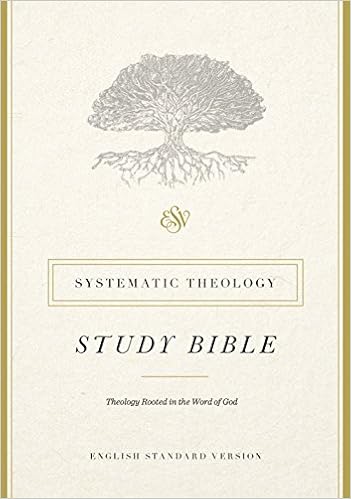
Systematic Theology Study Bible

ESV Systematic Theology Study Bible – New from Crossway , coming some time in the Fall. The latest date I’ve seen is October 21, 2017; however, it has already moved once as far as I can tell. You know I’m big on Study Bibles, and obviously adding Systematics is going to be big for me. I plan on getting this as soon as I can, hopefully before it is published. I’ll keep you updated on what I know.

Update – Looks like all editions (Hardcover, Leather, fake Leather) are going to be available 10/31/2017. That is the 500th Anniversary of the Reformation starting (Luther nailing the 95 Theses).

I won’t be buying the hardcover, I tend to favor the fake leather, but I can’t quite tell what the design looks like. May actually splurge and get the real leather.

Romans 12:21

Well, my assignments and reading for school have pretty much kept me from posting anything new the past few weeks. Also, the past week or two has been pretty this:qabsyvj

We’ve had the crud run through everyone in the house. That’s always fun when I have a new job, Mrs. MMT has a new job, Sprout is potty training, and I’m taking these courses. Oh yeah, and at some point, we’d like to have a life. Oh, also, as I mentioned in my reading challenge, I had requested a number of book from Baker, well, I received three in the mail this week. Good stuff.

I’m kind of freaking out about the amount of stuff I have going on. Then again, when my head stops being a lead balloon, things may not seem so bad. Anyway, that means no book review this week, also, the post is a day late. So, I’m just going to double dip. One of my assignments was to write up a few short thoughts on a verse that has particular meaning to me, so this is what I cam up with –

Be not overcome by evil, but overcome evil with good. – Romans 12:21

This is a verse that has been important to me for about the last 10-15 years. There are two parts that get to me. The first part, ‘be not overcome’ addresses a number of circumstances. If you watch the news a great deal, or get involved with ministries to the destitute, sex-trafficking, or refugees, you can feel overwhelmed. I sometimes see so much evil in the world that I just want to stop. I want to withdraw and avoid everything, and it becomes easy to feel like it is just too much, so why bother? I really likely the simple, direct, indicative, ‘be not overcome’.

The second part, ‘overcome evil with good,’ is sort of a launching point to many other aspects of the Bible. It makes me think of other verses, such as: turn the other cheek; the darkness fears the light; if God is for us, who can be against us; pray for your enemies; and basically the entirety of Revelation. There is almost a feeling for triumph with this part of the verse. You know that, long-term, in the end, Good will overcome and evil will be vanquished.

There is a lot of encouragement in the verse. To the first part, it says to me that if we are command not to be overcome, then it is within our ability (or that God will give us the ability) to overcome. That is very freeing, you know that when bad things happen, you will not always be overwhelmed, and eventually, goodness prevails. And it’s that second part that is probably the most encouraging. As I mentioned above, the end is already decided, the outcome is not in doubt; evil will be overcome by good.

It is a great reminder of the sovereignty of God. It give you hope and strength to get through whatever trails you may face. My wife and I actually put this verse up on a chalk board by the door not too long ago. We were part of a church plant that died. There were internal issues that actually lead to a church trial and eventually the defrocking of the pastor as well as the church being removed from the denomination. It was a frustrating and discouraging time for us, so this was a reminder that all we can do is what God has commanded is right, and we know that in the end, all will be restored.

Bible Reading Plans

A while ago I wrote about the need for a Study Bible. Now, I want to point out briefly the value in a reading plan for your Bible study. Have you ever tried to read the Bible? As in, all of it. Goodness it is long. Most people crack open Genesis and probably quit before you even get to Abraham. My parents’ church is encouraging them to read the whole Bible this year. It is a good goal, but it is pursued wrongly.

My dad was telling me about trying to power through. When we were at the beach in August, he was even trying to ‘get ahead’. Couple things about that – first and foremost, that is not meditation on the scripture. Second, it becomes rote and pointless. Especially if you do not enjoy it. He would say things like, it’s just so hard to get through all the genealogies, and measure, and rules; no one is going to remember, and they don’t matter anyway.

So, I would never recommend someone read it through from beginning to end; you really do get bogged down. The furthest I ever completed was using the Chronological Bible. It tries to mix things up when stories overlap (like the Gospels) and just seemed like a neat idea, and something a little different. It starts off with Job (the idea being that it was probably written before Genesis was written), then goes into the Pentateuch. I believe I made it a few chapters into Exodus.

You have to be honest with yourself about the difficulty of reading some of the OT books. Three to five chapters(20-30 minutes) a day for almost two weeks in Leviticus is tough. The solution is to use a plan that takes chapters from different parts of Scripture. There are a few ways to do this:

ESV Daily Reading Bible: Through the Bible in 365 Days, based on the popular M’Cheyne Bible Reading Plan  – This is the plan I have been using for about two months. I have this Bible, because I don’t like looking up the different verses, because I’m lazy. I want to be able to open it to the day and just read. Also, I was able to get it in patent leather, that nice smooth Bible you see that is usually cheap (mine was $12). I’m a sucker for it, I’ll by any book if I can get it in patent leather.

Anyway, this plan gives you chapters (usually one a day, but can be two-three, if they are short enough) from two books of the OT, one from the NT and one from Psalms. Following this plan, you’ll read the OT once a year, and the NT & Psalms twice a year. I really, really like this plan, I like reading from four difference sections; it really helps to keep it interesting and not feeling like you are bogged down. For those whom don’t want to by it, you can find it pretty much anywhere online, such as here.

Related to M’Cheyne plan is this – The One Year Bible: The entire English Standard Version arranged in 365 daily readings. It gives you one OT, NT, Proverbs, and Psalms everyday. It is a bit shorter, as you will not read the NT twice in a year. This is a good alternative, and I might have bought it, but when I originally looked, I think I missed that you get a verse from Proverbs and Psalms everyday and instead thought you just went through two parallel sections, OT and NT. Also, it only comes in paper or hardcover, not patent leather.

Another great option that mixes things up, but is a little slower (whole Bible in two years) is the The Book of Common Prayer (if you want this cool hipster version) daily office (readings). Now, with these you have the plans listed and then you have to search through and find the verses. I haven’t found any Bible options that are set up like this to be a daily read based on the calendar. It can also be found online.

It’s kind of cool that the BCP and the M’Cheyne have been used for hundreds of years. Not sure how popular the latter is, but the former is used by Anglicans all around the world. So, you will be reading the same verses ever days as thousands of others.

There are many other plans out there, but I think ones that hit multiple selections will make it much more likely you will follow-through. I suppose I will let you know ad the end of 2017. I personally like the Bible plans, like the One Year Bible, that break the Bibles into days, with the verses for that day. Maybe you are thriftyer and can just order a card, or book-mark, or pamphlet, or maybe a little too thrifty and print one out a work. Alternatively, if you bought a good Study Bible like I told you to, there will be reading plans in the back. Finally, for you tech savvy kids out there, it’s all online. You can follow the links above, and you’ll get the verses of the day right there.

Good luck if you try it. It really is important to try to read as much as possible in the Word and I think these plans are the best way to do it. Americans are illiterate when it comes to the Bible, though we supposedly hold it in high regard, calling it the inspired word of God (about 60% according to the most recent Pew poll). I’m part of the problem. Here I am, a Pretend Theologian and I haven’t read the whole Bible. There are probably books of the Bible from which haven’t even read a verse. Start looking around now, find a plan you like and in 2017, read the whole Bible.

August Biblical Studies Carnival

When Phil first contacted me about hosting a Biblical Studies Carnival, I expected him to ask for a credit card number or tell me about his friend, a Nigerian prince. I hadn’t come across a Carnival yet, though I had seen (and even followed) most of the blogs/posts that were featured in the series. After checking it out, I became excited to host.I still have no idea what I'm doing.

While most hosts are professors or PhD students, I’m more of a pretend theologian. I’m also someone who’s closer to a book reviewer than a BiblioBlogger. And so this Carnival might be a bit different than what you’re used to reading.

If you are interested in hosting, almost all of 2017 is open, simply contact Phil. Check out last month’s carnival, and look for the upcoming hosts:


Biblical Studies
James offers some short thoughts on the problems with YEC.

If you like Young Earth, there’s great fun for you at Noah’s Ark.jesus-dinosaur1

Related, Peter Enns on getting the Noah Story correct.

Craig asks why Genesis 36 is about Esau.

Bob explains his thoughts on reviewing the ‘raw data’ of the Old Testament. He also shot me one just under the wire look at Isaiah 38.

Cluade Mariottini writes that Judges 19 might be one of the most misunderstood verses in the Bible.

Interesting article about the Chinese church and interpreting the Old Testament. Beware, this is a wall of text.

Phil gives us an intro into 4 Ezra, look also for his write-ups on the seven visions of Ezra.

Jeff thinks that maybe Jesus was a rude dinner guest.

Reasons why 1 Timothy is not so simple to translate.

Ethics in Mathew, James, 1 Peter.

R. Scott Clark provides commentary on 1 Peter 5:1-5.

Peter Gurry with some thoughts on the textual variances in Revelation 2:13.

The Bible is not a book of promises.

RJS say literal reading, please, depending on what you mean by literal.

Will Brown has some info on the Apocalypse of Adam, which I didn’t even know was a thing.

Church History/Historical Theology/Theology
St. Patrick had mixed manuscripts based on his use of the Great Commission.

Reflections by Ken offers short bios, with sweet infographics, on Luther, Calvin, and Irenaeus.
How Hell Started
Beck has a few thoughts on the origins of Hell.

Matt Emerson notes an issue with the Vincentian Rule and Christ descending into Hell.


Book Reviews
Phil reviews Engaging the Septuagint.

Jennifer reviews the Cultural Background Study Bible, concluding that it is a great resource for people lacking in historical/ANE Worldview knowledge.

Scott McKnight reviews The Charity: A place for the Poor in the Biblical Traditions.

Michael C. Thompson reviews Pax Romona: War, Peace, and Conquest in the Roman World.

Chris Stump interviews the author/reviews Earth Science: God’s World, Our Home. (Yep, that’s a textbook. I’ve added a review of a middle school textbook to the Carnival.)

Pete Enns reviews The Early History of God: Yahweh and the Other Deities in Ancient Israel.

Lindsay reviews Progressive Covenantalism.

Jill Firth reviews the Book of Genesis from the Bible in Medieval Tradition series.

John reviews Finding God in the Waves: How I lost My Faith and Found it Again Through Science. Great quote from the article-

But this book will not appeal to most orthodox believers. It is not a simplistic de-conversion/conversion story—the spiritual equivalence of boy loses girl, boy gets girl back. It’s a lot messier than that—more like boy gets girl back…but discovers he’s also got an STD.

Not quite a book review, more of a preview of an upcoming book on Augustine.

Also not quite a book review, but the author guest-posting about his book Q in Matthew.

I guess I can shamelessly plug my review of the second edition of Four Views on Hell.

Calvin reviews a book by Servetus.

Misc
Karl Barth was not a fan of the Olympics, or sports in general, it seems.

American JesusMcKnight on what Grudem should have said.

Some new research out from LifeWay has some surprising results.

A new card game, The Cannon, is coming soon, in case you need to have fewer friends.

Finally, a fellow Atlien reminds us of the importance of a well-worn Bible.


Alright, that concludes the August 2016 Biblical Studies Carnival. Casual Friday KevinHopefully, I didn’t veer too far off track or ruin anything (as occasionally happens when I get involved). It was certainly an interesting task to host one of these. I found many really cool articles (sorry, I couldn’t post them all) and discovered great sites that I had never come across. Sorry if I misspelled your name or misrepresented your articles. All errors are those of my editor. Thank you so much to those who sent me articles to post. Thanks for playing along.

Reminder if you’d like to host anytime in 2017, contact Phil (twitter or email – plong42@gmail.com). It is an interesting challenge. Do it. I know there are more BiblioBloggers out there.