Introduction to Thessalonians 1 & 2

thessalonians_

I’m starting a quick series looking at 1 & 2 Thessalonians over the next few weeks. I have an intro for y’all this week, then a few weeks of commentary, followed by a review of the commentaries (see links below). Hope you enjoy and/or find it helpful.

The books of 1 and 2 Thessalonians were written to the Christians of the Macedonian city of of what is today Thessaloniki. Formerly known as Thessalonica, the city was named after Alexander the Great’s half-sister and served as the capital of Macedonia.  Often when we read books of the Bible, the places are too old and far away for us to make a connection, but they city is only still around today but is actually the second largest city in Greece and an important center of the region.

The church was established as part of Paul’s missionary journey as described in Acts 16-18 and the letters were likely written sometime in the early 50’s AD. There is no series denial of attribution to Paul for Second Thess, though there are a few who question First. There are early attestments from church fathers and each have been considered cannon until the 19th Century and rise of German Higher Criticism. Certainly, no Evangelical or academic Christian scholar doubt either today.

One interesting thing I came across while studying these letters is the arguments of which letter came first. It is important to remember that even though they are referred to as ‘first’ and ‘second’, when the Bible was put together, the Epistles were not ordered chronologically; they are ordered by length. Wannamaker (NIGNT) argues that ‘second’ was actually written first based on the reference in ‘first’ to a previous letter. In his theory, ‘second’ is written while Paul is in Athens and Timothy delivers it, which is the reference to his visit in ‘first’. Much of the rest of his reasoning boils down to the lack of evidence to consider ‘first’ to be written first. Wannamaker is not the first to make this argument, and spends time with those who argue against it, but appears to be in the minority of modern scholarship. Of the commentaries listed below, only Green (Pillar) interacts at any length.

While neither the Gospel message nor the pastoral instruction and advice are lessened or lost by the order of the letters, certain interpretations could change or be influenced depending on whether you find a particular point ot be a follow up. Wannamaker certainly appeals to ‘first’ to be written second as a reason for his side on some of the trickery passages to interpret; likewise Green refutes some interpretations. As for me, I find the arguments for ‘second’ be the original letter more convincing, and particularly think that comes out in the references to the second coming in each letter. The fact that ‘first’ is longer, but hits the same topics, just with more detail, appears to me to show a clarification that can logically only come later.

The letters both cover similar topics and are both relatively short. ‘First’ is only five chapters while ‘second’ clocks in with three. Major themes in each include the second coming, work/idleness, and suffering/perseverance. Of course each open with long greetings and ends with encouragement/blessing/benediction. ‘First’ also includes notes on Timothy report from his visit (possibly when he delivered ‘second’), Paul’s longing to see them again, and a few other instructions.


Commentaries Used:
The Letters to the Thessalonians (The Pillar New Testament Commentary (PNTC))
1 and 2 Thessalonians (Tyndale New Testament Commentaries (IVP Numbered))
The Message of 1 & 2 Thessalonians (Bible Speaks Today)
Commentary on 1 & 2 Thessalonians (The New International Greek Testament Commentary)
1-2 Thessalonians (Baker Exegetical Commentary on the New Testament)
1-2 Thessalonians (The IVP New Testament Commentary Series)
The First and Second Letters to the Thessalonians (The New International Commentary on the New Testament)

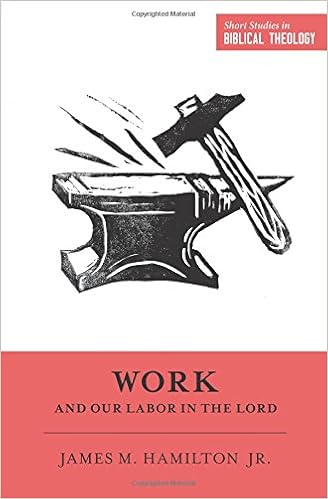
Book Review: Work and Our Labor in the Lord

Work and Our Labor in the Lord (Short Studies in Biblical Theology)

Rating – If you are looking for something.

Level – Short, moderate read, feels a little redundant at times

Summary
Hamilton attempts to concisely write a theology of work – why we work, what it means to work, and what it would look like to ‘labor for the Lord’. The book is broken into four main parts: work before the fall, work after the fall, work now after Christ’s coming, and finally, work in the new heavens and new earth.

My Thoughts
I’ll start off by saying I think this is one of the most difficult topics for which Christians can write. Not necessarily because the Bible is unclear on work, it is, and not because I thought Hamilton didn’t handle the theological points well. In fact, I thought he did a masterful job from a Biblical perspective; though there were occasionally odd section that appeared to have political undertones, but I guess that’s to be expected from an evangelical publication (or maybe I just read too much into it, and watch too much politics).

No, the problem is the reader. Especially me – educated, white-collar, upper-middle class reader, who has actual opportunities to think about different careers or finding fulfilling jobs. Due to the reader problem, I think books on work are hammered twice. First, because the reader looking for answers, such as what should I do with my life, do not find any and may come away disappointed. Second, because those are the readers, the authors tend to focus on that demographic. Hamilton avoids some of these trappings, probably due to his focus on theology, but they do show up. I won’t digress any further on that point.

The strength of this book is the first section, work before the fall. In our Biblically illiterate, 140 character limit culture, we miss too much of what the Bible actually says. For most of my life, I believed work was punishment for sin. I was around 30 before I heard someone point out that we worked the garden, it was one of the first commands from God and our original role in this world. So, work isn’t our punishment for sin, but our sin has corrupted out work. Hamilton does a great job of teaching and explaining this Biblical truth.

This point is expanded on in the work after the fall section as well. I especially liked the references to Ecclesiastes; which is always a great reminder of the way we view life in general, but I’m not sure I’ve seen it related specifically to work.

Overall, it is a solid book, but it left me wanting a little more. I’m probably a little too critical of Christian books focused on work, so if that is a topic you are studying you should put this book on your list. If not, you might want to skip. It is short, so that is a positive (why not just knock it out) and a negative (maybe not as in depth as you’d like). The Biblical Theology is strong, so that would be another reason to read it. So, grab this book, if you are looking for something.

*I received a free copy of this book in exchange for an honest review.

Daily Bible Reading Plans

I’ve been meaning to write a post about Bible Reading Plans and the pro’s/con’s of the M’Cheyne plan I used last year. Then I saw this video from Southern Seminary, and Dr. Whitney, author of Spiritual Disciplines, hit most of the broader points about reading plans.

I appreciate that he points out that there is no requirement to read the Bible, either daily or in a year, or to even read the whole Bible. We don’t want to be Pharisees,heaping requirements of behavior on people, especially ones that are not in the Bible. That being said, I think it is a good practice for every Christian to do something daily. I’m a big fan of those quick Daily Devotionals, my favorite so far is Utmost for His Highest, that usually have a short verse or part of a verse and then a brief commentary or pastoral message. The problem with those, is that you will not get the whole scope of the Bible. It will be mostly Gospels and Letters, with some Genesis, maybe Samuel (for the story of David) or some Jonah, and the Psalms.

For that reason, I think it is a worthwhile goal for every Christian to read the entirety of scripture, at least once. You could just open the Bible and get moving, but, honestly, you probably will not. It is hard, especially once you leave Exodus. You just feel bogged down. There are so many dates, genealogies, and then there is the repetitiveness. If you set out 15-20 minutes a day, you’ll start to feel like, ‘what did I just read?’ or ‘didn’t I read that a week ago?’. This is especially true in Kings, where the writer actually finishes a chapter or section with, ‘aren’t all these things written in Chronicles?’. You are sitting there thinking, ‘yeah man, I feel the same way.’

Thus the value in reading plans. As Dr. Whitney points out, there are multiple plans to follow, a lot of pre-made Bibles that are broken into that plan, and ones that have you reading different things. I know there is an ESV One Year Bible plan that starts in Genesis and Matthew. Another point about reading straight through, the OT books are long. Really long. You see the extent of this when you have the mixed up plans. You’ll read two Gospels and a couple of letters before you finish First and Second Samuel.

He also points out that you should look for a plan that has some ‘flex’, I’d slightly disagree and say, look for a plan that has days of the year in it. As in, a February 5th reading, a March 1st, etc. That was something I liked about the M’Cheyne plan. Also, the plan is a few hundred years old, so to know you are reading the same thing other Christians are today is pretty cool, but also the same thing someone in England read on February 5th, 1818, really connects you to the history and continuity of the church. I guess you’d have to endeavor to try to read the Bible a few times, to make up for the days you did miss. I suppose this is my plan. I’ve tried for two years so far, am not trying this year, might try next year, but certainly will try again two or three years in the future.

The biggest downside to the M’Cheyne plan, it is long. It isn’t just the whole Bible. It is the whole Old Testament, but it is the New Testament, Psalms and Proverbs, twice. That sounds cool at first, but it gets long. I am a fairly quick reader, but it would take me 15 minutes easy, or longer, to do the daily reading. If you are a slow reader, this is not the plan for you. Unless you are just looking for a challenge, and can devote substantial time to it. I’d recommend the ESV One Year, or the Two year reading plan over the M’Cheyne. Especially the two year if you are a little slower at reading, or if the thought is too intimidating. Alternatively, the Book of Common Prayer has a daily reading plan, and it is actually spread out over three years. So, you are looking at something more like five minutes a day. You can find this plan online, in emails, on apps, pretty much everywhere except a pre-made Bible laid out in that order. Which is a downside to me.

Finally, though I enjoyed reading all parts of the Bible, because the reading was so long and so heavy, I felt it diminished my desire to read and study deeper certain parts of the Bible. I typically go deeper and look into commentaries and try to write some thoughts on scripture, but to add that to the M’Cheyne plan and to a Daily Devotional, just did not work for me. I was worn out, basically on Bible reading overload.

So that’s it, hopefully some helpful tips. I’d highly recommend every Christian try getting through the whole Bible at least once; but you have to have a plan of attack. Likewise, you need to be realistic about how, and how much you will read.

Sermon on the Mount – Salt & Light

Matthew 5:13-16

When I was young and any injury happened to me, my dad had generally one cure in mind – salt. This was especially true in the summer, as I was (still am) one of those people that just gets absolutely swarmed by mosquitoes. I would have cuts and scabs cover my legs and many on my arms, and the solution in his mind was the beach.  Mostly because he just liked going there, but if something couldn’t be cured by salt, you had to add come sun also to, ‘dry it out.’ In winter drinking warm salt water and going outside was the general cure. My brother and I literally had salt put into our wounds, but you get the point – he was a raving madman. However, as I was researching this passage, I came across this quote from Pliny the Elder in his major work, Natural History, – ‘Nothing is more useful than salt and sunshine’ (in Latin, Sale e Sole, so there is a little wordplay, too).

Turns out, the benefits of salt, including its healing power was well known in the ancient world. The many uses of salt included, preservation, flavor, and disinfectant. Salt was also a symbol of loyalty and was used in sacrifices. Famously, Roman soldiers were paid in salt (sale in Latin) which lead to our word salary today. The most common use of salt, and the one that the disciples would most identify with, is as a preservative. Salt prevents decay. Christ is calling on the disciples to prevent decay of the world rotting from sin. This likely has to do with moral decay as the disciples preserved the Law. The word usually translated ‘earth’ here is the same as the word land. Whenever we read the Bible the word ‘land’ should stick out to us as that was the covenant promise to Israel.

Relatedly, when we see ‘world’ we should think gentiles, and/or culture of the time. So what does light do? Most simply put, it illuminates the darkness. Israel, and Christ’s disciples, know God and they are command to remember God and keep his law. The gentiles do not know God. Therefore, they are in darkness. As disciples, we are to give light to those in darkness. That is, preach the Gospel, do good works to glorify God, and bring the knowledge that we have to that whom haven’t yet heard.

There are many verses related to this concept of light. In Isaiah 42 and 49, we are told the True Light is the suffering servant (that is, Christ to come). In Romans 2:17, Paul considers the Jews to think they are the light to the gentiles. We are told that darkness fears the light. In John 5, John the Baptist is called ‘a burning and shinning lamp.’ Of course, John the Baptist is one of the great models of Evangelism.

So, the value of salt and light would be well known the ancient world; a world that didn’t have electricity, and therefore lacked refrigeration and ‘light’ as we know it today. I’ll wrap up with what John Stott sees as the three lesson from these verses.

  1. There is a fundamental difference between the Christian and the non-Christian, between the Church and the World.
  2. We must accept the responsibility the distinction puts on us.
  3. We must see the twofold Christian responsibility of: Preventing decay (salt) and illuminating darkness (light).

It is easy enough to say to Christian, go be salt and light, but as the recent public discussions (from the ‘Benedict Option’ to whatever it is Evangelicals are doing with Trump) have shown, it isn’t that simple. Fundamentalism and monasteries pull us too far from the world, they are the equivalent of putting the lamp under a basket, or as I read one criticism using – salt never did any good sitting on a shelf. Likewise, we can’t just join the world, especially today in the ‘everyone does right in their own eyes’ of moral relativism. We have to be the ones to preserve the moral laws of God. Just remember, at work you may be the only one to view life with moral absolutes, you may be the salt that is preventing decay, or in your neighborhood, you may be the only light your neighbor sees. They may be living in darkness, and it is incumbent on you to shine the Light of Christ into their lives. Salt and light is an incredibly responsibility, one I think most of us do not take seriously enough.

Follow along in the series – Intro, The Poor in Spirit & Those Who Mourn, The Meek and Those Who Hunger & Thirst, The Merciful, Pure in Heart, and Peacemakers, Those Who are Persecuted,

Commentaries used in this series:
Sermon on the Mount (The Story of God Bible Commentary)
The Message of the Sermon on the Mount (Matthew 5-7 : Christian Counter-Culture)
Studies in the Sermon on the Mount
Matthew (Baker Exegetical Commentary on the New Testament)
The Expositor’s Bible commentary : Matthew, Mark, Luke, with the New international version of the Holy Bible (Expositor’s Bible commentary, Vol.8)
Matthew: An Introduction and Commentary (Tyndale New Testament Commentaries)
New Bible Commentary

Sermon on the Mount – Those Who are Persecuted

Matthew 5:10-12

Verse 10 is the final of the eight beatitudes, then you kind of have verses 11 & 12, just hanging out there. These two verses continue with the theme of persecution, but there is a transition happening here. Grammatically, He switches from using the third person to the second (blessed are those vs. you). Some have argued that these act as a transition section to the upcoming ‘salt & light’ teaching, and I think that makes the most sense. I think Christ is talking more broadly to the crowd and then narrows in to His disciples. Something like, ‘speaking of persecution, it will happen to you, my close followers. Also, you will be as salt and light.’

However, for my purposes, I’m lumping all the persecution in together and then move on to Salt and Light next week. One a side note, in the ‘fun with reading commentaries’ category, D.A. Carson says that it makes sense that Christ will follow peacemaking with persecution, while John Stott, says that it is a strange succeeding point. I’m actually inclined to disagree with both, as I don’t see as much of a connection. Peacemaking is us intervening with two other parties, while persecution is someone else’s reaction to us. I don’t seem them as countervailing actions. Anyway, back on topic.

V10

This might be the most straight forward and easy to comprehend of the beatitudes. For one, it isn’t dependent on us, other people need to act in this instance. So, what is ‘righteousness sake?’ One thing it isn’t, is for being a member of the church, that would be anachronistic to the hearers of the message. As it is the last of the beatitudes, I view is taking up any of the preceding beatitudes. Of course, later on in the Sermon, Christ will expound on a number of laws and even more so in later parable (such as loving your neighbor) that are necessary for righteousness.

Interestingly, the promise of this brings us right back to verse 5:3, where we started. As we discussed, poor in spirit can be seen as knowing you are spiritually bankrupt, which is essentially the opposite of self-righteousness. Now, it is for true righteousness, the promise to come is the same.

V11

This verse becomes much more specific relative to the prior verse. We move from ‘those’ to ‘you’, the disciples, and from ‘righteousness sake’ to ‘because of Me.’ This moves from an inference that something could happen to almost the expectation that something will happen. This should have been somewhat startling to the disciples, remember, this was quite early in Christ’s ministry (the beginning actually). As Jews, they would have some idea of religious persecution in the broad sense, but now they are being told that be doing something specific (following Christ), persecution will happen. People will revile you and say false things about you. With the benefit of hindsight, they should have seen maybe Christ was not the type of Messiah they were expecting.

V12

If the persecution comment wasn’t surprising enough, the statement comparing them to the Prophets should have put them over the top. On the one hand, they are told the reward is great, on the other, they can expect some of the same treatment they knew the prophets had received. Also, to put them on the level of the prophets tells us about who they thought Christ was. The prophets were those that spoke for God, often with direct revelation from Him to the world. If them following Christ meant they would be giving the word of God, then clearly they saw Christ for who he was.

Follow along in the series – Intro, The Poor in Spirit & Those Who Mourn, The Meek and Those Who Hunger & Thirst, The Merciful, Pure in Heart, and Peacemakers.

Commentaries used in this series:
Sermon on the Mount (The Story of God Bible Commentary)
The Message of the Sermon on the Mount (Matthew 5-7 : Christian Counter-Culture)
Studies in the Sermon on the Mount
Matthew (Baker Exegetical Commentary on the New Testament)
The Expositor’s Bible commentary : Matthew, Mark, Luke, with the New international version of the Holy Bible (Expositor’s Bible commentary, Vol.8)
Matthew: An Introduction and Commentary (Tyndale New Testament Commentaries)
New Bible Commentary