Cheat Sheet to the Minor Prophets

I’m doing a few post on reading the minor prophets, specifically Amos, so I thought I’d back up and lay out some helpful things to remember/know while reading.


Prophet – from the Hebrew, related to fountain. So, God’s Fountain of words. The prophet is God’s spokesman. Described by one theologian as someone who cares more about the truth than being liked. Can either be spoken to by God or sees visions. The point is not to predict the future, that is not what a prophet is; though, they may receive revelations about the future.

Minor prophet – just means shorter books. Shorter in latin is something like minus, which just became minor. There are 12 of them and the writings combined fit in the middle, lengthwise, of the four major (longer) prophets. Sometimes there combination is called the Book of the Twelve.

Jerusalem – Northern Kingdom, made up of 10 tribes, sometimes referred to as Jacob or Joseph (or house thereof); also sometimes (especially in Hosea) called Ephraim. Capital was Samaria. Spiritual center was Bethal.

Judah – Southern Kingdom, made up of 2 tribes (Ben). Split when north wouldn’t recognize Rehoboam as king, after Solomon dies in 931. Capital was Jerusalem.

Ephraim – Most powerful tribe, descendant of Joseph.

Edom – Sovereign nation south of Judah; descendants of Esau. On and off war. More oracles against it than anyone else.

Assyrians – World badasses from 1000 to 605. Destroyed the temple in 722 and owned North Kingdom from 722 to 605.

Babylonians – World badasses from 605 to 539. Had both kingdoms. Jews were exiled. Nebuchadnezzar  defeats Assyrians. Destroys Jerusalem.

Persians – World Badasses from 585 to 330. Cyrus defeats Babylonains. Allows Judah to return, rebuild temple.

Baal – god of thunderstorms, fertility and agriculture; lord of Heaven. Jews worshiped him and God. Had ritual prostitution at the temple.

Day of the Lord – Basically the end of the world, where God sits in Judgment. In the Ancient Near East, they didn’t have endless wars. After a few battles, they could tell who would win. An area could be conquered in months, weeks or even days. God, being the most powerful will conquer and Judge the world in a day.

Major Themes of Minor Prophets

  • God’s Sovereignty
  • God’s people needing to return to worship of God and God alone
  • Peace, Justice and fair treatment of the poor/foreigners
  • Pre-exile, future destruction
  • Post-exile, future return to homeland
  • David King and continuing Kingdom, Temple/Jerusalem restored


Timeline

931 – Solomon dies; United Kingdom divides into North and South.

 Pre-Assyrian Prophets – Obediah (most likely 845), Joel (probably, between 875ish to 830ish, could also be 750ish to 720ish), Amos(755), all in the South and Jonah (probably, 785-775) and Hosea (750-725ish) in the North.

735ish-695ish – Micah

 722/21 – Destruction of Temple

 Assyrian Captivity (722-605)

Nahum in the north

Zephaniah and Habakkuk (non-concurrent) in the South

 Babylonian Captivity and Exile (605-535)

605 – First Jews deported

586 –  Fall of Jerusalem

Obadiah may be floating around here if not earlier.

539 – Cyrus defeats Babylon

 536 – Jews return to Judah, start to rebuild Temple

520 – Haggai and Zechariah

516 – Temple completed

445 – Walls of Jerusalem rebuilt

440ish – Malachi

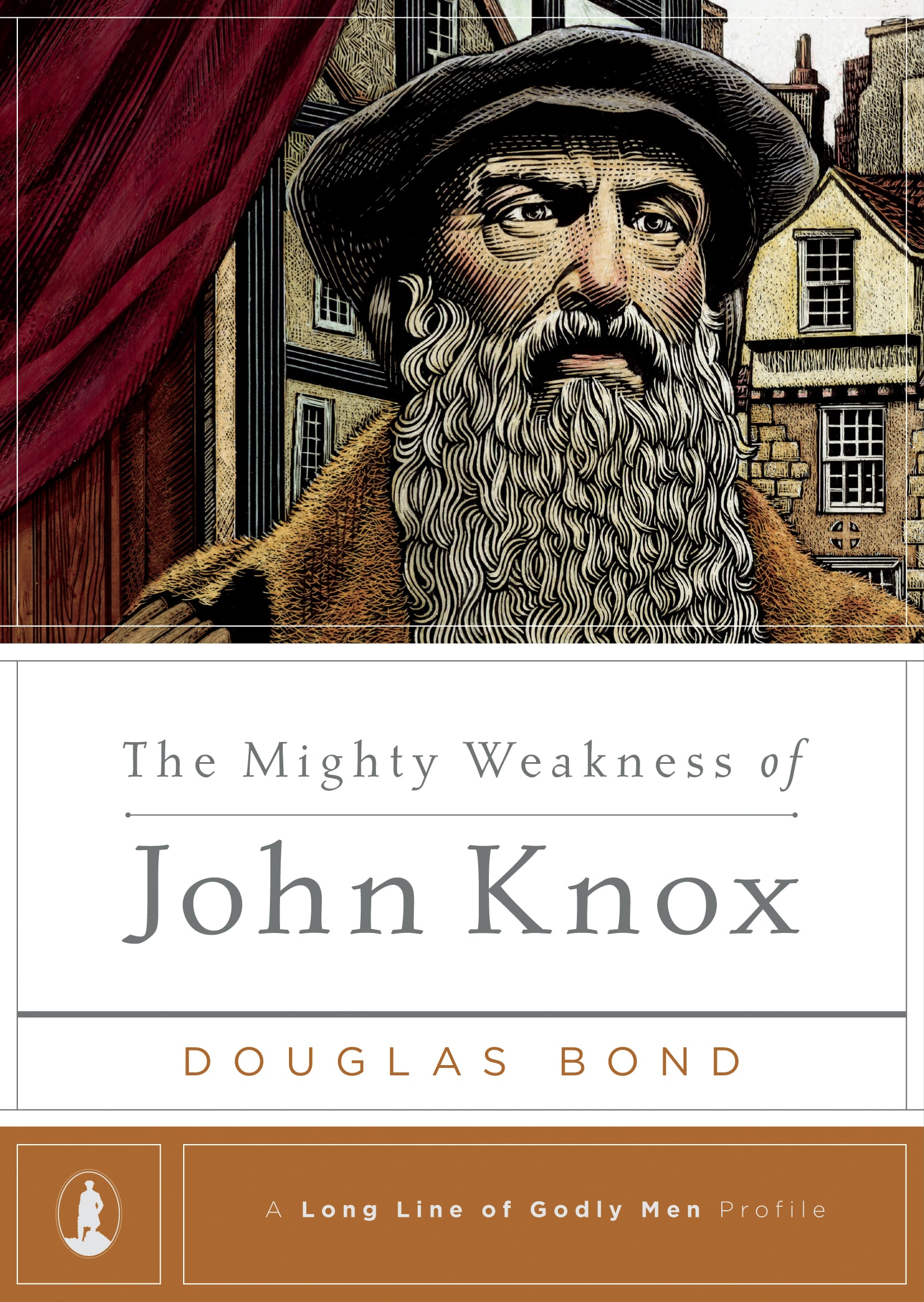
Book Review: The Mighty Weakness of John Knox

I’m very excited to post my first review as part Reformation’s Trust Publishing (the publishing arm for Ligonier Ministries) blogger program. I received this book for free in exchange for posting a review. I look forward to reviewing more from RT, especially in the Long Line of Godly Men Profile series.

The Mighty Weakness of John Knox – Douglas Bond

My Rating – If You are Looking for Something

 Level – Short, easy

Summary
It’s difficult to write a summary of a biography. The book itself is a biography of the life of John Knox. To hit some high points: Knox was friends with John Calvin in Geneva, preached to an English speaking church in Frankfurt, help occupy a castle and endured a siege, was on a slave galley (rowing for a ship) for 18 months, preached before kings and queens, and helped write the Scots Confession.

Bond’s central theme for this short biography is contrasting Knox’s physical weakness with his spiritual might. Apparently, Knox was small and frail and suffered lasting injuries from his time in the galley. When first asked to preach/teach during the castle siege, he ran away crying. However, once he gave in to God’s call, he preached like a trumpet blast and produced many writings as well.

The end of the book also contains the Scots Confession, which is a short (25 articles) confession that is well worth reading.

My Thoughts
This is my first encounter with the ‘Long Line of Godly Men Profiles’ series and will likely not be my last. I knew basically nothing about Knox, other than he was Scottish and was responsible for the Presbyterian Church. His life was interesting enough, and the author wrote well with a clear passion for Knox.

However, one thing I did not like was how often it seemed that Bond was being defensive of Knox. Maybe it is because knew very little of him, but Bond was constantly raising criticisms and then almost too briefly dismissing them. Maybe the legacy of Knox is questioned or viewed negatively, I couldn’t say, but this aspect gave the book an apologetic tone.

Overall, if you are looking for a biography on someone from the Reformation, this is a good start. John Knox led a very interesting life; but if you already know a decent amount about him, there are probably better biographies. This book has piqued my interest in him enough to search out a more in-depth biography.

Readers Guide to Amos

This is my attempt to help in reading the Minor Prophets. Today we hit on Oracles against the Nations (1:3-2:16).

Amos is speaking for Yahweh and judgements/condemnations that start off are against foreign nations (Aram, Philistia, & Phoenicia). The would have been met with applause by the hearers. He then moves in relative nations (Edom, Ammon, & Moab), then judgment against Israel’s sister nation (Judah). Finally, after spending 20 verses on those first 7 oracles, he drops 10 verses on Israel.

We have the narrowing in of judgement. We have something like this – consider for a moment that the Ancient Near East is now the Modern ‘Western’ World. The first three judgements would be some countries in Europe, perhaps German, France and Spain. The next three would be England, Ireland and Scotland and the seventh Canada. Continue reading

Dover Thrift Editions

This isn’t quite a series or book review, but if you haven’t been looking for the Dover Thrift Editions when you are buying books, you need to start. These are pretty much all classics of Literature at about as cheap as you can get.

I’ve bought these editions for as low as $1, and box sets at $8. For the most part, Kindle and other ebooks can’t even compete with the prices. If you have Prime you have free shipping already, but if not or you pruchase from somewhere else, you can load up on seven to eight books for super cheap and have then mailed for free.

If you like classics or have any interest in reading them, I highly recommend doing it with these editions. I buy all the classics I read this way. Though, maybe they are not always the best translations. If you are reading Tolstoy or someone else who’s book translations are disputed, do a little research first, it may not always be best.

I’m not getting paid, nor is this whatever the hell those fake post are called, to write this. I just like books and happen to have Prime. I’m also trying to hit a lot of the classics I missed in school or are just now hearing of. That being said, remember I do have an amazon store, so if you want to go browse it, you can click on Dover Thrift Editions to see what all they have to offer.


By this all people will know…

By this all people will know that you are my disciples, if you have love for one another. – John 13:35

Jesus said that the second greatest command was to love your neighbor as yourself. Between this and the command to love God, all other commandments would be accomplished. He goes on to tell us who our neighbor is, through the story of the ‘Good Samaritan’. For those whom are unaware, it’s everyone.

With that in mind, I’m not sure what these guys thought they were going to accomplish, or rather, how they thought this could glorify God. Look, even if you think Muslims are the worst thing ever, some great evil, and the greatest threat in the world, this doesn’t accomplish anything. Paul, in Romans, tells us that we do not overcome evil with evil, but with good.

Two guys playing army (or marines) like we did when we were kids, pretending to be tough from far away, while calling for violence and death, does not accomplish good, and most certainly does not overcome evil.

As American’s they have the right to hold the ‘protest’ and to say what they said. We have a legal guarantee to assemble and speak freely. However, one of these guys is a pastor, so presumably, he does this in the name of a ‘Christian.’ That’s what bothers me as a Christian, that they would hold this rally in the name of God, without following his commands.

Luckily, no one showed up. The news yesterday morning in Atlanta was one of concern. You have a few guys urging other people to show up armed and angry. This was disconcerting to police and citizens who worked in the area. In the end, it was just two guys interested in hearing themselves talk, standing alone in front of numerous media.


Blogging Bavinck 6 – Foundations of Dogmatic Theology

Alright, get ready, we are going to cruise straight through the entirety of Part III, which include chapters seven and eight (pgs. 207-279).  Chapter 7 is titled Scientific Foundations, of course his use of the word ‘science’ is not the way we use it in modern times. He jumps straight into a discussion of ‘Theological Prolegomena,’ which seems to be an explanation for the entirety of the book so far (over 200 pages). I guess when you writing is over 3,000 pages, it’s alright to have an intro that long. He even says ‘many theologians prefaced dogmatics with far-ranging introduction that had an apologetic thrust.’

He jumps back into what is his view of those foundations of thought – Rationalism, Empiricism, and Realism. I’m not going to write much about these because they for the most part are historical and apologetic in his treatment. Some aspects are obviously still important for today, but for the most part we have moved from Enlightenment thought, to Modernism, to now, Post-Modernism. Also, I just didn’t find them that interesting. Towards the end, he moves from Socrates ides of making knowledge the basis for philosophy, to the Augustinian idea that “God is the sun of the minds.” That is, we cannot see ‘any truth except in the light of God.’

Moving on to Chapter eight, he gets into the idea of the foundations of religion. Trying to find religion at its essence. He starts off, somewhat oddly, in the disputed etymology of the word ‘religion’ which is fairly interesting if you are geeky enough. Further on, he states ‘what makes human beings religious beings and drive them toward religion is the realization that they are related to God in a way that specifically differs from all their other relationships.’ The Reformed theologians made a better and clearer distinction for piety and worship. That is, piety is the principle of religion and worship is the act of religion.

Therefore, the ‘essence of religion cannot consist in anything other than that in it God is glorified and acknowledged precisely as God.’ He considers there to be no better description of religion than the answer to question 94 of the Heidelberg Catechism. It is important how we handle religion and worship, as to ignore or pay little attention to this assumes that God doesn’t care how he is served.

The next focus of the chapter is the head, heart, hand consideration of religion. What drives religion, the intellect, the will, or the heart. That is intellect being the focus on the knowledge of God. Obviously, we can’t go too far that way, or make that our only base, as that is Gnosticism; will being too deep a focus on morality, with religion having no other aim than loving your neighbor, but this leads to rationalism and deism; finally, the heart being religion as feeling. We covered most of this earlier in the impact of Schleiermacher. He finishes this section with the point that religion is not limited to one part, but it is the whole person.

The remained of the chapter is a quick discussion of the origins of religion.  He first write of the belief that the origin is fear, that people fear a cruel and deadly work and seek God/religion as a means of protection. He critiques this stating that this views God as a servant to humans. God and religion become mystical, but this makes God not the first principle, but instead makes it mysticism. Therefore, humans occur first in the world, then find God. The foundation of religion is them that we acknowledge our need. However, this requires at some point a ‘religionless’ man. This reasoning is absurd, as it would require someone, with no assumption of the existence of God, ‘creating’ God and asking for his protection. Obviously, someone could find no comfort in a God he created and the idea collapses in on itself.

His answer to the question of origin is what Calvin called the ‘seed of religion’ and ‘a sense of divinity’. In this, there is something in human faculty and natural aptitude that perceives the divine. It is the objective God, ‘He creates not only the light, but also the eye to see it.’

Follow along with me, go buy the whole set here – Reformed Dogmatics (4 Volume Set)

Blogging Bavinck 12, 3, 4, 5