Book Review: Choosing Donald Trump

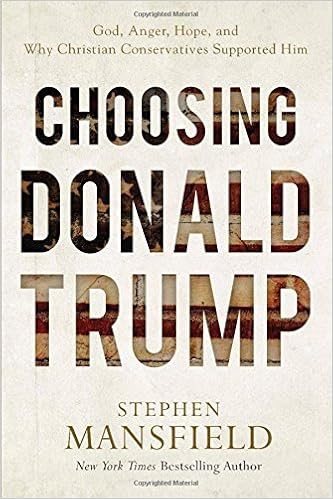
Choosing Donald Trump: God, Anger, Hope, and Why Christian Conservatives Supported Him

My Rating – Must read

Level – Quick and easy, short book

Summary
The subtitle of the the book pretty much sums up what it is about. Conservative Christians were angry and put there hope a man Mansfield calls ‘an unlikely champion’. If fact that is the first section of the four sections of the book.

This first section has two short chapters about the (then) current political situation and how Trump fit into it. The second section, called ‘the backstory’, is basically a 65 page biography of Trump. The third section, ‘the appeal’, get to why Christians would even be interested in someone like Trump. This is probably the most informative section, with chapters on the Johnson Amendment, Obama, Hilary Clinton, and voters who felt like the found a political voice only in him. The final section, ‘Prophets and Presidents’, where Mansfield dives into the interaction of prophets with kings in the Old Testament and then contrast that with the pastors around Trump today.

The book also includes a short intro and epilogue and an interesting ‘Trump in his own words’ section which is a collection of a few of Trump’s speeches about religion.

My Thoughts
I wasn’t sure what his book was going to be when I saw it on the list from Baker*. I don’t know who Mansfield is or whether he is a supporter or not, and I thought the book might be a bit apologetic for Evangelicals. Instead, it really is just a straight look at the situation. He doesn’t try to paint Trump as the terrible person, nor does he try to portray him in this great light that would explain why Evangelicals could vote for him.

One of the more interesting aspects of the book was the detailing of Trump’s admiration of Evangelicals, or at least preachers. He is somewhat famous now for staying up late and watching cable news, but apparently 20 years ago he stayed up late watching TV preachers. He seems infatuated with their charisma and influence on people. You get the impression that his outreach to Evangelicals maybe wasn’t just a political move, but him actually trying to ‘do good’ so to speak. It was almost like his pushes for ‘religious liberty’ and repeal of the Johnson Amendment are his good works, his attempt to earn some salvation. Honestly, I felt like had Trump met a different strain of American Christianity first, he could just as easily gone a completely different way.

That is actually a really disappointing idea, as this particular charismatic/Pentecostal/fundamentalist strain doesn’t necessarily line up with what he personally believes, but they are on the TV the most, so he sought them. He asked them what he needed to do, and they laid out, at least, the religious wing of his agenda. I really believe that had it been the liberal side, he’d be pushing refugee resettlement and environmentalism, or the reformed side, maybe sex-trafficking and racial reconciliation. He might not have even run as a republican. Anyway, for now that is just an interesting exercise in alternative history.

The biographical part of the book was fascinating. Mansfield did a great job distilling 70 years of this man’s life into just why/how he reacted to the religious vote the way he did and how he doesn’t really fit. The early chapter about Trump’s speech at Liberty University and his commentary on that are great insights.

Finally, I enjoyed the last part of the book where he delves into the famous pastors who supported Trump, their hypocrisy as it came to his morality versus their previous statements about Bill Clinton, and then how the tripped all over themselves to either excuse his behavior or explain why it didn’t matter. There was an interesting survey of all the Old Testament and historical figures different pastors have compare with Trump.

If you are a huge Trump supporter and think he was chosen by God to be the perfect leader of the United States, this book may not be for you; unless you want to be challenged in your thinking. However, if you are opposed to Trump, or politically left, or maybe not opposed but just confused, like me, as to how he garnered so much Evangelical support, this book is a must read.

*I received a free copy of this book in exchange for an honest review.

Hannity and Jeffress

I’ve rewritten the first sentence to this post about 10 times already, I’m just not sure where to start. I agree with all of John Fea’s points here, but I want to say a little more about the problem. Jeffress speech, and it was a speech not a sermon, was fine. It was a political speech to be sure, one that most Christians would get behind. Though, you really shouldn’t with point number 1, about the Ten Commandments. See my review of One Nation Under God for more, I don’t feel like go through it all again. Also, from the Wikipedia page on the Ten Commandments:

In the 1950s and 1960s the Fraternal Order of Eagles placed possibly thousands of Ten Commandments displays in courthouses and school rooms, including many stone monuments on courthouse property.[133] Because displaying the commandments can reflect a sectarian position if they are numbered (see above), the Eagles developed an ecumenical version that omitted the numbers, as on the monument at the Texas capitol (shown here). Hundreds of monuments were also placed by director Cecil B. DeMille as a publicity stunt to promote his 1956 film The Ten Commandments.[134] Placing the plaques and monuments to the Ten Commandments in and around government buildings was another expression of mid-twentieth century U.S. civil religion, along with adding the phrase “under God” to the Pledge of Allegiance.[132]

His second point on abortion is good, though I don’t think Christian’s should be single issue voters. His final point on gay marriage and the Obergefell decision is also pretty standard, though I guess here, too, we could debate the merits of government trying to legislate morality.

Everything was fine, for his speech. Nothing too dramatic or out of the ordinary for political pundits or Court Evangelicals. He gives his speech, then turns the stage over to Sean Hannity to promote his upcoming movie. All this is fine, if it had occurred on a Friday night or Saturday afternoon, really any time other than Sunday morning. His church is large, and holds an enormous audience, so it is fine to hold a big publicity event there, logistically. However, this was the regular worship service. His speech was a political message, not the Gospel of Jesus. Sunday morning and the worship service of any given church is for proclaiming Christ. It is a time for the ordinary means of grace, the preaching of the Word, taking of communion, and baptism (if you have one).

Jeffress welcomed everyone to hear the Gospel, but I didn’t hear it preached in his message. There was no call to repentance, no need for Christ explained. There was no redemptive narrative. There was only the call to vote not repent, to focus on politics no the cross, to regain power instead of humble yourself, and to make America great again not proclaim the greatness of God.

The American church, for the most part, has sold itself to political power. Events like this one on Sunday at First Baptist Dallas show where are focus is. A cable news hosting received a standing ovation for, well, being a cable news host. There was a roar of the crowd when he, the political conservative, was pitted against another cable news host, a liberal.

I don’t have much else to say about this. I just find it extremely disconcerting. Again, it is not necessarily his message, what he is saying and doing, but when and where he is doing it. This entanglement and church and politics. The movement away form the Gospel to power and control. We can easily look back now at the 1920’s-50’s and see how the ‘mainline’ churches lost focus. Inspired by the Enlightenment, there focus became humanities goodness. The focus on the Social Gospel took time and energy away from the actual Gospel, and they’ve never regained it.

I wonder if in another 50 years, we will look back and say to the 1908’s through now and say, inspired by the Moral Majority and Reagan, the ‘evangelical’ church lost their focus. We looked to political power and away from the cross. Christ tells us you can not serve two masters, and events like these make me wonder which one we are really serving.


One other note, Jeffress said government is ‘designed and instituted by God’, described it as ‘ordained and holy’ as the church. I wonder what he thought/thinks of Reagan and his message of ‘government is the problem.’ This could be a whole post to itself, so I won’t get too much into it now, but this is why I stopped being a Republican. The picking and choosing of when government is good and when it should be involved in regulating things.


Finally, I’ll also steal the idea from Dr. Fea’s other post, comparing Jeffress’ message to the one of my church. The sermon doesn’t seem to be up yet (edit – sermon), but I’ll post it when it is. My pastor gave a message on Political Power. How it is not our goal in life, and that we are called to be Christians first (not America first). I believe his sermon is in complete opposition to what Jeffress is doing. Whether explicitly or subconsciously, he is more concerned with preserving the political power of Christians than he is morality or the Gospel message.

In the News 10/20/17

I’m bringing back my news wrap up that I used to do. It is mostly politics, but I try to tie in anything related to Christianity or things I’ve written about.


School name to change from Jeff Davis to Obama:

“Jefferson Davis, although infamous in his own right, would probably not be too happy about a diverse school promoting the education of the very individuals he fought to keep enslaved being named after him,” Davis Magnet IB PTA President Janelle Jefferson said.

Related, a county in Kentucky is moving their Confederate monuments.
As I’ve written before, I’m not a fan of Confederate monuments or flags and think they should be removed. However, it is stupid and painfully ironic that someone would ban a book due to the offense of the language, as Mississippi did with To Kill A Mockingbird.  Banning books is never acceptable, and banning them for this reason is literally the plot to Fahrenheit 451.

Speaking of monuments, this cross, owned and maintained by a government agency, was ruled unconstitutional, a ruling that will stand should the Supreme Court not take up the case. As a Christian this bothers me on some level, but on in some ways it makes sense. I don’t think it would have popular support if it were a monument to another religion. However, the point isn’t to memorialize Christianity, but WWI veterans, so I feel this might be a bit much. It is quite old and clearly was constructed to make offense, the way that many of the Confederate monuments were used.

Wrapping up the monument/flag/anthem trend – Oklahoma is requiring people to stand during the Anthem, because nothing says freedom like denying someone the right to protest and forcing patriotism.

Apparently hookworm is still an issue. A parasite that devastate the South in the past, is inexplicably still around

“Our billionaire philanthropists like Bill Gates fund water treatment around the world, but they don’t fund it here in the US because no one acknowledges that this level of poverty exists in the richest nation in the world.”

Unsurprisingly, most pastors don’t support the Johnson Amendment. Now, to be clear, the Government is not saying they can’t preach politics from the pulpit, the IRS is just saying you can’t do it and still receive special treatment (tax-exempt status). Also, the amendment doesn’t apply only to churches, but all non-profits. I support it as one way to help keep (some) money out of politics, even if it was proposed only so Johnson could shut down part of his opponents funding. Only one church has ever lost their status due to a violation.

W. says in a speech nationalism is a growing problem.  He is obviously on to something with an Alabama senator is main funding comes from a white nationalist and the man himself is described like this:

Moore is “much closer to our ideal Alt-South candidate: Southern, Christian, populist and nationalist, slashing and willing to defy the federal government,” Shannan, the 9/11 truther who sat on the board of the Foundation to Defend the First Amendment when it donated to Moore’s nonprofit, wrote in an endorsement of Moore published last month. “The White vote in the South, which was splintered during the late 20th century, has reconsolidated like it was in the Jim Crow South.”

Surprisingly, the university of florida did the right thing when another white nationalist came to town. Which led to this whiny quote, “You think that you shut me down? Well, you didn’t.” He said this as he ‘abruptly’ ended his speech and stormed off stage.

What exactly is the point of prison?  This guy thinks it is for free labor, and opposes releasing low level offenders.

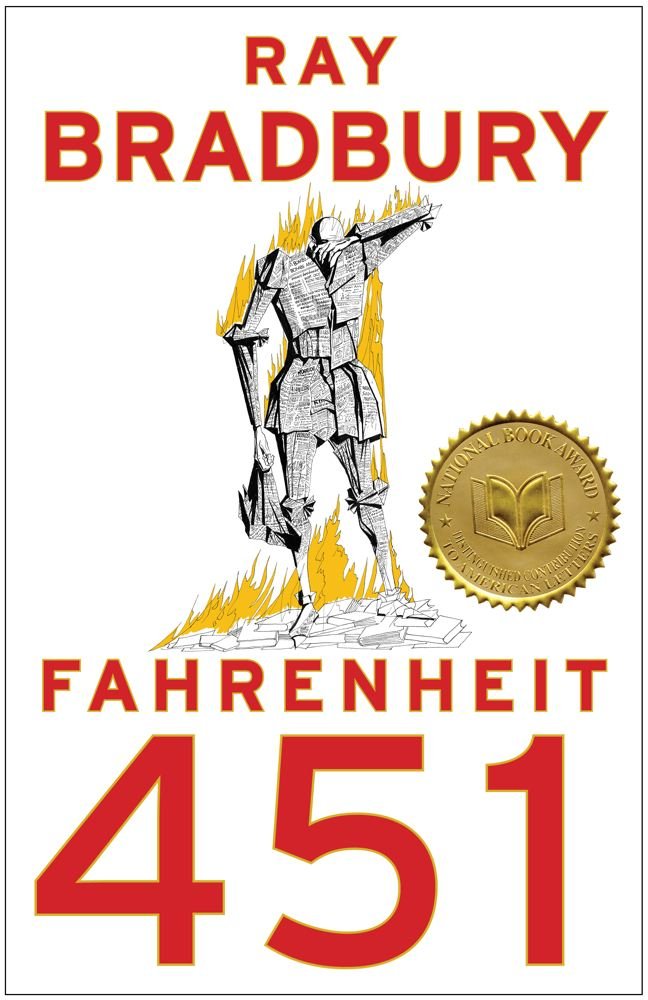
Book Review: Fahrenheit 451

Fahrenheit 451

You don’t have to burn books to destroy a culture. Just get people to stop reading them.
My Rating: Put it on your list
Level: Quick and easy read, fairly short.
Summary
Away in the dark near future, there is a still a profession called ‘fireman’, but they don’t save houses from burning (houses are fireproof now), but now they start fires. Not for houses, but for books. The book follows the story of one of these firemen as he starts to question why they are doing what they do, and instead starts saving and hiding books. After he is found out, he becomes the victim of the system he used to be a part of.
My Thoughts
This is a classic of dystopian fiction. The scary thing is, though some elements are over the top, much is too accurate. Bradburry rightly predicts (originally published in 1951) that books won’t be banned by the government or people in the majority for challenging the status quo, but instead, books will be questioned or banned for offending some group or another. We see this happening today, especially with elements of history that people do not like. He also predicted the heavy use of what are basically headphones. I went for a walk this morning and noticed every one of the dozen or so people I saw had headphones in.
As a big book-reader and someone who isn’t paranoid about the government, I see Bradburry’s vision as much more accurate than something like 1984. He was even wrong that the government would actively burn books by the will/request of the people. We don’t have to worry about that now, people just stopped reading them. Hell, people buy digital books, so you can’t even burn them anyway. But it doesn’t matter, in the most recent Pew study (2014) 23% of people hadn’t read a book in the past year. That’s up from 8% in 1978, the first year they asked. The median number of books read a year by American adults is 4. We don’t need to burn book, and the government doesn’t need to ban them. We are doing this to ourselves. We have 100 of channel showing pointless shit on TV and endless ways to stalk people we don’t even like on facebook and twitter, who needs books?
Maybe his most accurate portrayal was related to this. One of the characters in the book, whom the police watch due to being ‘peculiar’, lives in the only house that doesn’t glow blue at night. The family has their lights on and can be seen through the window sitting around talking, everyone else has their lights off and is watching TV, so that only a low, flickering blue color can be seen from the street. Where he is wrong is that no one thinks it odd now, but most people likely never think about it. I know I never did, but now if I walk around at night, I notice all the windows from the back of the houses and some of the bedrooms are dark and flickering blue. It becomes kind of eerie if you look or think about it too much.
 Anyway, over all, the book is a bit over-dramatic at times, well not being dramatic enough in others, due to un-imagined technological change. The concepts are great and the portrayal of why life could be like in this dystopian future is frighteningly accurate at times. I as I said above, it is a classic in the genre, and a book to put on your reading list.

Flags

I wrote a little about flags last summer. That post was mostly about my personal history with the Georgia and Confederate Battle Flags. I do want to do a quick hit on it and then talk about the ‘Pledge of Allegiance’ and the National Anthem, mostly because Confederate images have been in the news since Charlottesville this summer, National Anthem is up again now that football is back on, and mostly because I trying to help my pastor with a sermon series he’ll be doing soon about ‘power’, which includes economic and political power.

I went through the history of the Georgia flag in my previous post, so I just want to focus/expand here on one point. In the original post I pointed out that the Confederate Battle flag gained popularity in the 40’s through the Dixiecrats and that Georgia changed their flag in 1956. I think I should expand on that a bit. It is important to remember what happened in 1954 (after the close of the Georgia Legislature Session) – Brown vs. Board of Education of Topeka, and the Brown II in 1955 (also after closure). I’m not going to go into great detail about what these were, if you aren’t familiar (and American) you really need to go read it and educate yourself, but basically Brown overruled an old case, Plessy vs. Ferguson, and ‘separate but equal’ and essentially ruled that school could not be segregate by law. In Brown II, the Supreme Court said that desegregation must occur with ‘all deliberate speed’. Schools have to desegregate and do it now.

So, how did the Georgia Legislature open in 1956? With this statement from the governor during the State of the  State:

There will be no mixing of the races in the public schools and college classrooms of Georgia anywhere or at any time as long as I am governor….All attempts to mix the races, whether they be in the classrooms, on the playgrounds, in public conveyances or in any other area of close personal contact on terms of equity, peril the mores of the South….the tragic decision of the United States Supreme Court on May 17, 1954, poses a threat to the unparalleled harmony and growth that we have attained here in the South for both races under the framework of established customs. Day by day, Georgia moves nearer a showdown with this Federal Supreme Court – a tyrannical court ruthlessly seeking to usurp control of state-created, state-developed, and state-financed schools and colleges….The next portent looming on the horizon is a further declaration that a State’s power to prohibit mixed marriages is unconstitutional.

This set the tone for the legislative session, one in which they voted to change the flag to include something that Dixiecrats and (recently, but not originally) the KKK had taken up as a symbol of protest. The Senate Research Report about the flag is an interesting read on the history. There is also a great reminder that another proposal that came after Brown was that the State would close all public school rather than integrate and send residents a tax refund to help them pay for private schools (which could still legally discriminate). This sounds frighteningly similar to the current attempt of a ‘voucher’ system for homeschooling (which wouldn’t become legal in Georgia until 1984).

All that to say, I think people can disagree about confederate monuments and their place in society, I’d just ask that people think seriously, especially in the historical context, about what they mean. I think statues to people are weird on their one, but most people disagree, so if a statue to a Confederate general or Colonial was put up in the 1890’s and he was also influential in his state (governor, president of a flagship university), there are legitimate reasons to have some pause about removing them. If a statue was put up, a flag redesigned, or streets renamed in the 1940’s-60’s, you should have very serious reservations about supporting them and truly question the motives behind them.

This, as always, is already longer than I had anticipated writing, so I’ll pivot quickly to the ‘Pledge of Allegiance’ and then a quick thought or two on the national anthem.

Let’s start with Francis Bellamy a Christian Socialist most famous for writing the base of what would become the pledge. His version:

I pledge allegiance to my Flag and the Republic for which it stands, one nation, indivisible, with liberty and justice for all.

Fun fact – Bellamy was opposed to ‘state’s rights’ and the Federal system in general. That is the meaning behind ‘one nation, indivisible’; he, as a socialist, preferred a much more centralized, singular form of government that would make broad laws and states would not make any.  The purpose of the pledge is literally to indoctrinate people towards loyalty to the state.

In 1923 the words ‘Flag of the United States’ were added so all the immigrants knew which particular flag.  The Pledge was recognized by the Feds in 1942 and added to he flag code. In 1943, Supreme Court said it was not compulsory to say the pledge, after a court case brought by Jehovah’s Witnesses. The last change game in 1954, when the phrase ‘under God’ was added – see my review of Kevin Kruse’s book One Nation Under God for more.

Another fun fact, the Bellamy Salute was dropped in the 40’s due to it’s similarity to Hitler salute,  and the flag code was amended to require your hand over your heart instead.

As a libertarian minded Christian, I have a problem with pledging allegiance to a symbol of the State. I only vaguely remember saying the pledge growing up. I do not think it was every day, and looking back, I’m not sure it was said every day. I have the impression that it was more or less up to a particular teacher. When we did say it in high school, many people sat or didn’t say the words, because it seemed like an odd tradition. That all changed my senior year with 9/11. Then it was said everyday all the time.

Anyway, on to the National Anthem. People are kneeling now instead of standing, and it has become such a big deal that our President tweets about it and even sends the VP as a PR stunt to leave when it happened. We can ignore, for the moment, that over six million tax payer dollars were given to billionaires for them to promote patriotism with their ‘non-profit’ over the past few years – read the Senate report here. Doing a little research, it looks like the Anthem was pretty common at sports events following WW2. However, players actually even being out on the field for the playing/singing wasn’t required until 2009. A good place to start on the history of playing the Anthem would be this article from Politifact.

I’m not even sure what I want to say about this. As Christians is this really something with which we have a problem? Do we support compulsory patriotism? Or requirements to pay tribute to the state? I don’t think so. As I mentioned with the pledge above, I’m not big on the government requiring things like this. Instead, I think the effectiveness for which it has brought attention is one reason why certain people are so mad.

It also bothers me how much some people are opposed to protesting in general. This is a peaceful, non-violent, non-disruptive way of trying to call attention to a very serious issue in America. Now, it has kind of been hijacked and is arguably more about the President and his seemingly disbelief in the right of the people to protest. I’ve heard some of the objects – I’m not opposed to them protesting, it’s how they do it – but that is straight up bullshit. I don’t believe that for a second. That is a very common sentiment people try all the time, in all aspects of life. You pretend you are alright with an idea, just not the execution, but ultimately you will oppose any tactic they take. My question for people would be, how would you like them to protest? What would be the acceptable way? Also, do you appreciate the irony that one of our greatest rights that the anthem is and this country is suppose to represent is the right to free speech and to protest?

I’ll end this by saying the official position of the Monday Morning Theologian is that anyone is should be able to protest anything they want at any time so long as the protest isn’t violent or destructive (and to a lesser extent, take traffic in to account). It is un-American to criticize the way someone protest if they follow those rules. Debating what someone protest is great, and should be happening. Instead, in this case, we are getting a bunch of faux patriotism, ‘support the troops’ bullshit that is beyond counter productive. Finally, criticizing them on the ‘how’ only proves to me that people don’t have much else to say on the substance of the protest – that is the police brutality and the treatment of black people by the police in this country. I know our President disagrees with this, but I’d much rather have him argue the merits that say ridiculous think like the players should be fired for not standing during the playing of a song. Really think about the implications of his statements, whether you agree with the players or not, and how that impacts what we view as freedom in this country.

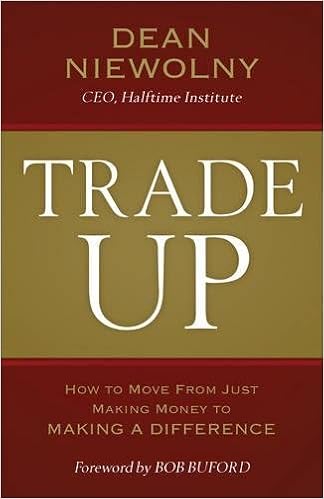
Book Review: Trade Up

Trade Up: How to Move from Just Making Money to Making a Difference

My Rating – If you are looking for something

Level – Easy read, very short

Summary
I’m not entirely sure how to summarize this book, as I’m still not entirely sure what it is supposed to be. It is broken into three parts – My Journey, Your Journey, and The Destination. The first section is a brief autobiography, the second honestly just seems like some marketing points for his organization (Halftime Institute), and the last chapter has some interesting ‘actionable’ steps related to people who are looking at a life change. Well, I should say, some specific people, those that are rich and successful and whom are looking for what to do with the ‘second half’ of their life/career.

My Thoughts
I’m probably far too cynical than the publisher’s target audience for me to like this book. For one thing, I’m not rich or successful but instead a government (the worst kind) paper-pusher and part-time, pretend, internet theologian. I’m not an influence, nor are my circles large and powerful. I don’t know CEOs or professional athletes/musicians (though it has been said that Mrs. MMT has the voice of an angel). So, to be fair to the Niewolny/Baker Books, I was probably not going to get much from this anyway.

Neiwolny’s biography was almost too short and superficial to be of much value. Though, his passion for his organization and what they do is obvious, and that is always good to see. The middle section of the book seemed like some expounded talking points, or maybe a collection of speeches he’s made in his role as CEO of Halftime. For me, it was too motivational speaker-y, but I could see how it could get some people pumped.

The last part of the book is really what makes it worth it. It is short and reading is almost always worth it, but it is also practical. He lays out how to think/what to do if you are one of these people. However, I think it could actually be expanded. This section would be useful to retirees or some kind of second career empty-nester. I don’t think you have to be rich, but obviously being financially stable or even independent makes it easier to implement most of his steps. One of which, to his credit, he points out may be for you to stay at work. I think this is an often missed step for Christians, especially newer ones. Now, if you are big deal, Christian, and looking for a change, you should read this book and contact the Halftime people. Others, this could just be one of the many books/websites you check out. Overall, I recommend this book only if you are look for it.

*I received a free copy of this book in exchange for an honest review.

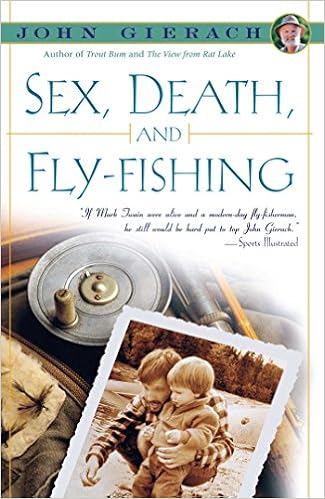
Book Review: Sex, Death, & Fly-Fishing

Sex, Death, and Fly-Fishing

My Rating – Must Read

Level – Quick, easy

Summary
Another collection of musings from John Gierach. Topics include bass fishing, private ponds, walking sticks, British Columbia, and of course the title chapter – ‘Sex, Death, & Fly-Fishing’. I’d say spoiler alert, but the book was published almost 30 years ago, so that seems unnecessary. The title comes from the first chapter, and honestly, it is surprising poetic. It comes from the Mayfly hatch. The midge, a little bug at the bottom of the river, emerge out all at roughly the same time to mate, then eggs are laid and then all die. All of the bugs emerging and all the Mayflies dying/falling back to the water, leads to a feeding frenzy for the fish. This in turn leads to a great time for fly-fishing. Get it?

My Thoughts
Geirach is quickly becoming one of my favorite authors. I wouldn’t call it love/hate, because I don’t dislike him, just endlessly envious of his style and ability to write. I’m almost annoyed that he isn’t more famous, he isn’t even on twitter or the fishing blogosphere (interestingly/ironically, wordpress say that isn’t a word). I’m sure a guy who has written 15 books, including one called Trout Bum (my review), isn’t worried about the opinion of a guy born after he was already publishing books.

His books really are something like proto-blogs. Imagine a successful outdoor blogger who writes a number of interesting series of posts, then picks the best few series over a number of years, pulls them out, and cleans them up, his books are what you’d get. His writing is narrative and personal, but can also be surprisingly informative. He is a master story-teller in a first person, short-story style. For anyone even remotely interested in fishing, this book is another must read from Gierach.

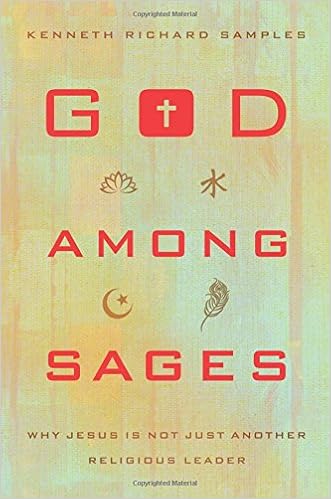
Book Review: God Among Sages

God among Sages: Why Jesus Is Not Just Another Religious Leader

My Rating – If you are looking for something

Level – Easy read, moderate length (a little repetitive)

Summary
Samples has put a book together that looks at Christ and historic Christianity, and compares Him to the leaders or representatives of four other major religions. The book is broken into three parts – a historicity of Christ, both as a man and God; a short intro to representatives of four other religions and how they compare to Christ; a few thoughts on plurality in the world and the Biblical view of other religions.

The first part of the book is broken into four sections, but overall it is a basic apologetic for the Christ of traditional Christianity. Samples goes through Christ claims of divinity, the reliability of the Bible, and then a few points on the fact that Christ, the man, a person in history, actually existed.

The second part of the book is really the meat and what you’d expect based on the title. It is also broken into four parts and Samples hits on Krishna as representative of Hinduism, Gautama (the Buddha’s birth name) for (obviously)  Buddhism, Confucius, and finally Muhammad for Islam. In each section he outlines the life of the person, the basics of their teachings/beliefs, and then how they compare to Christ.

The final part of the book is broken into three sections, plurality in our world, Biblical view of other religions, and finally a concluding summary of Christ’s claims verses the other four.

My Thoughts
I wasn’t really sure how to rate this book. I liked a good bit of it, but found other parts annoying. I guess it will depend on the perspective from which you come to this book. It is a little too apologetics 101 for me, especially the first part of the book. I understand, that almost by definition, if you are trying to substantiate the claims of Christianity, you have to use apologetics, but what bothers me is really more of the tone. There is a just an attitude and style of argument from those in the philosophical (especially Ontological) and presuppositional  apologetic framework seem to have. It just rubs me the wrong way. If you like it, or are new to apologetcs, the you will probably really enjoy the first section of the book. All that being said, he does a good job summarizing arguments for the reliability of the Bible and Christ’s claims of divinity that all Christians should know pretty well.

The section about the other leaders was a well written introduction. Some of it was new to me and others a good reminder from my high school world religions class. As Christianity declines and more people arrive from different parts of the world, it is becoming more and more important to know the basis of other beliefs. This book could be a good start (Sample pack? sorry) into the study of world religions. He cites other works at the end of each chapter if you want to go deeper. The only part I really didn’t like about the section of the book is that he repeats his arguments (stated in the first part of the book) about Christ again and again in each chapter. Maybe it is a pet peeve of mine, I just dislike redundancy and repetitiveness.

The last section of the book was probably my favorite. Sometimes, I’m not sure I’d necessarily call them moments of doubt, I do wonder, what if all paths lead to God? That does change my view that this is the path Christ chose for me, but what if one day we get to heaven and we find out that everyone is there and they all came through different ways? Maybe that would be kind of neat. Samples summary of the issues with plurality point out that this isn’t really possible. For one thing, not all ‘paths’ even have a ‘god’. Many don’t have an afterlife, but reincarnation. Also, what about people who are on no path, so to speak? Even as you try to be kind and loving and accepting (to some extent) of all other beliefs, it is good to remember that plurality (in the sense of all beliefs being equally valid) is unworkable.

I think many people could learn something from this book. However, it may not be for everyone. It isn’t quite on the level of everyone should read it, but if you are looking for a good intro to either divinity of Christ, reliability of the Bible, any of the four religions covered, or Christianity in a pluralistic world, then you should put this book on your list.

*I received a free copy of this book in exchange for an honest review. See more here.

Sermon on the Mount – Salt & Light

Matthew 5:13-16

When I was young and any injury happened to me, my dad had generally one cure in mind – salt. This was especially true in the summer, as I was (still am) one of those people that just gets absolutely swarmed by mosquitoes. I would have cuts and scabs cover my legs and many on my arms, and the solution in his mind was the beach.  Mostly because he just liked going there, but if something couldn’t be cured by salt, you had to add come sun also to, ‘dry it out.’ In winter drinking warm salt water and going outside was the general cure. My brother and I literally had salt put into our wounds, but you get the point – he was a raving madman. However, as I was researching this passage, I came across this quote from Pliny the Elder in his major work, Natural History, – ‘Nothing is more useful than salt and sunshine’ (in Latin, Sale e Sole, so there is a little wordplay, too).

Turns out, the benefits of salt, including its healing power was well known in the ancient world. The many uses of salt included, preservation, flavor, and disinfectant. Salt was also a symbol of loyalty and was used in sacrifices. Famously, Roman soldiers were paid in salt (sale in Latin) which lead to our word salary today. The most common use of salt, and the one that the disciples would most identify with, is as a preservative. Salt prevents decay. Christ is calling on the disciples to prevent decay of the world rotting from sin. This likely has to do with moral decay as the disciples preserved the Law. The word usually translated ‘earth’ here is the same as the word land. Whenever we read the Bible the word ‘land’ should stick out to us as that was the covenant promise to Israel.

Relatedly, when we see ‘world’ we should think gentiles, and/or culture of the time. So what does light do? Most simply put, it illuminates the darkness. Israel, and Christ’s disciples, know God and they are command to remember God and keep his law. The gentiles do not know God. Therefore, they are in darkness. As disciples, we are to give light to those in darkness. That is, preach the Gospel, do good works to glorify God, and bring the knowledge that we have to that whom haven’t yet heard.

There are many verses related to this concept of light. In Isaiah 42 and 49, we are told the True Light is the suffering servant (that is, Christ to come). In Romans 2:17, Paul considers the Jews to think they are the light to the gentiles. We are told that darkness fears the light. In John 5, John the Baptist is called ‘a burning and shinning lamp.’ Of course, John the Baptist is one of the great models of Evangelism.

So, the value of salt and light would be well known the ancient world; a world that didn’t have electricity, and therefore lacked refrigeration and ‘light’ as we know it today. I’ll wrap up with what John Stott sees as the three lesson from these verses.

  1. There is a fundamental difference between the Christian and the non-Christian, between the Church and the World.
  2. We must accept the responsibility the distinction puts on us.
  3. We must see the twofold Christian responsibility of: Preventing decay (salt) and illuminating darkness (light).

It is easy enough to say to Christian, go be salt and light, but as the recent public discussions (from the ‘Benedict Option’ to whatever it is Evangelicals are doing with Trump) have shown, it isn’t that simple. Fundamentalism and monasteries pull us too far from the world, they are the equivalent of putting the lamp under a basket, or as I read one criticism using – salt never did any good sitting on a shelf. Likewise, we can’t just join the world, especially today in the ‘everyone does right in their own eyes’ of moral relativism. We have to be the ones to preserve the moral laws of God. Just remember, at work you may be the only one to view life with moral absolutes, you may be the salt that is preventing decay, or in your neighborhood, you may be the only light your neighbor sees. They may be living in darkness, and it is incumbent on you to shine the Light of Christ into their lives. Salt and light is an incredibly responsibility, one I think most of us do not take seriously enough.

Follow along in the series – Intro, The Poor in Spirit & Those Who Mourn, The Meek and Those Who Hunger & Thirst, The Merciful, Pure in Heart, and Peacemakers, Those Who are Persecuted,

Commentaries used in this series:
Sermon on the Mount (The Story of God Bible Commentary)
The Message of the Sermon on the Mount (Matthew 5-7 : Christian Counter-Culture)
Studies in the Sermon on the Mount
Matthew (Baker Exegetical Commentary on the New Testament)
The Expositor’s Bible commentary : Matthew, Mark, Luke, with the New international version of the Holy Bible (Expositor’s Bible commentary, Vol.8)
Matthew: An Introduction and Commentary (Tyndale New Testament Commentaries)
New Bible Commentary